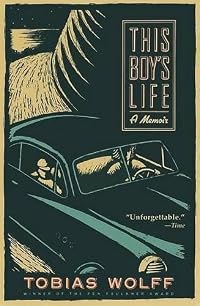
This Boy's Life: A Memoir
by Tobias Wolff
On This Page
Description
First published in 1989, this memoir has become a classic in the genre. With this book, Wolff essentially launched the memoir craze that has been going strong ever since. It was made into a movie in 1993. Fiction writer Tobias Wolff electrified critics with his scarifying 1989 memoir, which many deemed as notable for its artful structure and finely wrought prose as for the events it describes. The story is pretty grim: Teenaged Wolff moves with his divorced mother from Florida to Utah to show more Washington State to escape her violent boyfriend. When she remarries, Wolff finds himself in a bitter battle of wills with his abusive stepfather, a contest in which the two prove to be more evenly matched than might have been supposed. Deception, disguise, and illusion are the weapons the young man learns to employ as he grows upnot bad training for a writer-to-be. Somber though this tale of family strife is, it is also darkly funny and so artistically satisfying that listeners come away exhilarated. show lessTags
Recommendations
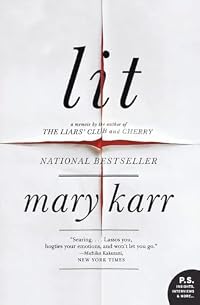

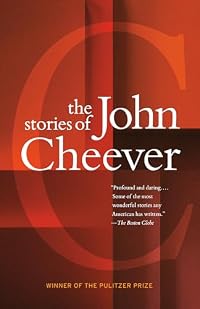
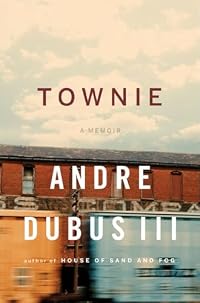
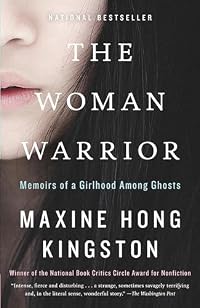
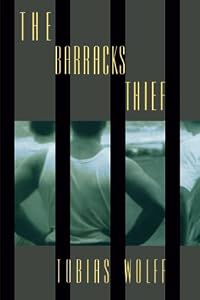
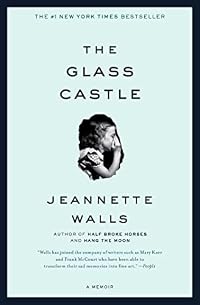
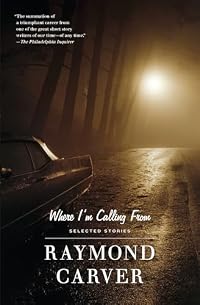
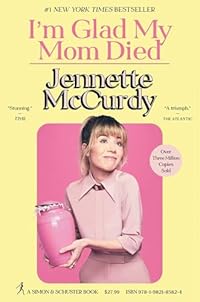



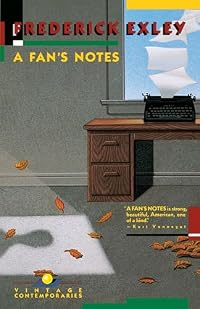
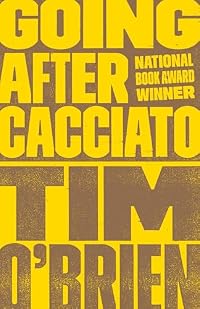
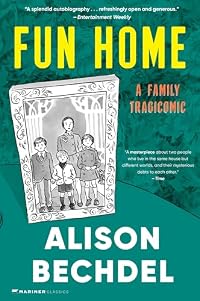
Member Recommendations
Member Reviews
This Boy's Life is author Tobias Wolff's coming-of-age memoir. After his parents divorced, Wolff remained with his mother while his older brother lived with their father. There was almost always an abusive man in his mother's life. She wasn't the only one who suffered from the abuse. Tobias (who preferred the name “Jack”) suffered, too. With little parental supervision, Wolff unfailingly hooked up with the wrong crowd with every move. Deceit became second nature to Wolff. He lied, stole, and engaged in other delinquent behavior, likely for self-preservation. While I was moved by Wolff's circumstances, I also couldn't help wondering how deeply ingrained these habits are in Wolff's character. Might he be an unreliable narrator of his show more own life story? show less
A second read, the first was more or less when it was published, thirty years ago. Tobias is ten and he and his mother are fleeing Florida and yet another of her bad relationships, headed for Utah; it is the early 50's. When she and Tobias's father split, each took one child. The other, Geoffrey Wolff is also a writer and among other things wrote about their father in The Duke of Deception- a handsome, brilliant, charismatic man who was unable, basically, to ever tell the truth. He tells the story of this six or so year period of his life in a series of connected stories in sections--each section focussed around a place and a situation and that are further divided into separate vignettes.
If possible the memoir was even more rewarding show more the second time around because my understanding of both the emotional difficult and the writing 'craft' that went into the creation goes so much deeper. Wolff achieves (what is more or less impossible) writing a memoir about that specific (and critical) period between pre- and late-adolescence not as a narrative but as a series of stories, dialogue and all, that is utterly convincing as a memoir. While it is written as if fiction, it feels and is, surely, the truth of that period of his life. Perhaps only his truth, but truth. One could discuss why this works for days or weeks. Wolff himself says in his preface: "I remember the past in terms of stories. That's how I think of it, how I talk about it, and how I've written it here." I've written plenty of stories that are based on my life experiences, but I deviate from the facts knowingly to shape the story the way I want it to go. Most of us can't help doing that, interfering with and remaking our past in that way. Here, Wolff ruthlessly re-imagines the past exactly as he remembers it, I say ruthlessly because he doesn't spare himself for one second. He is his father's son and lying and subterfuge come naturally to him, sometimes with (some) justification, sometimes not. Also he re-inhabits the mind of the boy he was, with no judgement from his adult self about the things he did (and didn't) do. Such as regret, yes, or even something like disbelief at his stupidity or naivete but never judgement. He was a kid, this is how I coped. The self-awareness that went into the work is blinding. ***** show less
If possible the memoir was even more rewarding show more the second time around because my understanding of both the emotional difficult and the writing 'craft' that went into the creation goes so much deeper. Wolff achieves (what is more or less impossible) writing a memoir about that specific (and critical) period between pre- and late-adolescence not as a narrative but as a series of stories, dialogue and all, that is utterly convincing as a memoir. While it is written as if fiction, it feels and is, surely, the truth of that period of his life. Perhaps only his truth, but truth. One could discuss why this works for days or weeks. Wolff himself says in his preface: "I remember the past in terms of stories. That's how I think of it, how I talk about it, and how I've written it here." I've written plenty of stories that are based on my life experiences, but I deviate from the facts knowingly to shape the story the way I want it to go. Most of us can't help doing that, interfering with and remaking our past in that way. Here, Wolff ruthlessly re-imagines the past exactly as he remembers it, I say ruthlessly because he doesn't spare himself for one second. He is his father's son and lying and subterfuge come naturally to him, sometimes with (some) justification, sometimes not. Also he re-inhabits the mind of the boy he was, with no judgement from his adult self about the things he did (and didn't) do. Such as regret, yes, or even something like disbelief at his stupidity or naivete but never judgement. He was a kid, this is how I coped. The self-awareness that went into the work is blinding. ***** show less
As a young boy, Toby Wolff and his divorced mother left Florida (and the abusive man they had been living with) for Utah, where his mother thought they could cash in on the "uranium rush". Eventually they ended up in Seattle where his mother married yet another controlling bastard, a Great Santini sort of character with a weaker moral compass and no hope of going down in a heroic blaze. Dwight was a master of subtle cruelty and psychological abuse, keeping physical violence to a minimum, but capable of it, nonetheless. Growing up with Dwight as a stepfather was similar to a shoplifter being sent to prison with the armed robbers---Jack learned to hone his techniques of deception by watching and sparring with a seasoned pro. Jack’s show more ultimate sting involved stealing school letterhead and transcript forms, writing bogus recommendation letters, and ultimately conning his way to a prep school scholarship, complete with an appropriate expensive wardrobe. The memoir is completely lacking in any sense of self-justification, rationalization or finger-pointing. I felt a good deal of sympathy for Jack, and that’s a tribute to the author’s skill, because reading about adolescent boys and their obnoxious or dangerous pranks usually just makes me really glad I didn’t have to raise one myself. One day I will undoubtedly carry on with his subsequent memoir, In Pharoah’s Army, to learn how this sneaky conniving little whelp managed to become such a fine writer, and whether he turned out to be a human being I might like to meet.
This book won the Los Angeles Times Book Award in 1989; was a finalist for the National Book Critics Circle Award that year; and received The Ambassador Book Award for Biography/ Autobiography in 1990. It is by way of being a classic of the memoir sub-genre of "Dysfunctional family/abusive childhood" stories.
Review written in January 2017 show less
This book won the Los Angeles Times Book Award in 1989; was a finalist for the National Book Critics Circle Award that year; and received The Ambassador Book Award for Biography/ Autobiography in 1990. It is by way of being a classic of the memoir sub-genre of "Dysfunctional family/abusive childhood" stories.
Review written in January 2017 show less
The memoirs of a teenage dirtbag. If nothing else, "This Boys Life" deserves credit for its author's clear-eyed appraisal of his younger self. He freely and plainly admits that he was once an insecure, mendacious, durg-abusing time-waster, and that, in itself, constitutes an act of some bravery. While the author grew up in a supremely undistinguished small town in the Pacific Northwest, his father was once a prep school boy, and "This Boys Life" contains a perceptive description of the then-fading system of aristocratic privilege operated at that point in time. The author seems to have had a writer's eye for description and characterization even when he had almost no interest in either reading or writing books, and this serves him well. show more "This Boy's Life" also has a terrific villain, Dwight, the author's stepfather, who is portrayed as a small, jealous, controlling, vain and violent man and is, without a doubt, one of the most unpleasant characters I've ever encountered in print. It's pretty clear from the author's telling that his mother, who is portrayed as both smart and resourceful, never really wanted to marry him but was more or less pressured into it by friends who insisted that she needed a partner and that her son needed a father. If anyone needs some evidence that a single-parent home is sometimes a better option than a bad marriage, "This Boys Life" provides an excellent case study.
In a way, though, the author's forthrightness makes "This Boy's Life" a less interesting book than it could have been. Wolff's easy duplicity meant that he lived a sort of double life for much of his adolescence, and his parents' background make for an unusual perspective on downward class mobility and snobbery in general. These themes are really best dealt with in novels, and so it's possible that I should just move on to this author's fiction. "This Boy's Life" is a fine example of the "midlife memoir" genre, but perhaps this one would have worked better as an autobiographical novel. Recommended, in any case, to fans of this genre. show less
In a way, though, the author's forthrightness makes "This Boy's Life" a less interesting book than it could have been. Wolff's easy duplicity meant that he lived a sort of double life for much of his adolescence, and his parents' background make for an unusual perspective on downward class mobility and snobbery in general. These themes are really best dealt with in novels, and so it's possible that I should just move on to this author's fiction. "This Boy's Life" is a fine example of the "midlife memoir" genre, but perhaps this one would have worked better as an autobiographical novel. Recommended, in any case, to fans of this genre. show less
One of the things I liked best about this memoir was its immediacy. Wolff's plain-spoken style kept me in the moment with his teenage self. His mother makes a series of bad decisions, one of which is moving to the middle of nowhere and marrying Dwight, a small-minded man with a tendency toward violence. Dwight's mistreatment and his mother's distance (she hardly figures in the story, although she was living in the same house) could have easily been used as excuses or explanations for Wolff's progressively more outrageous behavior, but he seems to look at himself with mostly clear eyes.
Frequently divorced from his own feelings and lacking almost any ability to empathize, the teenager often comes across as unlikable. But the older Wolff show more peeks through enough to let you know that somehow, he turned out all right in the end. show less
Frequently divorced from his own feelings and lacking almost any ability to empathize, the teenager often comes across as unlikable. But the older Wolff show more peeks through enough to let you know that somehow, he turned out all right in the end. show less
I don't read memoirs often. I don't even much care for the idea of a memoir. But as a fan of Wolff's poignant short stories, I gave this one a try. Surprisingly, Wolff pulls no punches. What's more, the punches are aimed at himself. He ruthlessly recounts his own childhood wickedness, his demented stupidity and the backwoods mentality he somehow nourished back into a keen understanding of human nature. Is this really a memoir? It reads like fiction, and good fiction. It reads like Ethan Canin. It could have been written by Ethan Canin.
I think you will get a lot of enjoyment out of this memoir, even if you don't know who this Tobias Wolff person is. I feel like if I read something like this by say, Don Delillo I'd just scoff. (Ethan show more Canin on the other hand...) But coming from the down-to-earth, unpredictable, charismatic Wolff, I buy it. show less
I think you will get a lot of enjoyment out of this memoir, even if you don't know who this Tobias Wolff person is. I feel like if I read something like this by say, Don Delillo I'd just scoff. (Ethan show more Canin on the other hand...) But coming from the down-to-earth, unpredictable, charismatic Wolff, I buy it. show less
This Boy's Life, a critically acclaimed 1989 memoir, chronicles the author's turbulent coming-of-age in the 1950s. The story follows young Toby and his mother, Rosemary, as they travel across the country—from Florida to Utah and eventually to Washington State—escaping dysfunctional relationships and pursuing a version of the American Dream that they consistently fail to achieve.
The book's narration is honest and dispassionate, avoiding self-pity while detailing a life of petty delinquency, domestic abuse, and the constant struggle for a secure identity. Toby's toxic relationship with his stepfather, Dwight, is central to the story. Dwight, a "dictatorial, gun-loving alcoholic," subjected Toby to psychological and physical abuse, show more such as forcing him to husk chestnuts until his fingers bled.
Faced with a world in which he feels "unworthy," Toby renames himself "Jack" (after Jack London) and begins a series of fabrications. This culminates in him forging transcripts and letters of recommendation to secure a scholarship to a prestigious prep school—an act he sees as consistent with the "authentic" person he believes he is. Despite their nomadic and frequently dangerous lifestyle, Toby and his mother have a deep, almost "telepathic" trust. Rosemary is portrayed as an adventurous but docile reckless woman who struggles to find healthy partners. Overall, I enjoyed this book because of its candor and lovely writing style. show less
The book's narration is honest and dispassionate, avoiding self-pity while detailing a life of petty delinquency, domestic abuse, and the constant struggle for a secure identity. Toby's toxic relationship with his stepfather, Dwight, is central to the story. Dwight, a "dictatorial, gun-loving alcoholic," subjected Toby to psychological and physical abuse, show more such as forcing him to husk chestnuts until his fingers bled.
Faced with a world in which he feels "unworthy," Toby renames himself "Jack" (after Jack London) and begins a series of fabrications. This culminates in him forging transcripts and letters of recommendation to secure a scholarship to a prestigious prep school—an act he sees as consistent with the "authentic" person he believes he is. Despite their nomadic and frequently dangerous lifestyle, Toby and his mother have a deep, almost "telepathic" trust. Rosemary is portrayed as an adventurous but docile reckless woman who struggles to find healthy partners. Overall, I enjoyed this book because of its candor and lovely writing style. show less
Members
- Recently Added By
Lists

Modern Library 100 Best Nonfiction Books
100 works; 8 members

Memoirs - Mary Karr
14 works; 1 member

Best books read in 2011
200 works; 51 members

Books Read in 2013
1,629 works; 51 members

Classics you know you should have read but probably haven't
421 works; 407 members

100 Biographies and Memoirs to Read in a (Single) Lifetime
98 works; 12 members
Amanda's Guaranteed Books
110 works; 5 members

Adult Books for YA Readers
194 works; 6 members

The Art of Manliness' 100+ Books Every Man Should Read
108 works; 2 members

Canon de la narrativa universal del s. XX (cicutadry)
499 works; 3 members
Author Information

Tobias Wolff was born in Birmingham, Alabama on June 19, 1945. He served in the military as a paratrooper during the Vietnam War. He received a B.A. in 1972 and a M.A. in 1975 from the University of Oxford and a M.A. in 1978 from Stanford University. He held faculty positions at Stanford University, Goddard College, Arizona State University, and show more Syracuse University. He was also a reporter for the Washington Post. His first collection of short stories, In the Garden of the North American Martyrs, won the St. Lawrence award for fiction in 1982. His other works include Back in the World, In Pharaoh's Army: Memories of a Lost War, The Night in Question, Old School, and Our Story Begins. The Barracks Thief won the PEN/Faulkner award for fiction in 1985. This Boy's Life: A Memoir won the Los Angeles Times Book prize in 1989 and was made into a 1993 film starring Robert De Niro and Leonardo DiCaprio. He also won three O. Henry Awards in 1980, 1981, and 1985 and the National Medal of Arts in 2015. He edited several anthologies of short stories including Matters of Life and Death: New American Stories, A Doctor's Visit: Short Stories by Anton Chekhov, and The Vintage Book of Contemporary American Short Stories. (Bowker Author Biography) show less
Some Editions
Awards and Honors
Awards
Distinctions
Notable Lists
Work Relationships
Has the adaptation
Is abridged in
Has as a reference guide/companion
Common Knowledge
- Original title
- This Boy's Life: A Memoir
- Original publication date
- 1989
- People/Characters
- Tobias Wolff; Rosemary Wolff; Dwight Hansen; Arthur Gayle
- Important places
- Chinook, Washington, USA; Concrete, Washington, USA; Pottstown, Pennsylvania, USA
- Related movies
- This Boy's Life (1993 | IMDb)
- Epigraph
- "The first duty in life is to assume a pose. What the second is, no one has yet discovered."
Oscar Wilde
"He who fears corruption fears life."
Saul Alinsky - Dedication
- For Michael and Patrick
- First words
- Our car boiled over again just after my mother and I crossed the Continental Divide.
- Last words
- (Click to show. Warning: May contain spoilers.)It was a good night to sing and we sang for all we were worth, as if we'd been saved.
- Original language
- American English
Classifications
Statistics
- Members
- 3,238
- Popularity
- 5,267
- Reviews
- 50
- Rating
- (3.90)
- Languages
- 7 — Dutch, English, German, Italian, Norwegian (Bokmål), Spanish, Swedish
- Media
- Paper, Audiobook, Ebook
- ISBNs
- 42
- ASINs
- 15