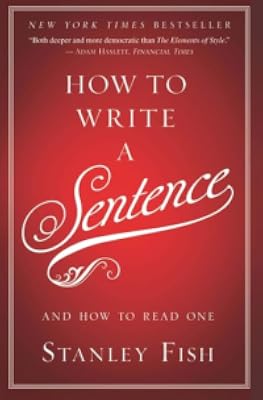
How to Write a Sentence: And How to Read One
by Stanley Fish
On This Page
Description
Fish has always been an aficionado of language, marveling at the adeptness of finely crafted sentences. Here he offers both sentence craft and sentence pleasure, skills invaluable to any writer (or reader).Tags
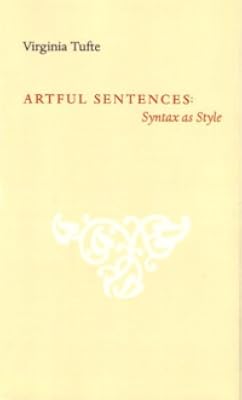
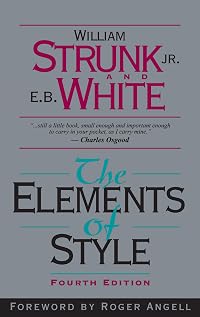
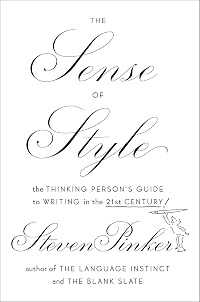
Recommendations











Member Reviews
An unapologetic potboiler, and probably not of very much practical use as a self-help book. But enjoyable enough as a virtuoso display of off-the-cuff textual criticism without a safety net of technical jargon.
Fish argues that we should see a sentence as a structure of logical semantic relationships between things rather than as a grammatical entity, an idea that he demonstrates in practice by taking a selection of famous and not-so-famous sentences from Great Writers and explaining how they convey meaning. Of course, Fish has been filleting the giants of Eng Lit for a living for half a century and is pretty good at it by now, so this is extremely well worth watching. Milton features heavily, as you would expect, but there's also a lot show more of Henry James, Joseph Conrad and Ford Maddox Ford, and the occasional venture into contemporaries like Philip Roth. Gertrude Stein and Virginia Woolf get a look in too. To his credit, Fish manages to hop across genres and centuries with remarkably little fuss: most of his examples need only a couple of lines of context to guide the reader along, and he manages almost entirely without resorting to the sort of technical terms that might scare beginners away. Fish isn't a Joseph Conrad or a Milton himself, of course: he's a university professor who has a lot of experience writing newspaper columns, so the text is fluent and presentable, but it doesn't pretend to be an example of what it is analysing.
The hypothetical self-helper who is following along with pen and paper is encouraged to try making up variants on these formulae ("It is a far, far, duller thing that I write now than I have ever written..."), but even Fish doesn't really seem to believe that this is going to happen. He mentions that it was his publisher who proposed the title of the book, and his wife the subtitle: that figures. As a "How to write..." book, I'm sure this must sell better than if it were marketed as a beginner's guide to close-reading of English prose, which is what it really is. show less
Fish argues that we should see a sentence as a structure of logical semantic relationships between things rather than as a grammatical entity, an idea that he demonstrates in practice by taking a selection of famous and not-so-famous sentences from Great Writers and explaining how they convey meaning. Of course, Fish has been filleting the giants of Eng Lit for a living for half a century and is pretty good at it by now, so this is extremely well worth watching. Milton features heavily, as you would expect, but there's also a lot show more of Henry James, Joseph Conrad and Ford Maddox Ford, and the occasional venture into contemporaries like Philip Roth. Gertrude Stein and Virginia Woolf get a look in too. To his credit, Fish manages to hop across genres and centuries with remarkably little fuss: most of his examples need only a couple of lines of context to guide the reader along, and he manages almost entirely without resorting to the sort of technical terms that might scare beginners away. Fish isn't a Joseph Conrad or a Milton himself, of course: he's a university professor who has a lot of experience writing newspaper columns, so the text is fluent and presentable, but it doesn't pretend to be an example of what it is analysing.
The hypothetical self-helper who is following along with pen and paper is encouraged to try making up variants on these formulae ("It is a far, far, duller thing that I write now than I have ever written..."), but even Fish doesn't really seem to believe that this is going to happen. He mentions that it was his publisher who proposed the title of the book, and his wife the subtitle: that figures. As a "How to write..." book, I'm sure this must sell better than if it were marketed as a beginner's guide to close-reading of English prose, which is what it really is. show less
Simply delightful. Stanley Fish appreciates “sentences that take your breath away.” His enthusiasm is infectious, fuelled by examples drawn from great literature. He makes you want to read each of those works (and countless others) slowly, so that you can savour every last sentence.
This is not a manual of style or correct usage; comparisons with Strunk and White are misplaced. There are a few simple exercises suggested, but what Fish is aiming at is not pedagogy, and certainly not pedantry. It is, rather, I think, a genuine wish to encourage readers (and writers) to refocus on the very stuff that makes great literature great: sentences.
What are sentences? They are basic building blocks of meaning, an organization of items in the show more world, a structure of logical relationships. It sounds a bit like the early Wittgenstein re-heated by J.L. Austin. It’s not. Stanley Fish is an unapologetic child of the New Criticism. His formula – Sentence craft equals sentence comprehension equals sentence appreciation – is nothing less than a justification for steeping oneself in the finest sentences that the history of literature can provide. Which is precisely what he does. show less
This is not a manual of style or correct usage; comparisons with Strunk and White are misplaced. There are a few simple exercises suggested, but what Fish is aiming at is not pedagogy, and certainly not pedantry. It is, rather, I think, a genuine wish to encourage readers (and writers) to refocus on the very stuff that makes great literature great: sentences.
What are sentences? They are basic building blocks of meaning, an organization of items in the show more world, a structure of logical relationships. It sounds a bit like the early Wittgenstein re-heated by J.L. Austin. It’s not. Stanley Fish is an unapologetic child of the New Criticism. His formula – Sentence craft equals sentence comprehension equals sentence appreciation – is nothing less than a justification for steeping oneself in the finest sentences that the history of literature can provide. Which is precisely what he does. show less
Ostensibly, this is a book about how to craft an effective sentence. But it is also a celebration of those who have done it really well. Much of the book consists of examples by writers who perfected the art of constructing sentences, and by so doing helped us to perceive reality more beautifully, or ironically, or succinctly, or evocatively, than we ever would have been able to do on our own.
Through numerous examples, Professor Fish demonstrates the elements of good writing: What characteristics of sentences make us want to know more of the story? How do we write such sentences? How can we combine words to reflect a certain perspective, advance a point of view, or convey a particular emotion?
To my mind, the best example in the book is show more provided by an extensive quote from Martin Luther King, Jr.’s Letter From A Birmingham Jail (1963). In a famous passage, the late Dr. King explained why blacks had run out of patience waiting for civil rights. He anguished over the impossibility of explaining to a six-year-old child why the world, for blacks, was like it was, and he lamented seeing “the depressing clouds of inferiority beginning to form in her little mental sky….” In this short and incredibly masterful phrase, Dr. King packed in years of history; textured it with analysis; and freighted it with emotion. One can appreciate how and why he moved so many.
Evaluation: Fish’s essay provides a lovely, short explication and appreciation of good writing, both for those who want to be counted among adept wordsmiths, and for those simply interested in appreciating the prowess of others. show less
Through numerous examples, Professor Fish demonstrates the elements of good writing: What characteristics of sentences make us want to know more of the story? How do we write such sentences? How can we combine words to reflect a certain perspective, advance a point of view, or convey a particular emotion?
To my mind, the best example in the book is show more provided by an extensive quote from Martin Luther King, Jr.’s Letter From A Birmingham Jail (1963). In a famous passage, the late Dr. King explained why blacks had run out of patience waiting for civil rights. He anguished over the impossibility of explaining to a six-year-old child why the world, for blacks, was like it was, and he lamented seeing “the depressing clouds of inferiority beginning to form in her little mental sky….” In this short and incredibly masterful phrase, Dr. King packed in years of history; textured it with analysis; and freighted it with emotion. One can appreciate how and why he moved so many.
Evaluation: Fish’s essay provides a lovely, short explication and appreciation of good writing, both for those who want to be counted among adept wordsmiths, and for those simply interested in appreciating the prowess of others. show less
My reading year began with Mortimer Adler's How to Read a Book. Adler mentions (p. xi) that after the book became a best-seller, it was parodied by How to Read Two Books and, more seriously, How to Read a Page. So when I saw How to Write a Sentence: And How to Read One, I was intrigued. With my usual marginalia noticeably absent, I must say the book was worth reading, but it is relatively easy enough to take in in one go. The book provides numerous examples of great sentences, including great beginning and ending sentences. (Dickens doesn't get a mention other than a suggestion that his were over-rated.) There are a number of exercises using various sentence types that are useful. Hemingway thought that if he could write just one good show more sentence, then the day was well-spent (A Moveable Feast, p. 22):
I would stand and look out over the roofs of Paris and think, 'Do not worry. You have always written before and you will write now. All you have to do is write one true sentence. Write the truest sentence that you know.' So finally I would write one true sentence, and then go on from there. It was easy then because there was always one true sentence that I knew or had seen or had heard someone say.Fish doesn't go so far, but sees the sentence as a building block for all great writing. I particularly liked the idea that to be a writer, one has to like sentences, much like the painter who paints because she likes the smell of paint (p. 1). And the poem by Kenneth Koch really sums up this delightful little book:
One day the Nouns were clustered in the street. An Adjective walked by, with her dark beautyThe Nouns were struck, moved, changed.The next day the Verb drove up, and created the Sentence.I would say that the major benefit of reading this work is that it brings the sentence back as the unit of work. I tend to focus more on paragraphs as corralled ideas, but overlook the importance of the humble sentence. Having read this work, I hope I can implement some of the clever suggestions and see the role of the humble sentence in framing not just stories, but also my academic work. show less
How to Write a Sentence is one of the most glorious books I have ever read. Fish's passion for words and writing--his own or the works of others--is evident in, appropriately, every sentence, whether written by this book's author or included as a model sentence upon which Fish's readers can base their own literary attempts. However, the very gloriousness of its language turns this book into something that cannot easily be dashed through on an airplane flight, or tossed off in a lazy hour at the beach. I found myself reading unexpectedly slowly, savouring the words and structure of each paragraph, tucking the book into the seat-back pocket between chapters to re-consider its contents before retrieving the volume, only to re-read the same show more pages over again. On a three-hour flight, I managed to read fewer than a hundred pages (this is probably only really shocking if you know me in person). Fish's ideas have lingered with me all week, and I find myself itching to practice his model sentences at odd times.
Everyone should read this book. If I am ever allowed to teach Freshman Composition, I would assign this book to my students in a heartbeat; I wish I could send a copy to every one of my former secondary-school students. It is at once inspiring and elegantly readable, the perfect companion for lovers of literature and aspiring writers all at once. How to Write a Sentence is a companion and a textbook simultaneously: Fish introduces his reader to books and sentences he loves (as if having a conversation) and then offers instructions for replicating the style and form of each example. Read this; assign this; practice following its guidelines; read it again.
Fish's slim little volume is as revolutionary and fresh for its time as Elements of Style was back in the early 1900s. Nearly a century later, How to Write a Sentence gives readers--and aspiring writers--fresh models and useful exercises that point out stylistic technique in concrete, practical ways. Read this book, but slowly. It is a delight.
(Original review: http://legereinterlitteras.blogspot.com/2013/01/stanley-fishs-sentence-style-bet... show less
Everyone should read this book. If I am ever allowed to teach Freshman Composition, I would assign this book to my students in a heartbeat; I wish I could send a copy to every one of my former secondary-school students. It is at once inspiring and elegantly readable, the perfect companion for lovers of literature and aspiring writers all at once. How to Write a Sentence is a companion and a textbook simultaneously: Fish introduces his reader to books and sentences he loves (as if having a conversation) and then offers instructions for replicating the style and form of each example. Read this; assign this; practice following its guidelines; read it again.
Fish's slim little volume is as revolutionary and fresh for its time as Elements of Style was back in the early 1900s. Nearly a century later, How to Write a Sentence gives readers--and aspiring writers--fresh models and useful exercises that point out stylistic technique in concrete, practical ways. Read this book, but slowly. It is a delight.
(Original review: http://legereinterlitteras.blogspot.com/2013/01/stanley-fishs-sentence-style-bet... show less
I hesitate to write this review. As I read Fish's book on sentences, I constantly analyzed how he constructed his own. Now I'm writing my review, conscious that my sentences have a long way to go before even approaching greatness.
Fish is a connoisseur of sentences. He's unapologetic about it:
"Some appreciate fine art; others appreciate fine wines. I appreciate fine sentences. I am always on the lookout for sentences that take your breath away, for sentences that make you say, "Isn't that something?" or "What a sentence" (3)!
His sentence collection, developed over the years, is the great strength of this book. Fish uses examples from Annie Dillard to Lewis Carroll, from John Donne to Edgar Allan Poe to illustrate his points. He isn't so show more enamored with a particular style of writing that he cannot appreciate and enjoy the English language in all its forms.
The strongest thing I learned from How to Write a Sentence was the difference between the "subordinating style," where every sub-clause is neatly and logically tucked into place and the "additive style", where clauses ramble on to paint a mood more than argue a point.
If there's a weakness in this book it's the overall feeling of pretentiousness that surfaces. The tone of his writing felt almost condescending at times. Rather than hearing the excitement of someone itching to share his sentence collection to his friends, you read the wizened teacher encouraging his students to practice, so that one day, they too will be able to write well. show less
Fish is a connoisseur of sentences. He's unapologetic about it:
"Some appreciate fine art; others appreciate fine wines. I appreciate fine sentences. I am always on the lookout for sentences that take your breath away, for sentences that make you say, "Isn't that something?" or "What a sentence" (3)!
His sentence collection, developed over the years, is the great strength of this book. Fish uses examples from Annie Dillard to Lewis Carroll, from John Donne to Edgar Allan Poe to illustrate his points. He isn't so show more enamored with a particular style of writing that he cannot appreciate and enjoy the English language in all its forms.
The strongest thing I learned from How to Write a Sentence was the difference between the "subordinating style," where every sub-clause is neatly and logically tucked into place and the "additive style", where clauses ramble on to paint a mood more than argue a point.
If there's a weakness in this book it's the overall feeling of pretentiousness that surfaces. The tone of his writing felt almost condescending at times. Rather than hearing the excitement of someone itching to share his sentence collection to his friends, you read the wizened teacher encouraging his students to practice, so that one day, they too will be able to write well. show less
Stanley Fish collects great sentences the way Charlie Sheen collects suspended sentences. This little book approaches the sentence as the fundamental building block of good writing and tries to figure out how it ticks. Fish doesn't really lay down any hard-and-fast, Strunk-and-White rules because he fully believes that a great sentence can be great while breaking all the rules. Instead, Fish selects a few prime examples and helps the reader to appreciate what's great about them (usually the fact that the form of the sentence embodies its content). So this little book may appeal more to connoisseurs than to practitioners...although members of the second group should all really be members of the first.
Members
- Recently Added By
Published Reviews
ThingScore 50
Stanley Fish is not a writer of this caliber. He is a fluent, sometimes a lively (for an academic), but finally an undistinguished writer. A self-advertised sophist, he is most at home in polemic. Sentence by sentence, this would-be connoisseur of sentences is insufficiently scrupulous. He often roams deep into cliché country. “You can talk the talk,” he writes, “but you can’t walk show more the walk.” Earlier he writes that “the very thought of putting pen to paper, an anachronism I find hard to let go of, is enough to bring on an anxiety attack.” An anachronism isn’t the same as a cliché, and pen to paper, as clichés go, is blue ribbon, and let go of it, gladly, Fish should have done. His diction, or word choice, is commonplace: those worn-out vogue words “focus,” “meaningful,” and “bottom line,” come to him all too readily. “But, far from being transparent and incisive,” he writes, “these declarations come wrapped in a fog; they seem to skate on their own surface and simply don’t go deep enough.” Take three metaphors, mix gently, sprinkle lightly with abstraction, and serve awkwardly. These infelicities are from Fish’s first twenty pages. Many more, to stay with my salad metaphor, are peppered throughout the book.
...
I seem to have written more than three thousand words without a single kind one for How to Write a Sentence and How to Read One. To remedy this, at least partially, let it be noted that, at 165 pages, index and acknowledgments and biographical note on the author included, it is a short book. show less
...
I seem to have written more than three thousand words without a single kind one for How to Write a Sentence and How to Read One. To remedy this, at least partially, let it be noted that, at 165 pages, index and acknowledgments and biographical note on the author included, it is a short book. show less
added by jimroberts
Fish’s aim is to offer a guide to sentence craft and appreciation that is both deeper and more democratic [than Strunk and White's]. What, at base, is a sentence? he asks, and then goes on to argue that the standard answer based in parts of speech and rules of grammar teaches students “nothing about how to write”. Instead, we should be examining the “logical relationships” within show more different sentence forms to see how they organise the world. His argument is that you can learn to write and later become a good writer by understanding and imitating these forms from many different styles.
... for those, and I would count myself among them, who fell in love with literature not by becoming enthralled to books they couldn’t put down but by discovering individual sentences whose rhythm and rhetoric was so compelling they couldn’t help but repeat them to anyone who would listen, it is a blessed replacement to that old Strunkian superego forever whispering in your ear – cut, cut, cut. show less
... for those, and I would count myself among them, who fell in love with literature not by becoming enthralled to books they couldn’t put down but by discovering individual sentences whose rhythm and rhetoric was so compelling they couldn’t help but repeat them to anyone who would listen, it is a blessed replacement to that old Strunkian superego forever whispering in your ear – cut, cut, cut. show less
added by torontolibrarian
Author Information

23+ Works 2,729 Members
Stanley Fish is Dean of the College of Liberal Arts and Sciences at the University of Illinois at Chicago
Common Knowledge
- Original publication date
- 2011
Classifications
- Genres
- Reference, Literature Studies and Criticism, Nonfiction
- DDC/MDS
- 808.042 — Literature & rhetoric Literature, rhetoric & criticism Rhetoric and collections of literary texts from more than two literatures Rhetoric and anthologies Handbooks for writers English
- LCC
- PE1441 .F57 — Language and Literature English language English Modern English
- BISAC
Statistics
- Members
- 1,129
- Popularity
- 22,474
- Reviews
- 22
- Rating
- (3.53)
- Languages
- English, French
- Media
- Paper, Audiobook, Ebook
- ISBNs
- 5
- ASINs
- 5