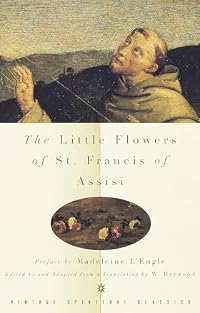
The Little Flowers of St. Francis
by Saint Francis of Assisi
On This Page
Description
First printed in 1476, this collection of stories, or "little flowers," chronicles Saint Francis of Assisi's journeys, activities, and miracles. Told in brief anecdotes of charming simplicity, the stories include Saint Francis' sermon to the birds, his taming of the savage wolf of Gubbio, his conversion of the Sultan of Babylon, and his miraculous healing of a leper. Picturesque and poetic, The Little Flowers of Saint Francis transports readers to the Middle Ages for an inspiring portrait of show more the saint and his earliest disciples. One of the world's most popular and widely read religious classics, its universal appeal extends to people of all faiths and every intellectual level. show lessTags
Recommendations








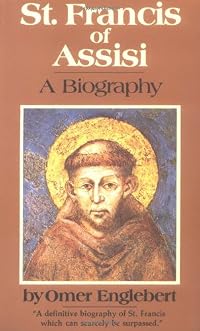








Member Recommendations
Member Reviews
I bought this because, standing there in the second-hand bookshop, I couldn’t work out what the nature of the text was. My curiosity would have been satisfied if I’d spotted the endnote. It turns out it’s a Medieval amalgamation of various texts, stitched together by a later editor. There’s a fair bit about it on Wikipedia if you’re interested, all of which makes it sound like a bit of a mess. That couldn’t be further from the truth. Whoever edited it together was some sort of genius.
The text as we have it is a collection of short chapters, mostly two or three pages long. Each tells a story either about St. Francis or various early Franciscan monks. Each story exemplifies a thoughtworthy point. The stories are fantastical, show more full of miracles. There’s little here that you could use for a biography of Francis, but it is a window into what Franciscans at the time believed about him. The section on the stigmata is particularly interesting in this regard. Here St Francis is portrayed as a second Christ, a living God, and after death, a psychopomp with powers of judgement over the dead. How did they avoid being killed as heretics? I don’t know enough about the period to answer that.
It made me consider the reliability of any written historical information from any dead culture. We have a clear dividing line between what we consider possible or impossible, but we cannot simply exclude the miracles and accept the remainder as history because the writers too had a clear dividing line. Their possible clearly differs from ours and includes the miraculous, but that doesn’t mean the remainder is true just because it happens to coincide with our possible. Imagine a testimony from the past that happens not to cross the line into our concept of the impossible. We might take it as a reliable historical account, yet to someone from that culture it might contain the most egregious series of improbabilities. But after all, what is history but a story we tell ourselves about the past?
Anyhow, I read the first 50 or 60 pages straight through like normal book and then, quite organically, my approach changed and I took to reading a chapter here, a chapter there as I had a quiet moment. Because no matter how strange the writers’ view of the universe and their mode of expressing themselves, the points they raise are worthy of contemplation. I think it would be a stretch to describe a hoary old sinner like me as reading anything in a devotional manner, but I can completely see why people are still using this book in this way nearly 700 years later. show less
The text as we have it is a collection of short chapters, mostly two or three pages long. Each tells a story either about St. Francis or various early Franciscan monks. Each story exemplifies a thoughtworthy point. The stories are fantastical, show more full of miracles. There’s little here that you could use for a biography of Francis, but it is a window into what Franciscans at the time believed about him. The section on the stigmata is particularly interesting in this regard. Here St Francis is portrayed as a second Christ, a living God, and after death, a psychopomp with powers of judgement over the dead. How did they avoid being killed as heretics? I don’t know enough about the period to answer that.
It made me consider the reliability of any written historical information from any dead culture. We have a clear dividing line between what we consider possible or impossible, but we cannot simply exclude the miracles and accept the remainder as history because the writers too had a clear dividing line. Their possible clearly differs from ours and includes the miraculous, but that doesn’t mean the remainder is true just because it happens to coincide with our possible. Imagine a testimony from the past that happens not to cross the line into our concept of the impossible. We might take it as a reliable historical account, yet to someone from that culture it might contain the most egregious series of improbabilities. But after all, what is history but a story we tell ourselves about the past?
Anyhow, I read the first 50 or 60 pages straight through like normal book and then, quite organically, my approach changed and I took to reading a chapter here, a chapter there as I had a quiet moment. Because no matter how strange the writers’ view of the universe and their mode of expressing themselves, the points they raise are worthy of contemplation. I think it would be a stretch to describe a hoary old sinner like me as reading anything in a devotional manner, but I can completely see why people are still using this book in this way nearly 700 years later. show less
St. Francis walked the earth at the turn of the twelfth century. In the later half of the fourteenth century, this book of stories about his life was published.
The stories are (literally) the stuff of legends. This is where we hear that St. Francis preached to the birds (although I think his evangelism and discipleship of a wolf was much more exciting). This is where we learn of the stigmata St. Francis was blessed with. Here we learn how St. Clare blessed a loaf of bread only to see the sign of the cross on every slice.
What I found most interesting about these stories was not that their creation or collection, but what they reveal about the mindset of the Christians of those centuries. While I found some elements inspiring, I was also show more saddened by misguided theology. I want to end with the positive, so let's start with the bad.
The Bad
St. Francis and his followers were gripped with the idea of penance and mortification in a very physical way. Chapter 3 provides a good example. One day St. Francis lamented that his companion, Friar Bernard, didn't answer him when he called three times. God proceeded to tell St. Francis that Friar Bernard was busy in Divine communion, so he could not answer anyone on the creaturely plane. Overwhelmingly upset with himself for his frustration with Friar Bernard, St. Francis found his companion, threw himself down before him, and said,
"I command you in the name of holy obedience that, to punish my presumption and the arrogance of my heart, when now I shall cast myself down on my back on the earth, you shall set one foot on my throat and the other on my mouth and so pass over me three times, from one side to the other, crying shame and infamy upon me, and especially say to me: 'Lie there, you churl, son of Peter Bernardone, whence have you so much pride, you who are a most abject creature" (9)?
The Christians of this era seemed to take a perverse joy in being abused. This attitude is miles removed from Jesus' words to sinner caught in the act: "I don't condemn you ... Go home, and from now on don't sin any more" (John 8:11 NIV). Instead of hearing Jesus' words of forgiveness, they chose their own self-punishment.
The Good
The inspiring part of this collection of stories can be seen in the same story: they took their sin seriously. If there was a tendency in their culture to overemphasize the most minute attitude of the heart and take matters into their own hands, there is a tendency in ours to ignore all sin and continue living like nothing is wrong. St. Francis and his followers recognized the diverse ways that pride can infect a community and did everything they could to resist it.
While I firmly believe that every Christ-follower should be rightly called, "saint," it's clear why the Roman church set some Christians apart as shining examples. show less
The stories are (literally) the stuff of legends. This is where we hear that St. Francis preached to the birds (although I think his evangelism and discipleship of a wolf was much more exciting). This is where we learn of the stigmata St. Francis was blessed with. Here we learn how St. Clare blessed a loaf of bread only to see the sign of the cross on every slice.
What I found most interesting about these stories was not that their creation or collection, but what they reveal about the mindset of the Christians of those centuries. While I found some elements inspiring, I was also show more saddened by misguided theology. I want to end with the positive, so let's start with the bad.
The Bad
St. Francis and his followers were gripped with the idea of penance and mortification in a very physical way. Chapter 3 provides a good example. One day St. Francis lamented that his companion, Friar Bernard, didn't answer him when he called three times. God proceeded to tell St. Francis that Friar Bernard was busy in Divine communion, so he could not answer anyone on the creaturely plane. Overwhelmingly upset with himself for his frustration with Friar Bernard, St. Francis found his companion, threw himself down before him, and said,
"I command you in the name of holy obedience that, to punish my presumption and the arrogance of my heart, when now I shall cast myself down on my back on the earth, you shall set one foot on my throat and the other on my mouth and so pass over me three times, from one side to the other, crying shame and infamy upon me, and especially say to me: 'Lie there, you churl, son of Peter Bernardone, whence have you so much pride, you who are a most abject creature" (9)?
The Christians of this era seemed to take a perverse joy in being abused. This attitude is miles removed from Jesus' words to sinner caught in the act: "I don't condemn you ... Go home, and from now on don't sin any more" (John 8:11 NIV). Instead of hearing Jesus' words of forgiveness, they chose their own self-punishment.
The Good
The inspiring part of this collection of stories can be seen in the same story: they took their sin seriously. If there was a tendency in their culture to overemphasize the most minute attitude of the heart and take matters into their own hands, there is a tendency in ours to ignore all sin and continue living like nothing is wrong. St. Francis and his followers recognized the diverse ways that pride can infect a community and did everything they could to resist it.
While I firmly believe that every Christ-follower should be rightly called, "saint," it's clear why the Roman church set some Christians apart as shining examples. show less
I'm not really sure if I approach this classic the right way - with the necessary prayerful devotion. First of all, this is not a reliable biography of Assisi. These are collected legends - the stuff of folklore - when the miracles, dreams and visions just gets more and more fantastical when they are told and retold and eventually one jots them down.
I read it with a smile on my face - a lot of them are quite humorous, inspiring in a childish kind of way - the devotion so extreme it becomes, well, oddly funny.
No doubt, Assisi was a very humble man, serving Christ and others with much devotion. When I read about this man who can tell the destiny of other monks, quiet the birds when he preach to them, calm the fierce wolf of Gubbio, have show more dreamlike visions of Christ, St. Paul etc. etc. well - I smile. It's just a lot of wonderful stories - we want them to be true…..and some of them no doubt are true, and some of it did happen. Some of it. show less
I read it with a smile on my face - a lot of them are quite humorous, inspiring in a childish kind of way - the devotion so extreme it becomes, well, oddly funny.
No doubt, Assisi was a very humble man, serving Christ and others with much devotion. When I read about this man who can tell the destiny of other monks, quiet the birds when he preach to them, calm the fierce wolf of Gubbio, have show more dreamlike visions of Christ, St. Paul etc. etc. well - I smile. It's just a lot of wonderful stories - we want them to be true…..and some of them no doubt are true, and some of it did happen. Some of it. show less
A very delightful little book, food for my soul. While this is definitely not for everyone, I found the air of innocent faith that breathed through these tales of St. Francis and his companions to be absolutely inspiring. The only reason I don't give it five stars is because the translator of this particular edition (Jon M. Sweeney) chose to use some jarring anachronisms, like the word "okay." Otherwise, the translation was very readable: simple, even child-like, a style which well fitted the atmosphere of the tales.
St. Francis of Assisi's ecstatic embrace of a life of poverty revolutionized Christianity even as it transformed the ethics of the West. In this luminous and lively book, St. Francis's followers preserved his legend and those of his first disciples, combining stories of miracles with convincing portraits of men who were no less human for having been touched by God.
A collection of stories about the life and ministry of St. Francis. These episodes cover miracles, visions, and unusual happenings, but also contain incidences of mistakes, failings, and tests. I don't know much about St. Francis, although I had a vague sense that he liked animals. This set of stories was a great introduction to the man's impact and legacy in Catholicism. That being said, it's pretty dry reading, and without the added commentary there would have been a lot of stories that made little sense to me.
I don't want to say that I like the movie better, but I'm glad I saw Roberto Rossellini's dramatization of some of these stories first before I read the book. Since Little Flowers was written in the 13th century it definitely is written for its time, that is full of miracles and an almost competitive piety. That being said there's a lot to learn from Francis and his friars as they take on a life of poverty, serve the poor and worship God with ecstatic joy. The stories often read as parables with Francis teaching the friars with his words and actions in a Zen-like manner. A good little book to read and ponder during Lent.
The Little Flowers of St. Francis of Assisi is also available for online reading in its entirety.
The Little Flowers of St. Francis of Assisi is also available for online reading in its entirety.
Members
- Recently Added By
Lists

Christianity Books You've Read
179 works; 18 members

Saints and Blesseds
74 works; 4 members

Italian Literature
556 works; 41 members

Books Mentioned In The Chalet School Series
9 works; 1 member

Book Titles Mentioned In Newberry Medal And Honor Books
884 works; 3 members
Author Information

198+ Works 3,362 Members
Some Editions
Awards and Honors
Series
Belongs to Publisher Series
Limited Editions Club (S:2.05)
insel taschenbuch (0048)
Centopaginemillelire (84)
The World's Classics (265)
Penguin Classics (L091)
Work Relationships
Is contained in
The Greatest Thing in the World / Acres of Diamonds / As a Man Thinketh / The Practice of the Presence of God / The Imitation of Christ by Guideposts (indirect)
The Brother Lawrence Collection: Practice and Presence of God, Spiritual Maxims, The Life of Brother Lawrence by Brother Lawrence (indirect)
Has the adaptation
Common Knowledge
- Canonical title
- The Little Flowers of St. Francis
- Original title
- Actus Beati Francisci et Sociorum Eius
- Alternate titles
- Fioretti di san Francesco
- Original publication date
- c. 1322-1328
- People/Characters
- Francis of Assisi
- Important places
- Italy
- Important events
- Middle Ages
- First words
- IN THE NAME OF OUR LORD JESUS CHRIST, THE CRUCIFIED, AND OF HIS MOTHER THE VIRGIN MARY.
It is first to be considered that the glorious St. Francis in all the acts of his life was conformable to Christ the Blessed. - Last words
- (Click to show. Warning: May contain spoilers.)I say unto thee, that the man who liveth well in the sight of God the highest good and great riches, and great honour and long life eternal in that perpetual glory of heaven, whereunto may the good God, our Lord and King Jesus Christ, bring us, to the praise of Jesus Christ and of His poor little one, Francis.
- Original language
- Latin
Classifications
- Genres
- Nonfiction, Religion & Spirituality, Biography & Memoir
- DDC/MDS
- 271.302 — Religion History of Christianity Religious congregations and orders in church history Franciscans
- LCC
- BX4700 .F63 .E5 — Philosophy, Psychology and Religion Christian Denominations Christian Denominations Catholic Church Biography and portraits Individual Saints
- BISAC
Statistics
- Members
- 1,405
- Popularity
- 16,763
- Reviews
- 20
- Rating
- (3.69)
- Languages
- 8 — Dutch, English, Finnish, French, German, Italian, Spanish, Portuguese (Portugal)
- Media
- Paper, Audiobook, Ebook
- ISBNs
- 83
- UPCs
- 1
- ASINs
- 97