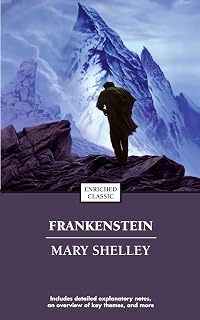
Frankenstein (Enriched Classics)
by Mary Shelley
On This Page
Description
Presents Mary Shelley's classic novel "Frankenstein," and contains a concise introduction, chronology of Shelley's life, an outline of key themes and plots, explanatory notes, and critical analysis.Tags
Recommendations



Member Reviews
When Robert Walton's ship becomes stuck in the Arctic ice, he and his crew spy a dark-clad figure, hunched on a sled and flying away from them over the ice. A short time later, they encounter another such sleigh, only this time, the lone driver is brought aboard the ship, exhausted and close on the heels of death. The crew tends to the mysterious man, and once he's able, he begins to tell Robert of the strange circumstances of his history and what brought him to be trapped on the ice.
The strange man begins with his origins as a young Victor Frankenstein, finding himself entranced by a book by Cornelius Agrippa discoursing his early views and ideas concerning science and natural philosophy -- especially those concerning the elixir of show more life. He carries this fascination with him to university in Ingolstadt where his studies finally allow him to reach his goal: creating life.
Instead of finding wonder in his new creation, he only sees the hideous face, the overly tall stature, and at once abandons the creature, hoping to leave it and all things concerning it behind. The months pass, and when Frankenstein readies himself to return home to Geneva, he learns of the murder of his younger brother. He intuitively knows who did it. From that moment on, he determines to find some way to rid himself and the world of his creation, even if it takes him to the ends of the Earth.
"Frankenstein" is one of those literary classics that you should have read in high school, but never got around to it. And as an avid reader of horror, I still don't know why I waited all this time to finally read it.
The one thing that struck me about the book is how vastly different it is from James Whale's 1931 film interpretation. In the movie, the creature's tall and green, with bolts protruding from his neck, eyes, half shut, can barely utter anything beyond a grunt or moan. In Mary Shelley's novel, the creature is also tall, but suffers emotionally from how others treat him. He has the ability to learn and teaches himself to read and to speak. He also becomes a very consummate student of humanity and turns what he learns into revenge against his maker.
"Frankenstein" is a novel about a monster, but who exactly is this monster? Is it Frankenstein's creation who is shunned because of his disfigured face and giant stature, who begins to hate only because that is what he has been shown? Or is it Frankenstein himself, who created and abandoned the creature because he found it monstrous? Or is it society itself, and how "civilization" fears that which it doesn't understand? show less
The strange man begins with his origins as a young Victor Frankenstein, finding himself entranced by a book by Cornelius Agrippa discoursing his early views and ideas concerning science and natural philosophy -- especially those concerning the elixir of show more life. He carries this fascination with him to university in Ingolstadt where his studies finally allow him to reach his goal: creating life.
Instead of finding wonder in his new creation, he only sees the hideous face, the overly tall stature, and at once abandons the creature, hoping to leave it and all things concerning it behind. The months pass, and when Frankenstein readies himself to return home to Geneva, he learns of the murder of his younger brother. He intuitively knows who did it. From that moment on, he determines to find some way to rid himself and the world of his creation, even if it takes him to the ends of the Earth.
"Frankenstein" is one of those literary classics that you should have read in high school, but never got around to it. And as an avid reader of horror, I still don't know why I waited all this time to finally read it.
The one thing that struck me about the book is how vastly different it is from James Whale's 1931 film interpretation. In the movie, the creature's tall and green, with bolts protruding from his neck, eyes, half shut, can barely utter anything beyond a grunt or moan. In Mary Shelley's novel, the creature is also tall, but suffers emotionally from how others treat him. He has the ability to learn and teaches himself to read and to speak. He also becomes a very consummate student of humanity and turns what he learns into revenge against his maker.
"Frankenstein" is a novel about a monster, but who exactly is this monster? Is it Frankenstein's creation who is shunned because of his disfigured face and giant stature, who begins to hate only because that is what he has been shown? Or is it Frankenstein himself, who created and abandoned the creature because he found it monstrous? Or is it society itself, and how "civilization" fears that which it doesn't understand? show less
This book, it was not fun to read, but after reading was very good to think about. There is depth, archetype, social critique, scientific critique, feminist critique, pedagogy, and so much more.
But oh god the language made me want to throw up oh lord.
I don't blame Mary though. I read in a biography that Percy (her husband) edited the book, and basically turned every short anglo saxon word into a long latinized word. So "hot" became "inflamed", "small" into "minute" and so forth.
There was one sentence which had eighty two words. SO MANY COMMAS.
But oh god the language made me want to throw up oh lord.
I don't blame Mary though. I read in a biography that Percy (her husband) edited the book, and basically turned every short anglo saxon word into a long latinized word. So "hot" became "inflamed", "small" into "minute" and so forth.
There was one sentence which had eighty two words. SO MANY COMMAS.
It gets lonely when you're a monster. Shelley makes us look at the inhuman aspects of ourselves. When what we create gets out of hand isn't it still our fault?
Victor Frankenstein was a precocious child, inspired by and obsessed with the scientists of the past. In university, he continues his obsession, which culminates in the creation of a man made of corpses. As the creature awakens, Victor is horrified and disgusted and runs away. He becomes stricken with illness shortly afterwards and his childhood friend, Henry Clerval, helps nurse him back to health. After four months, Victor finally recovers, only to find that his little brother, William, has been murdered. Sure that the fiend he created is responsible, Victor returns to his home. The tormented creature eventually reveals himself to his furious creator and relays the events leading to William’s murder. After his heart-rending story, show more he begs his creator to make a woman for him who will accept him and become his mate. Victor agrees, but has second thoughts. Should he create another monster like the one already in existence? If he decides against this second blasphemy, what repercussions will he and his family have to endure?
Mary Shelley’s classic novel Frankenstein is an iconic work that has spawned countless spin-offs, sequels, remakes, copies, and re-imaginings. It’s hardly surprising considering the eloquence and skill that she exhibits. With all the allusions and references to literature and works of science, she shows her vast education, which is even surprising today for an eighteen year old. I absolutely love this book, but I used to hate it. I remember reading it as a child and finding it boring and hard to understand. As an adult, I see the different philosophies being illustrated and the significance of its place in the romantic era. It explores themes such as the nature of man, the effect of isolation verses society on man, and the ethics of science. These are themes that science fiction authors are still writing about today, as seen in the film Splice, Scott Sigler’s novel Ancestor, and countless others. This is really the epitome of the gothic novel, which conveys its messages with a dose of horror and suspense.
The characters and their development is really what makes Frankenstein special. I can see the suffering and anger on both Victor’s and the creature’s side. Victor is a good person who got swept up in his fervor for science without thinking about the consequences. After making the creature, he tries to move forward with his life, but his past follows him. The creature, on the other hand, is actually a sympathetic character. Far from the shuffling, silent monster seen in film, he exhibits great intelligence and is shown to be inherently good. After being consistently rejected and abused by man, he turns to violence and really only to mimic how people have always treated him. He only ever desired to be loved and accepted. I tend to side more with the monster because he was created and then immediately abandoned with no instruction on how to act or survive in the human world. I find the fact that Victor finds this acceptable and proceeds to further antagonize his creation reprehensible.
I could probably go on and on about how Frankenstein is one of the best books ever written, so I’ll stop here. This work is still relevant today and can both horrify and interest modern audiences. I think everyone should read this book at least once. show less
Mary Shelley’s classic novel Frankenstein is an iconic work that has spawned countless spin-offs, sequels, remakes, copies, and re-imaginings. It’s hardly surprising considering the eloquence and skill that she exhibits. With all the allusions and references to literature and works of science, she shows her vast education, which is even surprising today for an eighteen year old. I absolutely love this book, but I used to hate it. I remember reading it as a child and finding it boring and hard to understand. As an adult, I see the different philosophies being illustrated and the significance of its place in the romantic era. It explores themes such as the nature of man, the effect of isolation verses society on man, and the ethics of science. These are themes that science fiction authors are still writing about today, as seen in the film Splice, Scott Sigler’s novel Ancestor, and countless others. This is really the epitome of the gothic novel, which conveys its messages with a dose of horror and suspense.
The characters and their development is really what makes Frankenstein special. I can see the suffering and anger on both Victor’s and the creature’s side. Victor is a good person who got swept up in his fervor for science without thinking about the consequences. After making the creature, he tries to move forward with his life, but his past follows him. The creature, on the other hand, is actually a sympathetic character. Far from the shuffling, silent monster seen in film, he exhibits great intelligence and is shown to be inherently good. After being consistently rejected and abused by man, he turns to violence and really only to mimic how people have always treated him. He only ever desired to be loved and accepted. I tend to side more with the monster because he was created and then immediately abandoned with no instruction on how to act or survive in the human world. I find the fact that Victor finds this acceptable and proceeds to further antagonize his creation reprehensible.
I could probably go on and on about how Frankenstein is one of the best books ever written, so I’ll stop here. This work is still relevant today and can both horrify and interest modern audiences. I think everyone should read this book at least once. show less
This book has little in common with the movies based on it. Unlike the movies, it is a complex story. Dr. Frankenstein’s monster speaks in a very clear, Oxford-educated style English. The monster is highly intelligent; he is also very pathetic. He represents the deep despair that extreme loneliness can bring. Dr. Frankenstein created a mate (as in the film “The Bride of Frankenstein”) to help offset the monster’s loneliness, but this creation had its own unforeseen set of complications.
While the monster commits horrible acts, you can’t help but feel some sympathy for him. He is angry with Dr. Frankenstein for creating him because, while he is similar to humans, he is not human. His isolation is palpable. Having been created show more in a laboratory, he has no sense of morality, and while he is not inherently evil, he behaves as if he were the ultimate evil.
The book is only 212 pages but there is much more going on than in many books twice as long. The writing is spare and concise; words are not wasted.
The story came about because of a contest among Mary Shelley, her husband Percy Bysshe Shelley, and Lord Byron. One dreary, rainy night, out of boredom, they challenged each other to write a ghost story, and hers was so good that Percy told Mary she should expand her short story into a novel. Mary Shelley wrote Frankenstein when she was only 19, in 1816.
I highly recommend this book to anyone interested in something serious that is meatier than typical modern fiction. It was very hard to put down. Ms. Shelley knew how to write a mesmerizing tale. show less
While the monster commits horrible acts, you can’t help but feel some sympathy for him. He is angry with Dr. Frankenstein for creating him because, while he is similar to humans, he is not human. His isolation is palpable. Having been created show more in a laboratory, he has no sense of morality, and while he is not inherently evil, he behaves as if he were the ultimate evil.
The book is only 212 pages but there is much more going on than in many books twice as long. The writing is spare and concise; words are not wasted.
The story came about because of a contest among Mary Shelley, her husband Percy Bysshe Shelley, and Lord Byron. One dreary, rainy night, out of boredom, they challenged each other to write a ghost story, and hers was so good that Percy told Mary she should expand her short story into a novel. Mary Shelley wrote Frankenstein when she was only 19, in 1816.
I highly recommend this book to anyone interested in something serious that is meatier than typical modern fiction. It was very hard to put down. Ms. Shelley knew how to write a mesmerizing tale. show less
In his quest for knowledge about nature and how to reanimate the non-living, Viktor Frankenstein creates an abomination that will haunt him until his death. What horrors can come from such knowledge and experimentation? Is it the daemon created or the creator who is the real monster?
I knew the story, of course, but had not read it until yesterday. It wasn't as scary as I had hoped but it kept me interested and in suspense many times. The chapters describing the travel was tedious to read, however, and I kept wanting to skim through it to get to the action. Beautifully written, but long stretches lacking in action pertaining to the story made it a difficult read at times.
I am glad I finally read this but not a favorite.
I knew the story, of course, but had not read it until yesterday. It wasn't as scary as I had hoped but it kept me interested and in suspense many times. The chapters describing the travel was tedious to read, however, and I kept wanting to skim through it to get to the action. Beautifully written, but long stretches lacking in action pertaining to the story made it a difficult read at times.
I am glad I finally read this but not a favorite.
A classic "ghost" story. Victor Frankenstein pursues science to its logical extreme to create life, and he is immediately horrified at his own success. The monster, however, is intelligent and resourceful and comes to understand his own loneliness and therefore seeks revenge on his creator. There are many unexplained occurences (How'd the monster find the ship? or get Henry Clerval's body onto the very shore that Frankenstein would wind up on?) especially for today's more savvy reader, but it's still a masterpiece.
UPDATE October 5, 2012
Simon Vance does a superb job narrating the audio (for Tantor Unabridged Classics). My heart breaks for the monster as he relates his loneliness and despair. Of course, I do not condone his way of trying show more to fix his condition! show less
UPDATE October 5, 2012
Simon Vance does a superb job narrating the audio (for Tantor Unabridged Classics). My heart breaks for the monster as he relates his loneliness and despair. Of course, I do not condone his way of trying show more to fix his condition! show less
Members
- Recently Added By
Lists

1001 Books You Must Read Before You Die
1,448 works; 1,134 members

100 Books to Read in a Lifetime (That Are Older Than 200 Years)
415 works; 175 members
BBC Big Read
191 works; 46 members

Dark Books for Winter Reading
71 works; 11 members

The College Board: 101 Great Books Recommended for College-Bound Readers
111 works; 7 members

To Read - Horror
137 works; 14 members
Author Information

437+ Works 73,607 Members
Mary Wollstonecraft Shelley was born in England on August 30, 1797. Her parents were two celebrated liberal thinkers, William Godwin, a social philosopher, and Mary Wollstonecraft, a women's rights advocate. Eleven days after Mary's birth, her mother died of puerperal fever. Four motherless years later, Godwin married Mary Jane Clairmont, bringing show more her and her two children into the same household with Mary and her half-sister, Fanny. Mary's idolization of her father, his detached and rational treatment of their bond, and her step-mother's preference for her own children created a tense and awkward home. Mary's education and free-thinking were encouraged, so it should not surprise us today that at the age of sixteen she ran off with the brilliant, nineteen-year old and unhappily married Percy Bysshe Shelley. Shelley became her ideal, but their life together was a difficult one. Traumas plagued them: Shelley's wife and Mary's half-sister both committed suicide; Mary and Shelley wed shortly after he was widowed but social disapproval forced them from England; three of their children died in infancy or childhood; and while Shelley was an aristocrat and a genius, he was also moody and had little money. Mary conceived of her magnum opus, Frankenstein, or the Modern Prometheus, when she was only nineteen when Lord Byron suggested they tell ghost stories at a house party. The resulting book took over two years to write and can be seen as the brilliant creation of a powerful but tormented mind. The story of Frankenstein has endured nearly two centuries and countless variations because of its timeless exploration of the tension between our quest for knowledge and our thirst for good. Shelley drowned when Mary was only 24, leaving her with an infant and debts. She died from a brain tumor on February 1, 1851 at the age of 54. (Bowker Author Biography) show less
Series
Belongs to Publisher Series
Work Relationships
Contains
Common Knowledge
- People/Characters
- Victor Frankenstein; Frankenstein's Monster
- Disambiguation notice
- Apart from the text of the novel, this edition includes more than 150 pages of additional material as follows: Introduction --
Chronology of Mary Shelley's life and work --
Historical context of Frankenstein --
Int... (show all)erpretive notes --
Critical excerpts --
Questions for discussion --
Suggestions for the Interested reader.
Classifications
Statistics
- Members
- 2,484
- Popularity
- 7,779
- Reviews
- 45
- Rating
- (3.77)
- Languages
- English
- Media
- Paper, Audiobook
- ISBNs
- 1
- ASINs
- 2