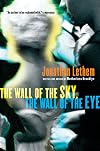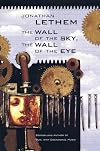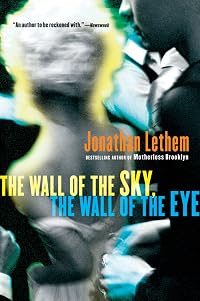
The Wall of the Sky, the Wall of the Eye
by Jonathan Lethem
On This Page
Description
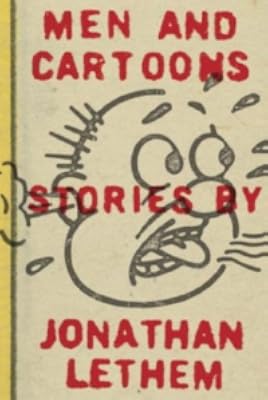
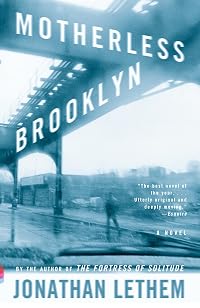
A dead man is brought back to life so he can support his family in "The Happy Man"; occasionally he slips into a zombielike state while his soul is tortured in Hell. In "Vanilla Dunk," future basketball players are given the skills of old-time stars like Michael Jordan and Wilt Chamberlain. And in "Forever, Said the Duck," stored computer personalities scheme to break free of their owners. In these and other stories in this striking collection, Jonathan Lethem, author of The Fortress of show more Solitude and Motherless Brooklyn, draws the reader ever more deeply into his strange, unforgettable world-a trip from which there may be no easy return. show lessTags
Recommendations







Member Reviews
This collection of short stories from Berkeley-by-way-of-Brooklyn writer Jonathan Lethem explores the same sort of absurdist science fiction landscape as his novel Amnesia Moon. These seven pieces show the depth and breadth of Lethem’s creativity as he explores the outer reaches of this genre.
The stories that were previously printed in Asimov’s Science Fiction magazine are among the standouts in this collection and speak both to the editor’s catholic tastes and Lethem’s ability to inhabit vastly different worlds and report back with chilling clarity.
The Happy Man, the lead off tale of a guy who spends half his time in hell and the other half trying to make up with his increasingly distant wife and troubled teenage son, sets the show more tone for the volume. In this troubling story, the reappearance of a ne’er-do-well uncle in his Earth-bound life begins to draw the two worlds into closer proximity. Lethem telegraphs his final blow but it is devastating all the same. This story stays with the reader and reveals the barely-disguised malice in our classic fairy tales.
Vanilla Dunk, is a slightly futuristic story of professional basketball in a time where the sport is in an advanced state of atrophy and has begun to consume itself like a snake eating its own tail. Powered exosuits give players the sampled skills of the greatest athletes of all time, turning the game into a live fantasy league.
Lethem uses the post-sport spectacle to probe the issues of race (when a white hotshot draws the much-vaunted skills of Michael Jordan) and fame like a tongue returning to the socket of a broken tooth. This is quite a different story than The Happy Man and it’s a testament to Lethem’s deft touch that one doesn’t need an understanding, or fondness for that matter, of basketball to enjoy it.
Not every story in The Wall of the Eye is a slam dunk, but the penultimate tale, The Hardened Criminals, shows what an incredible imagination Lethem possesses. To give away the story’s main conceit would be a crime in and of itself, but it ends up being a chilling indictment of the prison industry and the way that it is set up to strip away the humanity of those stupid, crazy, or unlucky enough to fall under its purview.
Lethem is a prolific novelist as well as short story writer and at times his prose reads dangerously close to poetry as in this introduction of the prison in The Hardened Criminals:
The prison was an accomplishment, a monument to human ingenuity, like a dam or an aircraft carrier. At the same time the prison was a disaster, something imposed by nature on the helpless city, a pit gouged by a meteorite, or a forest-fire scar. show less
The stories that were previously printed in Asimov’s Science Fiction magazine are among the standouts in this collection and speak both to the editor’s catholic tastes and Lethem’s ability to inhabit vastly different worlds and report back with chilling clarity.
The Happy Man, the lead off tale of a guy who spends half his time in hell and the other half trying to make up with his increasingly distant wife and troubled teenage son, sets the show more tone for the volume. In this troubling story, the reappearance of a ne’er-do-well uncle in his Earth-bound life begins to draw the two worlds into closer proximity. Lethem telegraphs his final blow but it is devastating all the same. This story stays with the reader and reveals the barely-disguised malice in our classic fairy tales.
Vanilla Dunk, is a slightly futuristic story of professional basketball in a time where the sport is in an advanced state of atrophy and has begun to consume itself like a snake eating its own tail. Powered exosuits give players the sampled skills of the greatest athletes of all time, turning the game into a live fantasy league.
Lethem uses the post-sport spectacle to probe the issues of race (when a white hotshot draws the much-vaunted skills of Michael Jordan) and fame like a tongue returning to the socket of a broken tooth. This is quite a different story than The Happy Man and it’s a testament to Lethem’s deft touch that one doesn’t need an understanding, or fondness for that matter, of basketball to enjoy it.
Not every story in The Wall of the Eye is a slam dunk, but the penultimate tale, The Hardened Criminals, shows what an incredible imagination Lethem possesses. To give away the story’s main conceit would be a crime in and of itself, but it ends up being a chilling indictment of the prison industry and the way that it is set up to strip away the humanity of those stupid, crazy, or unlucky enough to fall under its purview.
Lethem is a prolific novelist as well as short story writer and at times his prose reads dangerously close to poetry as in this introduction of the prison in The Hardened Criminals:
The prison was an accomplishment, a monument to human ingenuity, like a dam or an aircraft carrier. At the same time the prison was a disaster, something imposed by nature on the helpless city, a pit gouged by a meteorite, or a forest-fire scar. show less
Each story was completely different except for one aspect; Lethem's penchant for plunging the reader deep into the story and making you swim for the surface. The first few pages of each one baffled me as to what was happening, but then slowly, by inches, he reveals what is going on.
Imagination like this is just amazing to me. I can almost visualize how he came up with the story for Hardened Criminals. Shockingly literal, but with heart, it's unlike anything I've ever read. As are the rest of the stories - Five Fucks is surreal and warped. As is Forever, Said the Duck. Bizarre doesn't even begin to describe these.
The Happy Man is the most disturbing of them all - it focuses on a man who is dead, but revived so he can continue to show more support his family. However, he's not always there. Sometimes he's transported to his own private Hell, in which he is presided over as a small boy by The Happy Man, a rapist whose rape sets him free into his life again. A double edge sword he must endure to visit with his wife and son. The resolution of this brings up more questions than it answers and made me think a while after reading it. Very well done.
I cannot be sure that his use of language is deliberate or just forgetful and kind of sloppy. The lack of continuity in use of words and style bugged me at first, but I chalked it up to style and let it go. Let it take me. And it did. Everyone on the plane disappeared while I swam up through each story to air and daylight. show less
Imagination like this is just amazing to me. I can almost visualize how he came up with the story for Hardened Criminals. Shockingly literal, but with heart, it's unlike anything I've ever read. As are the rest of the stories - Five Fucks is surreal and warped. As is Forever, Said the Duck. Bizarre doesn't even begin to describe these.
The Happy Man is the most disturbing of them all - it focuses on a man who is dead, but revived so he can continue to show more support his family. However, he's not always there. Sometimes he's transported to his own private Hell, in which he is presided over as a small boy by The Happy Man, a rapist whose rape sets him free into his life again. A double edge sword he must endure to visit with his wife and son. The resolution of this brings up more questions than it answers and made me think a while after reading it. Very well done.
I cannot be sure that his use of language is deliberate or just forgetful and kind of sloppy. The lack of continuity in use of words and style bugged me at first, but I chalked it up to style and let it go. Let it take me. And it did. Everyone on the plane disappeared while I swam up through each story to air and daylight. show less
The Wall of the Eye, The Wall of the Sky contains eight short stories by Jonathan Letham:
The Happy Man
Vanilla Dunk
Light and the Sufferer
Forever, Said the Duck
Five Fucks
The Hardened Criminals
Sleepy People
Out of all of the stories in this collection, I found The Happy Man to be not only the most effective, but the most emotionally impactful, followed closely by The Hardened Criminals. Both stories involve a fractured father/son relationship that is believable and nuanced, and have no problem communicating the devastation and despair of the characters to the reader; the ending to The Happy Man stayed with me for quite a few days after reading. Also, science fiction or fantastical elements in both of these stories, while comical or show more ludicrous on the surface, are an integral part of the narrative, both metaphorically and literally.
Light and the Sufferer is also a serious story involving familial relationships, but the science fiction element is less of a contributing factor to the the main actions in the story itself, and in my opinion the story would be equally as strong if it were to be removed altogether.
Five Fucks and Sleepy People are more lighthearted, humorous additions to the collection. Just as enjoyable, if on a different level. Five Fucks actually made me laugh out loud at one point. Good stuff.
Vanilla Dunk is a decent read, but seeing as how it is primarily about basketball - a subject I have no interest in or knowledge of - it was a little lost on me.
Forever, Said the Duck was my least favorite of the bunch, and I think it mainly falls flat because it feels somewhat out of place. While the science fiction elements of the rest of the collection are either incidental to or a catalyst for the overriding story, in this one the science fiction element takes center stage as the focus, setting, and even character of the piece. It's a shift in tone that throws the entire collection slightly off kilter, but while it is the weakest story of the bunch thematically, it is not necessarily bad, just different.
Overall, this is an excellent collection of works by Letham, full of human frailty and the overwhelming struggle against emotional distance. I would hesitate to classify this collection as Science-Fiction, as I feel that most of the stories manage to transcend the genre, but I guess when it's this good, it doesn't matter what you call it. show less
The Happy Man
Vanilla Dunk
Light and the Sufferer
Forever, Said the Duck
Five Fucks
The Hardened Criminals
Sleepy People
Out of all of the stories in this collection, I found The Happy Man to be not only the most effective, but the most emotionally impactful, followed closely by The Hardened Criminals. Both stories involve a fractured father/son relationship that is believable and nuanced, and have no problem communicating the devastation and despair of the characters to the reader; the ending to The Happy Man stayed with me for quite a few days after reading. Also, science fiction or fantastical elements in both of these stories, while comical or show more ludicrous on the surface, are an integral part of the narrative, both metaphorically and literally.
Light and the Sufferer is also a serious story involving familial relationships, but the science fiction element is less of a contributing factor to the the main actions in the story itself, and in my opinion the story would be equally as strong if it were to be removed altogether.
Five Fucks and Sleepy People are more lighthearted, humorous additions to the collection. Just as enjoyable, if on a different level. Five Fucks actually made me laugh out loud at one point. Good stuff.
Vanilla Dunk is a decent read, but seeing as how it is primarily about basketball - a subject I have no interest in or knowledge of - it was a little lost on me.
Forever, Said the Duck was my least favorite of the bunch, and I think it mainly falls flat because it feels somewhat out of place. While the science fiction elements of the rest of the collection are either incidental to or a catalyst for the overriding story, in this one the science fiction element takes center stage as the focus, setting, and even character of the piece. It's a shift in tone that throws the entire collection slightly off kilter, but while it is the weakest story of the bunch thematically, it is not necessarily bad, just different.
Overall, this is an excellent collection of works by Letham, full of human frailty and the overwhelming struggle against emotional distance. I would hesitate to classify this collection as Science-Fiction, as I feel that most of the stories manage to transcend the genre, but I guess when it's this good, it doesn't matter what you call it. show less
Read the UK version, so no Ducks in mine.
Odd to read this simultaneously with [b:In Persuasion Nation|28746|In Persuasion Nation|George Saunders|http://photo.goodreads.com/books/1167955855s/28746.jpg|1128238], which furnishes its scifi similarly (lousy jobs, desperate people beyond sadness), but which, unlike Lethem, marries style to content. I recommend the Saunders wholeheartedly; the Lethem? Two stories, maybe three.
Recommended: "Five Fucks," which, as one (and, sadly, only one) reviewer below remarks, does a kind of Krazy Kat meets Calvino thing; and "Sleepy People," which is, as the title promises, dreamlike, barring, of course, the attempted rape, which isn't so dreamy. These stories, incidentally, are the only ones told from the show more POV of a woman. No accident that they're the best: Lethem clearly is stretching his empathy.
Why only 3 stars? The VR/postapocalyptic thing in "How We Got in Town and Out Again" is as dated as any VR fiction. And SPOILER "The Happy Man" is yet another boo-hoo story about child rape, which, troll prophylactic, is bad, but is as cheap a way to tie together a plot and character as the Holocaust: see [b:Hannibal Rising|32416|Hannibal Rising|Thomas Harris|http://photo.goodreads.com/books/1168390386s/32416.jpg|46673]. "Light and the Sufferer" is a crack deal gone wrong, told from the perspective of a white Long Island college kid whose brother's gotten mixed up with the wrong (black) crowd: basically Adventures in Babysitting meets The Panic in Needle Park, mixed with a bit of Howl's Moving Castle. show less
Odd to read this simultaneously with [b:In Persuasion Nation|28746|In Persuasion Nation|George Saunders|http://photo.goodreads.com/books/1167955855s/28746.jpg|1128238], which furnishes its scifi similarly (lousy jobs, desperate people beyond sadness), but which, unlike Lethem, marries style to content. I recommend the Saunders wholeheartedly; the Lethem? Two stories, maybe three.
Recommended: "Five Fucks," which, as one (and, sadly, only one) reviewer below remarks, does a kind of Krazy Kat meets Calvino thing; and "Sleepy People," which is, as the title promises, dreamlike, barring, of course, the attempted rape, which isn't so dreamy. These stories, incidentally, are the only ones told from the show more POV of a woman. No accident that they're the best: Lethem clearly is stretching his empathy.
Why only 3 stars? The VR/postapocalyptic thing in "How We Got in Town and Out Again" is as dated as any VR fiction. And SPOILER "The Happy Man" is yet another boo-hoo story about child rape, which, troll prophylactic, is bad, but is as cheap a way to tie together a plot and character as the Holocaust: see [b:Hannibal Rising|32416|Hannibal Rising|Thomas Harris|http://photo.goodreads.com/books/1168390386s/32416.jpg|46673]. "Light and the Sufferer" is a crack deal gone wrong, told from the perspective of a white Long Island college kid whose brother's gotten mixed up with the wrong (black) crowd: basically Adventures in Babysitting meets The Panic in Needle Park, mixed with a bit of Howl's Moving Castle. show less
An early short story collection from Lethem. As is usually true of his work, some stories are more postmodern with science fiction conceits, while others are the reverse. At times I'm content with the elusiveness, and at others I'd like more fleshed-out world-building. I enjoyed "The Happy Man" (though I anticipated the ending very quickly) and "The Hardened Criminals." "Forever, Said the Duck" was the weakest piece because the least original. I'm a huge Lethem fan and I enjoyed this collection, but I do have a strong preference for his novels.
I really like his later novels, and these early stories were a little disappointing. Really great sci-fi premises but a little heavy handed. If you like Lethem they're still worth a go.
A mediocre collection of short stories. The first one was almost good, until it took a turn for the predictable. The rest were mostly forgettable. Lethem is capable of writing good short fiction, but he sure didn’t put any of them in this book.
Members
- Recently Added By
Author Information

100+ Works 24,633 Members
Jonathan Lethem was born in Brooklyn, New York on February 19, 1964. His first novel, Gun, with Occasional Music was published in 1994. His other works include As She Climbed across the Table (1997), Amnesia Moon (1995), The Fortress of Solitude (2003), You Don't Love Me Yet (2007), Chronic City (2009), and Dissident Gardens (2013). He won the show more National Book Critics Circle Award for Motherless Brooklyn (1999). He also writes short stories, comics and essays. His work has appeared in The New Yorker, Harper's, Rolling Stone, Esquire, The New York Times, The Paris Review, McSweeney's and other periodicals and anthologies. (Bowker Author Biography) show less
Some Editions
Awards and Honors
Awards
Notable Lists
Work Relationships
Contains
Common Knowledge
- Canonical title*
- L'inferno comincia nel giardino
- Original title
- L'inferno comincia nel giardino
- Original publication date
- 1996
- Dedication
- "The Happy Man" is for Stanley Ellin
-otherwise, for Blake Lethem
*Some information comes from Common Knowledge in other languages. Click "Edit" for more information.
Classifications
Statistics
- Members
- 646
- Popularity
- 44,727
- Reviews
- 12
- Rating
- (3.45)
- Languages
- English, Italian
- Media
- Paper, Audiobook, Ebook
- ISBNs
- 9
- ASINs
- 4