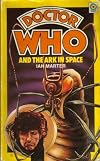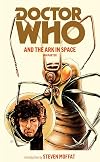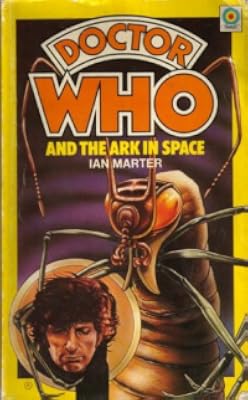
Doctor Who and the Ark in Space
by Ian Marter
Doctor Who: Target Novelisations: Doctor Who Library order (4), Doctor Who: Target Novelisations: Publication order (32), Doctor Who: Target Novelisations: Broadcast order (76), Doctor Who {non-TV} (Novelisations — Novelisation)
On This Page
Description
The survivors of a devastated future Earth lie in suspended animation on a great satellite. When Earth is safe again, they will awaken. But when the Doctor, Sarah and Harry arrive on the Terra Nova, they find the systems have failed and the humans never woke. The Wirrrn Queen has infiltrated the satellite, and laid her eggs inside one of the sleepers. As the first of the humans wake, they face an attack by the emerging Wirrrn. But not everyone is what they seem, and the only way the Doctor show more can discover the truth is by joining with the dead mind of the Wirrrn Queen. The price of failure is the Doctor's death, and the end of humanity. This novel is based on a Doctor Who story which was originally broadcast from 25 January to 15 February 1975. Featuring the Fourth Doctor as played by Tom Baker, and his companions Sarah Jane Smith and Harry Sullivan show lessTags
Recommendations








Member Reviews
The author of this novelisation is no ordinary author; it's the Target debut of Ian Marter, who played Harry Sullivan on screen and would go on to write ten Doctor Who books for Target in total, more than anyone other than Dicks. (Though, of course, Marter is a very, very distant second. I don't have any of Marter's other novelisations, but two decades ago I did read Harry Sullivan's War.)
Almost certainly because of this, we get a strong sense of Harry here, much more than we saw in the earlier The Loch Ness Monster (1976) or The Genesis of the Daleks (1976), where Harry often felt like an extra body in the room. Here, he is usually the viewpoint character for the strange discoveries on the Terra Nova (what Marter's book dubs the tv show more serial's "Space Station Nerva"), and while sometimes flabbergasted, he also occasionally contributes good ideas to the proceedings. I particularly liked a segment (added by Marter) where, while Sarah Jane is crawling through the space station ducts with the power cable, he tugs out an encouraging-but-patronizing message on it in Morse!
Equally, though, Marter has a good command of Tom Baker's Doctor in his flippant but foreboding mood, continuing the improvement we've seen in this area since The Pyramids of Mars (1976). It makes sense—standing alongside Tom Baker for a year's worth of recordings would probably give you a pretty good sense of the way he plays the Doctor!
The weak spot here is thus probably Sarah; Marter uses the Doctor and Harry as his main focalizing characters (sometimes switching which one within a paragraph, which is a bit jarring to a modern reader used to these things being more clearly demarcated), and tends only to use Sarah when there's no other option. Though as someone else pointed out to me, Sarah often has little to do in the actual stories on screen; it's only because of Lis Sladen's performance that she comes across as a strong character, Lis being a gifted actor who could do a lot with a little!
I don't know anything about Marter as a person, but based on this, I wonder if he read science fiction growing up; I feel like this book demonstrates an affinity for sf lingo and concepts you don't quite see in Terrance Dicks, whose interests seem elsewhere (in the adventure and the action and the history). I couldn't tell you why exactly, but in the book's somewhat moody, somewhat elliptical tone, it made me think of Fritz Leiber's sf from the 1950s and '60s, like The Big Time and The Wanderer; Marter is certainly the right age to have read Leiber growing up. Anyway, I sometimes found transitions confusing, but otherwise this is a solid piece of atmospheric sf; like some of the first Doctor books I read for my previous project, I think you could (Doctor and company aside) imagine this standing alone as a novel in a way that's not quite true of a Terrance Dicks effort. show less
Almost certainly because of this, we get a strong sense of Harry here, much more than we saw in the earlier The Loch Ness Monster (1976) or The Genesis of the Daleks (1976), where Harry often felt like an extra body in the room. Here, he is usually the viewpoint character for the strange discoveries on the Terra Nova (what Marter's book dubs the tv show more serial's "Space Station Nerva"), and while sometimes flabbergasted, he also occasionally contributes good ideas to the proceedings. I particularly liked a segment (added by Marter) where, while Sarah Jane is crawling through the space station ducts with the power cable, he tugs out an encouraging-but-patronizing message on it in Morse!
Equally, though, Marter has a good command of Tom Baker's Doctor in his flippant but foreboding mood, continuing the improvement we've seen in this area since The Pyramids of Mars (1976). It makes sense—standing alongside Tom Baker for a year's worth of recordings would probably give you a pretty good sense of the way he plays the Doctor!
The weak spot here is thus probably Sarah; Marter uses the Doctor and Harry as his main focalizing characters (sometimes switching which one within a paragraph, which is a bit jarring to a modern reader used to these things being more clearly demarcated), and tends only to use Sarah when there's no other option. Though as someone else pointed out to me, Sarah often has little to do in the actual stories on screen; it's only because of Lis Sladen's performance that she comes across as a strong character, Lis being a gifted actor who could do a lot with a little!
I don't know anything about Marter as a person, but based on this, I wonder if he read science fiction growing up; I feel like this book demonstrates an affinity for sf lingo and concepts you don't quite see in Terrance Dicks, whose interests seem elsewhere (in the adventure and the action and the history). I couldn't tell you why exactly, but in the book's somewhat moody, somewhat elliptical tone, it made me think of Fritz Leiber's sf from the 1950s and '60s, like The Big Time and The Wanderer; Marter is certainly the right age to have read Leiber growing up. Anyway, I sometimes found transitions confusing, but otherwise this is a solid piece of atmospheric sf; like some of the first Doctor books I read for my previous project, I think you could (Doctor and company aside) imagine this standing alone as a novel in a way that's not quite true of a Terrance Dicks effort. show less
http://nhw.livejournal.com/763482.html
Marter may well have been tempted to write this from the viewpoint of Harry Sullivan; if so, I think he was wise to restrain himself. He both adds and subtracts from the TV show here. He subtracts, somewhat to my surprise, most of the humorous lines of dialogue - specifically the Doctor's line "Well, my doctorate is purely honorary, and Harry here is only qualified to work on sailors." It is of course a joke against Harry (a naval doctor, but one who appears rather a twit at times), but I don't think that is the reason; perhaps Marter just felt the line didn't work as well on the page as it does on the screen, as he also drops the banter between Rogin and Lycett just after they are woken up.
He show more adds, however, some simply superb descriptive passages which one really regrets were not realised on-screen. Sometimes it's just little things, like the Doctor opening a door on the space station by thinking at it. There's also Sarah's journey through the ventilation duct, through the mass of Wirrrn (another thing added by Marter is an extra "r" in the name of the monster). He also adds graphical nastiness and violence. Noah's head explodes, revealing the Wirrrn within. Rogin's body is "burnt to a colourless crystal".
Basically, if your attention is suddenly held by the prose in one of Marter's novelisations, it's a fair bet that it's something he added to the original story. Doctor Who and the Ark in Space is a really good read. show less
Marter may well have been tempted to write this from the viewpoint of Harry Sullivan; if so, I think he was wise to restrain himself. He both adds and subtracts from the TV show here. He subtracts, somewhat to my surprise, most of the humorous lines of dialogue - specifically the Doctor's line "Well, my doctorate is purely honorary, and Harry here is only qualified to work on sailors." It is of course a joke against Harry (a naval doctor, but one who appears rather a twit at times), but I don't think that is the reason; perhaps Marter just felt the line didn't work as well on the page as it does on the screen, as he also drops the banter between Rogin and Lycett just after they are woken up.
He show more adds, however, some simply superb descriptive passages which one really regrets were not realised on-screen. Sometimes it's just little things, like the Doctor opening a door on the space station by thinking at it. There's also Sarah's journey through the ventilation duct, through the mass of Wirrrn (another thing added by Marter is an extra "r" in the name of the monster). He also adds graphical nastiness and violence. Noah's head explodes, revealing the Wirrrn within. Rogin's body is "burnt to a colourless crystal".
Basically, if your attention is suddenly held by the prose in one of Marter's novelisations, it's a fair bet that it's something he added to the original story. Doctor Who and the Ark in Space is a really good read. show less
This is a novelisation of the second Doctor Who story in the first season featuring Tom Baker as the 4th Doctor, broadcast an unbelievable 50 years ago. This story was the beginning of the famous "Gothic horror" era of the show where Philip Hinchcliffe was producer and Robert Holmes script editor in Tom Baker's first three seasons. This novelisation was the first written by an actor in the show, who played companion Harry Sullivan in Baker's first season or so. The body horror of Noah's conversion into a Wirrn is much more horrific here than on TV, where the monster effects were largely achieved through the use of green-painted bubble wrap. I was never quite as keen on this story as many other fans, but this is an effective show more novelisation, where there is a grim and claustrophobic atmosphere and all three regulars are well used in the plot. Marter's novelisation style was gritty and very different from that of all others who adapted Doctor Who series into book form, and his very early death was a tragedy. show less
This was my all-time favourite Dr Who episode, just shading Pyramids of Mars. The creeping green Wirrn larvae sacred the bejesus out of me and gave me sleepless nights for ages. becaue it had such an impact on em I sought out the novelization and was intrigued to find it had been written by ian Marter, who of course played Harry Sullivan in the show. I think the inside knowledge he brought made this one of the best novelizations. I wish I still had my copy today.
Ratings
Members
- Recently Added By
Author Information

17+ Works 2,473 Members
Series


Work Relationships
Is an adaptation of
Common Knowledge
- Original publication date
- 1977-05-10
- People/Characters
- The Doctor (4th); Sarah Jane Smith; Harry Sullivan
- Related movies
- Doctor Who: The Ark in Space: Part 1 (1975 | s12e5 | IMDb); Doctor Who: The Ark in Space: Part 2 (1975 | s12e6 | IMDb); Doctor Who: The Ark in Space: Part 3 (1975 | s12e7 | IMDb); Doctor Who: The Ark in Space: Part 4 (1975 | s12e8 | IMDb)
- First words
- Out among the remotest planets, in faithful orbit through the Solar System, the Satellite revolved slowly in the glimmer of a billion distant suns, reflecting their faint light from its cold and silent surfaces.
- Last words
- (Click to show. Warning: May contain spoilers.)At last her task had begun...
Classifications
Statistics
- Members
- 346
- Popularity
- 91,246
- Reviews
- 4
- Rating
- (3.77)
- Languages
- English
- Media
- Paper, Audiobook, Ebook
- ISBNs
- 5
- ASINs
- 6