On This Page
Description
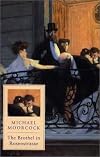
Old Count von Bek remembers his sexual glory days in pre-1914 Mirenburg. He remembers Alexandra, his teenage lover and the brothel in Rosenstrasse where outrageous fantasies were realised. But all the while civil war closes in. Politics and military power soon destroy the exotic and erotic mirage.Tags
Recommendations




































Member Reviews
The Brothel in Rosenstrasse is a sweet-bitter story of the Continental fin de siecle. It is ever-so-loosely linked to author Moorcock's Eternal Champion hyperwork through the von Bek family, but it has no fantastic or "speculative" elements, and it reads with the pace of an introspective literary novel, not a pulp action novella. There is a good deal of explicit sex and moral puzzlement, with a bit of political intrigue and some existential digust and despair.
The setting is Mirenburg, capital of the principality of Waldenstein at the close of the 19th century, and the story is structured as a memoir being written by the dilletante black-sheep younger-son aristocratic protagonist. Occasionally--and invariably mid-paragraph with no overt show more signals of the change of register--Rickhardt von Bek interjects his present circumstances of decrepitude and impending death. Thus he juxtaposes his much later physical mortality with the demise of his youthful dreams acted out in the Mirenburg reminiscences.
The novel has some admirable metaficitonal positioning, with references to Huysmans and Salammbo, among others. Von Bek is supposed to have been the successful author of a prior memoir The 100 Day Siege: A Personal Record of the Last Months of Mirenburg, but that was superficial journalism for the reading public, while his real personal concerns are only written out in this deathbed manuscript. The whole thing is divided into three very long chapters, with the rambling narrative voice providing few natural stopping-places within them. I enjoyed it a great deal, and I recommend it to seekers of literary decadence. show less
The setting is Mirenburg, capital of the principality of Waldenstein at the close of the 19th century, and the story is structured as a memoir being written by the dilletante black-sheep younger-son aristocratic protagonist. Occasionally--and invariably mid-paragraph with no overt show more signals of the change of register--Rickhardt von Bek interjects his present circumstances of decrepitude and impending death. Thus he juxtaposes his much later physical mortality with the demise of his youthful dreams acted out in the Mirenburg reminiscences.
The novel has some admirable metaficitonal positioning, with references to Huysmans and Salammbo, among others. Von Bek is supposed to have been the successful author of a prior memoir The 100 Day Siege: A Personal Record of the Last Months of Mirenburg, but that was superficial journalism for the reading public, while his real personal concerns are only written out in this deathbed manuscript. The whole thing is divided into three very long chapters, with the rambling narrative voice providing few natural stopping-places within them. I enjoyed it a great deal, and I recommend it to seekers of literary decadence. show less
Ratings
Members
- Recently Added By
Author Information

657+ Works 64,852 Members
Michael Moorcock, 1939 - Writer Michael Moorcock was born December 18, 1939 in Mitcham, Surrey, England. Moorcock was the editor of the juvenile magazine Tarzan Adventures from 1956-58, an editor and writer for the Sexton Blake Library and for comic strips and children's annuals from 1959-61, an editor and pamphleteer for Liberal Party in 1962, show more and became editor and publisher for the science fiction magazine New Worlds in 1964. He has worked as a singer-guitarist, has worked with the rock bands Hawkwind and Blue Oyster Cult and is a member of the rock band Michael Moorcock and the Deep Fix. Moorcock's writing covers a wide range of science fiction and fantasy genres. "The Chronicles of Castle Brass" was a sword and sorcery novel, and "Breakfast in the Ruins: A Novel of Inhumanity" uses the character Karl Glogauer as a different person in different times. Karl participates in the political violence of the French Revolution, the Paris Commune, and a Nazi concentration camp. Moorcock also wrote books and stories that featured the character Jerry Cornelius, who had no consistent character or appearance. "The Condition of Muzak" completed the initial Jerry Cornelius tetralogy and won Guardian Literary Prize in 1977. "Byzantium Endures" and "The Laughter of Carthage" are two autobiographical novels of the Russian emigre Colonel Pyat and were the closest Moorcock came to conventional literary fiction. "Byzantium Endures" focuses on the first twenty years of Pyat's life and tells of his role in the Russian revolution. Pyat survives the revolution and the subsequent civil war by working first for one side and then another. "The Laughter of Carthage" covers Pyat's life from 1920-1924 telling of his escape from Communist Russia and his travels in Europe and America. It's a sweeping picture of the world during the 1920's because it takes the character from living in Constantinople to Hollywood. Moorcock returned to the New Wave style in "Blood: A Southern Fantasy" (1994) and combined mainstream fiction with fantasy in "The Brothel of Rosenstrasse," which is set in the imaginary city of Mirenburg. MoorCock won the 1967 Nebula Award for Behold the Man and the 1979 World Fantasy Award for his novel, Gloriana. (Bowker Author Biography) show less
Series

Work Relationships
Is abridged in
Common Knowledge
- Original publication date
- 1982
Classifications
Statistics
- Members
- 193
- Popularity
- 168,832
- Reviews
- 1
- Rating
- (3.45)
- Languages
- English, German
- Media
- Paper
- ISBNs
- 6