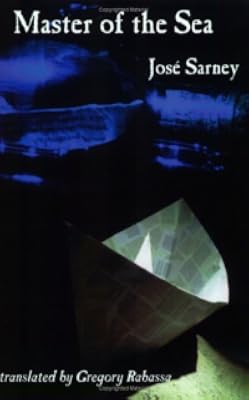
Master of the Sea
by José Sarney
On This Page
Description
Aboard his boat the Chita Verde, Captain Cristorio passes his life sailing among archipelagos of islands and the immensity of the open waters, searching for this beloved dragged off in his youth by ocean monsters. Along the way he encounters ghost ships and mysterious sea creatures, shipwrecked sailors and abandoned islandsTags
Recommendations










































Member Reviews
This was my first foray into Brazilian literature from the Portuguese. With Gregory Rabassa as translator, I was pretty confident there would be nothing to complain about there. Frankly, I was a little put off by the political background of Jose Sarney, especially given the ghost-written memoirs that american politicos tend to put out. I was very pleasantly surprised and noted that this novel predated his serving as president of Brazil from 1985 to 1990.
I found this novel very intriguing and hard to put down. A quick read apart from some difficulty in keeping track of the names. But that is a frequent problem for me with south american literature. The novel also jumps around a bit in time like Garcia Marquez magical realism novels. I show more especially like Sarney's ability to make you feel Cristorio's affinity for the sea and to see how he and his fellow fishermen view the sea as a living entity. We learn about the beauty, the danger, the magic, and the mundane of the sea. We learn about its phantoms and ghosts, even though fisherman don't think one should discuss the mysterious things that are seen at see. Cristorio's living boat Chita Verde, and his first love (after the sea) Quertide in her flowered panties and green calico dress float throughout the book.
I would highly recommend this book and plan to seek out a translation of his Os Marimbondos de Fogo next. show less
I found this novel very intriguing and hard to put down. A quick read apart from some difficulty in keeping track of the names. But that is a frequent problem for me with south american literature. The novel also jumps around a bit in time like Garcia Marquez magical realism novels. I show more especially like Sarney's ability to make you feel Cristorio's affinity for the sea and to see how he and his fellow fishermen view the sea as a living entity. We learn about the beauty, the danger, the magic, and the mundane of the sea. We learn about its phantoms and ghosts, even though fisherman don't think one should discuss the mysterious things that are seen at see. Cristorio's living boat Chita Verde, and his first love (after the sea) Quertide in her flowered panties and green calico dress float throughout the book.
I would highly recommend this book and plan to seek out a translation of his Os Marimbondos de Fogo next. show less
 This review was written for LibraryThing Early Reviewers.
Reading this book was a little like drifting in and out of sleep while swaying in a hammock. It is a book full of such pacing: close your eyes for just a moment and we've jumped forward or backward. We'll watch that scene for a moment and then slowly blink to find ourselves in another wee tale. For a book full of sea monsters and ghost pirates, sex and scandal, it was a surprisingly gentle and quiet read.
This review was written for LibraryThing Early Reviewers.I found this book interesting but not involving. The prose style was somewhat stilted and clichéd, and the plot at times proved repetitive and aimless. Characters were either poorly delineated or defined by a single trait. However, Sarney develops Cristório’s relationship to the sea well and examines a number of related motifs throughout the course of the book. Antão Cristório, the titular character, lives his whole life near or on the sea. His childhood is defined by the sea, his early days spent as a fisherman on others’ boats and he finally becomes the expert captain of his own biana. The other obsession in his life – besides the sea – starts when he loses his fiancée Quertide to a legendary sea monster, searches for show more her, then finally takes cold comfort in his wife and family. Along the way there are a number of ghosts, immortals, dead ships, dreams and delirium.
Sarney’s work incorporates a number of features that figure into other books categorized as magic realism. Like Gabriel Garcia Marquez’s One Hundred Years of Solitude, the world of Sarney’s novel has a hermetic, timeless feel. In the former, characters – even those thought long gone – are always returning to Macondo, names are passed down continuously and even those who try to escape somehow end up coming back. Cristório’s ship gives him a good amount of freedom, but he is confined to the familiar shores around northern Brazil. The unknown ‘outside’ is represented by the multitude of dead ships from around the world and whenever one encounters the ghost ships, the recommended response is to just ignore it – a denial of not just the incomprehensible, but also of the world beyond their familiar ports and islands. Cristório also encounters many returns, especially from his preternatural friends, Querente and Aquimundo, who are able to come back from death or near death. When his friends try to discuss specific history or far away countries, Cristório and other locals often ridicule them or tell them to stop talking nonsense.
Sarney’s handling of the fantastic elements in his narrative can also be compared to other magic realist authors. One Hundred Years of Solitude matter-of-factly mixes the implausible events with the more mundane aspects of life and when they do occur, it is accepted by the community and becomes part of the family history. An author, Haruki Murakami, often begins with mundane existences which then take startling turns into the unexplainable. Many of his novels use the first person narrator and he’s able to depict his characters’ surprise and subsequent search for explanations. I felt that Sarney went somewhere in between these two (admittedly very generalized) approaches and was less successful than either. Initially, it appears that the supernatural is just a part of Cristório’s world, as on some of his initial journeys older men also witness the events and often have legends or myths to explain them. Back-from-the-dead characters and ghost ships are very common, to the point of exhaustion. However, after a while, all the other characters seem to think that Cristório’s going crazy for believing in ghosts. It isn’t possible to say that the constant reoccurrence of ghost ships is just part of Cristório’s special relationship with the sea – some sort of delirium or extrasensory perception - since some events (like Quertide’s abduction or some ghost ships) are accepted by the community while others (like the monsters impersonating people or other ghost ships) are called a figment of Cristório’s imagination. If he was the only one who had these experiences, then there might be some evidence for this belief. It seemed like there was too much ‘magic’, not enough ‘realism’ and some confusion as to how the supernatural fit into the ordinary world. show less
Sarney’s work incorporates a number of features that figure into other books categorized as magic realism. Like Gabriel Garcia Marquez’s One Hundred Years of Solitude, the world of Sarney’s novel has a hermetic, timeless feel. In the former, characters – even those thought long gone – are always returning to Macondo, names are passed down continuously and even those who try to escape somehow end up coming back. Cristório’s ship gives him a good amount of freedom, but he is confined to the familiar shores around northern Brazil. The unknown ‘outside’ is represented by the multitude of dead ships from around the world and whenever one encounters the ghost ships, the recommended response is to just ignore it – a denial of not just the incomprehensible, but also of the world beyond their familiar ports and islands. Cristório also encounters many returns, especially from his preternatural friends, Querente and Aquimundo, who are able to come back from death or near death. When his friends try to discuss specific history or far away countries, Cristório and other locals often ridicule them or tell them to stop talking nonsense.
Sarney’s handling of the fantastic elements in his narrative can also be compared to other magic realist authors. One Hundred Years of Solitude matter-of-factly mixes the implausible events with the more mundane aspects of life and when they do occur, it is accepted by the community and becomes part of the family history. An author, Haruki Murakami, often begins with mundane existences which then take startling turns into the unexplainable. Many of his novels use the first person narrator and he’s able to depict his characters’ surprise and subsequent search for explanations. I felt that Sarney went somewhere in between these two (admittedly very generalized) approaches and was less successful than either. Initially, it appears that the supernatural is just a part of Cristório’s world, as on some of his initial journeys older men also witness the events and often have legends or myths to explain them. Back-from-the-dead characters and ghost ships are very common, to the point of exhaustion. However, after a while, all the other characters seem to think that Cristório’s going crazy for believing in ghosts. It isn’t possible to say that the constant reoccurrence of ghost ships is just part of Cristório’s special relationship with the sea – some sort of delirium or extrasensory perception - since some events (like Quertide’s abduction or some ghost ships) are accepted by the community while others (like the monsters impersonating people or other ghost ships) are called a figment of Cristório’s imagination. If he was the only one who had these experiences, then there might be some evidence for this belief. It seemed like there was too much ‘magic’, not enough ‘realism’ and some confusion as to how the supernatural fit into the ordinary world. show less
This review was written for LibraryThing Early Reviewers.As with other Magic Realism books, briefly describing the plot line in this work can be difficult. But in the end it goes something like this: The protagonist fornicates. Then he goes to sea and experiences dream-like encounters with the supernatural and surreal, overcoming any fear and gaining a new friend from the afterlife for his troubles. Once home, the cycle more or less begins again.
I suppose my synopsis gives it away: I did not enjoy this book. Although it had some poetic moments, the use of magic realism at times felt cheap and easy. I never quite felt, as I did while reading One Hundred Years of Solitude, as though I were actually inside someone's dreams, or watching The Yellow Submarine somewhere between being asleep and show more awake. It just didn't have that power.
In the end, it was without a compelling plot, and suffered from subplots that often seemed to serve little purpose. Perhaps something was lost in translation?
I can't recommend this work to any but those with an inexplicable obsession for reading works of magic realism, and even then I do so with the warning that this is not the best representative of that genre. show less
I suppose my synopsis gives it away: I did not enjoy this book. Although it had some poetic moments, the use of magic realism at times felt cheap and easy. I never quite felt, as I did while reading One Hundred Years of Solitude, as though I were actually inside someone's dreams, or watching The Yellow Submarine somewhere between being asleep and show more awake. It just didn't have that power.
In the end, it was without a compelling plot, and suffered from subplots that often seemed to serve little purpose. Perhaps something was lost in translation?
I can't recommend this work to any but those with an inexplicable obsession for reading works of magic realism, and even then I do so with the warning that this is not the best representative of that genre. show less
This review was written for LibraryThing Early Reviewers.This was the first book I received as a LibraryThing Early Reviewer. I am very selective when I make requests for books and thought that this one would fall in line with the Allende and Garcia Marquez novels I read back in my college days. Unfortunately, this fell way short of the beauty and power of those other, more well known, works of magical realism.
For one thing, I found the book's rampant misogyny to be a bit tough to stomach. But I'd have been able to overlook that if the language had been transcendent and the story itself flowed more easily. It read like a series of vignettes roughly strung together and making little sense. I suppose it was intended to invoke a confused, non-linear dream narrative, but it didn't work for me. I show more kept losing interest and putting it down, only to return to it, reluctantly, days later. It took me a very long time to finish this slim volume.
I suspect some of the blame can be placed on an awkward, and perhaps too literal, translation. But whatever the case may be, I can't recommend it. show less
For one thing, I found the book's rampant misogyny to be a bit tough to stomach. But I'd have been able to overlook that if the language had been transcendent and the story itself flowed more easily. It read like a series of vignettes roughly strung together and making little sense. I suppose it was intended to invoke a confused, non-linear dream narrative, but it didn't work for me. I show more kept losing interest and putting it down, only to return to it, reluctantly, days later. It took me a very long time to finish this slim volume.
I suspect some of the blame can be placed on an awkward, and perhaps too literal, translation. But whatever the case may be, I can't recommend it. show less
This review was written for LibraryThing Early Reviewers.This is an epic tale; a sort of Brazilian Moby Dick. I found it very difficult to relate to because of the mythological creatures and the magic in it. also, the concept of great love seems to have been great sexual attraction for Quertide, and the ability to bear lots of children easily for Christorio's wife. That is hard for a feminist to swallow. However, the language, scope and flow of the book are beautiful, and I would certainly recommend it as an example of Brazilian Magic Realism. It's just not my cup of tea.
This review was written for LibraryThing Early Reviewers.When I read a translation, I always wonder just how much the translator adds or removes from the reading experience. I suspect a "good" translation is one in which you can't really feel the presence of the translator at all, but I wouldn't swear by it.
I felt the presence of the translator (Gregory Rabassa) in Master of the Sea. But I wasn't unduly upset by it. The prose was florid - salty descriptions of sex and the not-quite-dead. But I can only imagine that it would have been more florid in the original Portugese.
Captain Cristorio is undoubtedly both a hero and a villain, and he certainly has interesting adventures - for a while. After there had been several voyages to sea though, and much gnashing of teeth about lost love, and more show more of the large cast of dead, but not-quite friends and enemies of Cristorio, I tired of this story's "magical realism". Although the journeys were enjoyable, ultimately, they seemed to lead me nowhere in particular. show less
I felt the presence of the translator (Gregory Rabassa) in Master of the Sea. But I wasn't unduly upset by it. The prose was florid - salty descriptions of sex and the not-quite-dead. But I can only imagine that it would have been more florid in the original Portugese.
Captain Cristorio is undoubtedly both a hero and a villain, and he certainly has interesting adventures - for a while. After there had been several voyages to sea though, and much gnashing of teeth about lost love, and more show more of the large cast of dead, but not-quite friends and enemies of Cristorio, I tired of this story's "magical realism". Although the journeys were enjoyable, ultimately, they seemed to lead me nowhere in particular. show less
This review was written for LibraryThing Early Reviewers.Members
- Recently Added By
Author Information
32+ Works 117 Members
Some Editions
Common Knowledge
- Original publication date
- 1978
Classifications
- Genres
- Fiction and Literature, General Fiction
- DDC/MDS
- 869.342 — Literature & rhetoric Spanish Literature Literatures of Portuguese and Galician languages Portuguese fiction 20th Century 1945-1999
- LCC
- PQ9698.29 .A76 .D613 — Language and Literature French, Italian, Spanish and Portuguese literatures Portuguese literature Provincial, local, colonial, etc. Brazil
Statistics
- Members
- 24
- Popularity
- 1,107,225
- Reviews
- 9
- Rating
- (2.78)
- Languages
- English
- Media
- Paper
- ISBNs
- 1