On This Page
Description
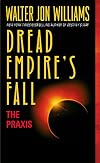
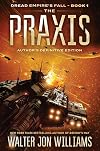
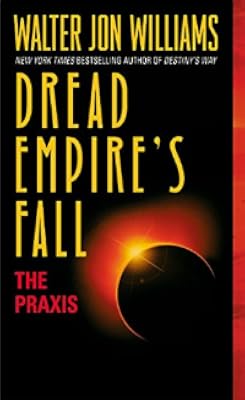
The first book in the completed Dread Empire's Fall trilogy, followed by The Sundering and Conventions of War. All will must bend to the perfect truth of The Praxis For millennia, the Shaa have subjugated the universe, forcing the myriad sentient races to bow to their joyless tyranny. But the Shaa will soon be no more. The dread empire is in its rapidly fading twilight, and with its impending fall comes the promise of a new galactic order . . . and bloody chaos. A young Terran naval officer show more marked by his lowly birth, Lt. Gareth Martinez is the first to recognize the insidious plot of the Naxid -- the powerful, warlike insectoid society that was enslaved before all others -- to replace the masters' despotic rule with their own. Barely escaping a swarming surprise attack, Martinez and Caroline Sula, a pilot whose beautiful face conceals a deadly secret, are now the last hope for freedom for every being who ever languished in Shaa chains -- as the interstellar battle begins against a merciless foe whose only perfect truth is annihilation. show lessTags
Recommendations




Member Recommendations
Member Reviews
Imagine Queen Victoria and Chairman Mao got together and spawned a race of technologically advanced aliens who conquer all the other intelligent species in the galaxy so that they can be taught proper manners. Then the aliens get bored and all die, leaving their former subjects to fend for themselves. What could go wrong?
The Praxis is grand space opera with the fatal flaw of being glacially paced. For thousands of years, the galactic empire has been dominated by the all-powerful Shaa, who haver gathered the lesser races beneath them. But the Shaa have dwindled, and their last survivor is dying. Something like 80% of the book is taken up with the mundane business of main characters in these last days of peace. Martinez is a junior officer in the navy, maneuvering to advance his own career and his noble house. Sula is another junior officer, who's disgraced name hides the darker secret that she's an imposter, and the real Lady Sula is dead.
The story ambles through the non-events of these non-entities lives, until the 80% mark, where it turns out that one show more of the races of the Praxis has planned a coup to make themselves the new immortal masters. Martinez is the only one to spot the coup going off, while lucky coincidence saves the Home Fleet from the rebellion. Then there's a titanic battle that sees the good guys losing, but our heroes advancing, ready for book 2.
The pacing is awful. If there's any saving grace, it's that it does help set up the general incompetence of all involved. The Shaa have ruled for 3400 years, and the closest thing to battles in all that time have been bombarding much more primitive races. The finely tuned antimatters weapons have never been fired in anger, and the navy is full of deadwood, incompetent third sons, and officers more interested in sports than tactics. No one knows what they're doing in a way that very reminiscent of the slaughters of the opening days of the First World War.
At the same time, the other saving grace of space opera, a fantastic setting, is barely used. Galactic politics are another top-heavy bureaucracy with aristocratic elegance, without the delightful tense fragility of say, Tsarist Russia, or the absurdity of the late Austro-Hungarian empire. There are many alien species, but our characters are human, and don't even get a good evolutionarily derived stereotype.
I'll probably pick up book two from the library to see if it's better now that the shooting has started, but for now I'm notably bored. show less
The story ambles through the non-events of these non-entities lives, until the 80% mark, where it turns out that one show more of the races of the Praxis has planned a coup to make themselves the new immortal masters. Martinez is the only one to spot the coup going off, while lucky coincidence saves the Home Fleet from the rebellion. Then there's a titanic battle that sees the good guys losing, but our heroes advancing, ready for book 2.
The pacing is awful. If there's any saving grace, it's that it does help set up the general incompetence of all involved. The Shaa have ruled for 3400 years, and the closest thing to battles in all that time have been bombarding much more primitive races. The finely tuned antimatters weapons have never been fired in anger, and the navy is full of deadwood, incompetent third sons, and officers more interested in sports than tactics. No one knows what they're doing in a way that very reminiscent of the slaughters of the opening days of the First World War.
At the same time, the other saving grace of space opera, a fantastic setting, is barely used. Galactic politics are another top-heavy bureaucracy with aristocratic elegance, without the delightful tense fragility of say, Tsarist Russia, or the absurdity of the late Austro-Hungarian empire. There are many alien species, but our characters are human, and don't even get a good evolutionarily derived stereotype.
I'll probably pick up book two from the library to see if it's better now that the shooting has started, but for now I'm notably bored. show less
Surprisingly good. Not freaking fantastic, but really, really good.
Of course, I have to discount the opening which made me want to run and hide, saying, "no, no, this book is so not for me," with all its stuffy space fleet stuff, but once we got into everything else almost immediately after the slog of a beginning, I was hooked.
One really shouldn't judge a whole series based on the first 30 pages. I should know better. And I was right. The life on the planets set me right. We got to see how the rich versus the poor live in a very cool setup that satisfies, we got to get knee-deep in the politics, but what caught me most was the steady, careful worldbuilding. The alien species are interesting, but not as important as the political moves show more and the attempted coup.
Sound like standard stuff?
Well, here's where it gets kind of interesting. This came out in 2002 and yet I was getting some serious Battlestar Galactica vibes... as in the remake, the gritty terror. And then there was the serious satire and weakness of the ancient military and this one captain's obsession with football that matches the entire fleet's idiocy. And then there was the homage to the end of the Senate in Star Wars, some serious culture vibes that would make it into the later Mass Effect games, and much more.
It's almost like this book inspired all the modern breed of space operas. Not the single-minded pursuit of space opera, but the celebration of all the things surrounding a big space battle while also delivering on that space battle.
For that, I really appreciate the novel. The writing isn't always what I'd call fantastic, but the ideas and the steady inclusion of so many different aspects of SF in general WAS. I enjoyed it quite a lot ever since we got through the opener and actually grew to love it by the end. It snuck up on me. :) show less
Of course, I have to discount the opening which made me want to run and hide, saying, "no, no, this book is so not for me," with all its stuffy space fleet stuff, but once we got into everything else almost immediately after the slog of a beginning, I was hooked.
One really shouldn't judge a whole series based on the first 30 pages. I should know better. And I was right. The life on the planets set me right. We got to see how the rich versus the poor live in a very cool setup that satisfies, we got to get knee-deep in the politics, but what caught me most was the steady, careful worldbuilding. The alien species are interesting, but not as important as the political moves show more and the attempted coup.
Sound like standard stuff?
Well, here's where it gets kind of interesting. This came out in 2002 and yet I was getting some serious Battlestar Galactica vibes... as in the remake, the gritty terror. And then there was the serious satire and weakness of the ancient military and this one captain's obsession with football that matches the entire fleet's idiocy. And then there was the homage to the end of the Senate in Star Wars, some serious culture vibes that would make it into the later Mass Effect games, and much more.
It's almost like this book inspired all the modern breed of space operas. Not the single-minded pursuit of space opera, but the celebration of all the things surrounding a big space battle while also delivering on that space battle.
For that, I really appreciate the novel. The writing isn't always what I'd call fantastic, but the ideas and the steady inclusion of so many different aspects of SF in general WAS. I enjoyed it quite a lot ever since we got through the opener and actually grew to love it by the end. It snuck up on me. :) show less
Williams, Walter Jon. The Praxis. Dread Empire’s Fall No. 1. Harper, 2002.
Walter Jon Williams is a journeyman author of science fiction. He is well versed in all the tropes of the genre, builds consistent fictional worlds and always tells a good story. The Dread Empire’s Fall has a lot in common with other series of its kind—notably, David Weber’s Honor Harrington novels and Lois McMaster Bujold’s Vorkosigan Saga. It is less wedded to the C. S. Forester model than Weber’s work and has a harder edge than Bujold’s novels. The premise is that an ancient race got to all the wormholes first and imposed a ruthless clan-based aristocracy on all the sentient species in the galaxy. Wen the last alien overlord dies, chaos erupts in show more the empire. Think Russia in the post-Soviet era. The series is held together by two strong characters, the second son of a mercantile family whose talents are unappreciated by the aristocratic military leadership, and a woman from the mean streets masquerading as an aristocrat. Both are highly skilled starship commanders. They are attracted to one another but also highly competitive. This frenemy relationship keeps our interest through the series. If epic space opera is your thing, you will be hooked by The Praxis. show less
Walter Jon Williams is a journeyman author of science fiction. He is well versed in all the tropes of the genre, builds consistent fictional worlds and always tells a good story. The Dread Empire’s Fall has a lot in common with other series of its kind—notably, David Weber’s Honor Harrington novels and Lois McMaster Bujold’s Vorkosigan Saga. It is less wedded to the C. S. Forester model than Weber’s work and has a harder edge than Bujold’s novels. The premise is that an ancient race got to all the wormholes first and imposed a ruthless clan-based aristocracy on all the sentient species in the galaxy. Wen the last alien overlord dies, chaos erupts in show more the empire. Think Russia in the post-Soviet era. The series is held together by two strong characters, the second son of a mercantile family whose talents are unappreciated by the aristocratic military leadership, and a woman from the mean streets masquerading as an aristocrat. Both are highly skilled starship commanders. They are attracted to one another but also highly competitive. This frenemy relationship keeps our interest through the series. If epic space opera is your thing, you will be hooked by The Praxis. show less
"Dread Empire's Fall" is a tightly-coupled trilogy, basically one very long novel; the 3 volumes have to be read together and in order. I found it a very compelling read; the sheer momentum of the story carried me effortlessly past flaws that in a less well-written book would have stopped me cold. (For example, in one of the military tactics that's fairly crucial to the plot, I think he's got the physics wrong and it wouldn't actually work.)
There's lots of moral ambiguity; the worst single atrocity of the war is committed by "our" side (a tyranny only marginally less brutal and corrupt than the other side). In the end, we find that in winning the war, the "good guys" have accomplished nothing except to restore the _status quo ante_. show more The same old, corrupt, incompetent elite is back in power, having seemingly learned nothing; all the underlying issues are unresolved; it seems clear that another war is inevitable within a generation or so (maybe just in time for our hero's son, newborn at the end of this trilogy, to get his own chance at glory). The resolution of the romance subplot also seems rather arbitrary . -- Tim show less
This is what good literature should be like- engaging plot, solid characterization, solid character development. Williams uses a flashback format in an effective manner to keep me guessing, but with enough foreshadowing so that thinks make sense. I don't have to be completely astounded by what happens. (I'm looking at you, GoT.) A reader wants to enjoy where the plot is going, which means we can make some level of prediction as to what happens- even in science fiction, especially in science fiction, the characters have to be *real*.
However, I like a book that finishes. It shouldn't be "To Be Continued". This book quite definitely doesn't finish. Numerous key points are in no way answered or explained, and it ends in the middle of a show more battle. A solid series should have every book complete in itself, like Lewis' Narnia. I should want more of those characters and that universe, not more of the plot to understand what happened. There is no way to understand this story without reading - and buying - the next book. show less
However, I like a book that finishes. It shouldn't be "To Be Continued". This book quite definitely doesn't finish. Numerous key points are in no way answered or explained, and it ends in the middle of a show more battle. A solid series should have every book complete in itself, like Lewis' Narnia. I should want more of those characters and that universe, not more of the plot to understand what happened. There is no way to understand this story without reading - and buying - the next book. show less
This has been on my purchase and to read list for a long time. I remember some early works like the Crown Jewels and Ambassador of Progress by Williams that I enjoyed. So I started in on this.
And it did start slow. But I stuck with it. And then it emerged as well done. Perhaps our heroes are too much involved as the only ones who can think of new solutions to the problem of warfare in an age where nothing has changed for thousands of years.
A subtler way might have been for their new tactics being used to get the ball rolling and then happenstance allowing them to further refine other issues that occur.
There are mores of society and political marriage that rival other times and empires where progeny were created to safeguard the family show more wealth and this plays out well too.
In all, a read that prompted me to immediately order the next book in the series. show less
And it did start slow. But I stuck with it. And then it emerged as well done. Perhaps our heroes are too much involved as the only ones who can think of new solutions to the problem of warfare in an age where nothing has changed for thousands of years.
A subtler way might have been for their new tactics being used to get the ball rolling and then happenstance allowing them to further refine other issues that occur.
There are mores of society and political marriage that rival other times and empires where progeny were created to safeguard the family show more wealth and this plays out well too.
In all, a read that prompted me to immediately order the next book in the series. show less
Members
- Recently Added By
Lists

Best Military Science Fiction
57 works; 26 members

Books Read in 2022
5,226 works; 115 members
Author Information

110+ Works 13,149 Members
Awards and Honors
Distinctions
Series

Common Knowledge
- Canonical title
- The Praxis
- Original publication date
- 2002-10
- People/Characters
- Gareth Martinez; Caroline Sula; Severin; Vipsania Martinez; Walpurga Martinez; Sempronia Martinez (show all 8); Roland Martinez; Anticipation of Victory
- Important places
- Zanshaa; Corona; Magaria
- Dedication
- For Kathy Hedges
- First words
- "Of course, following the Great Master's death, I will kill myself."
The Shaa was the last of its kind. - Last words
- (Click to show. Warning: May contain spoilers.)And Severin was going to work out what they were, if only he could keep from freezing.
- Original language
- English
Classifications
Statistics
- Members
- 930
- Popularity
- 28,779
- Reviews
- 25
- Rating
- (3.62)
- Languages
- 5 — English, French, German, Polish, Romanian
- Media
- Paper, Audiobook, Ebook
- ISBNs
- 19
- ASINs
- 8