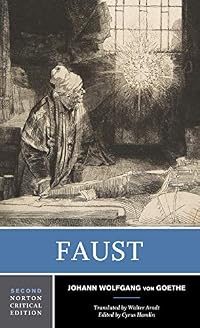
Faust: A Tragedy (Norton Critical Edition)
by Johann Wolfgang von Goethe
On This Page
Description
A complete annotated translation of Goethe's "Faust," plus extensive interpretive notes, "Faust" illustrations and other visual sources used by Goethe, several pieces of Goethe's correspondence and commentary, eleven contemporary reviews by well-known writers, and ten modern pieces of criticism; also includes a Goethe chronology and selected bibliography.Tags
Recommendations











Member Reviews
A masterful translation of Goethe's amazingly complex master opus.
Goethe updates the traditional Faust legend for the modern world: Faust is still striving, but toward modern ends. He exhausts knowledge and then makes a pact with Mephistopheles. He seeks after love, and after obtaining it, sees its cruel consequences for his beloved. He then seeks after Classical beauty as expressed in Helena. After somewhat achieving his purpose he then seeks to master nature and build a city from land reclaimed from the sea. Yet even then he is never satisfied-- at death he still seeks more. In a twist on the traditional Faust legend, Faust is "saved" and not handed over to the evil one, so that he can strive in the afterlife toward the eternal show more feminine.
The Norton critical edition presents Arndt's translation which attempts maintain a poetic feel. Goethe's poetic meter changes by the circumstances, and is itself a wonder, let alone the profound depth of philosophy and other issues addressed. The interpretive notes are most helpful for the person untrained in Goethe and Faust, and the contextual information greatly benefits understanding. The essays provided are beneficial for deeper analysis of not just Goethe's intentions with Faust, but also how Goethe's Faust has been understood and used in the intervening two centuries. show less
Goethe updates the traditional Faust legend for the modern world: Faust is still striving, but toward modern ends. He exhausts knowledge and then makes a pact with Mephistopheles. He seeks after love, and after obtaining it, sees its cruel consequences for his beloved. He then seeks after Classical beauty as expressed in Helena. After somewhat achieving his purpose he then seeks to master nature and build a city from land reclaimed from the sea. Yet even then he is never satisfied-- at death he still seeks more. In a twist on the traditional Faust legend, Faust is "saved" and not handed over to the evil one, so that he can strive in the afterlife toward the eternal show more feminine.
The Norton critical edition presents Arndt's translation which attempts maintain a poetic feel. Goethe's poetic meter changes by the circumstances, and is itself a wonder, let alone the profound depth of philosophy and other issues addressed. The interpretive notes are most helpful for the person untrained in Goethe and Faust, and the contextual information greatly benefits understanding. The essays provided are beneficial for deeper analysis of not just Goethe's intentions with Faust, but also how Goethe's Faust has been understood and used in the intervening two centuries. show less
The author threw in just about everything but the kitchen sink into these two plays that start off with the story of the medieval academic who strikes a bargain with the devil, and then take off from there in a wild variety of moods and meters. The author, remembering a puppet play that he saw as a child, sketched out a prose drama based on the legend in 1776. But did not publish it; instead he reworked it into 12,110 lines of verse over the next sixty years. Part I was first performed in 1829 to celebrate his eightieth birthday. Part II was published posthumously in 1832. He borrows material, verse forms, and even characters from German ballads, plays by Aristophanes, Euripides, and Shakespeare, Mozart’s operas, Herodotus’s show more History, Ovid’s Metamorphoses Italian renaissance painting and sculpture, economic ideas about paper money, and early 19th century theories of mountain creation, to name but a few of his sources.
It was hard for me to imagine this work on stage with its sudden shifts of scene, material, and mood, and long sections of plays within the plays as anything but lumpy gravy, i.e., an often tedious experience for the theater goer. However, he left a feast for scholars and interpreters. I read the Norton Critical edition, second edition, over half of which was interpretive notes, charts, illustrations, and literary criticism. Whew! It often felt more like a mountain climb than reading a play. Great poetry, but I’m giving it one star off for obscurity. show less
It was hard for me to imagine this work on stage with its sudden shifts of scene, material, and mood, and long sections of plays within the plays as anything but lumpy gravy, i.e., an often tedious experience for the theater goer. However, he left a feast for scholars and interpreters. I read the Norton Critical edition, second edition, over half of which was interpretive notes, charts, illustrations, and literary criticism. Whew! It often felt more like a mountain climb than reading a play. Great poetry, but I’m giving it one star off for obscurity. show less
Johann Wolfgang von Goethe is perhaps the quintessential German author, and Faust is perhaps his quintessential work. It took him his whole life to write Faust, with the writing of Part 1 stretching over 30 years. There are various reasons for this; anyone interested should read John Gearey’s Goethe’s ‘Faust: The Making of Part 1 to find out more. Obviously, this slow percolation had a profound impact on the form and content of the ‘dramatic poem’ (it is not quite a play, despite Goethe’s calling it a tragedy, and despite the fact that it has been performed. It is closer to Seneca’s closet dramas, or Milton’s ‘Samson Agonistes’). As Goethe aged (matured?), his conception of the poem changed, leading to profound show more changes in the main character of Faust and in the structure of the first part.
The poem begins with two interesting prologues, one in Heaven and one in the theatre. Both were only written much later, after Goethe had made radical changes to the poem. The prologue in Heaven introduces the idea that Faust will, like Job, be tested by God and the Devil, represented by the ambiguous evil spirit, Mephistopheles. This scheme already hints at the fact that Faust will eventually be saved, in contrast to the original story and Marlowe’s play, in which Faust is damned. This prologue also contains some of the poem’s most famous lines: ‘Man errs the while he strives’ (Es irrt der Mensch, so lang’ er strebt)
We are next introduced to Faust in his room. He says that he has plumbed the depths of human knowledge, but he is still unsatisfied. Unlike the legend and Marlowe, Goethe does not have Faust make a pact with the devil at this early stage. Rather, Faust summons what Goethe calls ‘the Earth Spirit’, who rejects Faust’s pleading for understanding. (It is rather more complicated than I am sketching, but this is just a general relation of the plot). After some more exposition, Faust decides to commit suicide by drinking poison. He is prevented from doing this by the ringing of the bells proclaiming Easter morning. This highly symbolic redemption of Faust reminds the reader that this is not the traditional story of Faust’s damnation. Ironically, it is after this that Faust makes the pact with Mephisto, who arrives in the shape of a dog. The terms of the pact are that Faust will lose his soul if Mephisto can ever provide Faust with a moment’s experience to which he shall say ‘Stop, thou art so fair’. Mephisto also utters the lines that will serve as Bulgakov’s epigram to The Master and Margarita. After Faust asks him who is, he responds:
Part of that power which still
Produceth good, whilst ever scheming evil
Ein Teil von jener Kraft,
Die stets das Böse will und stets das Gut schafft
The rest of Part 1 is concerned with what has come to be called ‘The Gretchen Tragedy’: Faust falls in love with a girl called Margarete, or Gretchen, and through the machinations of Mephistopheles, he wins her heart. The tragedy is that he manages to kill Gretchen’s mother with a sleeping draught, and then impregnates Gretchen. Her brother, Valentine, challenges Faust to a duel, and is killed by Faust with the help of Mephisto. Faust deserts Gretchen to partake in the Walpurgisnacht celebrations with Mephisto (more on this below) and Gretchen kills her child. She is imprisoned, and apparently loses her mind, singing songs reminiscent of Ophelia (there are a lot of connections to Shakespeare in Goethe’s poem). Faust eventually returns to free Gretchen, but she does not recognise him. When he finally convinces her of his identity, she refuses to leave. When Mephisto enters the dungeon to hurry Faust along, Gretchen recognises that he is a devil. Mephisto claims that she is doomed, but in the penultimate lines of the poem, an unseen voice proclaims from above that she is ‘Redeemed!’ The poem ends with Faust and Mephisto fleeing like condemned criminals, which they are. Things do not look good for Faust’s salvation.
The Walpurgisnacht ceremony is probably the strangest, most incongruous part of the play. Gearey spends a fair amount of time trying to interpret this section of the poem, with little success as far as I am concerned. Much of this section, especially the rather tiresome ‘Intermezzo: Walpurgisnacht Dream or the Golden Wedding of Oberon and Titania’ (yes, another Shakespeare reference) is rather heavy-handed satire, with many topical references to very minor writers who had criticised or praised Goethe. In fact, Goethe himself appears in the ‘Intermezzo’, though in a disguised form. He also refers to the Weimar theatre company, saying that they will easily be able to stage the ‘Intermezzo’, as it is only one personage speaking after another. This is apparently supposed to be funny, but the humour really does not translate well from the 18th century to today, or from German to English. Or maybe I am making excuses for Goethe’s strange yen for obscurity in this passage. Whatever it may be, I found this part of the poem fairly pointless: it has almost nothing to do with Faust, who barely speaks during the ceremony, and is completely absent from the dream. It also does not advance any of Goethe’s themes. All in all, it is simply bizarre, and mars the cohesion of the play. I would not have minded some comic relief, but this just does not make sense. Mephisto is, in any case, much funnier than this pointless babbling.
I wish that Goethe had revised the older sections of Part 1 instead of presenting such a patchwork poem. I am, however, aware of the claims that have been made for him, that he left the play unchanged because it served as a monument to his artistic progression. As Gearey quotes Bernard Shaw:
I have never admitted the right of an elderly author to alter the work of a younger author, even when the author happens to be his former self.
Besides these caveats, I found Part 1 interesting and worth reading. I have read that Part 2 is much more cohesive and better-written than Part 1, so I am looking forward to that. show less
The poem begins with two interesting prologues, one in Heaven and one in the theatre. Both were only written much later, after Goethe had made radical changes to the poem. The prologue in Heaven introduces the idea that Faust will, like Job, be tested by God and the Devil, represented by the ambiguous evil spirit, Mephistopheles. This scheme already hints at the fact that Faust will eventually be saved, in contrast to the original story and Marlowe’s play, in which Faust is damned. This prologue also contains some of the poem’s most famous lines: ‘Man errs the while he strives’ (Es irrt der Mensch, so lang’ er strebt)
We are next introduced to Faust in his room. He says that he has plumbed the depths of human knowledge, but he is still unsatisfied. Unlike the legend and Marlowe, Goethe does not have Faust make a pact with the devil at this early stage. Rather, Faust summons what Goethe calls ‘the Earth Spirit’, who rejects Faust’s pleading for understanding. (It is rather more complicated than I am sketching, but this is just a general relation of the plot). After some more exposition, Faust decides to commit suicide by drinking poison. He is prevented from doing this by the ringing of the bells proclaiming Easter morning. This highly symbolic redemption of Faust reminds the reader that this is not the traditional story of Faust’s damnation. Ironically, it is after this that Faust makes the pact with Mephisto, who arrives in the shape of a dog. The terms of the pact are that Faust will lose his soul if Mephisto can ever provide Faust with a moment’s experience to which he shall say ‘Stop, thou art so fair’. Mephisto also utters the lines that will serve as Bulgakov’s epigram to The Master and Margarita. After Faust asks him who is, he responds:
Part of that power which still
Produceth good, whilst ever scheming evil
Ein Teil von jener Kraft,
Die stets das Böse will und stets das Gut schafft
The rest of Part 1 is concerned with what has come to be called ‘The Gretchen Tragedy’: Faust falls in love with a girl called Margarete, or Gretchen, and through the machinations of Mephistopheles, he wins her heart. The tragedy is that he manages to kill Gretchen’s mother with a sleeping draught, and then impregnates Gretchen. Her brother, Valentine, challenges Faust to a duel, and is killed by Faust with the help of Mephisto. Faust deserts Gretchen to partake in the Walpurgisnacht celebrations with Mephisto (more on this below) and Gretchen kills her child. She is imprisoned, and apparently loses her mind, singing songs reminiscent of Ophelia (there are a lot of connections to Shakespeare in Goethe’s poem). Faust eventually returns to free Gretchen, but she does not recognise him. When he finally convinces her of his identity, she refuses to leave. When Mephisto enters the dungeon to hurry Faust along, Gretchen recognises that he is a devil. Mephisto claims that she is doomed, but in the penultimate lines of the poem, an unseen voice proclaims from above that she is ‘Redeemed!’ The poem ends with Faust and Mephisto fleeing like condemned criminals, which they are. Things do not look good for Faust’s salvation.
The Walpurgisnacht ceremony is probably the strangest, most incongruous part of the play. Gearey spends a fair amount of time trying to interpret this section of the poem, with little success as far as I am concerned. Much of this section, especially the rather tiresome ‘Intermezzo: Walpurgisnacht Dream or the Golden Wedding of Oberon and Titania’ (yes, another Shakespeare reference) is rather heavy-handed satire, with many topical references to very minor writers who had criticised or praised Goethe. In fact, Goethe himself appears in the ‘Intermezzo’, though in a disguised form. He also refers to the Weimar theatre company, saying that they will easily be able to stage the ‘Intermezzo’, as it is only one personage speaking after another. This is apparently supposed to be funny, but the humour really does not translate well from the 18th century to today, or from German to English. Or maybe I am making excuses for Goethe’s strange yen for obscurity in this passage. Whatever it may be, I found this part of the poem fairly pointless: it has almost nothing to do with Faust, who barely speaks during the ceremony, and is completely absent from the dream. It also does not advance any of Goethe’s themes. All in all, it is simply bizarre, and mars the cohesion of the play. I would not have minded some comic relief, but this just does not make sense. Mephisto is, in any case, much funnier than this pointless babbling.
I wish that Goethe had revised the older sections of Part 1 instead of presenting such a patchwork poem. I am, however, aware of the claims that have been made for him, that he left the play unchanged because it served as a monument to his artistic progression. As Gearey quotes Bernard Shaw:
I have never admitted the right of an elderly author to alter the work of a younger author, even when the author happens to be his former self.
Besides these caveats, I found Part 1 interesting and worth reading. I have read that Part 2 is much more cohesive and better-written than Part 1, so I am looking forward to that. show less
I think it was my translation, but the book ended up reading whimsical. Without any intriguing poeticism, the story was just dull and moralistic.
I'm ready to give up and move on. I'm totally okay with this decision.
Rating refers to the translation.
Ratings
Members
- Recently Added By
Lists

Five star books
1,755 works; 108 members
Author Information

3,038+ Works 51,372 Members
Johann Wolfgang von Goethe, 1749-1832 Johann Wolfgang von Goethe was born in Frankfurt am Main. He was greatly influenced by his mother, who encouraged his literary aspirations. After troubles at school, he was taught at home and gained an exceptionally wide education. At the age of 16, Goethe began to study law at Leipzig University from 1765 to show more 1768, and he also studied drawing with Adam Oeser. After a period of illness, he resumed his studies in Strasbourg from 1770 to 1771. Goethe practiced law in Frankfurt for two years and in Wetzlar for a year. He contributed to the Frankfurter Gelehrte Anzeigen from 1772 to 1773, and in 1774 he published his first novel, self-revelatory Die Leiden des Jungen Werthers. In 1775 he was welcomed by Duke Karl August into the small court of Weimar, where he worked in several governmental offices. He was a council member and member of the war commission, director of roads and services, and managed the financial affairs of the court. Goethe was released from day-to-day governmental duties to concentrate on writing, although he was still general supervisor for arts and sciences, and director of the court theatres. In the 1790s Goethe contributed to Friedrich von Schiller´s journal Die Horen, published Wilhelm Meister's Apprenticeship, and continued his writings on the ideals of arts and literature in his own journal, Propyläen. The first part of his masterwork, Faust, appeared in 1808, and the second part in 1832. Goethe had worked for most of his life on this drama, and was based on Christopher Marlowe's Faust. From 1791 to 1817, Goethe was the director of the court theatres. He advised Duke Carl August on mining and Jena University, which for a short time attracted the most prominent figures in German philosophy. He edited Kunst and Altertum and Zur Naturwissenschaft. Goethe died in Weimar on March 22, 1832. He and Duke Schiller are buried together, in a mausoleum in the ducal cemetery. (Bowker Author Biography) show less
Series
Belongs to Publisher Series
Common Knowledge
- Canonical title
- Faust: A Tragedy (Norton Critical Edition) (Norton Critical Edition)
- First words
- Preface: A critical edition of Goethe's Faust in a new verse translation is a formidable undertaking.
- Last words
- (Click to show. Warning: May contain spoilers.)The Eternal Feminine: The Eternal Feminine in the last lines no doubt refers to divine forgiveness, and, in a half-hearted way, it must also refer to Gretchen who precedes Faust in his ascent to higher regions; but most meaningfully, it refers to the ideal of purity that must inspire, though it must not inhibit, even the man of action and that, to Goethe, always appeared in feminine guise.
- Disambiguation notice
- Please distinguish between this Norton Critical Edition and other editions of Goethe's Faust: A Tragedy, or any parts and variants thereof. Thank you.
Classifications
- Genre
- Fiction and Literature
- DDC/MDS
- 832.6 — Literature & rhetoric German & related literatures German drama 1750–1832 : 18th century; classical period; romantic period
- LCC
- PT2026 .F2 .A75 — Language and Literature German, Dutch and Scandinavian literatures German literature Individual authors or works 1700-ca. 1860/70 Goethe Translations
- BISAC
Statistics
- Members
- 1,045
- Popularity
- 24,563
- Reviews
- 6
- Rating
- (4.00)
- Languages
- English
- Media
- Paper
- ISBNs
- 3
- ASINs
- 4