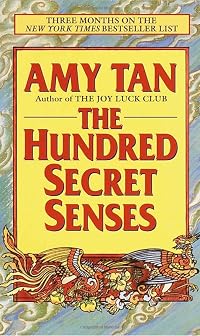
The Hundred Secret Senses
by Amy Tan
On This Page
Description
The story of two sisters, one brought up in the U.S., the other in China. The American sister is contemptuous of the other's belief in ghosts until events cause her to understand what they can do. A tale of two cultures by the author of The Kitchen God's Wife.Tags
Recommendations




Member Reviews
This is my first Amy Tan's novel, and I am impressed. I never thought I would really get into a novel that has shimmering ghosts as part of the theme. But I did! The interaction of the two main characters, half-sisters Olivia and Kwan, is complicated due to a host of reasons, not the least of which is Olivia's entanglement in so many personal problems. But Kwan, in an indirect way, slowly but surely disentangles them for her half-sister. Past lives, glimpses in China's history - all come into play here. Kwan's character won me over: her childlike, unabashedley frank and totally selfless personality coupled with unexpected wisdom of an aged person, the realistic ease with which Amy Tan describes Kwan as a Chinese person who finds herself show more in foreign to her circumstances and adjusts to them in her own way - all this, combined, leads to an unexpected and interesting denouement. show less
Reading this book made me want two things: to visit China and to not eat anything at all while I'm in China.
This novel centers on the complicated relationship between two sisters and about the many ghosts, past and present, that influence our decisions. Tan does an excellent job introducing cultural differences in thought and perspective, particularly about loyalty and responsibility, and how those differences come together in individuals at the intersection of two or more cultures. I appreciate the way that Tan approaches the issue of the assumptions we make about other individuals, other cultures, and ourselves and what makes a life worth living.
I couldn't see China quite as clearly as I would have liked but more clearly than I think show more I have while reading any other book about China. While reading the sections that took place in China I felt quite clearly the weight of thousands of years of tradition and responsibility punctuated by interference from outside forces. What a different history China has from the way I view my place in U.S. history.
Perhaps I would have done better to let this novel simmer a little longer before reviewing it so clumsily, but then I'd run the risk of never reviewing it at all because that's where I am with things right now. If I don't do something right now it seems to get lost in the to-do pile. So I'm opting for clumsily completing projects rather than not doing them at all. Embracing imperfection---that's what I'm all about these days (or at least that's what I'm all about saying I'm all about. Actually doing it is another matter). show less
This novel centers on the complicated relationship between two sisters and about the many ghosts, past and present, that influence our decisions. Tan does an excellent job introducing cultural differences in thought and perspective, particularly about loyalty and responsibility, and how those differences come together in individuals at the intersection of two or more cultures. I appreciate the way that Tan approaches the issue of the assumptions we make about other individuals, other cultures, and ourselves and what makes a life worth living.
I couldn't see China quite as clearly as I would have liked but more clearly than I think show more I have while reading any other book about China. While reading the sections that took place in China I felt quite clearly the weight of thousands of years of tradition and responsibility punctuated by interference from outside forces. What a different history China has from the way I view my place in U.S. history.
Perhaps I would have done better to let this novel simmer a little longer before reviewing it so clumsily, but then I'd run the risk of never reviewing it at all because that's where I am with things right now. If I don't do something right now it seems to get lost in the to-do pile. So I'm opting for clumsily completing projects rather than not doing them at all. Embracing imperfection---that's what I'm all about these days (or at least that's what I'm all about saying I'm all about. Actually doing it is another matter). show less
Reading this book made me want two things: to visit China and to not eat anything at all while I'm in China.
This novel centers on the complicated relationship between two sisters and about the many ghosts, past and present, that influence our decisions. Tan does an excellent job introducing cultural differences in thought and perspective, particularly about loyalty and responsibility, and how those differences come together in individuals at the intersection of two or more cultures. I appreciate the way that Tan approaches the issue of the assumptions we make about other individuals, other cultures, and ourselves and what makes a life worth living.
I couldn't see China quite as clearly as I would have liked but more clearly than I think show more I have while reading any other book about China. While reading the sections that took place in China I felt quite clearly the weight of thousands of years of tradition and responsibility punctuated by interference from outside forces. What a different history China has from the way I view my place in U.S. history.
Perhaps I would have done better to let this novel simmer a little longer before reviewing it so clumsily, but then I'd run the risk of never reviewing it at all because that's where I am with things right now. If I don't do something right now it seems to get lost in the to-do pile. So I'm opting for clumsily completing projects rather than not doing them at all. Embracing imperfection---that's what I'm all about these days (or at least that's what I'm all about saying I'm all about. Actually doing it is another matter). show less
This novel centers on the complicated relationship between two sisters and about the many ghosts, past and present, that influence our decisions. Tan does an excellent job introducing cultural differences in thought and perspective, particularly about loyalty and responsibility, and how those differences come together in individuals at the intersection of two or more cultures. I appreciate the way that Tan approaches the issue of the assumptions we make about other individuals, other cultures, and ourselves and what makes a life worth living.
I couldn't see China quite as clearly as I would have liked but more clearly than I think show more I have while reading any other book about China. While reading the sections that took place in China I felt quite clearly the weight of thousands of years of tradition and responsibility punctuated by interference from outside forces. What a different history China has from the way I view my place in U.S. history.
Perhaps I would have done better to let this novel simmer a little longer before reviewing it so clumsily, but then I'd run the risk of never reviewing it at all because that's where I am with things right now. If I don't do something right now it seems to get lost in the to-do pile. So I'm opting for clumsily completing projects rather than not doing them at all. Embracing imperfection---that's what I'm all about these days (or at least that's what I'm all about saying I'm all about. Actually doing it is another matter). show less
i don't know how to describe this, but i feel like every time i read amy tan, i'm reading heart writing. this was so lovely and beautiful. the history and relationship she evokes here is really something special. there is this feeling of going back in time, of seeing a culture and a small town living away from the world, and there is a modern sense also. she merges these two ways of life and these sensibilities so well.
this was pretty wonderful all around.
"She was finally old enough to forget all she had been told to be."
this was pretty wonderful all around.
"She was finally old enough to forget all she had been told to be."
I tore through this. Because of this, my first thought was, hey, this must be patsy chick drivel, because it's really easy to read. It's smacks of the mid-nineties setting it lives in and the protagonist is an whining, typical self-stylized photographer with hostility about her childhood and ambivalence about her Chinese-American heritage.
But then I realized that the reason it is so quick to read is that it is very, very interesting. The rhythm is built with two interlaced storylines (nothing too new here), one the present day and the other a quasi-mythical romp through 19th Century rural China. Tan's storytelling craft, especially with the Chinese portions, is honed. The plot is at times trying (separated couple soul-searching as to show more whether they should get back together again; house-shopping in San Francisco), most of it is compelling, with, if not blatant twists, interesting curves.
And I'm loathe to admit it, but the plot/emotional denouement at the end got me. I stayed up late into the night and savored it. show less
But then I realized that the reason it is so quick to read is that it is very, very interesting. The rhythm is built with two interlaced storylines (nothing too new here), one the present day and the other a quasi-mythical romp through 19th Century rural China. Tan's storytelling craft, especially with the Chinese portions, is honed. The plot is at times trying (separated couple soul-searching as to show more whether they should get back together again; house-shopping in San Francisco), most of it is compelling, with, if not blatant twists, interesting curves.
And I'm loathe to admit it, but the plot/emotional denouement at the end got me. I stayed up late into the night and savored it. show less
I came very close to DNF this book, but the interest in sister Kwan and the Chinese aspect of the story kept me reading. I couldn't stand the narrator, sister Olivia. She is absolutely toxic; a selfish nitwit. She had exactly ten pages at the end of the book where she was "redeemed." Too little, too late.
I'm not sorry I finished the book though. Kwan and her Yin eyes, the tales of the ghosts, those were enchanting.
I'm not sorry I finished the book though. Kwan and her Yin eyes, the tales of the ghosts, those were enchanting.
When she is five years old, Olivia meets a half sister she never knew she had. Kwan is twelve years older and arrives from China to live with Olivia and her family in San Francisco. It is 1962 and Kwan has lived a life light years away from Olivia in terms of culture and language, religion and belief – she is a puzzle to Olivia as she offers up stories of an ancient previous life lived in mid-nineteenth century China. Kwan seems to have the power to communicate with the dead through her “yin eyes,” something that fascinates, frightens and bewilders Olivia.
Narrated mostly from the point of view of Olivia, but interspersed with Kwan’s fantastic stories, The Hundred Secret Senses is a novel about two sisters and their complicated show more relationship. As Olivia struggles with her failing marriage, Kwan is her constant companion, whether Olivia likes it or not. Olivia is removed from her Chinese heritage and embarrassed by Kwan’s stilted English and superstitious beliefs. But despite her best efforts to dismiss Kwan’s stories, Olivia finds herself drawn into a world where dead people speak, the past becomes entwined with the present, and fate seems unavoidable.
Fate has no logic, you can’t argue with it any more than you can argue with a tornado, an earthquake, a terrorist. Fate is another name for Kwan. – from The Hundred Secret Senses, page 168 -
Amy Tan’s characters jump to life on the page. Original, funny, and deeply complex, the characters drive this story about human connection, love, secrets, and the mystery of life itself. I loved Kwan, a character who is quirky, lovable, and immensely wise.
Kwan, in contrast, is a tiny dynamo, barely five feet tall, a miniature bull in a china shop. Everything about her is loud and clashing. She’ll wear a purple checked jacket over turquoise pants. She whispers loudly in a husky voice, sounding as if she had chronic laryngitis, when in fact she’s never sick. She dispense health warnings, herbal recommendations, and opinions on how to fix just about anything, from broken cups to broken marriages. She bounces from topic to topic, interspersing tips on where to find bargains. Tommy once said that Kwan believes in free speech, free association, free car-wash with fill-’er-up. The only change in Kwan’s English over the last thirty years is in the speed with which she talks. Meanwhile, she thinks her English is great. She often corrects her husband. “Not stealed,” she’ll tell George. “Stolened.” – from The Hundred Secret Senses, page 21 -
Tan takes her readers back to China, into an old world of tiny towns and breathtaking vistas, and immerses us in a world of Chinese ghosts and deeply entrenched superstition. She slowly reveals the relationship between Olivia and Kwan, moving toward a conclusion which is surprising, heartbreaking, and filled with hope.
I loved this book with its mix of humor and sentiment. Tan alternates between reality and spiritual knowledge, turning what we think we know on its head. She reveals a deeper understanding about what it means to be human and connected in a world which seems vast and mysterious. Readers who appreciate lyrical writing and complex characterization will want to add this Tan novel to their must read pile. The Hundred Secret Senses earned Tan a spot on the 1996 short list for The Orange Prize for Fiction.
Highly Recommended. show less
Narrated mostly from the point of view of Olivia, but interspersed with Kwan’s fantastic stories, The Hundred Secret Senses is a novel about two sisters and their complicated show more relationship. As Olivia struggles with her failing marriage, Kwan is her constant companion, whether Olivia likes it or not. Olivia is removed from her Chinese heritage and embarrassed by Kwan’s stilted English and superstitious beliefs. But despite her best efforts to dismiss Kwan’s stories, Olivia finds herself drawn into a world where dead people speak, the past becomes entwined with the present, and fate seems unavoidable.
Fate has no logic, you can’t argue with it any more than you can argue with a tornado, an earthquake, a terrorist. Fate is another name for Kwan. – from The Hundred Secret Senses, page 168 -
Amy Tan’s characters jump to life on the page. Original, funny, and deeply complex, the characters drive this story about human connection, love, secrets, and the mystery of life itself. I loved Kwan, a character who is quirky, lovable, and immensely wise.
Kwan, in contrast, is a tiny dynamo, barely five feet tall, a miniature bull in a china shop. Everything about her is loud and clashing. She’ll wear a purple checked jacket over turquoise pants. She whispers loudly in a husky voice, sounding as if she had chronic laryngitis, when in fact she’s never sick. She dispense health warnings, herbal recommendations, and opinions on how to fix just about anything, from broken cups to broken marriages. She bounces from topic to topic, interspersing tips on where to find bargains. Tommy once said that Kwan believes in free speech, free association, free car-wash with fill-’er-up. The only change in Kwan’s English over the last thirty years is in the speed with which she talks. Meanwhile, she thinks her English is great. She often corrects her husband. “Not stealed,” she’ll tell George. “Stolened.” – from The Hundred Secret Senses, page 21 -
Tan takes her readers back to China, into an old world of tiny towns and breathtaking vistas, and immerses us in a world of Chinese ghosts and deeply entrenched superstition. She slowly reveals the relationship between Olivia and Kwan, moving toward a conclusion which is surprising, heartbreaking, and filled with hope.
I loved this book with its mix of humor and sentiment. Tan alternates between reality and spiritual knowledge, turning what we think we know on its head. She reveals a deeper understanding about what it means to be human and connected in a world which seems vast and mysterious. Readers who appreciate lyrical writing and complex characterization will want to add this Tan novel to their must read pile. The Hundred Secret Senses earned Tan a spot on the 1996 short list for The Orange Prize for Fiction.
Highly Recommended. show less
Members
- Recently Added By
Lists

Favourite Women's Prize for Fiction, Orange & Bailey's Prize contenders
132 works; 52 members

Unread books
1,063 works; 87 members

Magic Realism
371 works; 52 members

Female Protagonist
1,056 works; 57 members
Female Author
1,234 works; 67 members

Blue Pyramid 1,276 Best Books of All Time
1,248 works; 32 members

Carole's List
445 works; 13 members

Llibres que he llegit el 2021
54 works; 1 member

Makes Me Want to Eat (or Drink)
39 works; 12 members

Myth (Reuse and Retelling)
188 works; 23 members

Ghost Stories That Thrill Us
256 works; 115 members
Author Information

40+ Works 53,642 Members
Some Editions
Awards and Honors
Awards
Distinctions
Notable Lists
Series
Belongs to Publisher Series
Goldmann (44256 / 44500)
Work Relationships
Is abridged in
Has as a student's study guide
Common Knowledge
- Canonical title
- The Hundred Secret Senses
- Original title
- The Hundred Secret Senses
- Original publication date
- 1995
- People/Characters
- Olivia; Kwan; Simon; Zeng; Yiban
- Important places
- China; California, USA
- Dedication
- For Faith
- First words
- My sister Kwan believes she has yin eyes.
- Last words
- (Click to show. Warning: May contain spoilers.)And we dance, joy spilling from sorrow.
- Original language*
- English
*Some information comes from Common Knowledge in other languages. Click "Edit" for more information.
Classifications
Statistics
- Members
- 6,122
- Popularity
- 2,057
- Reviews
- 73
- Rating
- (3.82)
- Languages
- 13 — Catalan, Danish, Dutch, English, Finnish, French, German, Hungarian, Italian, Norwegian (Bokmål), Spanish, Swedish, Portuguese (Portugal)
- Media
- Paper, Audiobook, Ebook
- ISBNs
- 68
- ASINs
- 36