Pablo Picasso, 1881-1973 : Genius of the Century
by Ingo F. Walther
On This Page
Description
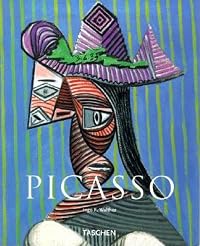
One name in the history of the 20th century art stands out over all others: Pablo Picasso (1881-1973). As painter, graphic artist and sculptor, he displayed an inventive enterprise and innovative bravado that always kept him one step ahead of his contemporaries. As one of them, the painter Max Ernst, ruefully put it: No one can touch Picasso. He is genius incarnate. The works selected here cover Picasso's entire output, from the less familiar to key masterpieces such as Guernica, from the show more Blue and Rose Periods early in his career through his cubist and classicist phases and the formal experiments of the Thirties to his later involvement with politics in art. show lessTags
Recommendations















Member Reviews
Another in the excellent Taschen series on individual artists that retails at a phenomenally low price. I nearly gave it the full five stars but there are one or two attempts to over-explain the works that just halted me from that accolade.
Nevertheless, this is an excellent introduction to Picasso that I think is superior to the older Roland Penrose introduction in the Phaidon series which has just a touch too much hagiography for my taste. In fact, Walther's book made me appreciate Picasso as an artist and as a man far more than did the attempt of Penrose to deify him. This was a man who was, indeed, greater than his image. I ended up actually liking him a great deal regardless of the art!
I am still not convinced that the work in his show more old age was overly-significant except to himself but it has its integrity. It may even be argued that a genius with a sustained commitment to recording his declining powers and the effects of old age is doing a curious and unique service to humanity and that perhaps we should consider this late body of work of importance for that reason alone. We live with a prejudice (which I share) for innovation and youth but there is little justification for that position other than cultural ideology.
The reproductions are excellent and much more balanced than in the Phaidon collection, with more emphasis on telling the story of Picasso in the round and much less on the 'great works' syndrome. This story is one of remarkable creativity based on one simple truth - that art has no purpose other than the expression of the artist's artistry. Picasso never seems to have believed the propaganda surrounding him, never seems to have tried to search for meanings and saw his work as fundamentally the artistic expression of himself.
This is a form of egoism, of course, but not necessarily one of pride. Rather it is one of exploration of doubt. If we non-artists can dream of constructing ourselves as a work of art, Picasso's art is the outward expression of that purpose - the recorded expression in art of one man over time. This makes his recorded work an account of a man who had amazing talent from early youth to great old age - not a continuous vision in form but a continuous vision in underlying content. The works of the old age are thus wholly consonant in fundamental intent with what went on before.
A sub-text of the book and so reflective of Picasso's ouevre is that, for all his innovation, he was an artist very much within the Western tradition, despite the influence of so-called primitivist non-European sculpture on 'Les Demoiselles d'Avignon' and other works. Again, this becomes clear in direct references to the 'great' masters of the Western tradition in his old age (not to my taste) but also in the classicism of the period between Cubism and the radical works of the 1930s.
There is great beauty in the apparent ugliness and disproportion of Picasso's work. I keep coming back not to the obvious paintings like Guernica but to the almost Vatican-purple, blues and blacks of 'Still Life with Steer's Skull' of 1942 which is almost the materialisation of the electric in colour. This book is highly recommended as a very sound introduction to the artist. show less
Nevertheless, this is an excellent introduction to Picasso that I think is superior to the older Roland Penrose introduction in the Phaidon series which has just a touch too much hagiography for my taste. In fact, Walther's book made me appreciate Picasso as an artist and as a man far more than did the attempt of Penrose to deify him. This was a man who was, indeed, greater than his image. I ended up actually liking him a great deal regardless of the art!
I am still not convinced that the work in his show more old age was overly-significant except to himself but it has its integrity. It may even be argued that a genius with a sustained commitment to recording his declining powers and the effects of old age is doing a curious and unique service to humanity and that perhaps we should consider this late body of work of importance for that reason alone. We live with a prejudice (which I share) for innovation and youth but there is little justification for that position other than cultural ideology.
The reproductions are excellent and much more balanced than in the Phaidon collection, with more emphasis on telling the story of Picasso in the round and much less on the 'great works' syndrome. This story is one of remarkable creativity based on one simple truth - that art has no purpose other than the expression of the artist's artistry. Picasso never seems to have believed the propaganda surrounding him, never seems to have tried to search for meanings and saw his work as fundamentally the artistic expression of himself.
This is a form of egoism, of course, but not necessarily one of pride. Rather it is one of exploration of doubt. If we non-artists can dream of constructing ourselves as a work of art, Picasso's art is the outward expression of that purpose - the recorded expression in art of one man over time. This makes his recorded work an account of a man who had amazing talent from early youth to great old age - not a continuous vision in form but a continuous vision in underlying content. The works of the old age are thus wholly consonant in fundamental intent with what went on before.
A sub-text of the book and so reflective of Picasso's ouevre is that, for all his innovation, he was an artist very much within the Western tradition, despite the influence of so-called primitivist non-European sculpture on 'Les Demoiselles d'Avignon' and other works. Again, this becomes clear in direct references to the 'great' masters of the Western tradition in his old age (not to my taste) but also in the classicism of the period between Cubism and the radical works of the 1930s.
There is great beauty in the apparent ugliness and disproportion of Picasso's work. I keep coming back not to the obvious paintings like Guernica but to the almost Vatican-purple, blues and blacks of 'Still Life with Steer's Skull' of 1942 which is almost the materialisation of the electric in colour. This book is highly recommended as a very sound introduction to the artist. show less
Could they have made the type in this book any smaller? I get that it’s meant to be a condensed overview of Picasso’s work, but they shouldn’t make the type so small that it becomes difficult to read unless it’s meant to be a minimal amount and basically supplementary to the images (which in this case, it’s clearly not). That being said, the book did meet its goal in providing a brief and accessible overview of the artist; the author went into just enough detail that we gained a reasonable glimpse into Picasso’s life and development as an artist, and a reasonable range of imagery accompanied the text. I fully meant to get Taschen’s full publication on Picasso rather than this condensed version, but it’s still a good show more starter on the subject and it definitely convinced me to delve further into exploring this artist. show less
A study of twentieth-century art is impossible without the inclusion of Pablo Ruiz, who began using his mother's name, Picasso, as his signature at the age of 13, when his art teacher father handed the young artist his palette and never again painted. The text in this volume of Benedikt Taschen's series on important artists is not gracefully executed. The reader feels distinctly that English is not the author's native tongue and certain elements of carelessness in the writing suggest that Walther was more concerned with the manuscript deadline than scholarship. Picasso's own words, appearing as blocked quotes in the margins, are not dated, nor sources given. The reader is not able to chronologically trace the change in philosophy show more reflected in his words. This was particularly irritating when the great artist contradicts himself, as was evident in three of the quotations:
"Paintings are nothing but research and experiment. I never paint
a picture as a work of art. Everything is research. I keep researching,
and in this constant enquiry there is a logical development" (p. 51) .
and
"I have never burdened myself with searching. I paint what I see,
sometimes in one form, sometimes in another. I do not brood, nor do
I experiment. When I feel I want to say something, I say it in such a
way as I feel I ought to" (p. 57) .
and
"The different styles I have been using in my art must not be seen as an
evolution . . . I have never had time for the idea of searching . . . I have
never made radically different experiments . . . Different themes
inevitably require different methods of expression. This does not imply
either evolution or progress, but it is a matter of following the idea one
wants to express and the way in which one wants to express it" (p. 72).
Walther's poorly disguised gut reaction of disgust and shock in describing some of Picasso's work is a monument to the reaction many must have felt (and apparently continue to feel) in viewing some of the artist's paintings. Walther uses words such as "horror," "grotesque," "misshapen," and "ugly," at one point writing, "Picasso wanted to destroy absolutely everything" (p. 37). Aside from the book's technical problems (including an inordinate number of typographical errors), the facts of biography are presented, and an abundance of full-color plates and numerous black-and-white photographs and reproductions of Picasso's drawings are made available to the viewer. (November 1994) show less
"Paintings are nothing but research and experiment. I never paint
a picture as a work of art. Everything is research. I keep researching,
and in this constant enquiry there is a logical development" (p. 51) .
and
"I have never burdened myself with searching. I paint what I see,
sometimes in one form, sometimes in another. I do not brood, nor do
I experiment. When I feel I want to say something, I say it in such a
way as I feel I ought to" (p. 57) .
and
"The different styles I have been using in my art must not be seen as an
evolution . . . I have never had time for the idea of searching . . . I have
never made radically different experiments . . . Different themes
inevitably require different methods of expression. This does not imply
either evolution or progress, but it is a matter of following the idea one
wants to express and the way in which one wants to express it" (p. 72).
Walther's poorly disguised gut reaction of disgust and shock in describing some of Picasso's work is a monument to the reaction many must have felt (and apparently continue to feel) in viewing some of the artist's paintings. Walther uses words such as "horror," "grotesque," "misshapen," and "ugly," at one point writing, "Picasso wanted to destroy absolutely everything" (p. 37). Aside from the book's technical problems (including an inordinate number of typographical errors), the facts of biography are presented, and an abundance of full-color plates and numerous black-and-white photographs and reproductions of Picasso's drawings are made available to the viewer. (November 1994) show less
Ratings
Members
- Recently Added By
Author Information

All Editions
Some Editions
Series
Belongs to Publisher Series
Common Knowledge
- Canonical title
- Pablo Picasso : 1881-1973 : Genius of the century; Pablo Picasso, 1881-1973 : Genius of the Century
- Alternate titles
- Picasso
- Original publication date
- 1986
- People/Characters
- Pablo Picasso
- First words
- There can be no doubt that, both in quantity and in quality, Picasso's art is unparalleled and that his paintings, sculptures, etchings and ceramics reveal the hand of someone who deserves to be called Genius of the Century.
- Last words
- (Click to show. Warning: May contain spoilers.)The extent to which he excelled in such matters made his genius appear all the more accessible to the general public, if only to put him on an even higher pedestal and to exalt him glowingly as a distant, unapproachable monument to what the human spirit can achieve.
- Original language
- German
Classifications
Statistics
- Members
- 678
- Popularity
- 42,424
- Reviews
- 3
- Rating
- (3.81)
- Languages
- 15 — Danish, Dutch, English, Finnish, French, German, Greek, Hungarian, Italian, Polish, Portuguese (Portugal), Croatian, Spanish, Swedish, Turkish
- Media
- Paper, Ebook
- ISBNs
- 52
- ASINs
- 8