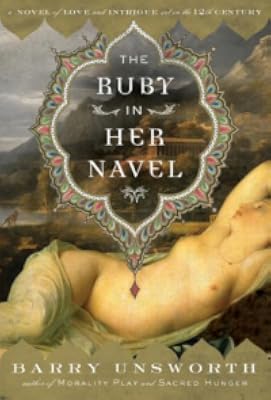
The Ruby in Her Navel
by Barry Unsworth
On This Page
Description
Set in the Middle Ages during the brief yet glittering rule of the Norman kings, The Ruby in Her Navel is a tale in which the conflicts of the past portend the present. The novel opens in Palermo, in which Latin and Greek, Arab and Jew live together in precarious harmony. Thurstan Beauchamp, the Christian son of a Norman knight, works for Yusuf, a Muslim Arab, in the palace's central finance office, a job which includes the management of blackmail and bribes, and the gathering of secret show more information for the king. But the peace and prosperity of the kingdom is being threatened, internally as well as externally. Known for his loyalty but divided between the ideals of chivalry and the harsh political realities of his tumultuous times, Thurstan is dispatched to uncover the conspiracies brewing against his king. During his journeys, he encounters the woman he loved as a youth; and the renewed promise of her love, as well as the mysterious presence of an itinerant dancing girl, sends him on a spiritual odyssey that forces him to question the nature of his ambition and the folly of uncritical reverence for authority. With the exquisite prose and masterful narrative drive that have earned him widespread acclaim, Barry Unsworth transports the reader to a distant past filled with deception and mystery, and whose racial, tribal, and religious tensions are still with us today. Reading group guide included. show lessTags
Recommendations













Member Reviews
This book by the fine historical novelist Barry Unsworth is set in 1149 Palermo, Sicily, where power struggles between East and West have left King Roger hard pressed to maintain his throne. Both the Pope and the Bishop of Rome refuse to recognize his rule, and Conrad Hohenstaufen (ruler of the west) and Manuel Comnenus (ruler of the east) are threatening to invade Sicily to secure their powers. Palermo has always been tolerant to various ethnic communities, but a Christian group is making false accusations against Muslims, Jews, and other "outsiders" to take over power.
Thurstan Beauchamp narrates this story. He is a young man still, the son of a Norman knight and a Saxon mother. He works in the Diwan of Control, the central financial show more office at the palace, where his employer is Yusuf Ibn Mansur, a Muslim man with political savvy and of unimpeachable honesty who is willing to help Thurstan become influential if he can avoid falling into one of the dangerous political games the various factions are playing against each other. Traveling throughout Europe as "Purveyor of Pleasures and Shows," Thurstan finds a group of five Yazidis, including Nesrin, a belly dancer with uncommon talent, and immediately hires them to come to Palermo to perform for the king. He is drawn to Nesrin's great beauty and allure, but things take yet another turn when he meets again with the Lady Alicia on the same trip, once his great love when he was still a boy and she then just a girl also. Now she has returned from the land of Jerusalem as a widow of considerable wealth, and seems just as taken with Thurstan, who finds his love for her has not abated over the years.
Further complicating matters, we learn early on that Thurstan's most cherished dream has been to become a knight and fight in the crusades, as his father has done before him, though this opportunity was taken away from him just when it seemed about to be realised. Now with Lady Alicia's return on the scene, many opportunities beckon. The novel builds up at a moderate pace, all the while filled with period details which inform us about aspects of daily life in 12th century Palermo. Thurstan, narrating in the first person from the vantage point of a period after the events have taken place, is a personable main character, whom we cannot help but empathise with though he makes many grave gaffes and mistakes, and much as his naivety and youth show he has yet much to learn, we see the events though his eyes before he had gained the advantage of hindsight, so that the reader is offered only glimpses of the whole, until a complex mystery is revealed.
A jewel of a book which I can't wait to reread to pick up on all the fine intricate details I may have missed the first time. I also loved Andrew Sachs' narration in the audio version. A well-earned five stars for this gem. show less
Thurstan Beauchamp narrates this story. He is a young man still, the son of a Norman knight and a Saxon mother. He works in the Diwan of Control, the central financial show more office at the palace, where his employer is Yusuf Ibn Mansur, a Muslim man with political savvy and of unimpeachable honesty who is willing to help Thurstan become influential if he can avoid falling into one of the dangerous political games the various factions are playing against each other. Traveling throughout Europe as "Purveyor of Pleasures and Shows," Thurstan finds a group of five Yazidis, including Nesrin, a belly dancer with uncommon talent, and immediately hires them to come to Palermo to perform for the king. He is drawn to Nesrin's great beauty and allure, but things take yet another turn when he meets again with the Lady Alicia on the same trip, once his great love when he was still a boy and she then just a girl also. Now she has returned from the land of Jerusalem as a widow of considerable wealth, and seems just as taken with Thurstan, who finds his love for her has not abated over the years.
Further complicating matters, we learn early on that Thurstan's most cherished dream has been to become a knight and fight in the crusades, as his father has done before him, though this opportunity was taken away from him just when it seemed about to be realised. Now with Lady Alicia's return on the scene, many opportunities beckon. The novel builds up at a moderate pace, all the while filled with period details which inform us about aspects of daily life in 12th century Palermo. Thurstan, narrating in the first person from the vantage point of a period after the events have taken place, is a personable main character, whom we cannot help but empathise with though he makes many grave gaffes and mistakes, and much as his naivety and youth show he has yet much to learn, we see the events though his eyes before he had gained the advantage of hindsight, so that the reader is offered only glimpses of the whole, until a complex mystery is revealed.
A jewel of a book which I can't wait to reread to pick up on all the fine intricate details I may have missed the first time. I also loved Andrew Sachs' narration in the audio version. A well-earned five stars for this gem. show less
I enjoyed this a great deal. It was an experience, not just a story and a telling, but all of that and more - a world, a mindset, an exploration - and deeply satisfying all up.
The first thing that grabbed me was the strength of the first-person narrator. There's a deep and stark and involved style to his voice that helps seat the book in its time and place (more about this later) but also establishes the novel firmly as Thurstan-telling-his-story. I have endless impatience with books that a first-person without a reason - i.e. why and how is this person telling me their story? - but this one does it flat out with what appears to be bald-faced honesty, that later gains a layer of knowing extra meaning (which I love).
And through the show more telling, the reader comes to understand intrinsically - so much more deeply than merely being told - some aspects of the 12th-century Mediterranean that underpin the book: that abstract thought is underdeveloped, and the concept of visualising and imagining one close to magic; that this is a world in which simplicity and complexity war, or at least overlap; and that while it could be said that the Dark Ages are ending, there has never been such hate as is now welling up.
Amidst all of this, I found the entwined stories of political intrigue and Thurstan's emotional getting-of-wisdom to be deeply satisfying, in that way I like best where things reveal to have been just what I thought, but even more so and with added twists I had not seen coming. And while I had some slight distresses about the way Alicia was depicted at the end of the day, Nesrin was pretty magnificent. show less
The first thing that grabbed me was the strength of the first-person narrator. There's a deep and stark and involved style to his voice that helps seat the book in its time and place (more about this later) but also establishes the novel firmly as Thurstan-telling-his-story. I have endless impatience with books that a first-person without a reason - i.e. why and how is this person telling me their story? - but this one does it flat out with what appears to be bald-faced honesty, that later gains a layer of knowing extra meaning (which I love).
And through the show more telling, the reader comes to understand intrinsically - so much more deeply than merely being told - some aspects of the 12th-century Mediterranean that underpin the book: that abstract thought is underdeveloped, and the concept of visualising and imagining one close to magic; that this is a world in which simplicity and complexity war, or at least overlap; and that while it could be said that the Dark Ages are ending, there has never been such hate as is now welling up.
Amidst all of this, I found the entwined stories of political intrigue and Thurstan's emotional getting-of-wisdom to be deeply satisfying, in that way I like best where things reveal to have been just what I thought, but even more so and with added twists I had not seen coming. And while I had some slight distresses about the way Alicia was depicted at the end of the day, Nesrin was pretty magnificent. show less
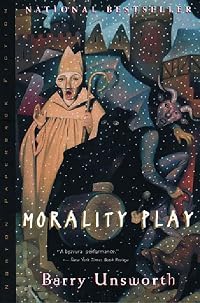
Barry Unsworth's The Ruby in Her Navel: A Novel truly is a novel of love and intrigue as the dust jacket promises. The book is another erudite historical mystery driven by Unsworth's superb story-telling skills. Readers may also want to try Unsworth's Morality Play.
The tale is set in 12th century Sicily during the rule of the Norman kings (said rule was certainly news to me). The Norman king uses Muslims in some high offices and our heroic protagonist Thurstan works for one of the most highly placed Muslims, Yusuf, `Lord of the Diwan of Control'. In 12th-century Palermo, all races and creeds lived and worked in relative harmony and peace. But the second Crusade has just crashed and there are those who want to end the Muslim influence. show more
The failure of the Crusade also returns to Sicily Lady Alicia, the woman whom Thurstan loved in his early years. Thurstan's expectations of becoming a knight and Alicia becoming his Lady had been demolished years earlier when his father suddenly gave his land to the Church. Now suddenly she is back and rekindles an improbable love. Alicia, however, is not the most remarkable woman in Unsworth's tale; that special place is reserved for Nesrin, the dancer with the ruby in her navel.
Unsworth delivers layers within layers of intrigue. I was got off guard by the coup de grace - even though after it happened I realized it should have been obvious. The Ruby in Her Navel is historical fiction raised to its pinnacle. Highest recommendation. show less
The tale is set in 12th century Sicily during the rule of the Norman kings (said rule was certainly news to me). The Norman king uses Muslims in some high offices and our heroic protagonist Thurstan works for one of the most highly placed Muslims, Yusuf, `Lord of the Diwan of Control'. In 12th-century Palermo, all races and creeds lived and worked in relative harmony and peace. But the second Crusade has just crashed and there are those who want to end the Muslim influence. show more
The failure of the Crusade also returns to Sicily Lady Alicia, the woman whom Thurstan loved in his early years. Thurstan's expectations of becoming a knight and Alicia becoming his Lady had been demolished years earlier when his father suddenly gave his land to the Church. Now suddenly she is back and rekindles an improbable love. Alicia, however, is not the most remarkable woman in Unsworth's tale; that special place is reserved for Nesrin, the dancer with the ruby in her navel.
Unsworth delivers layers within layers of intrigue. I was got off guard by the coup de grace - even though after it happened I realized it should have been obvious. The Ruby in Her Navel is historical fiction raised to its pinnacle. Highest recommendation. show less
A novel of palace intrigue set in 12th century Palermo. We are at the court of King Roger II, a Norman, who rules an ethnically diverse realm in which he tries to balance the rights of Christian and Muslim and Jew. Only the Muslims, however, seem content with this arrangement, perhaps because they comprise King Roger's most trusted counselors. He mistrusts his own people, the Normans, and for good reason as events reveal. The Catholics have just lost the Second Crusade—ignominiously and with terrible loss of life—so they are hardly in a mood for pluralism. They seek closer alignment with the crown, greater control of its offices and pursestrings, and expulsion of all Muslims from Sicily. Thurstan Beauchamp, the narrator, works in show more the palace in the Diwan of Control. He is of Norman ancestry and a Christian. His supervisor, Yusuf Ibm Mansur, seeks to train him in the arts of intrigue, for the factions are constantly conspiring against each other and Thurston's face is an open book.
Some time before the present action, Thurston's dreams of knighthood were quashed when his father inexplicably turned ascetic and gave all of his worldly goods to the monastery he then entered. Thurston was thus promptly disinherited, and is understandably unhappy that his birthright should have been traded away solely for the comfort of his father's eternal soul. Now he must work for a living. His post, under Yusuf's guidance, involves travel. On his first trip of the novel he runs into his first love, Lady Alicia, who was torn from him when he was 15 or so and sent off to marry a corpulent crusader in the Holy Land. Now, 20 years later, here she is, newly widowed, on horseback, riding with groom and lady-in-waiting through some provincial backwater to which Thurston had been dispatched on an errand. His love for her and his dreams of knighthood are subsequently rekindled. In time, she expresses her belief that is was Providence that brought them together again and she announces her intention to make him her husband.
There is the larger political context which undergirds the intrigues at the palace. Most threateningly, King Conrad III of Germany and Emperor Manuel I Comnenus of Byzantium are allying as a means of dethroning Roger, whom they view as a usurper, and expelling all Muslims from Sicily. It is King Roger's hope to strike up a correpondence with Conrad in an effort to break his alliance with Byzantium. The writing is emotionally affecting and the deployment of suspense masterful. Unsworth's handling of the complex plot seems effortless. There are numerous plot twists and betrayals and other surprises that I am deliberately not discussing that will set your heart pounding and curl your hair. The title story of the ruby is just one of these. This is narrative of a very high order, and the tone is beautifully modulated throughout. I liked Unsworth's Booker-winning SACRED HUNGER immensely, but THE RUBY IN HER NAVEL is the finer work. Comparisons are specious, but solely in terms of artistic achievement I put the book on a par with William Styron's SOPHIE'S CHOICE. It is among the limited number of great novels that one will be privileged to read in this too brief life. show less
Some time before the present action, Thurston's dreams of knighthood were quashed when his father inexplicably turned ascetic and gave all of his worldly goods to the monastery he then entered. Thurston was thus promptly disinherited, and is understandably unhappy that his birthright should have been traded away solely for the comfort of his father's eternal soul. Now he must work for a living. His post, under Yusuf's guidance, involves travel. On his first trip of the novel he runs into his first love, Lady Alicia, who was torn from him when he was 15 or so and sent off to marry a corpulent crusader in the Holy Land. Now, 20 years later, here she is, newly widowed, on horseback, riding with groom and lady-in-waiting through some provincial backwater to which Thurston had been dispatched on an errand. His love for her and his dreams of knighthood are subsequently rekindled. In time, she expresses her belief that is was Providence that brought them together again and she announces her intention to make him her husband.
There is the larger political context which undergirds the intrigues at the palace. Most threateningly, King Conrad III of Germany and Emperor Manuel I Comnenus of Byzantium are allying as a means of dethroning Roger, whom they view as a usurper, and expelling all Muslims from Sicily. It is King Roger's hope to strike up a correpondence with Conrad in an effort to break his alliance with Byzantium. The writing is emotionally affecting and the deployment of suspense masterful. Unsworth's handling of the complex plot seems effortless. There are numerous plot twists and betrayals and other surprises that I am deliberately not discussing that will set your heart pounding and curl your hair. The title story of the ruby is just one of these. This is narrative of a very high order, and the tone is beautifully modulated throughout. I liked Unsworth's Booker-winning SACRED HUNGER immensely, but THE RUBY IN HER NAVEL is the finer work. Comparisons are specious, but solely in terms of artistic achievement I put the book on a par with William Styron's SOPHIE'S CHOICE. It is among the limited number of great novels that one will be privileged to read in this too brief life. show less
I can only join in the praise for this fine Unsworth novel. He produces the most intricate plots in such well-researched historical settings. A parallel with contemporary world affairs makes this novel even more worth the effort of reading it.
About a month ago Barry Unsworth died and following a conversation on a LT thread I decided that I should read something of his as he was an author I had not come across before.
Twelfth century Sicily is a multicultural society — King Roger is the Norman ruler but his subjects and advisers include Muslims, Jews and Christians (both Catholic and Orthodox). Unfortunately the Second Crusade has just come to its unfortunate, for the Catholics, end and tensions are rising. Our narrator for this story is Thurstan Beauchamp, son of a Norman knight, but thwarted in his desire to become a knight himself. He has ended up working in one of the king's ministries working for a Muslim. He is idealistic and slightly naive. Into his life come two show more women - the dancer Nesrin and his first love Alicia, who is recently widowed.
This is very good historical fiction. I liked the way Unsworth built his picture of the times. I might have wanted to kick Thurstan sometimes as he doesn't seem to be able to see what is happening around him. But, for me, that is one of the signs of a good book as I wanted his story to come out in a positive way.
I'll definitely be reading more of Barry Unsworth's work in the future. I am just sorry I didn't discover his books before his death. show less
Twelfth century Sicily is a multicultural society — King Roger is the Norman ruler but his subjects and advisers include Muslims, Jews and Christians (both Catholic and Orthodox). Unfortunately the Second Crusade has just come to its unfortunate, for the Catholics, end and tensions are rising. Our narrator for this story is Thurstan Beauchamp, son of a Norman knight, but thwarted in his desire to become a knight himself. He has ended up working in one of the king's ministries working for a Muslim. He is idealistic and slightly naive. Into his life come two show more women - the dancer Nesrin and his first love Alicia, who is recently widowed.
This is very good historical fiction. I liked the way Unsworth built his picture of the times. I might have wanted to kick Thurstan sometimes as he doesn't seem to be able to see what is happening around him. But, for me, that is one of the signs of a good book as I wanted his story to come out in a positive way.
I'll definitely be reading more of Barry Unsworth's work in the future. I am just sorry I didn't discover his books before his death. show less
At the heart of this novel is the age-old tension between Christendom and Islam. Set after the second failed crusade in twelfth-century Sicily which is a melting pot of Christians and Moslems - mainly Normans, Latins, Franks, Turks and Arabs. King Roger is seen to encourage all to work together in harmony.
We are introduced to Thurstan, whose father gave up the rat race to become a monk. This removed Thurstan's chances of knighthood, so he works as a procurer of entertainers for the king.
Thurstan is rather an innocent and is easily manipulated by those in power. When he gets invited to a gathering at the king's country retreat and meets his childhood sweetheart Alicia, he falls for her again and thus starts a whole chain of events. show more Meanwhile he finds a troupe of belly dancers and musicians and entranced by the dancer Nesrin, brings them back to Palermo to perform for the king.
This is a novel of romance and high intrigue, and of a young man gaining adulthood. Thurstan is a thoughtful chap, and as the tale is told in the first person, we get all his thinking written down on the page.
Underneath all the pondering, is a first rate historical thriller with a good love element trying to get out, however it does rather get bogged down in the philosophising. show less
We are introduced to Thurstan, whose father gave up the rat race to become a monk. This removed Thurstan's chances of knighthood, so he works as a procurer of entertainers for the king.
Thurstan is rather an innocent and is easily manipulated by those in power. When he gets invited to a gathering at the king's country retreat and meets his childhood sweetheart Alicia, he falls for her again and thus starts a whole chain of events. show more Meanwhile he finds a troupe of belly dancers and musicians and entranced by the dancer Nesrin, brings them back to Palermo to perform for the king.
This is a novel of romance and high intrigue, and of a young man gaining adulthood. Thurstan is a thoughtful chap, and as the tale is told in the first person, we get all his thinking written down on the page.
Underneath all the pondering, is a first rate historical thriller with a good love element trying to get out, however it does rather get bogged down in the philosophising. show less
Members
- Recently Added By
Published Reviews
added by doomjesse
Lists

Booker Prize
491 works; 62 members

Man Booker Prize Longlist 2006
19 works; 2 members
Author Information

20+ Works 6,833 Members
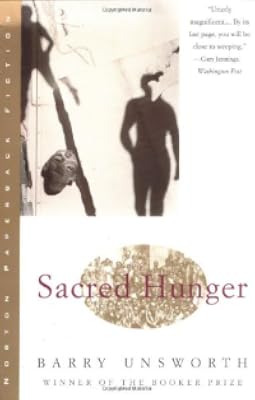
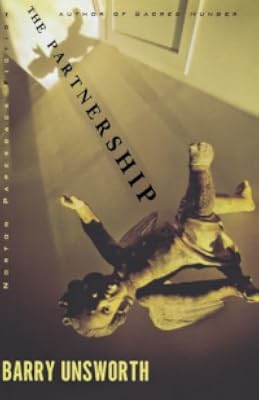
Barry Unsworth was born in Wingate, England on August 10, 1930. He received an undergraduate degree in English from the University of Manchester in 1951. He started out writing short stories, but soon switched to novels. His first novel, The Partnership, was published in 1966. He wrote 17 novels during his lifetime including Stone Virgin, Losing show more Nelson, The Songs of the Kings, Land of Marvels, and The Quality of Mercy. Sacred Hunger won a Booker Prize in 1992. Morality Play and Pascali's Island were both made into feature films. He died from lung cancer on June 5, 2012 at the age of 81. (Bowker Author Biography) show less
Awards and Honors
Awards
Distinctions
Common Knowledge
- Canonical title
- The Ruby in Her Navel
- Original publication date
- 2006
- Important places
- Palermo, Italy
- Epigraph
- The price of wisdom is above rubies.
The Book of Job - Dedication
- For Aira
- First words
- When Nesrin the dancer became famous in the courts of Europe, many were the stories told about the ruby that glowed in her navel as she danced.
- Blurbers
- Crace, Jim; Norwich, John Julius
Classifications
Statistics
- Members
- 455
- Popularity
- 67,290
- Reviews
- 14
- Rating
- (3.44)
- Languages
- English, French, Portuguese, Spanish
- Media
- Paper, Audiobook, Ebook
- ISBNs
- 17
- ASINs
- 5