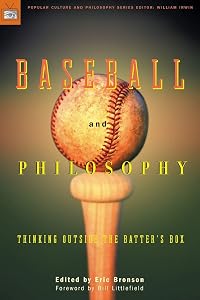
Baseball and Philosophy: Thinking Outside the Batter's Box
by Eric Bronson (Editor)
Popular Culture and Philosophy (6)
On This Page
Description
Baseball and Philosophy presents thirty-one talented professional thinkers who have found wisdom in and through baseball. They explore some of the game's deeper questions and expound baseball's lessons for truth, justice, American identity, and human fulfillment.--Is the intentional walk unethical?--Can superstition help you play better?--Do Cubs fans teach us about religious faith?--Does chance decide who wins the World Series?Tags
Recommendations
























Member Reviews
Great Book! A perfect blending of baseball and philosophy. Fun examples of using baseball to highlight/illustrate important concepts in philosophy and using philosophy to elucidate baseball.
Organized into nine "innings," each containing two chapters (top of the inning and bottom of the inning :), Baseball and Philosophy addresses definitions of "home," faith and sacrifice, umpires, cheating and deception, democracy, moral identity, race and cultural issues, statistics, women (hardball vs. softball), the ethics of the intentional walk, and why baseball is like Socratic philosophy. Following the "game," there are six "Post-Game Press Conference" debates illustrating opposing responses to questions of ethics, political philosophy, show more metaphysics, legal philosophy, aesthetics, and education.
Although my guess is that some philosophy professors would take issue with the lack of in-depth analysis of philosophical concepts and theories, I see the book as a useful way of showing how those concepts and theories (examined in-depth in lecture and/or more standard philosophy texts) can be applied in the "real" world. Although many of the articles focused on familiar themes of morality (cheating, deception), legal issues, statistical theory, and capitalism ($$$), I was surprised by some of the other issues and concepts explored/mentioned: Social Darwinism, resistance, Categorical Imperative, Democracy, epistemology, feminist philosophy, metaphysics, philosophical views of the body, philosophy of science, and Japanese Warrior culture.
I am not an expert in philosophy, but I was impressed by the wide range of philosophical perspectives represented in the book—from Aristotle and Thomas Aquinas, through Alexis de Tocqueville and Cornell West, to Wittgenstein and Zen Buddhism. My favorite chapter in this regard was Willie Young's "Taking One for the Team: Baseball and Sacrifice" which managed to squeeze Julia Kristeva, St. Augustine, Seneca, Aristotle, Stoicism, Hegel, Tolkien, Kierkegaard, and Derrida into a 13-page essay!
I also appreciated the editor's inclusion of cross referencing to point the reader to other chapters that address related issues and helped avoid unnecessary repetition of positions and explanations.
One problem with the book, perhaps due to its 2004 publication date, is the lack of recognition of the problem of steroids and performance enhancing drugs in baseball. Many of the articles refer in glowing terms to players like Manny Ramirez, Alex Rodriguez, Sammy Sosa, Barry Bonds, and Mark McGwire without acknowledging the suspicion of steroid use they were all under, even in 2004. Today it would be impossible to use many of these articles without addressing the more recent accusations and admissions which taint some of these illustrations of "excellence." The post-game "debate" pieces on steroids/"PET"s really aren't long enough to address the issue adequately. (In fact, I didn't find the post-game pieces of much use whatsoever. Though I should admit that I've never found the debate format pedagogically useful as it only seems to cement false dichotomies without exploring the nuanced gray areas in between.
Despite these problems, I would recommend this book and this approach to combining popular culture and philosophy (see http://www.librarything.com/series/Popular+Culture+and+Philosophy for other books in the Popular Culture and Philosophy series). I both enjoyed the read and appreciated the way the book made me think about my favorite pastime. show less
Organized into nine "innings," each containing two chapters (top of the inning and bottom of the inning :), Baseball and Philosophy addresses definitions of "home," faith and sacrifice, umpires, cheating and deception, democracy, moral identity, race and cultural issues, statistics, women (hardball vs. softball), the ethics of the intentional walk, and why baseball is like Socratic philosophy. Following the "game," there are six "Post-Game Press Conference" debates illustrating opposing responses to questions of ethics, political philosophy, show more metaphysics, legal philosophy, aesthetics, and education.
Although my guess is that some philosophy professors would take issue with the lack of in-depth analysis of philosophical concepts and theories, I see the book as a useful way of showing how those concepts and theories (examined in-depth in lecture and/or more standard philosophy texts) can be applied in the "real" world. Although many of the articles focused on familiar themes of morality (cheating, deception), legal issues, statistical theory, and capitalism ($$$), I was surprised by some of the other issues and concepts explored/mentioned: Social Darwinism, resistance, Categorical Imperative, Democracy, epistemology, feminist philosophy, metaphysics, philosophical views of the body, philosophy of science, and Japanese Warrior culture.
I am not an expert in philosophy, but I was impressed by the wide range of philosophical perspectives represented in the book—from Aristotle and Thomas Aquinas, through Alexis de Tocqueville and Cornell West, to Wittgenstein and Zen Buddhism. My favorite chapter in this regard was Willie Young's "Taking One for the Team: Baseball and Sacrifice" which managed to squeeze Julia Kristeva, St. Augustine, Seneca, Aristotle, Stoicism, Hegel, Tolkien, Kierkegaard, and Derrida into a 13-page essay!
I also appreciated the editor's inclusion of cross referencing to point the reader to other chapters that address related issues and helped avoid unnecessary repetition of positions and explanations.
One problem with the book, perhaps due to its 2004 publication date, is the lack of recognition of the problem of steroids and performance enhancing drugs in baseball. Many of the articles refer in glowing terms to players like Manny Ramirez, Alex Rodriguez, Sammy Sosa, Barry Bonds, and Mark McGwire without acknowledging the suspicion of steroid use they were all under, even in 2004. Today it would be impossible to use many of these articles without addressing the more recent accusations and admissions which taint some of these illustrations of "excellence." The post-game "debate" pieces on steroids/"PET"s really aren't long enough to address the issue adequately. (In fact, I didn't find the post-game pieces of much use whatsoever. Though I should admit that I've never found the debate format pedagogically useful as it only seems to cement false dichotomies without exploring the nuanced gray areas in between.
Despite these problems, I would recommend this book and this approach to combining popular culture and philosophy (see http://www.librarything.com/series/Popular+Culture+and+Philosophy for other books in the Popular Culture and Philosophy series). I both enjoyed the read and appreciated the way the book made me think about my favorite pastime. show less
Not a -bad- anthology of essays on baseball and philosophy.... just.... eh. It took me a lot longer to read this than expected (also a busy time for me, with work, kids, starting up the gardens, etc), but it just seemed more drier and not as truly philosophical as some of the other pop culture and philosophy books (Seinfeld and Philosophy, Lord of the Rings and philosophy, etc). Some of the essays were more or less just essays and not even linking baseball to philosophy at all. Hit or miss articles makes it not a bad anthology but not a great one either.
Ratings
Members
- Recently Added By
Author Information
Series

Common Knowledge
- Canonical title
- Baseball and Philosophy: Thinking Outside the Batter's Box
Classifications
- Genres
- Sports and Leisure, Philosophy, Nonfiction, General Nonfiction
- DDC/MDS
- 796.357 — Arts & recreation Recreation, sports, and performing arts Athletic and outdoor sports and games Ball sports Ball and stick sports Baseball
- LCC
- GV867.64 .B365 — Geography, Anthropology and Recreation Recreation. Leisure Recreation. Leisure Sports Ball games: Baseball, football, golf, etc.
- BISAC
Statistics
- Members
- 201
- Popularity
- 163,424
- Reviews
- 2
- Rating
- (3.58)
- Languages
- English
- Media
- Paper, Ebook
- ISBNs
- 2
- ASINs
- 1