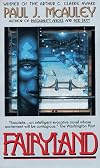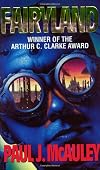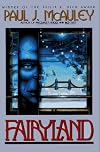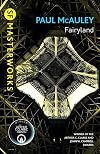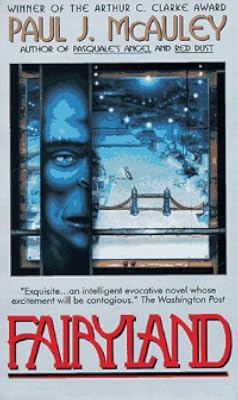
Fairyland
by Paul McAuley
On This Page
Description
The 21st century. Europe is divided between the First World bourgeoisie, made rich by nanotechnology and the cheap versatile slave labour of genetically engineered Dolls and the Fourth World of refugees and homeless displaced by war and economic upheaval. In London, Alex Sharkey is trying to make his mark as a designer of psychoactive viruses, whilst staying one step ahead of the police and the Triad gangs. At the cost of three hours of his life, he finds an unlikely ally in a scary, show more super-smart little girl called Milena, but his troubles really start when he helps Milena quicken intelligence in a Doll, turning it into the first of the fairies. Milena isn't sure if she's mad or if she's the only sane person left in the world; she only knows that she wants to escape to her own private Fairyland and live forever. Although Milena has created the fairies for her own ends, some of the Folk, as fey and dangerous as any in legend, have other ideas about her destiny ... show lessTags
Recommendations













Member Reviews
A dark, immersive biopunk epic which is very close to being a top-tier achievement – and yet somehow, in the final third, it just kept slipping away from me faster and faster, until by the end I no longer had any firm grip on who half the characters were, or what exactly had happened to them, or why. Whether that's the book's fault or mine I'm not quite sure.
The setting is a nearish-future Europe of scientific advance and social decay, in which nanotechnology is as prominent a feature as conflict refugees. At the bleeding edge of hi-tech development are the genetically engineered ‘dolls’ who are used as slave labour, as sex toys, or simply as modish pets for the super-rich. But a creepily brainy little girl genius has worked out a show more way to awaken the dolls' intelligence, accidentally – or perhaps not – turning them into a runaway, fast-evolving new species of ‘fairies’ that start to overrun the continent.
What this book does well, it does brilliantly. The tone is fantastically well evoked – genuinely oppressive and dark and atmospheric, so that picking the book up or putting it down can change your mood in dramatic ways. The structure, too, is excellent – split into three parts, each works almost as a standalone novella with its own new protagonist and setting. The first, in a twisted but recognisable London, is a sort of East-End rozzers-and-gangsters tale set in a world of psychoactive viruses and virtual reality. Act two, for my money the strongest section, jumps to the run-down Paris suburbs, where destitute children are being targeted by some evil that has set up camp in the ruins of Disneyland Paris. And Part Three is a frontiersy, war-is-hell story about a video reporter on the front lines of a conflict in Albania.
It's such a rich form of world-building – if perhaps very slightly too ambitious for its own good, but that is already a great problem for any book to have. In the end, the challenges of keeping these disparate storylines on target for any kind of coherent conclusion proved a bit too much to cope with, I thought, resulting in a growing sense from the reader that you're getting irredeemably lost. This is not helped by the otherwise admirably uncompromising and hard sci-fi prose style from our author, a biologist, who thinks nothing of chucking around explanations like this:
Slowly, copies of the library of fairy fembot code are written into tangled buckyball strings, which are delivered to Alex's T-lymphocytes within protein coats derived from modified HIV virus.
Even so, the hits are much more prominent than the misses here. The world of Fairyland, if often hard to understand, does feel real, and the threats feel genuinely menacing – one character, Mister Mike, filled me with dread every time he made an appearance. McAuley also has a lot of fun concocting cyberpunk updates of fairy mythology, with a ghastly Spenserian ‘fairy queen’ and a very dark reinterpretation of the old stories about fairy-folk stealing people's babies. Though ultimately a little unfulfilling, this is a book determined to hack into your cortex and show you things you've never seen anywhere else – and they are definitely worth the watch. show less
The setting is a nearish-future Europe of scientific advance and social decay, in which nanotechnology is as prominent a feature as conflict refugees. At the bleeding edge of hi-tech development are the genetically engineered ‘dolls’ who are used as slave labour, as sex toys, or simply as modish pets for the super-rich. But a creepily brainy little girl genius has worked out a show more way to awaken the dolls' intelligence, accidentally – or perhaps not – turning them into a runaway, fast-evolving new species of ‘fairies’ that start to overrun the continent.
What this book does well, it does brilliantly. The tone is fantastically well evoked – genuinely oppressive and dark and atmospheric, so that picking the book up or putting it down can change your mood in dramatic ways. The structure, too, is excellent – split into three parts, each works almost as a standalone novella with its own new protagonist and setting. The first, in a twisted but recognisable London, is a sort of East-End rozzers-and-gangsters tale set in a world of psychoactive viruses and virtual reality. Act two, for my money the strongest section, jumps to the run-down Paris suburbs, where destitute children are being targeted by some evil that has set up camp in the ruins of Disneyland Paris. And Part Three is a frontiersy, war-is-hell story about a video reporter on the front lines of a conflict in Albania.
It's such a rich form of world-building – if perhaps very slightly too ambitious for its own good, but that is already a great problem for any book to have. In the end, the challenges of keeping these disparate storylines on target for any kind of coherent conclusion proved a bit too much to cope with, I thought, resulting in a growing sense from the reader that you're getting irredeemably lost. This is not helped by the otherwise admirably uncompromising and hard sci-fi prose style from our author, a biologist, who thinks nothing of chucking around explanations like this:
Slowly, copies of the library of fairy fembot code are written into tangled buckyball strings, which are delivered to Alex's T-lymphocytes within protein coats derived from modified HIV virus.
Even so, the hits are much more prominent than the misses here. The world of Fairyland, if often hard to understand, does feel real, and the threats feel genuinely menacing – one character, Mister Mike, filled me with dread every time he made an appearance. McAuley also has a lot of fun concocting cyberpunk updates of fairy mythology, with a ghastly Spenserian ‘fairy queen’ and a very dark reinterpretation of the old stories about fairy-folk stealing people's babies. Though ultimately a little unfulfilling, this is a book determined to hack into your cortex and show you things you've never seen anywhere else – and they are definitely worth the watch. show less
It's always a risky business writing about 'our world a little way into the future'. For all its originality and accolades, 2001: A Space Odyssey, for instance, was terrible at this. In other cases, the picture isn't 'right' but it still works - for example with John Brunner' Shockwave Rider, based on the predictions of Alvin Toffler's classic non-fiction futurology Future Shock.
What's striking about the dystopian, drug-ridden future of Paul McAuley's Fairyland is that it is still as stunning today as it was when it was written back in 1995. What is also remarkable is that, even though it is a fairly dark and dismal story - and the 'hero' Alex Sharkey is not exactly the most appealing of characters - it remains an enjoyable and show more entertaining read. It's dark without being depressing.
McAuley makes superb use of extensions of biological concepts, from viruses and nanostructures designed to modify our sensations and beliefs to manufactured sub-human creatures called dolls that are subverted by a genetically enhanced little girl to become the hypnotically strange fairies. For a lot of the book Sharkey is driven by a geas, desperately searching for the girl who captivated him so many years before (perhaps the urge is chemically induced - he isn't sure and doesn't care).
The book is divided into three sections - the second and third aren't quite as satisfying as the first, in that the book would probably benefited from a single point of view, and we stray more later on. It's also fair to say that some of the concepts later on, involving a pair of human beings being mentally absorbed into the internet are a bit confusing. Even so there's huge fascination in the way McAuley spins the storyline and the book piles on superb original ideas on future ways we could misuse our minds and bodies.
As far as I can see this book is out of print (though plenty of copies are available from Amazon Marketplace using the link) - this is a crime. It's a true classic. show less
What's striking about the dystopian, drug-ridden future of Paul McAuley's Fairyland is that it is still as stunning today as it was when it was written back in 1995. What is also remarkable is that, even though it is a fairly dark and dismal story - and the 'hero' Alex Sharkey is not exactly the most appealing of characters - it remains an enjoyable and show more entertaining read. It's dark without being depressing.
McAuley makes superb use of extensions of biological concepts, from viruses and nanostructures designed to modify our sensations and beliefs to manufactured sub-human creatures called dolls that are subverted by a genetically enhanced little girl to become the hypnotically strange fairies. For a lot of the book Sharkey is driven by a geas, desperately searching for the girl who captivated him so many years before (perhaps the urge is chemically induced - he isn't sure and doesn't care).
The book is divided into three sections - the second and third aren't quite as satisfying as the first, in that the book would probably benefited from a single point of view, and we stray more later on. It's also fair to say that some of the concepts later on, involving a pair of human beings being mentally absorbed into the internet are a bit confusing. Even so there's huge fascination in the way McAuley spins the storyline and the book piles on superb original ideas on future ways we could misuse our minds and bodies.
As far as I can see this book is out of print (though plenty of copies are available from Amazon Marketplace using the link) - this is a crime. It's a true classic. show less
http://nwhyte.livejournal.com/1314799.html
A 1995 novel of the near future which won the Arthur C. Clarke Award (and I think also the BSFA). It's a pessimistic take on the post-nanotech future, particularly convincing on the relationship between high-tech computing and low-tech field combat in a very recognisable near-future Albania (yep, I've stayed in that hotel too).
I thought the settings were very convincing if rather gloomy - 1994-95 saw the height of the Bosnian conflict, and from that perspective McAuley's Balkans, mired in conflict for decades, would have seemed entirely plausible. Unfortunately I couldn't quite bring myself to care much about the characters, but I did admire the scenery.
A 1995 novel of the near future which won the Arthur C. Clarke Award (and I think also the BSFA). It's a pessimistic take on the post-nanotech future, particularly convincing on the relationship between high-tech computing and low-tech field combat in a very recognisable near-future Albania (yep, I've stayed in that hotel too).
I thought the settings were very convincing if rather gloomy - 1994-95 saw the height of the Bosnian conflict, and from that perspective McAuley's Balkans, mired in conflict for decades, would have seemed entirely plausible. Unfortunately I couldn't quite bring myself to care much about the characters, but I did admire the scenery.
This is an interesting book. I am wondering how to describe a dis-jointed, reality-skewed futuristic trip through Europe in a way that does it justice.
Alex Sharkey is a child of the late twentieth century bumbling through life on the edge of legality. The consequences of his choices lead him to search through Europe for Fairyland. A home for the modified "dolls" - fairies. Split into three parts the flow of the book is interrupted by the introduction of new characters and their relationship with the fairies. It does all come together in the end but in some ways reads like three novellas linked by a theme . At times I wondered whether it was worth reading. The long descriptions of psychoactive viruses and gene modification were complex show more and outside my comfort zone for reading, but I loved the story; the quest and the characters we meet.
Well worth reading. show less
Alex Sharkey is a child of the late twentieth century bumbling through life on the edge of legality. The consequences of his choices lead him to search through Europe for Fairyland. A home for the modified "dolls" - fairies. Split into three parts the flow of the book is interrupted by the introduction of new characters and their relationship with the fairies. It does all come together in the end but in some ways reads like three novellas linked by a theme . At times I wondered whether it was worth reading. The long descriptions of psychoactive viruses and gene modification were complex show more and outside my comfort zone for reading, but I loved the story; the quest and the characters we meet.
Well worth reading. show less
It's been over a decade since I read this book, but I still have fond memories. It's very captivating, and introduces the reader to a strange, yet possible future if we let bio-technology get out of control.
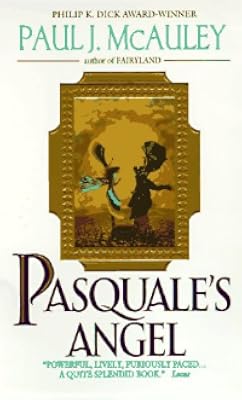
I bought this one at random when I was in the scifi section of Borders, because it has a very pretty front cover, but it turned out to be really good. It's some kind of nanotechnology/biochemistry scifi thing, kind of hard to explain the plot. But it's great, and much darker than its fluffy title suggests. The writing style reminded me of China Miéville, and also of Neal Stephenson (but with fewer tangents). Sadly, my copy of this book had a lot of typos, which distracted me a bit. Also I felt he overused the word "prognathous".
(Alistair) Well, this is probably the second oddest book on my booklog pile as of right now.
Let's see, now: in a near-future run-down dystopia (which, alas, included one of my personal Must Throw Book At Wall near-future dystopia traits within, oh, 25 pages of the beginning), bionanotech runs amuck, people are parasitized by meme-carrying viruses and personality-altering "fembots" - which would be nanites except for a throwaway line concerning someone holding the trademark on the word for non-nanoscale machines, and a current pet fad is for bright blue, sterile, vaguely hairless-ape-like "dolls", run by crude personality chips...
...until one artificially bright little girl introduces these two themes to each other, starting a revolution show more of personality among the "dolls", and kicking off a tremendously entangled and frankly surrealistic plot as the consequences of this, and of the "dolls" modeling themselves on an array of fairyland archetypes (hence the title) play themselves out.
Technically, I think it's a good book - and it kept me reading it, although it didn't really succeed in making me care much about the characters, with one minor-character exception - but I didn't care for it much, on the whole. But then, that's because the world portrayed is essentially a Crapsack World dystopia, and frankly, I think I'm losing my taste for Crapsack World dystopias these days.
( http://weblog.siliconcerebrate.com/cerebrate/2008/12/fairyland_paul_j_mcauley.ht... ) show less
Let's see, now: in a near-future run-down dystopia (which, alas, included one of my personal Must Throw Book At Wall near-future dystopia traits within, oh, 25 pages of the beginning), bionanotech runs amuck, people are parasitized by meme-carrying viruses and personality-altering "fembots" - which would be nanites except for a throwaway line concerning someone holding the trademark on the word for non-nanoscale machines, and a current pet fad is for bright blue, sterile, vaguely hairless-ape-like "dolls", run by crude personality chips...
...until one artificially bright little girl introduces these two themes to each other, starting a revolution show more of personality among the "dolls", and kicking off a tremendously entangled and frankly surrealistic plot as the consequences of this, and of the "dolls" modeling themselves on an array of fairyland archetypes (hence the title) play themselves out.
Technically, I think it's a good book - and it kept me reading it, although it didn't really succeed in making me care much about the characters, with one minor-character exception - but I didn't care for it much, on the whole. But then, that's because the world portrayed is essentially a Crapsack World dystopia, and frankly, I think I'm losing my taste for Crapsack World dystopias these days.
( http://weblog.siliconcerebrate.com/cerebrate/2008/12/fairyland_paul_j_mcauley.ht... ) show less
Members
- Recently Added By
Lists

S.F. Masterworks (Complete)
229 works; 15 members

SF Masterworks
193 works; 8 members

Arthur C. Clarke Award Winners and Shortlisted Books
219 works; 14 members

Best Science Fiction Novels
816 works; 426 members
Author Information

141+ Works 6,610 Members
Some Editions
Awards and Honors
Series
Belongs to Publisher Series
Common Knowledge
- Canonical title
- Fairyland
- Original title
- Fairyland
- Original publication date
- 1995
- People/Characters
- Alex Sharkey; Melina; Ray; Katrina; The Twins; Morag (show all 7); Mrs Powell
- Important places*
- Londres, Angleterre, Royaume-Uni; Paris, ïle-de-France, France
- Epigraph
- '... the Goddess starts her endgame in Britain,
where nobody's looking...'
Fraser Clarke, August, 1994 - First words
- The room is full of ghosts.
- Last words
- (Click to show. Warning: May contain spoilers.)It will be the first of his children.
*Some information comes from Common Knowledge in other languages. Click "Edit" for more information.
Classifications
Statistics
- Members
- 675
- Popularity
- 42,787
- Reviews
- 16
- Rating
- (3.38)
- Languages
- 7 — Czech, English, French, German, Italian, Polish, Spanish
- Media
- Paper, Audiobook, Ebook
- ISBNs
- 18
- ASINs
- 5