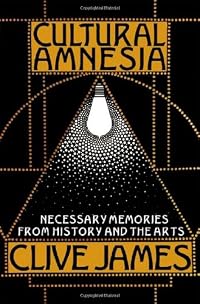
Cultural Amnesia: Necessary Memories from History and the Arts
by Clive James
On This Page
Description
Echoing Edward Said's belief that "Western humanism is not enough, we need a universal humanism," renowned critic Clive James presents here his life's work. Containing over one hundred original essays, organized by quotations from A to Z, this book illuminates, rescues, or occasionally destroys the careers of many of the greatest thinkers, humanists, musicians, artists, and philosophers of the twentieth century. In discussing, among others, Louis Armstrong, Walter Benjamin, Sigmund Freud, F. show more Scott Fitzgerald, Franz Kafka, Marcel Proust, and Ludwig Wittgenstein, James writes, "If the humanism that makes civilization civilized is to be preserved into the new century, it will need advocates. These advocates will need a memory, and part of that memory will need to be of an age in which they were not yet alive." This is the book to burnish these memories of a Western civilization that James fears is nearly lost.--From publisher description. show lessTags
Recommendations








Member Recommendations
Member Reviews
From the Rupert Murdoch of cultural criticism, a gigantic anthology of cocktail-party, wafer-thin "takes" on artists, thinkers, and political figures from Tacitus to Tony Curtis. There's little sustained thought, a lot of nervous jumping about between trivia and self-aggrandizing anecdotes. CJ drops names, boasts of learning Latin to read Tacitus and French to read Montesquieu, but one can't escape the impression of a mind that is broader than it is deep. If it never occurred to you that Satan is the most interesting character in Paradise Lost, that Chaplin's The Great Dictator is preachy, or that Schubert died tragically young, prepare to be staggered by these insights. A weird subtext of the book seems to be resentment of the show more intellectual left. Leftist intellectuals are either hypocrites (Brecht) or pampered ivory-tower ideologues (Said). Even the saintly Walter Benjamin is mocked for waiting too long to flee the Nazis! Grinding the ax of Cold War liberal anti-communism, it seems, is the real name of the James game. show less
There were two world wars, a period of relative quiet in between, then another brief period after. The twentieth century saw mass murders in the millions on the orders of Hitler, Stalin, Mao, Trotsky, and Pol Pot. There were no Mozarts, no Beethovens, no Van Goghs. It was up to–as it always is–the writers, poets, painters, film-makers, music-makers, and journalists to bear witness and report back to the planet. Some did better than others. Clive James suggests a 'cultural amnesia' was a result and thus has written a tome of humanist biographical sketches to bring us back to consciousness. Instead of a cultural amnesia, perhaps it was a cultural concussion. Shell-shock on a mass level where concussion protocol was required before the show more global body politic were ready to see with clarity what just happened. These 'sketches' that James has curated aren't really biographies of the assembled humanists, rather they afford him springboards for riffing on a panoply of topics and tangents which may or may not stay on topic. He seems to have read more words than any human at this point in time. He speaks 100 languages, and is disappointed that you and I do not. Most importantly, he campaigns loudly for a world population that embraces art and artists, and writers and poets, including a world that hungers for a music of inclusion, inspiration, and elevation. He campaigns well. show less
I finally finished this tome of 852 pages-not including the index. I think that I have been reading it for about a month or more. James lists alphabetically the various authors and politicians that have made an impression on him and their contribution to the history of the 20th century. His subtitle to this book is Notes in the Margin of My Time. I was impressed at how he found some of these people as they seemed very obscure to me. On further reading, you can see the themes that are very important to James. World War ll and the rise of antisemitism and the senseless destruction of the Russian people by successive Soviet governments are the two that James comes back to in most of the biographies. James does digress in many of his show more biographical descriptions touching on a wide variety of topics.His selection of people is interesting and on further reflection, covers European culture but is not representative of American society or women's voices. Still, very interesting and worth reading-when you have time! show less
“The message seems to be that when the possibility of critical discussion is withdrawn, anything can happen, and everything is altered. Among the many things altered is logic itself.” On Mao Zedong, p. 459
So lately I’ve been perusing Clive James’s massive Cultural Amnesia, a browser’s guide to the major thinkers, writers, and cultural icons of the past several hundred years (back as far as Sir Thomas Browne), though most of the personages that fill these pages are from just the past century. At first glance, this book may appear to be friendly to your average reader, one of those books the average reader might pick up to gain a not-so-quick overview of Western thought, or even perhaps just some good talking points for the next show more cocktail party. Average reader, beware; this book is probably not for you. Even when discussing known figures (Coco Chanel, Jean-Paul Sartre, Michael Mann come to mind), James veers off in completely unexpected directions. Not that this is necessarily bad; Montaigne is famous for this. The difference between Montaigne and James, however, is that Montaigne has a wholly unique and essential way of bringing the reader full circle. James frequently leaves the reader far from where they started.
He also frequently leaves the reader with his abhorrence of totalitarianism. This, no matter the subject, inevitably makes its way into almost all of the essays, even the one on Coco Chanel, who he pinions for accepting the protection of a German officer during WWII before hiding out in Switzerland until France saw fit to recognize her as a national treasure. In fact, the essay on Chanel becomes more of an essay about materialism and the economics of war-time Berlin. This is precisely what makes James’s book so fascinating. If you don’t mind getting lost in ideas, following tangents that leave you sometimes far from the place of origin, then this book is a treasure of information: historical, cultural, theoretical. I was so overwhelmed by what I was reading, I started to take notes on some of the essays and created a general reading list of interesting books mentioned in the various essays. These essays are not a starting point for the reader, but rather a focal point. James distills decades of hindsight and perspective through his unique lens and sets the reader on a quest for primary sources, the best thing that can happen for someone like me who loves nothing better than a fat bibliography at the end of an academic article.
“The wretched of the earth get no help from witch doctors, and when academic language gets beyond shourting distance of ordinary speech, voodoo is all it is.” On Walter Benjamin, p. 56
However, this book is not scholarly in the sense that it’s an academic treatise or historical account: there isn’t even a bibliography at the end (only an index!). Yet reading even one page makes you feel as if you’ve learned something, and usually you have. These essays are the opinions of someone dedicated to exposing the faults of some of the West’s most revered thinkers and icons–but not out of malice. As the title suggests, James wants us to remember the multi-faceted aspects of history and to reject the often easy and convenient narrative of our past, especially when it comes to totalitarianism, fascism, communism, and the ideologies that fueled them.
“Tyrants conduct monologues above a million solitudes.” Albert Camus, The Rebel, qtd. in Cultural Amnesia, p. 88 show less
So lately I’ve been perusing Clive James’s massive Cultural Amnesia, a browser’s guide to the major thinkers, writers, and cultural icons of the past several hundred years (back as far as Sir Thomas Browne), though most of the personages that fill these pages are from just the past century. At first glance, this book may appear to be friendly to your average reader, one of those books the average reader might pick up to gain a not-so-quick overview of Western thought, or even perhaps just some good talking points for the next show more cocktail party. Average reader, beware; this book is probably not for you. Even when discussing known figures (Coco Chanel, Jean-Paul Sartre, Michael Mann come to mind), James veers off in completely unexpected directions. Not that this is necessarily bad; Montaigne is famous for this. The difference between Montaigne and James, however, is that Montaigne has a wholly unique and essential way of bringing the reader full circle. James frequently leaves the reader far from where they started.
He also frequently leaves the reader with his abhorrence of totalitarianism. This, no matter the subject, inevitably makes its way into almost all of the essays, even the one on Coco Chanel, who he pinions for accepting the protection of a German officer during WWII before hiding out in Switzerland until France saw fit to recognize her as a national treasure. In fact, the essay on Chanel becomes more of an essay about materialism and the economics of war-time Berlin. This is precisely what makes James’s book so fascinating. If you don’t mind getting lost in ideas, following tangents that leave you sometimes far from the place of origin, then this book is a treasure of information: historical, cultural, theoretical. I was so overwhelmed by what I was reading, I started to take notes on some of the essays and created a general reading list of interesting books mentioned in the various essays. These essays are not a starting point for the reader, but rather a focal point. James distills decades of hindsight and perspective through his unique lens and sets the reader on a quest for primary sources, the best thing that can happen for someone like me who loves nothing better than a fat bibliography at the end of an academic article.
“The wretched of the earth get no help from witch doctors, and when academic language gets beyond shourting distance of ordinary speech, voodoo is all it is.” On Walter Benjamin, p. 56
However, this book is not scholarly in the sense that it’s an academic treatise or historical account: there isn’t even a bibliography at the end (only an index!). Yet reading even one page makes you feel as if you’ve learned something, and usually you have. These essays are the opinions of someone dedicated to exposing the faults of some of the West’s most revered thinkers and icons–but not out of malice. As the title suggests, James wants us to remember the multi-faceted aspects of history and to reject the often easy and convenient narrative of our past, especially when it comes to totalitarianism, fascism, communism, and the ideologies that fueled them.
“Tyrants conduct monologues above a million solitudes.” Albert Camus, The Rebel, qtd. in Cultural Amnesia, p. 88 show less
There is a moment in the Bond film You Only Live Twice where Moneypenny throws Sean Connery a teach-yourself-Japanese book before he leaves for a mission in Tokyo. Bond tosses it back to her with the admirably curt reply, ‘You forget I got a First in Oriental languages at Cambridge.’
I was reminded of this many times while reading Clive James's new and enormous book of biographical essays, Cultural Amnesia, because Bond's breezy insouciance is something Clive James seems constantly trying to pull off. Of the hundred-plus figures James writes about, fewer than twenty-five worked in English. Some of the others don't even exist in translation yet, but that's all right because James has read every single one of them in the original, and show more he's going to make damn sure you know about it.
It's hard to dislike though. James has the endearing and all-too-rare quality of assuming the same intellectual curiosity (and capacity) in his readers as he has in himself, and authors are consistently introduced with helpful comments on how amenable their work is to the student of French, German, Italian or whatever. Occasionally he admits some shortcomings – ‘I can't read Czech. Not yet, anyway’, or reminisces that ‘There was a time when I could fairly fluently read Russian, and get through a simple article in Japanese’ – but these self-criticisms are decidedly self-serving.
Some people call James a show-off. That's a matter of taste. I don't mind show-offs if they genuinely have a lot of knowledge to show off, and you can't fault James on that score. From the evidence of this book, he must have done nothing but read for twelve hours a day every day for the past fifty years. What's astonishing is how much of it he remembers. It would take me a lifetime to read all the writers he can reference within a single essay.
A lifetime is exactly what it has taken Clive James to read them, and at times this book is presented as being something of a life's work for him. It's arranged alphabetically, from Anna Akhmatova to Stefan Zweig, and the first thing you find yourself examining is who's made the list. Although it putatively focuses on the twentieth century, there are some notable names from rather earlier, including Keats and Montaigne. There are a lot of people you won't have heard of, as well as several surprising absences. Hitler is there, but Stalin isn't. Albert Einstein is not there, but his cousin Alfred is. Michael Mann, bizarrely, is included although there's no mention of Scorsese or Lynch. There is a heavy bias towards writers, and specifically towards European writers: among other things the book is a celebration of the fertile intellectual ground that was the café culture in Vienna and Paris, before the literary scene in those cities was crushed by fascism.
And in the end, the names themselves are just jumping-off points for James to write essays, often brilliant ones, about the intellectual concerns thrown up by the last century. The essays taken as themselves are wonderfully stimulating, not only fascinating in their subject matter but also a sheer joy to read because of the quality of his writing. As a prose stylist I can't think of anyone to touch him. He admires efficiency of expression in others, and this has made him one of the most aphoristic, quotable writers:
The lessons of history don't suit our wishes: if they did, they would not be lessons, and history would be a fairy-story.
The best way of reviewing the book is to say that every other sentence is as good as this. Nor is he afraid to use his prose gift to convey awkward messages. Coming in a general sense from the left, he has no time whatever for leftist ideology and he is particularly good on dissecting some of their holy cows like multiculturalism or feminism; here he is on the recent popularity of anti-Americanism:
It would help if the world's large supply of anti-American commentators could decide on which America we are supposed to be in thrall to: the Machiavellian America that can manipulate any country's destiny, or the naïve America that can't find it on the map. While we're waiting for the decision, it might help if we could realize the magnitude of the fix that America got us out of in 1945, and ask ourselves why we expect a people rich and confident enough to do that to be sensitive as well. Power is bound to sound naïve, because it doesn't spot the bitter nuances of feeling helpless.
At times like this I was practically dancing around my room with pleasure. Still, there is sometimes a sense that his veneration of clarity, while refreshing, can be misleading. Although it's obviously essential in an essay or in philosophy, there is at least an argument that in the arts a cimplexity of exression can be a pleasure in itself. Certainly this would be one defence of Miles Davis (whose abstruseness James dislikes) or of Thomas Pynchon (he doesn't get a mention, but I suspect James would disapprove).
The subject matter of many of the essays, dealing as they do with one or other form of totalitarianism, can be fairly bleak, and one thing a James fan might miss a little is the humour he usually brings to his writing. It's a pity that he seems to have felt it was inappropriate, because when it does emerge, in his lighter moments, the sentences can really come alive. How's this for a description of male porn stars:
With their clothes off and their virile members contractually erect, they are merely competitors in some sort of international caber-tossing competition in which they are not allowed to use their hands.
While the women ‘can earn millions for spending a couple of hours a day wrapping themselves around an oaf’. Sometimes, but too rarely, this kind of wit is indeed brought to bear on political issues: he points out how outrageous it is that no one in the West finds the idea of the Kirov Ballet objectionable (though it has long been renamed in Russia), and wonders how people would react to the Himmler Youth Orchestra or the Pol Pot Academy for Creative Writing.
It is a continual concern of the book to demand what moral responsibilities an intellectual should have when faced with totalitarianism. It's this approach which has led to James's much commented-on demonization of Jean-Paul Sartre, who is ‘a devil's advocate to be despised more than the devil’, ‘the most conspicuous example in the twentieth century of a fully qualified intellectual aiding and abetting the opponents of civilization’. Watching him lay into someone like this is great fun, not least because it gives you a few ideas of what to say to the next Sartre-nut who corners you at a party. Sometimes he seems to hold these people up to some very demanding standards: he's convincing on Sartre's feeble response to Nazism, but surely it's a bit much to question why Wittgenstein never mention the Fascists in Philosophische Untersuchungen, a work of pure linguistic philosophy?
And if individual essays are often exceptional, the way they fit together in the book as a whole has problems. The main one being that there is almost a theme to the book, but not quite. The theme which looms largest is the way in which the twentieth century can be characterised as a clash between two forms of totalitariansim, left and right. But to really make this work, about a quarter of the essays, the ones which don't bear on this subject, would need to be cut. Alternatively if it's just going to be a random collection of biographies, a different quarter should be cut, namely some of those which do concern totalitarianism. As it is, we are left halfway between, not sure if the book is darting around with general curiosity, or if it's trying to build some kind of cumulative argument.
A cumulative argument is still there, but it doesn't have the coherence it might have done. Perhaps that's by design. All I know is I loved the book, loved it because it was unashamedly intelligent and curious and because even when I violently disagreed with it (on multiculturalism, for example), I was still delighted by how beautifully the arguments were being expressed. Its close reading of its subjects invites a reader to examine it in the same way, and so in a sense my criticisms of the work are also testament to its effectiveness. Still, although there are a lot of fascinating characters in the book, the overwhelming presence is of Clive James himself, and I don't believe he ever had any other intention. The key quote comes in the essay on the great German critic Marcel Reich-Ranicki, of whom James says
Just because he has an incurable knack of making himself sound arrogant shouldn't deafen us to the truth of his humility.
Here you sense strongly that James would love someone to say something similar of himself. If you're one of those people that does find him arrogant, this book will doubtless give you plenty of ammunition to back up the theory. But if you're interested in learning something of what he's picked up from a lifetime's reading – not least about the art of writing a brilliant sentence – then Cultural Amnesia is a whole rich continent waiting to be explored. show less
I was reminded of this many times while reading Clive James's new and enormous book of biographical essays, Cultural Amnesia, because Bond's breezy insouciance is something Clive James seems constantly trying to pull off. Of the hundred-plus figures James writes about, fewer than twenty-five worked in English. Some of the others don't even exist in translation yet, but that's all right because James has read every single one of them in the original, and show more he's going to make damn sure you know about it.
It's hard to dislike though. James has the endearing and all-too-rare quality of assuming the same intellectual curiosity (and capacity) in his readers as he has in himself, and authors are consistently introduced with helpful comments on how amenable their work is to the student of French, German, Italian or whatever. Occasionally he admits some shortcomings – ‘I can't read Czech. Not yet, anyway’, or reminisces that ‘There was a time when I could fairly fluently read Russian, and get through a simple article in Japanese’ – but these self-criticisms are decidedly self-serving.
Some people call James a show-off. That's a matter of taste. I don't mind show-offs if they genuinely have a lot of knowledge to show off, and you can't fault James on that score. From the evidence of this book, he must have done nothing but read for twelve hours a day every day for the past fifty years. What's astonishing is how much of it he remembers. It would take me a lifetime to read all the writers he can reference within a single essay.
A lifetime is exactly what it has taken Clive James to read them, and at times this book is presented as being something of a life's work for him. It's arranged alphabetically, from Anna Akhmatova to Stefan Zweig, and the first thing you find yourself examining is who's made the list. Although it putatively focuses on the twentieth century, there are some notable names from rather earlier, including Keats and Montaigne. There are a lot of people you won't have heard of, as well as several surprising absences. Hitler is there, but Stalin isn't. Albert Einstein is not there, but his cousin Alfred is. Michael Mann, bizarrely, is included although there's no mention of Scorsese or Lynch. There is a heavy bias towards writers, and specifically towards European writers: among other things the book is a celebration of the fertile intellectual ground that was the café culture in Vienna and Paris, before the literary scene in those cities was crushed by fascism.
And in the end, the names themselves are just jumping-off points for James to write essays, often brilliant ones, about the intellectual concerns thrown up by the last century. The essays taken as themselves are wonderfully stimulating, not only fascinating in their subject matter but also a sheer joy to read because of the quality of his writing. As a prose stylist I can't think of anyone to touch him. He admires efficiency of expression in others, and this has made him one of the most aphoristic, quotable writers:
The lessons of history don't suit our wishes: if they did, they would not be lessons, and history would be a fairy-story.
The best way of reviewing the book is to say that every other sentence is as good as this. Nor is he afraid to use his prose gift to convey awkward messages. Coming in a general sense from the left, he has no time whatever for leftist ideology and he is particularly good on dissecting some of their holy cows like multiculturalism or feminism; here he is on the recent popularity of anti-Americanism:
It would help if the world's large supply of anti-American commentators could decide on which America we are supposed to be in thrall to: the Machiavellian America that can manipulate any country's destiny, or the naïve America that can't find it on the map. While we're waiting for the decision, it might help if we could realize the magnitude of the fix that America got us out of in 1945, and ask ourselves why we expect a people rich and confident enough to do that to be sensitive as well. Power is bound to sound naïve, because it doesn't spot the bitter nuances of feeling helpless.
At times like this I was practically dancing around my room with pleasure. Still, there is sometimes a sense that his veneration of clarity, while refreshing, can be misleading. Although it's obviously essential in an essay or in philosophy, there is at least an argument that in the arts a cimplexity of exression can be a pleasure in itself. Certainly this would be one defence of Miles Davis (whose abstruseness James dislikes) or of Thomas Pynchon (he doesn't get a mention, but I suspect James would disapprove).
The subject matter of many of the essays, dealing as they do with one or other form of totalitarianism, can be fairly bleak, and one thing a James fan might miss a little is the humour he usually brings to his writing. It's a pity that he seems to have felt it was inappropriate, because when it does emerge, in his lighter moments, the sentences can really come alive. How's this for a description of male porn stars:
With their clothes off and their virile members contractually erect, they are merely competitors in some sort of international caber-tossing competition in which they are not allowed to use their hands.
While the women ‘can earn millions for spending a couple of hours a day wrapping themselves around an oaf’. Sometimes, but too rarely, this kind of wit is indeed brought to bear on political issues: he points out how outrageous it is that no one in the West finds the idea of the Kirov Ballet objectionable (though it has long been renamed in Russia), and wonders how people would react to the Himmler Youth Orchestra or the Pol Pot Academy for Creative Writing.
It is a continual concern of the book to demand what moral responsibilities an intellectual should have when faced with totalitarianism. It's this approach which has led to James's much commented-on demonization of Jean-Paul Sartre, who is ‘a devil's advocate to be despised more than the devil’, ‘the most conspicuous example in the twentieth century of a fully qualified intellectual aiding and abetting the opponents of civilization’. Watching him lay into someone like this is great fun, not least because it gives you a few ideas of what to say to the next Sartre-nut who corners you at a party. Sometimes he seems to hold these people up to some very demanding standards: he's convincing on Sartre's feeble response to Nazism, but surely it's a bit much to question why Wittgenstein never mention the Fascists in Philosophische Untersuchungen, a work of pure linguistic philosophy?
And if individual essays are often exceptional, the way they fit together in the book as a whole has problems. The main one being that there is almost a theme to the book, but not quite. The theme which looms largest is the way in which the twentieth century can be characterised as a clash between two forms of totalitariansim, left and right. But to really make this work, about a quarter of the essays, the ones which don't bear on this subject, would need to be cut. Alternatively if it's just going to be a random collection of biographies, a different quarter should be cut, namely some of those which do concern totalitarianism. As it is, we are left halfway between, not sure if the book is darting around with general curiosity, or if it's trying to build some kind of cumulative argument.
A cumulative argument is still there, but it doesn't have the coherence it might have done. Perhaps that's by design. All I know is I loved the book, loved it because it was unashamedly intelligent and curious and because even when I violently disagreed with it (on multiculturalism, for example), I was still delighted by how beautifully the arguments were being expressed. Its close reading of its subjects invites a reader to examine it in the same way, and so in a sense my criticisms of the work are also testament to its effectiveness. Still, although there are a lot of fascinating characters in the book, the overwhelming presence is of Clive James himself, and I don't believe he ever had any other intention. The key quote comes in the essay on the great German critic Marcel Reich-Ranicki, of whom James says
Just because he has an incurable knack of making himself sound arrogant shouldn't deafen us to the truth of his humility.
Here you sense strongly that James would love someone to say something similar of himself. If you're one of those people that does find him arrogant, this book will doubtless give you plenty of ammunition to back up the theory. But if you're interested in learning something of what he's picked up from a lifetime's reading – not least about the art of writing a brilliant sentence – then Cultural Amnesia is a whole rich continent waiting to be explored. show less
I have always admired Clive James. While being of quite similar political mien, I don't always completely agree with his arguments. Nevertheless, I find his writing and his huge appetite for both words and life hugely attractive.
Naturally, not everyone will like his peculiar mixture of archness, verbosity, and barely disguised Australian sense of irony. But even if James' writing-style doesn't suit your palate, do try to ignore those mannerisms that irritate you and concentrate instead on the scope of his achievement in bringing together all these not-quite-but-just-about-lost figures from civilisation's history and seating them all at the same banquet. Here, they can converse, and argue in the hall of our consciousness once again. I show more for one, was so relieved to read this book and savour it essay by essay and to think: "Someone has remembered to remind ME how to remember!"
Immersed in the suburbs as I have become, it is still shocking how quickly the combined clamour of CNN, Sky TV, conglomerate advertising, and pop-psychology can deafen the ears of even those who wish to hear tales of whence our civilisation and various cultures have truly evolved from. Thank you, Clive James. It was nice to listen to something with real timbre, an interesting beat, and recognisable melodies for a change. show less
Naturally, not everyone will like his peculiar mixture of archness, verbosity, and barely disguised Australian sense of irony. But even if James' writing-style doesn't suit your palate, do try to ignore those mannerisms that irritate you and concentrate instead on the scope of his achievement in bringing together all these not-quite-but-just-about-lost figures from civilisation's history and seating them all at the same banquet. Here, they can converse, and argue in the hall of our consciousness once again. I show more for one, was so relieved to read this book and savour it essay by essay and to think: "Someone has remembered to remind ME how to remember!"
Immersed in the suburbs as I have become, it is still shocking how quickly the combined clamour of CNN, Sky TV, conglomerate advertising, and pop-psychology can deafen the ears of even those who wish to hear tales of whence our civilisation and various cultures have truly evolved from. Thank you, Clive James. It was nice to listen to something with real timbre, an interesting beat, and recognisable melodies for a change. show less
I haven't read it all, but the first few chapters were promising. Then I got to the chapter I know something about—jazz—in the form of the Louis Armstrong "take." It's terrible, mainly because it says almost nothing about Louis and focuses almost exclusively on the amazingness of Bix Biederbeck. Um, okay. The Miles Davis chapter is about how money ruined Miles artistically. Um? And there's a long screen in the Duke Ellington chapter about how terrible John Coltrane's playing was, which... well, none of that does anything to help me feel I should trust him on the subjects I know less about. This is an author who doesn't realize when he doesn't know enough to talk about a subject. It doesn't inspire confidence, or an eagerness to read show more the rest of the book, though I may return to it occasionally, for chapters in the literary field, since James probably knows more about that subject. I suppose... maybe. show less
Members
- Recently Added By
Published Reviews
ThingScore 38
One of James’s charms as a critic is that he genuinely seems to enjoy praising people. (An early collection of his poems was actually titled Fan Mail.) But in order to appear ungrudging, he is sometimes hyperbolic, and therefore unconvincing: Is it really apt to write of Camus that “the Gods poured success on him but it could only darken his trench coat: it never soaked him to the skin”? show more Or of Flaubert that “he searched the far past, and lo! He found a new dawn”?
Yet much may be forgiven a man who can begin a paragraph by saying, “It will be argued that Heinrich Heine was not Greta Garbo,” or who can admit that for years he has been authoritatively mispronouncing the name Degas and the word empyrean. If you open Cultural Amnesia in the hope of getting a bluffer’s guide to the intellectuals, you will be disappointed; but if you read it as an account of how an educator has himself been self-educated, you will be rewarded well enough. show less
Yet much may be forgiven a man who can begin a paragraph by saying, “It will be argued that Heinrich Heine was not Greta Garbo,” or who can admit that for years he has been authoritatively mispronouncing the name Degas and the word empyrean. If you open Cultural Amnesia in the hope of getting a bluffer’s guide to the intellectuals, you will be disappointed; but if you read it as an account of how an educator has himself been self-educated, you will be rewarded well enough. show less
added by SnootyBaronet
The book's bulk is impressive, as if its 900 pages were the product of cerebration on steroids. James himself views it as a Herculean labour, remarking that it has taken him 40 years to write. Halfway through, he worries that it might be "a folly", like one of those overgrown, impractical architectural projects designed by eighteenth-century dilettanti who built pagodas or zigurrats onto their show more Georgian houses. James's twinge of panic is justified: Cultural Amnesia, I am sorry to say, is incoherent, garbled and ultimately pointless, meandering through a series of endless circuits inside his crowded, voluminous head. In its way, it's a noble folly, quaintly and quixotically idealistic. But it is also, from time to time, merely foolish. During those four decades of toil, James apparently lost sight of what kind of book he wanted to write - or rather he has ended up writing several contradictory, self-cancelling books at once, producing an amorphous, myriad-minded monologue whose structure and purpose are far from clear...
The varying subtitles of Cultural Amnesia acknowledge its mental muddle. The proof copy I read proclaims that these are "Necessary Memories from History and the Arts", which sounds sternly prescriptive: we are expected to absorb this elephantine curriculum with its immemorial wisdom. But the Australian edition is subtitled "Notes in the Margin of My Times", which sounds more plaintively peripheral. Notes, however, do not generally accumulate into such an onerous pile, and marginalia, like the so-called nature strips in the Hobart suburb where I grew up, are kept under control by the narrowness of the space in which they're scribbled. James is a brilliant columnist, unbeatable if confined to a couple of thousand zippy words. But a few hundred columns do not add up to a cathedral. show less
The varying subtitles of Cultural Amnesia acknowledge its mental muddle. The proof copy I read proclaims that these are "Necessary Memories from History and the Arts", which sounds sternly prescriptive: we are expected to absorb this elephantine curriculum with its immemorial wisdom. But the Australian edition is subtitled "Notes in the Margin of My Times", which sounds more plaintively peripheral. Notes, however, do not generally accumulate into such an onerous pile, and marginalia, like the so-called nature strips in the Hobart suburb where I grew up, are kept under control by the narrowness of the space in which they're scribbled. James is a brilliant columnist, unbeatable if confined to a couple of thousand zippy words. But a few hundred columns do not add up to a cathedral. show less
added by SnootyBaronet
Lists

Non-Fiction Worth Reading
1,015 works; 260 members

Best of World Literature
431 works; 51 members

Art of Reading
188 works; 5 members

Mustich's 1000 Books to Read Before You Die: A Life Changing List
1,001 works; 18 members
Author Information

75+ Works 7,274 Members
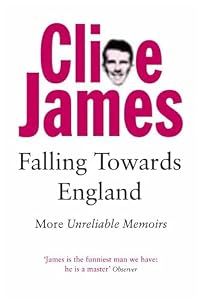
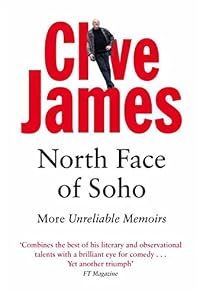
Vivian Leopold James was born on Oct. 7, 1939, in Kogarah, a suburb of Sydney, Australia. His father was taken prisoner by the Japanese at the beginning of World War II and died when the American transport plane carrying him back to Australia crashed into Manila Bay.He changed his first name to Clive after Vivian Leigh became famous for starring show more in Gone With the Wind. After graduating from the University of Sydney and working briefly as an assistant editor on The Sydney Morning Herald, Mr. James set sail for London in 1962. The first volume of his autobiography, "Unreliable Memoirs", which was published in 1980 and rose to the top of the best-seller list in Britain, described his childhood in Australia. Its sequel, "Falling Towards England", covered, in often painful detail, his mostly unsuccessful attempts to gain traction in London, where he shared a flat with the future filmmaker Bruce Beresford. Pembroke College, Cambridge, came to the rescue, offering him a place. Mr. James did manage to earn a degree and even embarked on a doctoral dissertation. Eric Idle, the future Monty Python star, welcomed him into Footlights, the student theatrical troupe; he became its president. He pressed his poems on every journal available and parlayed his enthusiasm for Hollywood. A scrambling career in literary journalism followed, recounted in "North Face of Soho". His essays were first collected in "The Metropolitan Critic" (1974). Later collections included "At the Pillars of Hercules" (1977) and "From the Land of Shadows" (1982). His television criticism, issued in book form in "Visions Before Midnight" (1977), "The Crystal Bucket" (1981) and "Glued to the Box" (1983), was gathered in a single volume, "On Television," in 1991. Clive Leopold James passed away on Sunday 12/01/2019 in Cambridge, England at the age of 80. show less
Awards and Honors
Awards
Distinctions
Common Knowledge
- Original title
- Cultural Amnesia: Necessary Memories from History and the Arts
- Original publication date
- 2007
- People/Characters
- Nadezhda Mandelstam; Thomas Mann; Sigmund Freud; Franz Kafka; Walter Benjamin; Marcel Proust (show all 7); Ludwig Wittgenstein
- Dedication
- To Aung San Suu Kyi, Ayaan Hirsi Ali, Ingrid Betancourt, and to the memory of Sophie Scholl
- First words
- In the late nineteenth and early twentieth centuries, Vienna was the best evidence that the most accommodating and fruitful ground for the life of the mind can be something more broad than a university campus.
- Last words
- (Click to show. Warning: May contain spoilers.)He said that history is the story of liberty becoming conscious of itself.
Classifications
- Genres
- Literature Studies and Criticism, Nonfiction, History, General Nonfiction, Biography & Memoir, Art & Design
- DDC/MDS
- 909.09821 — History & geography History World history Other Geographic Classifications Other Classifications Ocean And Sea Basins The West; the Atlantic region
- LCC
- CB245 .J338 — Auxiliary Sciences of History History of Civilization History of Civilization Civilization and race
- BISAC
Statistics
- Members
- 1,349
- Popularity
- 17,638
- Reviews
- 23
- Rating
- (4.13)
- Languages
- English
- Media
- Paper, Audiobook, Ebook
- ISBNs
- 11
- ASINs
- 14