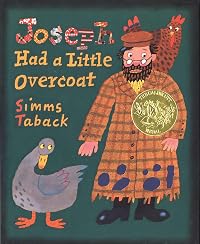
Joseph Had a Little Overcoat
by Simms Taback
On This Page
Description
A very old overcoat is recycled numerous times into a variety of garments.Tags
Recommendations
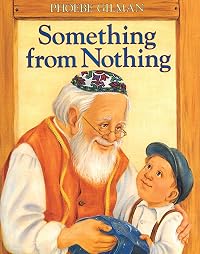



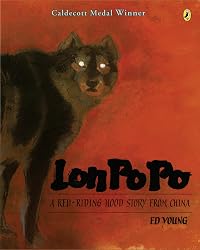
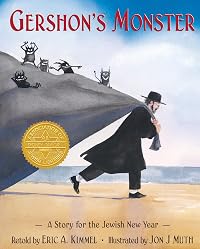
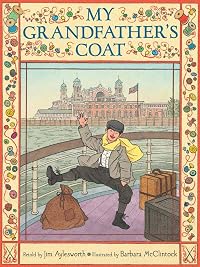
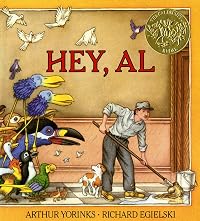

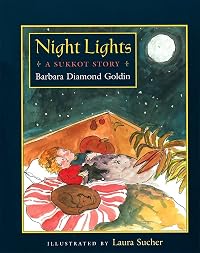
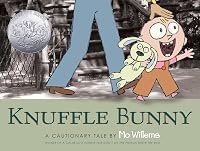
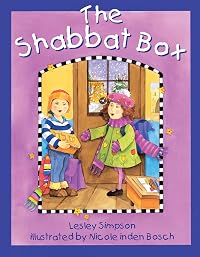
Member Recommendations

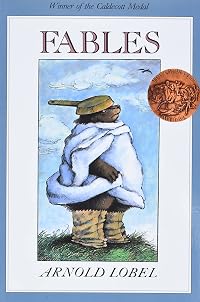
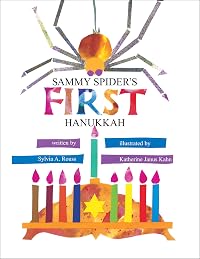
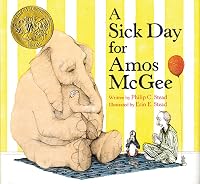
raizel Interesting to compare Joseph's activities, age, and clothing.
AbigailAdams26 Readers who enjoyed this title might want to look at another picture-book retelling of the same folk song.
Member Reviews
As his overcoat gets worn, Joseph, a clever man in a Polish shtetl turns it into a jacket, and then a vest. He continues to recycle it until it’s reduced to a button. Then when he loses it, he turns it into a book and a song. “Which shows you can always make something out of nothing.”
Taback’s bright and spritely mixed media illustrations of watercolor, gouache, and collage include family portraits, sly references to Sholem Aleichem’s stories about Tevye the dairyman and images in Marc Chagall’s paintings. A newspaper lying in the street has the headline “Fiddler on Roof Falls Off Roof” and jokes about the rabbi from Chelm (the village of notorious dimwits) who discovers that the sea is salty because it’s full of herring.
Taback’s bright and spritely mixed media illustrations of watercolor, gouache, and collage include family portraits, sly references to Sholem Aleichem’s stories about Tevye the dairyman and images in Marc Chagall’s paintings. A newspaper lying in the street has the headline “Fiddler on Roof Falls Off Roof” and jokes about the rabbi from Chelm (the village of notorious dimwits) who discovers that the sea is salty because it’s full of herring.
Based upon a Yiddish song, Hob Ich Mir a Mantl ("I Had a Little Overcoat"), which author Simms Taback loved as a young boy, this Caldecott Medal winning picture-book tells the story of Joseph, a shtetl-dwelling man who wears his beloved overcoat to tatters. Undaunted by this catastrophe, he transforms his coat into a shorter jacket, and - when that in turn is worn and tattered - into a vest. And so it goes, as Joseph's erstwhile overcoat becomes smaller and smaller, until he has nothing. But (and here's the moral promised on the title page), "you can always make something out of nothing..."
I enjoyed Joseph Had a Little Overcoat, which apparently first saw print in 1977, with different illustrations, and think the zany mixed media show more artwork - done in watercolor, gouache, pencil, ink and collage - was creative and attention-grabbing. Certainly, I can see why it won Taback the Caldecott! I also enjoyed many of the little visual references to aspects of eastern European Jewish culture - the little tributes to Sholem Aleichem, the letters written in Hebrew (or in Yiddish, using the Hebrew syllabary) - and appreciated the fact that the song which provided the inspiration for this story was included at the rear, in English translation. All in all, a most engaging book, with a fun story (AND a moral!), and entertaining artwork. show less
I enjoyed Joseph Had a Little Overcoat, which apparently first saw print in 1977, with different illustrations, and think the zany mixed media show more artwork - done in watercolor, gouache, pencil, ink and collage - was creative and attention-grabbing. Certainly, I can see why it won Taback the Caldecott! I also enjoyed many of the little visual references to aspects of eastern European Jewish culture - the little tributes to Sholem Aleichem, the letters written in Hebrew (or in Yiddish, using the Hebrew syllabary) - and appreciated the fact that the song which provided the inspiration for this story was included at the rear, in English translation. All in all, a most engaging book, with a fun story (AND a moral!), and entertaining artwork. show less
In this cumulative tale, a Jewish farmer named Joseph has an overcoat which grows too old and worn, so he turns it into a jacket. When that becomes too worn, he makes it into a vest, then a scarf, and so on, until in the end, Joseph has nothing but a button. When he loses the button, he writes a story about the overcoat.
Based on a Yiddish song, Joseph Had a Little Overcoat is a type of folktale known as a "cumulative tale", where a repetitive action is completed, usually with a surprise ending. In this case, Joseph continues to make his overcoat into something new - and smaller - with each iteration, until finally all that is left is a button. At the end, he loses the button, but is able to write a story about it, which leads to the show more explicitly stated moral at the end: "Which shows... you can always make something out of nothing." The axiom is lampshaded and told tongue-in-cheek, as evident by the title page, which has the tag, "He wore the coat for a long time and then something happened to it. (and there's a moral, too!)".
The book itself is unusual through the artwork and style. Most noticeably, there are shapes cut out from the right-hand side of almost every page. Though what is shown of the page beneath matches the illustrations on the page above, when readers turn the page, the shapes outline the new article of clothing Joseph has made each time. The cut-out shapes gradually grow smaller and smaller, until all that is left is a tiny hole: the button.
The artwork is busy and bold. Done in a collage style, there is little perspective, the scale of objects are off (on the first page, a rooster is nearly as large as Joseph himself), and there is a riotous mash of disparate styles. Mismatched patterns are jumbled together, crude drawings are juxtaposed with real pictures of people hanging on the wall, and bright reds and deep greens clash on nearly every page. The effect is startling at first, though vaguely reminiscent of Russian folkart. The effect can be overwhelming, but does offer little gems to discover with each re-reading. For instance, a cat shows up on nearly every page in a new position, the realistic pictures on the wall offer allusions to famous Jewish philosophers and authors, and on nearly every page is a reference to what is happening in the story hidden in framed cross-stitches on the walls or in writing on a letter lying in the corner of the page.
The book also highlights and celebrates Jewish heritage. Newspapers in some of the frames are written in Yiddish and a fiddler on the roof sings snatches of the traditional song the story is based on. Some of the references may be there for parents or other adults enjoying the story more than children, like the newspaper headline that reads, "Fiddler on Roof Falls Off Roof" or a recipe card that says, "Mix a shlemiel and a shlimazel and you'll get a shmegegge".
For such a short book, Joseph Had a Little Overcoat offers much. From its tongue-in-cheek humor, its distinct, bold collage style, and the wealth of new things to find on every page, Joseph Had a Little Overcoat is a hit with children and adults. show less
Based on a Yiddish song, Joseph Had a Little Overcoat is a type of folktale known as a "cumulative tale", where a repetitive action is completed, usually with a surprise ending. In this case, Joseph continues to make his overcoat into something new - and smaller - with each iteration, until finally all that is left is a button. At the end, he loses the button, but is able to write a story about it, which leads to the show more explicitly stated moral at the end: "Which shows... you can always make something out of nothing." The axiom is lampshaded and told tongue-in-cheek, as evident by the title page, which has the tag, "He wore the coat for a long time and then something happened to it. (and there's a moral, too!)".
The book itself is unusual through the artwork and style. Most noticeably, there are shapes cut out from the right-hand side of almost every page. Though what is shown of the page beneath matches the illustrations on the page above, when readers turn the page, the shapes outline the new article of clothing Joseph has made each time. The cut-out shapes gradually grow smaller and smaller, until all that is left is a tiny hole: the button.
The artwork is busy and bold. Done in a collage style, there is little perspective, the scale of objects are off (on the first page, a rooster is nearly as large as Joseph himself), and there is a riotous mash of disparate styles. Mismatched patterns are jumbled together, crude drawings are juxtaposed with real pictures of people hanging on the wall, and bright reds and deep greens clash on nearly every page. The effect is startling at first, though vaguely reminiscent of Russian folkart. The effect can be overwhelming, but does offer little gems to discover with each re-reading. For instance, a cat shows up on nearly every page in a new position, the realistic pictures on the wall offer allusions to famous Jewish philosophers and authors, and on nearly every page is a reference to what is happening in the story hidden in framed cross-stitches on the walls or in writing on a letter lying in the corner of the page.
The book also highlights and celebrates Jewish heritage. Newspapers in some of the frames are written in Yiddish and a fiddler on the roof sings snatches of the traditional song the story is based on. Some of the references may be there for parents or other adults enjoying the story more than children, like the newspaper headline that reads, "Fiddler on Roof Falls Off Roof" or a recipe card that says, "Mix a shlemiel and a shlimazel and you'll get a shmegegge".
For such a short book, Joseph Had a Little Overcoat offers much. From its tongue-in-cheek humor, its distinct, bold collage style, and the wealth of new things to find on every page, Joseph Had a Little Overcoat is a hit with children and adults. show less
I enjoyed this book for its creative visuals and use of cut-outs to illustrate the changes in clothing. An easy read for children, and gives a strong forward message about resourcefulness and not taking things for granted.
This Caldecott-winning picture book tells the story of Joseph, whom, as you may have guessed, had a little overcoat. When his overcoat wears out he doesn’t throw it away. That is not his style. He turns it into a jacket and wears it to the fair. The jacket, in turn, serves him well until it is so worn that Joseph turns it into a vest. As the overcoat shrinks and transforms – from jacket, to vest, to scarf, to necktie, to kerchief to button- Joseph, whom the author’s note mentions looks a lot like himself, never loses his grin at discovering a new way to wear the overcoat, or his zest for the places he wears it. The art, chiefly composed of watercolor, Gouache, pencil, ink and collaged images (of flowers, food and Jewish icons such show more as Freud, Meir and Aleichem) also features clever die-cuts. Holes on the right-hand pages visually trim the coat down to size as the story proceeds. But what happens when Joseph loses his button and is left with nothing? He “made a book about it. Which shows…you can always make something out of nothing.”
The story is a retelling of a Yiddish folk song, “Hob Ich Mir a Mantl” or “I Had a Little Overcoat,” which the author heard as a child. It is also the basis for other tellings of this story, including Something From Nothing by Phoebe Gilman and an earlier version of this title, which Taback reillustrates here. The rhythmic text and vibrant art are enormously appealing. The sometimes kitschy humor and the cultural references embedded for the grown-ups throughout is also part of what makes this version of the tale so nice. All of this serves to amplify the wisdom of this traditional story. It's the essential messages it teaches about optimism, joy and resourcefulness that make this such a resonant work.
Although Joseph is a study in cheerfulness and the ending is happy, it’s not hard to read some sadness under the surface, or at least to speculate that the story developed as a response to difficult circumstances. Long before the camps were the pogroms. Before the pogroms there were the hardships of poverty, of discrimination, of disease and infant death, of slavery and displacement. So the idea of loss as a part of life that must be met creatively, even when there is seemingly nothing at all to hold onto, is one that has power in Jewish culture. As Maeera Y. Shreiber writes in “The End of Exile: Jewish Identity and Its Diasporic Poetics”
“Exile and displacement have long been figured as the requisite or ineluctable conditions of Jewish aesthetic production…One solution to the catastrophe is, of course, to go silent-to hang up one's lyre and acknowledge that forced homelessness dooms the possibility of song, which depends on and affirms a link to the divine principle that bestows meaning on the community. The alternative is to turn a liability into an asset”
The ending’s twist from the material to the conceptual, as the button’s loss generates not another object, but a story, is a testament to the power of art as both cultural treasure and act of resistance. Joseph tells the story of the coat to tell the story of who he is and to tell the story of his people. It is a parable that works equally well in a secular or religious context, of how to face loss and how to generate new life in the face of it.
This book is always a hit at preschool and kindergarten storytimes because children love the rhythm of the text and the quirky art. It is a fun book to recommend for multicultural children’s literature assignments. It is also useful for people looking for material for speeches, sermon and services about creativity, acceptance or change. Occasionally students need books illustrated in various styles. The collages here may serve as a springboard for an art project or program at the library. For librarians or library administrators facing budget cuts or harsh circumstances the book could also provide inspiration regarding making do in hard times.
Works Cited:
Taback, Simms. Joseph Had a Little Overcoat. New York: Viking, 1999. Print.
Shreiber, Maeera Y. “The End of Exile: Jewish Identity and Its Diasporic Poetics.” PMLA Mar 1998: pp. 273-287. JSTOR. Web. Mar 7 2010. show less
The story is a retelling of a Yiddish folk song, “Hob Ich Mir a Mantl” or “I Had a Little Overcoat,” which the author heard as a child. It is also the basis for other tellings of this story, including Something From Nothing by Phoebe Gilman and an earlier version of this title, which Taback reillustrates here. The rhythmic text and vibrant art are enormously appealing. The sometimes kitschy humor and the cultural references embedded for the grown-ups throughout is also part of what makes this version of the tale so nice. All of this serves to amplify the wisdom of this traditional story. It's the essential messages it teaches about optimism, joy and resourcefulness that make this such a resonant work.
Although Joseph is a study in cheerfulness and the ending is happy, it’s not hard to read some sadness under the surface, or at least to speculate that the story developed as a response to difficult circumstances. Long before the camps were the pogroms. Before the pogroms there were the hardships of poverty, of discrimination, of disease and infant death, of slavery and displacement. So the idea of loss as a part of life that must be met creatively, even when there is seemingly nothing at all to hold onto, is one that has power in Jewish culture. As Maeera Y. Shreiber writes in “The End of Exile: Jewish Identity and Its Diasporic Poetics”
“Exile and displacement have long been figured as the requisite or ineluctable conditions of Jewish aesthetic production…One solution to the catastrophe is, of course, to go silent-to hang up one's lyre and acknowledge that forced homelessness dooms the possibility of song, which depends on and affirms a link to the divine principle that bestows meaning on the community. The alternative is to turn a liability into an asset”
The ending’s twist from the material to the conceptual, as the button’s loss generates not another object, but a story, is a testament to the power of art as both cultural treasure and act of resistance. Joseph tells the story of the coat to tell the story of who he is and to tell the story of his people. It is a parable that works equally well in a secular or religious context, of how to face loss and how to generate new life in the face of it.
This book is always a hit at preschool and kindergarten storytimes because children love the rhythm of the text and the quirky art. It is a fun book to recommend for multicultural children’s literature assignments. It is also useful for people looking for material for speeches, sermon and services about creativity, acceptance or change. Occasionally students need books illustrated in various styles. The collages here may serve as a springboard for an art project or program at the library. For librarians or library administrators facing budget cuts or harsh circumstances the book could also provide inspiration regarding making do in hard times.
Works Cited:
Taback, Simms. Joseph Had a Little Overcoat. New York: Viking, 1999. Print.
Shreiber, Maeera Y. “The End of Exile: Jewish Identity and Its Diasporic Poetics.” PMLA Mar 1998: pp. 273-287. JSTOR. Web. Mar 7 2010. show less
Top 100 Favorite because:
Joseph had a little overcoat is what I wish 'There was an old lady who swallowed a fly' had been. Simms Tarback authors and illustrates both books and the die-cut style is unique and I could tell this book was written by the same person who wrote 'old lady'. The bits of Jewish words, people, history, and culture sprinkled throughout the book felt personal and authentic in its placement and purpose. The author's note at the end as well the lyrics to the song that inspired it (albeit translated from Yiddish to English), add even more depth and personality. The whimsy and humorous text is complemented by the colors and expressions in the illustrations, while the bits of Jewish culture enhances the overall show more narrative. I love the 'devil in the details' of real pictures and pieces of Jewish culture inserted into the artwork. show less
Joseph had a little overcoat is what I wish 'There was an old lady who swallowed a fly' had been. Simms Tarback authors and illustrates both books and the die-cut style is unique and I could tell this book was written by the same person who wrote 'old lady'. The bits of Jewish words, people, history, and culture sprinkled throughout the book felt personal and authentic in its placement and purpose. The author's note at the end as well the lyrics to the song that inspired it (albeit translated from Yiddish to English), add even more depth and personality. The whimsy and humorous text is complemented by the colors and expressions in the illustrations, while the bits of Jewish culture enhances the overall show more narrative. I love the 'devil in the details' of real pictures and pieces of Jewish culture inserted into the artwork. show less
Taback was inspired by a traditional Yiddish folk song, that tells the tale of a poor man whose overcoat had many holes. He cuts is down to make a jacket, and when that is worn, he cuts it down further to make a vest. He continues in this way until there is nothing left … and then he makes a book! Proving that with some ingenuity you can make something from nothing.
Taback’s wonderfully detailed illustrations earned a Caldecott Medal. I found myself pouring over the vibrantly colored pages, full of small details that pictured traditional Jewish life in Poland. In his illustrations Taback includes letters, newspapers, portraits, books and posters. These details will appeal more to adults, but I marveled at the little history lessons show more included in them. He even has a “Fiddler on the Roof” in one illustration! I also love the cut-outs that show the use of fabric scraps. show less
Taback’s wonderfully detailed illustrations earned a Caldecott Medal. I found myself pouring over the vibrantly colored pages, full of small details that pictured traditional Jewish life in Poland. In his illustrations Taback includes letters, newspapers, portraits, books and posters. These details will appeal more to adults, but I marveled at the little history lessons show more included in them. He even has a “Fiddler on the Roof” in one illustration! I also love the cut-outs that show the use of fabric scraps. show less
Members
- Recently Added By
Lists

Caldecott Medal Books
91 works; 15 members

Top-Rated Children's Books
87 works; 16 members

Scholastic 100 Best Read-Aloud Books
100 works; 8 members

Books Read in 2023
5,638 works; 147 members
Author Information

42+ Works 8,567 Members
Simms Taback was born on February 13, 1932 in New York City. Before serving two years in the Army, he graduated from Cooper Union for the Advancement of Science and Art in 1953. He worked as an art director at CBS Records and The New York Times and as an advertising art director at William Douglas McAdams. He designed and illustrated the first show more McDonald's Happy Meal box in the 1970s. During his lifetime, he was the illustrator and occasional author of about 50 children's books including There Was an Old Lady Who Swallowed a Fly, Joseph Had a Little Overcoat, which won the Caldecott Medal in 2000, and Postcards from Camp. He died of pancreatic cancer on December 25, 2011 at the age of 79. (Bowker Author Biography) show less
Awards and Honors
Awards
Distinctions
Series
Belongs to Publisher Series
Work Relationships
Has the adaptation
Common Knowledge
- Canonical title
- Joseph Had a Little Overcoat
- Original publication date
- 1977; 1999 new illustrations - c Simms Taback, Viking Children's Books, a division of Penguin Putnam; 2000-09 Scholastic
- People/Characters
- Joseph
- Related movies
- It's Red, It's Green; Joseph Had a Little Overcoat (2002 | IMDb)
- Dedication
- Dedicated to Alex Cohen; Donated by the Starr - Weg Family in honor of Amir's Bar Mitzvah
- First words
- Joseph had a little overcoat. It was old and worn.
- Last words
- (Click to show. Warning: May contain spoilers.)So Joseph made a book about it. Which shows ...
you can always make something from nothing. - Disambiguation notice
- 1977 version has different illustrations; both versions illustrated by the author, Simms Taback.
Classifications
Statistics
- Members
- 3,120
- Popularity
- 5,668
- Reviews
- 204
- Rating
- (4.30)
- Languages
- 5 — English, French, Hebrew, Korean, Russian
- Media
- Paper, Audiobook, Ebook
- ISBNs
- 36
- UPCs
- 1
- ASINs
- 12