A Fortunate Man: The Story of a Country Doctor
by John Berger
On This Page
Description
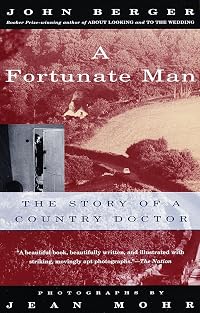
In 1966 John Berger spent three months in the Forest of Dean shadowing an English country GP, John Sassall. Sassall is a fortunate man - his work occupies and fulfils him, he lives amongst the patients he treats, the line between his life and his work is happily blurred. In A Fortunate Man, Berger's text and the photography of Jean Mohr reveal with extraordinary intensity the life of a remarkable man. It is a portrait of one selfless individual and the rural community for which he became the show more hub. Drawing on psychology, biography and medicine, A Fortunate Man is a portrait of sacrifice. It is also a profound exploration of what it means to be a doctor, to serve a community and to heal. show lessTags
Recommendations






























Member Reviews
John Berger’s study of a country doctor named Sassell is as thought-provoking as it is ground-breaking (still). Accompanied by numerous poignant photographs from Jean Mohr, Berger’s essay considers what it is to be a country doctor and in particular how Sassall became one, how it changed him, and how he changed it. With an almost clinical detachment, Berger reflects on Sassall’s accomplishments and import of his role. It is both philosophically and phenomenologically rigorous and yet full of light and empathy. Absolutely fascinating.
Of course Berger would not be Berger if his very process of documenting this doctor were not itself a subject of study and reflection. And as Berger struggles with the meaning of a biography that is show more not of or about some famous political or military figure, we are led to wonder about wider issues, both social and political. Highly recommended. show less
Of course Berger would not be Berger if his very process of documenting this doctor were not itself a subject of study and reflection. And as Berger struggles with the meaning of a biography that is show more not of or about some famous political or military figure, we are led to wonder about wider issues, both social and political. Highly recommended. show less
In this quietly revolutionary work of social observation and medical philosophy, Booker Prize-winning writer John Berger and the photographer Jean Mohr train their gaze on an English country doctor and find a universal man--one who has taken it upon himself to recognize his patient's humanity when illness and the fear of death have made them unrecognizable to themselves. In the impoverished rural community in which he works, John Sassall tend the maimed, the dying, and the lonely. He is not only the dispenser of cures but the repository of memories. And as Berger and Mohr follow Sassall about his rounds, they produce a book whose careful detail broadens into a meditation on the value we assign a human life. First published thirty years show more ago, A Fortunate Man remains moving and deeply relevant--no other book has offered such a close and passionate investigation of the roles doctors play in their society. "In contemporary letters John Berger seems to me peerless; not since Lawrence has there been a writer who offers such attentiveness to the sensual world with responsiveness to the imperatives of conscience." --Susan Sontag show less
Years ago I was at a dinner party, one of the group being a quietly spoken woman who had largely stayed mute. Somebody happened to say that she had a good dentist. Suddenly this woman exploded. 'How do you know he's a good dentist', she practically spat the words out. It wasn't a question, it was an accusation. None of us really knew how to respond and I still don't, despite having considered it a lot. Not being a dentist, how could I possibly 'know'? Whereas she, it now transpired, was both a practising and academic dentist. We'd strayed onto her turf and there didn't seem to be any getting off it. She mentioned no names, but talked darkly of dentists who were popular in Melbourne but who were clueless at their work. Gulp. My dentist show more was popular. I liked him. I went about calling him a 'good dentist'. Suddenly my very teeth seemed to loosen in my jaw. I got a tooth ache on the spot.
So, let's change that question to 'How do we define why we see one doctor as good and another not?'
For me, it's 'bedside manner'. Some doctors have it, others don't. Despite thinking it is vital, I have never tried to explain what it is. I've only felt either that I've been in its presence, or, more often, I haven't. Having read this book, I can see how trivial my thoughts were. Berger took the opportunity to explore the question profoundly. I think it is important to note the wording of the question. We are not asking which doctor is better, we are asking which doctor we perceive as better and why.
Enter Dr Eskell, presented in the book as Dr Sassall.
The book begins by following Sassall about as he attends to patients. From the very beginning we are aware that he is nothing if not fallible. In the first scenario he tells witnesses to an accident in the forest that the victim will not lose his leg. He does. What confidence on the part of both doctor and writer to begin this way.
And then, after these descriptions, Berger starts his process of analysing what it all means.
There are certainly openings for criticising this book. Berger perhaps goes too far in his attempts to explain what he sees. As some have noted, he is not exactly waving the flag for feminism either. I think it's obvious that Berger is feeling his way and that we may see this book as the precursor to what then became his life's work, writing of the European peasant and his vanishing world. Without his thinking hard about Sassell and his community, I find it difficult to see that he would have picked up that cause.
But the most interesting point to be made is that both individual doctors and the medical establishment at large still place such great weight upon it. The faint praise waved in its direction by the ordinary reader, as represented on Goodreads, is incredibly different from the place it holds in medical literature.
Professor Roger Jones, in 2015 as editor of the British Journal of General Practice wrote that 'First published in 1967, this is one of those must-read general practice books, essential for every trainer, trainee and practice library, and one, I suspect, which has been more frequently recommended than read.' The review starts out in rather uncomplimentary terms, but grudgingly ends:
In my opinion, Jones, like lots of others, doesn't understand that Berger is not painting Sassell as a saint, far from it. He is clearly concerned that Sassell is a human being trying to do things that are humanly not possible. And it is made obvious in the text that the 'Fortunate' of the title is not a positive thing. Rather, it is the cause of the doctor's undoing. I don't see at any point during the book anything but concern from Berger. Nobody could read this book and be surprised that its subject killed himself.
In 2005, on the occasion of a general celebration of Berger's work, a special session on A Fortunate Man was held. Leading up to it, Dr Gene Feder said that it was '...still the most important book about general practice ever written.'
The plug for it continued:
In 2009, in a post by Dr Peter Kramer, he comments not only on how influential this book was on his own determination to become a doctor, but quotes Iona Heath "If I could choose only one book on the planet, it would be this book." She said it on the occasion of the 2005 event at which a reissue of the book was launched.
Professor Ken Worpole, later commented in his report of the event that 'Rereading A Fortunate Man I was astonished to realise that I had absorbed many of the passages in it by heart and have paraphrased them as my own thoughts and insights over the past forty years, forgetful of their origins in this remarkable work.' His report continues
more here: https://alittleteaalittlechat.wordpress.com/2018/09/11/a-fortunate-man-by-john-b... show less
So, let's change that question to 'How do we define why we see one doctor as good and another not?'
For me, it's 'bedside manner'. Some doctors have it, others don't. Despite thinking it is vital, I have never tried to explain what it is. I've only felt either that I've been in its presence, or, more often, I haven't. Having read this book, I can see how trivial my thoughts were. Berger took the opportunity to explore the question profoundly. I think it is important to note the wording of the question. We are not asking which doctor is better, we are asking which doctor we perceive as better and why.
Enter Dr Eskell, presented in the book as Dr Sassall.
How is it that Sassall is acknowledged as a good doctor? By his cures? This would seem to be the answer. But I doubt it. You have to be a startlingly bad doctor and make many mistakes before the results tell against you. In the eyes of the layman the results always tend to favour the doctor. No, he is acknowledged as a good doctor because he meets the deep but unformulated expectation of the sick for a sense of fraternity. He recognizes them.
The book begins by following Sassall about as he attends to patients. From the very beginning we are aware that he is nothing if not fallible. In the first scenario he tells witnesses to an accident in the forest that the victim will not lose his leg. He does. What confidence on the part of both doctor and writer to begin this way.
And then, after these descriptions, Berger starts his process of analysing what it all means.
This individual and closely intimate recognition is required on both a physical and psychological level. On the former it constitutes the art of diagnosis. Good general diagnosticians are rare, not because most doctors lack medical knowledge, but because most are incapable of taking in all the possibly relevant facts - emotional, historical, environmental as well as physical. They are searching for specific conditions instead of the truth about a man which may then suggest various conditions. It may be that computers will soon diagnose better than doctors. But the facts fed to the computers will still have to be the result of intimate, individual recognition of the patient.
On the psychological level recognition means support. As soon as we are ill we fear that our illness is unique. We argue with ourselves and rationalize, but a ghost of the fear remains. And it remains for a very good reason. The illness, as an undefined force, is a potential threat to our very being and we are bound to be highly conscious of the uniqueness of that being. The illness, in other words, shares in our own uniqueness. By fearing its threat, we embrace it and make it specially our own. That is why patients are inordinately relieved when doctors give their complaint a name. The name may mean very little to them; they may understand nothing of what it signifies; but because it has a name, it has an independent existence from them. They can now struggle or complain against it. To have a complaint recognized, that is to say defined, limited and depersonalized, is to be made stronger. The whole process, as it includes doctor and patient, is a dialectical one. The doctor in order to recognize the illness fully - I say fully because the recognition must be such as to indicate the specific treatment - must first recognize the patient as a person: but for the patient - provided that he trusts the doctor and that trust finally depends upon the efficacy of his treatment - the doctor's recognition of his illness is a help because it separates and depersonalizes that illness.
There are certainly openings for criticising this book. Berger perhaps goes too far in his attempts to explain what he sees. As some have noted, he is not exactly waving the flag for feminism either. I think it's obvious that Berger is feeling his way and that we may see this book as the precursor to what then became his life's work, writing of the European peasant and his vanishing world. Without his thinking hard about Sassell and his community, I find it difficult to see that he would have picked up that cause.
But the most interesting point to be made is that both individual doctors and the medical establishment at large still place such great weight upon it. The faint praise waved in its direction by the ordinary reader, as represented on Goodreads, is incredibly different from the place it holds in medical literature.
Professor Roger Jones, in 2015 as editor of the British Journal of General Practice wrote that 'First published in 1967, this is one of those must-read general practice books, essential for every trainer, trainee and practice library, and one, I suspect, which has been more frequently recommended than read.' The review starts out in rather uncomplimentary terms, but grudgingly ends:
However, re-reading it at one sitting very recently, I recognised the limpid beauty of some of Berger’s prose, the subtlety of his descriptions of nature and of human interactions, and his insights into the needs of ordinary people faced with illness, anguish and loss. His – or is it Sassall’s? – understanding of the role of the general practitioner as a witness and a “clerk of record”, needs to be widely understood, and never more so in these days of therapeutic miracles and performance indicators, when the unmeasurable essence of patient care can so easily be overlooked.
In my opinion, Jones, like lots of others, doesn't understand that Berger is not painting Sassell as a saint, far from it. He is clearly concerned that Sassell is a human being trying to do things that are humanly not possible. And it is made obvious in the text that the 'Fortunate' of the title is not a positive thing. Rather, it is the cause of the doctor's undoing. I don't see at any point during the book anything but concern from Berger. Nobody could read this book and be surprised that its subject killed himself.
In 2005, on the occasion of a general celebration of Berger's work, a special session on A Fortunate Man was held. Leading up to it, Dr Gene Feder said that it was '...still the most important book about general practice ever written.'
The plug for it continued:
Speakers will include Iona Heath, Tony Calland (who was a partner in John Sassall's practice), Patrick Hutt (a recently qualified doctor and author of Confronting an III Society), Jane Simpson (junior doctor), Michael Rosen (broadcaster and writer) and Sukhdev Sandu (critic and writer). They will talk about what the book means to them and what it still has to tell us almost four decades after it was first published.
In 2009, in a post by Dr Peter Kramer, he comments not only on how influential this book was on his own determination to become a doctor, but quotes Iona Heath "If I could choose only one book on the planet, it would be this book." She said it on the occasion of the 2005 event at which a reissue of the book was launched.
On the evening of 26 April 2005, nearly forty years after its publication, and as part of a short London season of events based around the work of John Berger, over 200 people, many of them doctors, packed into one of the lecture theatres at Queen Mary College, London, to testify to one extraordinary book which had shaped their lives and political beliefs. The event was sponsored by the Royal College of General Practitioners, who have just republished it.
Professor Ken Worpole, later commented in his report of the event that 'Rereading A Fortunate Man I was astonished to realise that I had absorbed many of the passages in it by heart and have paraphrased them as my own thoughts and insights over the past forty years, forgetful of their origins in this remarkable work.' His report continues
more here: https://alittleteaalittlechat.wordpress.com/2018/09/11/a-fortunate-man-by-john-b... show less
Years ago I was at a dinner party, one of the group being a quietly spoken woman who had largely stayed mute. Somebody happened to say that she had a good dentist. Suddenly this woman exploded. 'How do you know he's a good dentist', she practically spat the words out. It wasn't a question, it was an accusation. None of us really knew how to respond and I still don't, despite having considered it a lot. Not being a dentist, how could I possibly 'know'? Whereas she, it now transpired, was both a practising and academic dentist. We'd strayed onto her turf and there didn't seem to be any getting off it. She mentioned no names, but talked darkly of dentists who were popular in Melbourne but who were clueless at their work. Gulp. My dentist show more was popular. I liked him. I went about calling him a 'good dentist'. Suddenly my very teeth seemed to loosen in my jaw. I got a tooth ache on the spot.
So, let's change that question to 'How do we define why we see one doctor as good and another not?'
For me, it's 'bedside manner'. Some doctors have it, others don't. Despite thinking it is vital, I have never tried to explain what it is. I've only felt either that I've been in its presence, or, more often, I haven't. Having read this book, I can see how trivial my thoughts were. Berger took the opportunity to explore the question profoundly. I think it is important to note the wording of the question. We are not asking which doctor is better, we are asking which doctor we perceive as better and why.
Enter Dr Eskell, presented in the book as Dr Sassall.
The book begins by following Sassall about as he attends to patients. From the very beginning we are aware that he is nothing if not fallible. In the first scenario he tells witnesses to an accident in the forest that the victim will not lose his leg. He does. What confidence on the part of both doctor and writer to begin this way.
And then, after these descriptions, Berger starts his process of analysing what it all means.
There are certainly openings for criticising this book. Berger perhaps goes too far in his attempts to explain what he sees. As some have noted, he is not exactly waving the flag for feminism either. I think it's obvious that Berger is feeling his way and that we may see this book as the precursor to what then became his life's work, writing of the European peasant and his vanishing world. Without his thinking hard about Sassell and his community, I find it difficult to see that he would have picked up that cause.
But the most interesting point to be made is that both individual doctors and the medical establishment at large still place such great weight upon it. The faint praise waved in its direction by the ordinary reader, as represented on Goodreads, is incredibly different from the place it holds in medical literature.
Professor Roger Jones, in 2015 as editor of the British Journal of General Practice wrote that 'First published in 1967, this is one of those must-read general practice books, essential for every trainer, trainee and practice library, and one, I suspect, which has been more frequently recommended than read.' The review starts out in rather uncomplimentary terms, but grudgingly ends:
In my opinion, Jones, like lots of others, doesn't understand that Berger is not painting Sassell as a saint, far from it. He is clearly concerned that Sassell is a human being trying to do things that are humanly not possible. And it is made obvious in the text that the 'Fortunate' of the title is not a positive thing. Rather, it is the cause of the doctor's undoing. I don't see at any point during the book anything but concern from Berger. Nobody could read this book and be surprised that its subject killed himself.
In 2005, on the occasion of a general celebration of Berger's work, a special session on A Fortunate Man was held. Leading up to it, Dr Gene Feder said that it was '...still the most important book about general practice ever written.'
The plug for it continued:
In 2009, in a post by Dr Peter Kramer, he comments not only on how influential this book was on his own determination to become a doctor, but quotes Iona Heath "If I could choose only one book on the planet, it would be this book." She said it on the occasion of the 2005 event at which a reissue of the book was launched.
Professor Ken Worpole, later commented in his report of the event that 'Rereading A Fortunate Man I was astonished to realise that I had absorbed many of the passages in it by heart and have paraphrased them as my own thoughts and insights over the past forty years, forgetful of their origins in this remarkable work.' His report continues
more here: https://alittleteaalittlechat.wordpress.com/2018/09/11/a-fortunate-man-by-john-b... show less
So, let's change that question to 'How do we define why we see one doctor as good and another not?'
For me, it's 'bedside manner'. Some doctors have it, others don't. Despite thinking it is vital, I have never tried to explain what it is. I've only felt either that I've been in its presence, or, more often, I haven't. Having read this book, I can see how trivial my thoughts were. Berger took the opportunity to explore the question profoundly. I think it is important to note the wording of the question. We are not asking which doctor is better, we are asking which doctor we perceive as better and why.
Enter Dr Eskell, presented in the book as Dr Sassall.
How is it that Sassall is acknowledged as a good doctor? By his cures? This would seem to be the answer. But I doubt it. You have to be a startlingly bad doctor and make many mistakes before the results tell against you. In the eyes of the layman the results always tend to favour the doctor. No, he is acknowledged as a good doctor because he meets the deep but unformulated expectation of the sick for a sense of fraternity. He recognizes them.
The book begins by following Sassall about as he attends to patients. From the very beginning we are aware that he is nothing if not fallible. In the first scenario he tells witnesses to an accident in the forest that the victim will not lose his leg. He does. What confidence on the part of both doctor and writer to begin this way.
And then, after these descriptions, Berger starts his process of analysing what it all means.
This individual and closely intimate recognition is required on both a physical and psychological level. On the former it constitutes the art of diagnosis. Good general diagnosticians are rare, not because most doctors lack medical knowledge, but because most are incapable of taking in all the possibly relevant facts - emotional, historical, environmental as well as physical. They are searching for specific conditions instead of the truth about a man which may then suggest various conditions. It may be that computers will soon diagnose better than doctors. But the facts fed to the computers will still have to be the result of intimate, individual recognition of the patient.
On the psychological level recognition means support. As soon as we are ill we fear that our illness is unique. We argue with ourselves and rationalize, but a ghost of the fear remains. And it remains for a very good reason. The illness, as an undefined force, is a potential threat to our very being and we are bound to be highly conscious of the uniqueness of that being. The illness, in other words, shares in our own uniqueness. By fearing its threat, we embrace it and make it specially our own. That is why patients are inordinately relieved when doctors give their complaint a name. The name may mean very little to them; they may understand nothing of what it signifies; but because it has a name, it has an independent existence from them. They can now struggle or complain against it. To have a complaint recognized, that is to say defined, limited and depersonalized, is to be made stronger. The whole process, as it includes doctor and patient, is a dialectical one. The doctor in order to recognize the illness fully - I say fully because the recognition must be such as to indicate the specific treatment - must first recognize the patient as a person: but for the patient - provided that he trusts the doctor and that trust finally depends upon the efficacy of his treatment - the doctor's recognition of his illness is a help because it separates and depersonalizes that illness.
There are certainly openings for criticising this book. Berger perhaps goes too far in his attempts to explain what he sees. As some have noted, he is not exactly waving the flag for feminism either. I think it's obvious that Berger is feeling his way and that we may see this book as the precursor to what then became his life's work, writing of the European peasant and his vanishing world. Without his thinking hard about Sassell and his community, I find it difficult to see that he would have picked up that cause.
But the most interesting point to be made is that both individual doctors and the medical establishment at large still place such great weight upon it. The faint praise waved in its direction by the ordinary reader, as represented on Goodreads, is incredibly different from the place it holds in medical literature.
Professor Roger Jones, in 2015 as editor of the British Journal of General Practice wrote that 'First published in 1967, this is one of those must-read general practice books, essential for every trainer, trainee and practice library, and one, I suspect, which has been more frequently recommended than read.' The review starts out in rather uncomplimentary terms, but grudgingly ends:
However, re-reading it at one sitting very recently, I recognised the limpid beauty of some of Berger’s prose, the subtlety of his descriptions of nature and of human interactions, and his insights into the needs of ordinary people faced with illness, anguish and loss. His – or is it Sassall’s? – understanding of the role of the general practitioner as a witness and a “clerk of record”, needs to be widely understood, and never more so in these days of therapeutic miracles and performance indicators, when the unmeasurable essence of patient care can so easily be overlooked.
In my opinion, Jones, like lots of others, doesn't understand that Berger is not painting Sassell as a saint, far from it. He is clearly concerned that Sassell is a human being trying to do things that are humanly not possible. And it is made obvious in the text that the 'Fortunate' of the title is not a positive thing. Rather, it is the cause of the doctor's undoing. I don't see at any point during the book anything but concern from Berger. Nobody could read this book and be surprised that its subject killed himself.
In 2005, on the occasion of a general celebration of Berger's work, a special session on A Fortunate Man was held. Leading up to it, Dr Gene Feder said that it was '...still the most important book about general practice ever written.'
The plug for it continued:
Speakers will include Iona Heath, Tony Calland (who was a partner in John Sassall's practice), Patrick Hutt (a recently qualified doctor and author of Confronting an III Society), Jane Simpson (junior doctor), Michael Rosen (broadcaster and writer) and Sukhdev Sandu (critic and writer). They will talk about what the book means to them and what it still has to tell us almost four decades after it was first published.
In 2009, in a post by Dr Peter Kramer, he comments not only on how influential this book was on his own determination to become a doctor, but quotes Iona Heath "If I could choose only one book on the planet, it would be this book." She said it on the occasion of the 2005 event at which a reissue of the book was launched.
On the evening of 26 April 2005, nearly forty years after its publication, and as part of a short London season of events based around the work of John Berger, over 200 people, many of them doctors, packed into one of the lecture theatres at Queen Mary College, London, to testify to one extraordinary book which had shaped their lives and political beliefs. The event was sponsored by the Royal College of General Practitioners, who have just republished it.
Professor Ken Worpole, later commented in his report of the event that 'Rereading A Fortunate Man I was astonished to realise that I had absorbed many of the passages in it by heart and have paraphrased them as my own thoughts and insights over the past forty years, forgetful of their origins in this remarkable work.' His report continues
more here: https://alittleteaalittlechat.wordpress.com/2018/09/11/a-fortunate-man-by-john-b... show less
Super analysis of a GP in rural Gloucestershire; particularly relevant at the time of the pandemic when doctors, overwhelmed, seemed distant from the patients as individuals, with loss of personality and being recognised, doctor and patient. This later edition has a sad ending - what is the worth of human life, when can one be satisfied?
John Berger never fails to impress, with his innovative fusion of art forms in his work. He is a literary innovator like no other, making ideas come alive. ‘A Fortunate Man’ (1967) is a philosophical meditation and a social observation on the doctor’s role in a community, the defining of the doctor-patient relationship and a study on the confrontation of death.
He partnered with photographer Jean Mohr to create a memorable work which fuses visual images and the written word – using the photos as integrated text. He created a innovative text combining memoir, philosophical meditation, sociological commentary, essay and photojournalism in a unique and engaging fashion - a haunted and transfixing region somewhere between fiction show more and non-fiction. He can perhaps be regarded as the father of such writers such as Ryszard Kapu'sci'nski, W G Sebald and Eduardo Galeano.
He uses psychoanalysis and illustrations of medical care to define his protagonist, Dr. Sassall, a country doctor in an economically depressed area in England. Berger discusses such issues as the role of the doctor-patient relationship, and the evaluative process of clinical diagnosis with the use of intuition, diagnostic acumen, and intellectual challenge. The immersion of the doctor in the process of human illness is described and illuminated. He describes the ‘Universal Man’, one who has taken it upon himself to recognize his patient's humanity when illness and the fear of death have made them unrecognizable to themselves.
First published thirty years ago, it is still recognizable to me today as a practicing general physician. The privileged position, the required loss of privacyof the patient, the sense of trust and responsibility that comes with that privilege, the self-enquiry required with the intense mental stress involved in assessing your own work as worthy or requiring further skill acquisition.
As a solo doctor in a country locale, Dr. Sassall was faced with the intellectual challenge of self regulation of his ongoing education and standards. He was part of the community, and had a unique social status that allowed him to shape his relationships with people in a unique manner.
Although some of the philosophical renderings of the doctor’s role by Berger did not hit a chord with me, many were spot on, and the doctor’s descriptions were completely in line with mine.
This book should probably be compulsory reading for all medical students, as a discussion of the doctor-patient relationship, apart from the obvious artistic merit. The narratives of Dr. Sassall's clinical encounters and the portrait of his professional and emotional progress, have much to teach the practicing physician about the jointly created physician-patient relationship.
I think that this book was written at a turning point in medical care, when doctor’s role in society was changing dramatically – from that of dutiful care-giver, to a more depersonalized one of information transmission and disengaged advice. This is witnessed in the decline of the general practionner in solo practices, the growth of sub-specialists in groups, the increase in adversarial actions towards doctors, and the disenchantment of the public brought about by this altered relationship. Medicine has evolved into a service-providing technologically-based industry and moved further away from the personal intensity of care-giving.
As a clinician in medicine, it was also an interesting medical study to read this book. The intensity of the emotional and mental dedication of the doctor was recognizable. Also recognizable were common traits such as the need for ongoing intellectual exploration and evaluation.
But it came to me, early in this book, that this doctor suffered from manic-depressive disorder – a prevalent mental problem in intelligent people. I wondered if this doctor would eventually self-destruct, reading about his black periods and his episodic severe disengagement and mental immobility.
Indeed, I read somewhere else that Dr. Sassall committed suicide – I don’t know how long after this book was published. I felt a huge sadness that he was not able to benefit from our more ‘modern’ psychiatric tools of treatment today – in the end, the most desperate patient in the book was the doctor.
This book remains in my mind as deeply moving, passionate and tragic. In the words of Susan Sontag:
"In contemporary letters John Berger seems to me peerless; not since Lawrence has there been a writer who offers such attentiveness to the sensual world with responsiveness to the imperatives of conscience." show less
He partnered with photographer Jean Mohr to create a memorable work which fuses visual images and the written word – using the photos as integrated text. He created a innovative text combining memoir, philosophical meditation, sociological commentary, essay and photojournalism in a unique and engaging fashion - a haunted and transfixing region somewhere between fiction show more and non-fiction. He can perhaps be regarded as the father of such writers such as Ryszard Kapu'sci'nski, W G Sebald and Eduardo Galeano.
He uses psychoanalysis and illustrations of medical care to define his protagonist, Dr. Sassall, a country doctor in an economically depressed area in England. Berger discusses such issues as the role of the doctor-patient relationship, and the evaluative process of clinical diagnosis with the use of intuition, diagnostic acumen, and intellectual challenge. The immersion of the doctor in the process of human illness is described and illuminated. He describes the ‘Universal Man’, one who has taken it upon himself to recognize his patient's humanity when illness and the fear of death have made them unrecognizable to themselves.
First published thirty years ago, it is still recognizable to me today as a practicing general physician. The privileged position, the required loss of privacyof the patient, the sense of trust and responsibility that comes with that privilege, the self-enquiry required with the intense mental stress involved in assessing your own work as worthy or requiring further skill acquisition.
As a solo doctor in a country locale, Dr. Sassall was faced with the intellectual challenge of self regulation of his ongoing education and standards. He was part of the community, and had a unique social status that allowed him to shape his relationships with people in a unique manner.
Although some of the philosophical renderings of the doctor’s role by Berger did not hit a chord with me, many were spot on, and the doctor’s descriptions were completely in line with mine.
This book should probably be compulsory reading for all medical students, as a discussion of the doctor-patient relationship, apart from the obvious artistic merit. The narratives of Dr. Sassall's clinical encounters and the portrait of his professional and emotional progress, have much to teach the practicing physician about the jointly created physician-patient relationship.
I think that this book was written at a turning point in medical care, when doctor’s role in society was changing dramatically – from that of dutiful care-giver, to a more depersonalized one of information transmission and disengaged advice. This is witnessed in the decline of the general practionner in solo practices, the growth of sub-specialists in groups, the increase in adversarial actions towards doctors, and the disenchantment of the public brought about by this altered relationship. Medicine has evolved into a service-providing technologically-based industry and moved further away from the personal intensity of care-giving.
As a clinician in medicine, it was also an interesting medical study to read this book. The intensity of the emotional and mental dedication of the doctor was recognizable. Also recognizable were common traits such as the need for ongoing intellectual exploration and evaluation.
But it came to me, early in this book, that this doctor suffered from manic-depressive disorder – a prevalent mental problem in intelligent people. I wondered if this doctor would eventually self-destruct, reading about his black periods and his episodic severe disengagement and mental immobility.
Indeed, I read somewhere else that Dr. Sassall committed suicide – I don’t know how long after this book was published. I felt a huge sadness that he was not able to benefit from our more ‘modern’ psychiatric tools of treatment today – in the end, the most desperate patient in the book was the doctor.
This book remains in my mind as deeply moving, passionate and tragic. In the words of Susan Sontag:
"In contemporary letters John Berger seems to me peerless; not since Lawrence has there been a writer who offers such attentiveness to the sensual world with responsiveness to the imperatives of conscience." show less
A sad, yet vocative story of a country doctor in rural Gloucestershire during the 1960s. The forest of Dean is quite a deprived area and remain so even to this day. The dedication and attribution of a man’s life to the betterment of the population that he serves, is humbling and thoughtful. An understanding of the sacrifice that this is comes across and there is no showing away from the negative aspect of this. This is not heroism nor idolisation this is an accolade and tribute to a duty and the life well lived.
Members
- Recently Added By
Lists

Best Medical Nonfiction
79 works; 29 members

Best Biographies, Autobiographies and Memoirs
465 works; 160 members

Mustich's 1000 Books to Read Before You Die: A Life Changing List
1,001 works; 19 members

Books We'd Want on a Desert Island
203 works; 131 members

The Five Books That Represent Us
391 works; 148 members
Author Information

150+ Works 17,204 Members
John Peter Berger was born in London, England on November 5, 1926. After serving in the British Army from 1944 to 1946, he enrolled in the Chelsea School of Art. He began his career as a painter and exhibited work at a number of London galleries in the late 1940s. He then worked as an art critic for The New Statesman for a decade. He wrote fiction show more and nonfiction including several volumes of art criticism. His novels include A Painter of Our Time, From A to X, and G., which won both the James Tait Black Memorial Prize and the Booker Prize in 1972. His other works include an essay collection entitled Permanent Red, Into Their Labors, and a book and television series entitled Ways of Seeing. In the 1970s, he collaborated with the director Alain Tanner on three films. He wrote or co-wrote La Salamandre, The Middle of the World, and Jonah Who Will Be 25 in the Year 2000. He died on January 1, 2017 at the age of 90. (Bowker Author Biography) show less
All Editions
Awards and Honors
Notable Lists
Series
Belongs to Publisher Series
Common Knowledge
- Canonical title*
- Un hombre afortunado
- Original title
- A Fortunate man
- Original publication date
- 1967
- Dedication
- This book is dedicated
to John and Betty whom it concerns, and
to Phillip O'Connor
for the letters he wrote to me whilst I was writing it.
J.B. - First words
- Landscapes can be deceptive. Sometimes a landscape seems to be less a setting for the life of its inhabitants than a curtain behind which their struggles, achievements and accidents take place.
- Last words
- (Click to show. Warning: May contain spoilers.)The conclusion is inconclusive and simple. Sassall practices medicine. His practice perhaps corresponds a little to my description of it. Since we have as yet scarcely begun to establish a society which can assess his contribution socially, since we can only judge him, at best, by empirical standards of convenience, I can only end by quoting the logic by which he himself has to work, a logic which for all its stoicism has in it the seed of a great affirmative vision: 'Whenever I am reminded of death – and it happens every day – I think of my own, and this makes me try to work harder.'
*Some information comes from Common Knowledge in other languages. Click "Edit" for more information.
Classifications
Statistics
- Members
- 366
- Popularity
- 85,360
- Reviews
- 13
- Rating
- (4.02)
- Languages
- 6 — Chinese, English, French, German, Italian, Spanish
- Media
- Paper, Ebook
- ISBNs
- 17
- ASINs
- 9