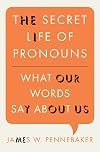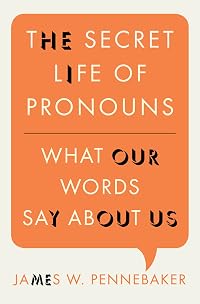
The Secret Life of Pronouns: What Our Words Say about Us
by James W. Pennebaker
On This Page
Description
We spend our lives communicating. In the last fifty years, we've zoomed through radically different forms of communication, from typewriters to tablet computers, text messages to tweets. We generate more and more words with each passing day. Hiding in that deluge of language are amazing insights into who we are, how we think, and what we feel. In The Secret Life of Pronouns, social psychologist and language expert James W. Pennebaker uses his groundbreaking research in computational show more linguistics-in essence, counting the frequency of words we use-to show that our language carries secrets about our feelings, our self-concept, and our social intelligence. Our most forgettable words, such as pronouns and prepositions, can be the most revealing, their patterns are as distinctive as fingerprints. Using innovative analytic techniques, Pennebaker X-rays everything from Craigslist advertisements to the Federalist Papers-or your own writing, in quizzes you can take yourself-to yield unexpected insights. Who would have predicted that the high school student who uses too many verbs in her college admissions essay is likely to make lower grades in college? Or that a world leader's use of pronouns could reliably presage whether he led his country into war? You'll learn why it's bad when politicians use "we" instead of "I," what Lady Gaga and William Butler Yeats have in common, and how Ebenezer Scrooge's syntax hints at his self-deception and repressed emotion. Barack Obama, Sylvia Plath, and King Lear are among the figures who make cameo appearances in this sprightly, surprising tour of what our words are saying-whether we mean them to or not. show lessTags
Recommendations










Member Reviews
This book contains some Chaz Bono-level anecdotal evidence about the effects of testosterone on behavior. I kind of wanted to cry when I read the following (but maybe I've got too much naturally-occuring testosterone coursing through my biologically-female (or whatever) veins preventing me from crying, or using social pronouns).
And I quote:
"For a variety of reasons, both men and women occasionally undergo testosterone therapy, whereby they are given periodic injections of the hormone. What would happen to their language during times when their testosterone levels were high versus when they were low? Through an odd series of events, I was able to answer the question." (57)
How does Pennebaker answer this question? He looks at the show more writing of two people: one 28yo transguy taking T to transition and one 60yo non-trans guy taking T to"restore his upper body strength" (58)
Now that's rigorous science, folks. Wait, though, there's more.
"...there was one fascinating and reliable difference--in social pronouns (including words like we, us, he, she, they, and them). As testosterone levels dropped, they used more social pronouns. Think what this means: Both GH and the anthropologist inject themselves with testosterone and they now focus on tasks, goals, events, and the occasional object--but not people." (58)
Is this really a RELIABLE sample? Two people?
"It is news because these language differences signal that men tend to talk and think about concrete objects and things in highly specific ways. They are naturally categorizing things... a man naturally categorize and assigns objects to spatial relations at rates higher than women."
Please can we go back to the 90s when people had heard of social construction of identity?
PS: The Gender Genie http://bookblog.net/gender/genie.php score for this review (minus quotations) is: Female Score: 54 Male Score: 111. Take that, Pennebaker. show less
And I quote:
"For a variety of reasons, both men and women occasionally undergo testosterone therapy, whereby they are given periodic injections of the hormone. What would happen to their language during times when their testosterone levels were high versus when they were low? Through an odd series of events, I was able to answer the question." (57)
How does Pennebaker answer this question? He looks at the show more writing of two people: one 28yo transguy taking T to transition and one 60yo non-trans guy taking T to"restore his upper body strength" (58)
Now that's rigorous science, folks. Wait, though, there's more.
"...there was one fascinating and reliable difference--in social pronouns (including words like we, us, he, she, they, and them). As testosterone levels dropped, they used more social pronouns. Think what this means: Both GH and the anthropologist inject themselves with testosterone and they now focus on tasks, goals, events, and the occasional object--but not people." (58)
Is this really a RELIABLE sample? Two people?
"It is news because these language differences signal that men tend to talk and think about concrete objects and things in highly specific ways. They are naturally categorizing things... a man naturally categorize and assigns objects to spatial relations at rates higher than women."
Please can we go back to the 90s when people had heard of social construction of identity?
PS: The Gender Genie http://bookblog.net/gender/genie.php score for this review (minus quotations) is: Female Score: 54 Male Score: 111. Take that, Pennebaker. show less
Pennebaker either wrote an extremely boring book about a fascinating subject, or an extremely fascinating book about a boring subject. Clearly he's excited about this topic, but I'm just not sure it was worth writing an entire book about it. For me, it comes close to being interesting. Word usage, word choices, and what that says about us is interesting. Data analysis of the same, also interesting. Does this require an entire volume dedicated to the topic? Probably not. If I would have read a long web article on this, I probably would have felt justified in the 30 minutes or so I spent on it. As it was, it just dragged on a little too long. That said, it was well written and his passion and enthusiasm comes through and helps us (the show more readers) get to the finish line at the end. show less
My family laughed at me when they found out I was reading a book about the secret life of pronouns—what secrets could pronouns possibly have, anyway?—but the concept that the "nothing words" of language can be a mirror into individuals' lives was fascinating to me.
I was somewhat disappointed to discover, however, that a person's word usage is so subtle that it takes a computer program to find these connections. I can't just walk down a street, strike up a conversation with a random stranger, and within 10 minutes be able to tell if the person is arrogant, depressed, insecure, or lying, simply by paying attention to word nuances.
We all know that words have a huge affect on our lives, but the point this book repeatedly makes is not show more that words shape us, but rather that our words—particularly the function words that no one notices—reflect who we are, what motivates us, and how we think. Despite our efforts to hide aspects of our personalities, our words shout out to the world startling insights anyway; fortunately, though, no one realizes just how much our words are saying about us.
By reading this book, I had hoped to learn how to become a better ghost writer and how to manipulate the tone of my writing for various projects. I didn't exactly get that, but the book was fascinating nonetheless. show less
I was somewhat disappointed to discover, however, that a person's word usage is so subtle that it takes a computer program to find these connections. I can't just walk down a street, strike up a conversation with a random stranger, and within 10 minutes be able to tell if the person is arrogant, depressed, insecure, or lying, simply by paying attention to word nuances.
We all know that words have a huge affect on our lives, but the point this book repeatedly makes is not show more that words shape us, but rather that our words—particularly the function words that no one notices—reflect who we are, what motivates us, and how we think. Despite our efforts to hide aspects of our personalities, our words shout out to the world startling insights anyway; fortunately, though, no one realizes just how much our words are saying about us.
By reading this book, I had hoped to learn how to become a better ghost writer and how to manipulate the tone of my writing for various projects. I didn't exactly get that, but the book was fascinating nonetheless. show less
I would be hard-pressed to think of a geekier book title, but it's perfect. I was so happy to win this book on Early Reviewers. I love psychology and I love language. Pennebaker does an admirable job of going in depth and clearly explaining nuances and implications of his findings while keeping the material flowing and not getting bogged down in technical or other issues. He is careful and consistent in disclaiming that most of these really intriguing insights into how we use language are correlations, and that whereas they are useful in describing, they are difficult to use in predicting.
Some of the magic is evident in considering that along with computer word counts finding these patterns, our brains' implicit processes can similarly show more identify patterns of language an interlocutor and adapt, even though we are not consciously aware during conversation of how we and others use "function" words.
I never expected to be dog-earing and underlining in a book like this. I especially enjoyed the sections on coping with trauma and on the language of deception (reading about performatives was my favorite "huh, how about that?" moment). show less
Some of the magic is evident in considering that along with computer word counts finding these patterns, our brains' implicit processes can similarly show more identify patterns of language an interlocutor and adapt, even though we are not consciously aware during conversation of how we and others use "function" words.
I never expected to be dog-earing and underlining in a book like this. I especially enjoyed the sections on coping with trauma and on the language of deception (reading about performatives was my favorite "huh, how about that?" moment). show less
 This review was written for LibraryThing Early Reviewers.
I was prepared to be bored by this book. Why? Well because so many books promising similar things have been boring, dull, and anything by interesting. I can say that I was very happily proven WRONG – right away.
This book is fascinating, and is written in a very engaging manner. You will be reading parts (or maybe all of it) out loud to your significant other, or maybe even the poor unsuspecting person sitting next to you on the bus.
Will you be looking at your e-mails differently after reading this book? Will you double check the texts & IM’s from your loved ones? Checking out the lyrics of your favorite songs? Most probably.
This isn’t a book about words so much as it is a book about how language reflects who we are at any given show more moment. Some things are obvious and some findings are totally counter-intuitive. All of them are quite fascinating. show less
This book is fascinating, and is written in a very engaging manner. You will be reading parts (or maybe all of it) out loud to your significant other, or maybe even the poor unsuspecting person sitting next to you on the bus.
Will you be looking at your e-mails differently after reading this book? Will you double check the texts & IM’s from your loved ones? Checking out the lyrics of your favorite songs? Most probably.
This isn’t a book about words so much as it is a book about how language reflects who we are at any given show more moment. Some things are obvious and some findings are totally counter-intuitive. All of them are quite fascinating. show less
This review was written for LibraryThing Early Reviewers.Glancing at the title with its highlighted pronouns, one might think this is a proscriptive grammar book but one would be mistaken. It deals with sociolinguistics and how our choice of words reveals who we are, where we are and what we are doing. Words give away social class, emotional state and whether or not we are telling the truth. This book will not turn you into a walking lie detector; it is only through the use of word counting programs and computer analysis programs that our speech gives up its secrets.
Pennebaker studied function words – pronouns, articles, prepositions, auxiliary verbs, negations and a few other small words – as found in transcribed conversations, blogs, essays, and e-mails. He likes to refer to these words show more as stealth words. Leaders use “I” less than followers and people who use “a, an” and “the” a lot do better in college. Younger people generally use more personal pronouns, past tense verbs and negative emotion words; older people use more articles, nouns, prepositions, future tense verbs and positive emotion words. Verbs, especially auxiliary verbs, indicate lower power status. Women use more personal pronouns and verbs, men use more big words, nouns, numbers and curse words. (You have probably already noticed some of this in your own conversations.)
Several exercises, such as writing about a picture or photo, are included and Pennebaker directs the reader to try some of them at his website. Chapter 4 explores formal, analytic and narrative writing as found in literature, song lyrics, even suicide notes. Those who use a formal style tend to smoke and drink less, are concerned with power and status, and are less self-honest. Analytic writing indicates cognitive complexity, predicts higher grades, and the writer is more honest and open to new experiences and reads more. Those who use narrative writing have higher social skills, more friends and are more out-going. (It begins to sound a bit like a fortune cookie.)
Pennebaker gives some examples of the descriptions people wrote when asked to write about a photo of two people at a backyard barbeque. These samples were very revealing as the writers actually said more about themselves than about the facts of the pictures. An alcoholic is sure there is a keg at the party, a recently engaged woman is sure the couple is happily married and a politically active student “knows” the couple is having a political conversation. He even “knows” which candidate each supported for president. (Projection is a well-known psychological phenomenon.)
We are all familiar with the truth coming out via Freudian slips. People telling the truth tend to relate stories with more details and more pronouns while fabricators use more emotion words. Those who are innocent say “I” more while those who are guilty use more third person pronouns. Pennebaker also mentions the University of Washington study which was able to predict whether a marriage would last just by analyzing the couple’s interactions. Respect, positive emotions and avoiding accusations are related to marital harmony. Dismissive comments, avoidant behavior and personal attacks did not bode well for the relationship. This goes along with language style matching (LSM) in which speakers adjust their speaking style to that of their listeners. High LSM accounts for regional speech differences and is not just found in happy couples: “when playing or watching sports, people tend to talk about the game.” (Someone please alert the media.)
The last chapter is a hodge-podge, jumping from who wrote some of the Federalist papers (he analyzed them but still isn’t sure who wrote eleven of the anonymous papers), to Beatles’ lyrics (they did come together over time) to U.S. Presidents (G. W. Bush is interested in people, Reagan was a disinterested story teller and Obama is very self-confident).
Following the last chapter is an eight page “Handy Guide for Spotting and Interpreting Function Words in the Wild.” He suggests that you may want to tear out these pages and carry them with you but I do not think that would be very helpful. If you are trying to count someone’s pronouns you won’t be paying attention to what they are saying and the relationship will be in jeopardy. This also directly contradicts his statement at the beginning of the book that it is only by using word counting computer programs that we can learn these hidden clues to personality.
Pennebaker’s style tends to vary throughout the book. Sometimes he presents information in a formal manner and other times he seems to be channeling a magazine cover, along the lines of Find Out What Kind of Friend/Parent/Lover You Are: Take Our Quiz!. The following sentences taken from a single paragraph give an idea of the variability in his writing. “Most important, language analyses can shed light on historical events in new ways. (. . .) The historical questions that can be answered are limited only by the availability of language samples and the researchers’ imaginations. (. . .) Did St. Paul really write all the letters attributed to him in the Bible? (Nope—not a chance.) Has Lady Gaga had an affair with Tom Cruise? (No idea. Hope not.)”
As for my final analysis, I find the subject matter very interesting but I did not care for Pennebaker’s writing style or his facile Psych 101 examples and conclusions. show less
Pennebaker studied function words – pronouns, articles, prepositions, auxiliary verbs, negations and a few other small words – as found in transcribed conversations, blogs, essays, and e-mails. He likes to refer to these words show more as stealth words. Leaders use “I” less than followers and people who use “a, an” and “the” a lot do better in college. Younger people generally use more personal pronouns, past tense verbs and negative emotion words; older people use more articles, nouns, prepositions, future tense verbs and positive emotion words. Verbs, especially auxiliary verbs, indicate lower power status. Women use more personal pronouns and verbs, men use more big words, nouns, numbers and curse words. (You have probably already noticed some of this in your own conversations.)
Several exercises, such as writing about a picture or photo, are included and Pennebaker directs the reader to try some of them at his website. Chapter 4 explores formal, analytic and narrative writing as found in literature, song lyrics, even suicide notes. Those who use a formal style tend to smoke and drink less, are concerned with power and status, and are less self-honest. Analytic writing indicates cognitive complexity, predicts higher grades, and the writer is more honest and open to new experiences and reads more. Those who use narrative writing have higher social skills, more friends and are more out-going. (It begins to sound a bit like a fortune cookie.)
Pennebaker gives some examples of the descriptions people wrote when asked to write about a photo of two people at a backyard barbeque. These samples were very revealing as the writers actually said more about themselves than about the facts of the pictures. An alcoholic is sure there is a keg at the party, a recently engaged woman is sure the couple is happily married and a politically active student “knows” the couple is having a political conversation. He even “knows” which candidate each supported for president. (Projection is a well-known psychological phenomenon.)
We are all familiar with the truth coming out via Freudian slips. People telling the truth tend to relate stories with more details and more pronouns while fabricators use more emotion words. Those who are innocent say “I” more while those who are guilty use more third person pronouns. Pennebaker also mentions the University of Washington study which was able to predict whether a marriage would last just by analyzing the couple’s interactions. Respect, positive emotions and avoiding accusations are related to marital harmony. Dismissive comments, avoidant behavior and personal attacks did not bode well for the relationship. This goes along with language style matching (LSM) in which speakers adjust their speaking style to that of their listeners. High LSM accounts for regional speech differences and is not just found in happy couples: “when playing or watching sports, people tend to talk about the game.” (Someone please alert the media.)
The last chapter is a hodge-podge, jumping from who wrote some of the Federalist papers (he analyzed them but still isn’t sure who wrote eleven of the anonymous papers), to Beatles’ lyrics (they did come together over time) to U.S. Presidents (G. W. Bush is interested in people, Reagan was a disinterested story teller and Obama is very self-confident).
Following the last chapter is an eight page “Handy Guide for Spotting and Interpreting Function Words in the Wild.” He suggests that you may want to tear out these pages and carry them with you but I do not think that would be very helpful. If you are trying to count someone’s pronouns you won’t be paying attention to what they are saying and the relationship will be in jeopardy. This also directly contradicts his statement at the beginning of the book that it is only by using word counting computer programs that we can learn these hidden clues to personality.
Pennebaker’s style tends to vary throughout the book. Sometimes he presents information in a formal manner and other times he seems to be channeling a magazine cover, along the lines of Find Out What Kind of Friend/Parent/Lover You Are: Take Our Quiz!. The following sentences taken from a single paragraph give an idea of the variability in his writing. “Most important, language analyses can shed light on historical events in new ways. (. . .) The historical questions that can be answered are limited only by the availability of language samples and the researchers’ imaginations. (. . .) Did St. Paul really write all the letters attributed to him in the Bible? (Nope—not a chance.) Has Lady Gaga had an affair with Tom Cruise? (No idea. Hope not.)”
As for my final analysis, I find the subject matter very interesting but I did not care for Pennebaker’s writing style or his facile Psych 101 examples and conclusions. show less
This review was written for LibraryThing Early Reviewers.The Secret Life of Pronouns by James W. Pennebaker, Professor and Head, Department of Psychology, The University of Texas, is an intriguing account of the big impact of small words on personality. As he notes in his Preface, “pronouns, articles, prepositions, and a handful of other small, stealthy words reveal parts of [our] personality, thinking style, emotional state, and connections with others.” The ‘function’ words as he calls them, include: ‘I’, ‘you’, ‘we’, ‘they’, ‘a’, ‘an’, ‘the’, ‘but’, ‘not’, ‘for’, and ‘over’, to list a few, and these serve not only as parts of speech but also as keys to personality traits and social connections. An example: The most frequently spoken word show more in English, ‘I’, is used more often by followers than by leaders. Contrasted with function is the style, or ‘content’ words: nouns, verbs, adverbs, and adjectives, which words provide common understanding of things, or objects, and actions and modifications to same.
Professor Pennebaker is a social psychologist who has crossed over into several disciplines: linguistics, computer and information technology, anthropology, sociology, and philosophy among others, to establish the hypothesis that these ‘stealth’ words reveal or reflect psychological states. The impetus for such inter-disciplinary work was the advent of computer technology and the program, Linguistic Inquiry and Word Count (LIWC). The LIWC analytic tool has been used by Pennebaker and his colleagues to describe gender differences, especially the language of sex, age, and social class, and in determining personality attributes, as well as in emotional trauma, lie detection, status and leadership hierarchies, and even the language of love.
A most revealing example of the value ‘invisible’ function words in the context of content words is Pennebaker’s analysis of word usage and frequency in Lincoln’s Gettysburg Address. One might think after reading the text that its most frequently used words are ‘nation’, ‘war’, ‘men’, or possibly ‘dead’, but in actuality the most commonly used word is ‘that’ (12 times or 4.5%), ‘the’ (4.1%), ‘we’ (3.7%), ‘here’ (3.5%), ‘to’ (3.0%), a (2.6%), and (2.2%), and ‘can’, ‘for’, ‘have’, ‘it’, ‘not’, ‘of’, ‘this’ (1.9% each) – fourteen little words comprising 37% of the text. Only one content word, ‘nation’ is among the top fifteen frequently used words (used twice or 1.9%). By extension, according to Pennebaker, the list of common stealth or function words in our English language includes some 450, or just over half (55%) of all the words used. Moreover, most of these words are of three letters or less!
If character is fate in that elegant rendering by Novalis of a fragment from sage Herakleitos, then language reveals character, and The Secret Life of Pronouns is testament to this. I highly recommend this book for its wit, delight, and good sense to those who want to continue to be careful with their words. show less
Professor Pennebaker is a social psychologist who has crossed over into several disciplines: linguistics, computer and information technology, anthropology, sociology, and philosophy among others, to establish the hypothesis that these ‘stealth’ words reveal or reflect psychological states. The impetus for such inter-disciplinary work was the advent of computer technology and the program, Linguistic Inquiry and Word Count (LIWC). The LIWC analytic tool has been used by Pennebaker and his colleagues to describe gender differences, especially the language of sex, age, and social class, and in determining personality attributes, as well as in emotional trauma, lie detection, status and leadership hierarchies, and even the language of love.
A most revealing example of the value ‘invisible’ function words in the context of content words is Pennebaker’s analysis of word usage and frequency in Lincoln’s Gettysburg Address. One might think after reading the text that its most frequently used words are ‘nation’, ‘war’, ‘men’, or possibly ‘dead’, but in actuality the most commonly used word is ‘that’ (12 times or 4.5%), ‘the’ (4.1%), ‘we’ (3.7%), ‘here’ (3.5%), ‘to’ (3.0%), a (2.6%), and (2.2%), and ‘can’, ‘for’, ‘have’, ‘it’, ‘not’, ‘of’, ‘this’ (1.9% each) – fourteen little words comprising 37% of the text. Only one content word, ‘nation’ is among the top fifteen frequently used words (used twice or 1.9%). By extension, according to Pennebaker, the list of common stealth or function words in our English language includes some 450, or just over half (55%) of all the words used. Moreover, most of these words are of three letters or less!
If character is fate in that elegant rendering by Novalis of a fragment from sage Herakleitos, then language reveals character, and The Secret Life of Pronouns is testament to this. I highly recommend this book for its wit, delight, and good sense to those who want to continue to be careful with their words. show less
This review was written for LibraryThing Early Reviewers.Members
- Recently Added By
Lists

Recovery from Psychopath
127 works; 1 member
Author Information

9+ Works 972 Members
James W. Pennebaker, Ph.D., is professor of psychology at the University of Texas at Austin. His research has earned honors from the American Psychological Association and the Pavlovian Society. He is the recipient of multiple teaching awards from the University of Texas and is the author of more than 150 professional publications. His work has show more earned research grants from the National Science Foundation and the National Institute of Mental Health show less
Common Knowledge
- Canonical title
- The Secret Life of Pronouns: What Our Words Say about Us
- Alternate titles
- The Secret Life of Pronouns
- Original publication date
- 2011-09-05
- Dedication
- For you
and for us
and where we have been
and where we will go. - First words
- Preface: Stop for a minute and think about your last conversation, e-mail, or text message.
Chapter 1: Over 100,000 years ago, our ancestors began talking. About 5,000 years ago, humans started writing. In the last 150 years, we adopted everything from the telegraph, radio, and television to e-mail, text messages,... (show all) blogs, and other social media. The ways we connect with one another may have changed but we still are compelled to communicate our ideas, experiences, and emotions to those around us. - Last words
- (Click to show. Warning: May contain spoilers.)In looking back over the thinking styles—complex versus simple, causal versus noncausal, and dynamic versus categorical—no single style is naturally better or more productive than another. Sometimes complex, causal, and dynamic thinking styles can help people get through the day; sometimes these same styles can be a problem. In reality, all of us bounce around in our thinking styles depending on what we are thinking about. Just because Obama is abstract in answering a question about education, it doesn't tell us how he thinks about his decision to smoke a cigarette or take aspirin for a headache.
- Blurbers
- Wegner, Daniel M.; McAdams, Dan P.
- Original language
- English US
Classifications
Statistics
- Members
- 633
- Popularity
- 45,838
- Reviews
- 30
- Rating
- (3.20)
- Languages
- English
- Media
- Paper, Audiobook, Ebook
- ISBNs
- 7
- ASINs
- 5