
William Strunk (1869–1946)
Author of The Elements of Style
About the Author
William Strunk Jr. was born in Cincinnati, Ohio on July 1, 1869. He received a bachelor's degree at the University of Cincinnati in 1890 and Ph.D. at Cornell University in 1896. He taught English at Cornell University for forty-six years. He wrote two books: The Elements of Style, which was later show more published under the title The Elements and Practice of Composition, and English Metres. He was also an editor and edited important works by such authors as William Shakespeare, John Dryden, and James Fenimore Cooper. He served as a literary consultant to the 1936 MGM film version of Romeo and Juliet. He died on September 26, 1946. (Bowker Author Biography) show less
Disambiguation Notice:
The Elements of Style was later edited and expanded by E.B. White and is now often referred to as 'Strunk and White'. This page is for the author William Strunk, Jr., alone - please do not combine with the page for Strunk and White, or E.B. White.
Image credit: William Strunk Jr. ca. 1930's
Works by William Strunk
The Elements of Style Workbook: Writing Strategies with Grammar Book (Writing Workbook Featuring New Lessons on Writing with Style) (2017) 69 copies
The Elements of Style by William Strunk Jr. & How To Speak And Write Correctly by Joseph Devlin - Special Edition (2006) 11 copies
The Elements of Style by Strunk Jr., William, White, E. B. on 01/11/2003 4th (fourth) edition 3 copies
The Elements of Style [VHS] 2 copies
The Elements of Reasoning 2 copies
Tagged
Common Knowledge
- Canonical name
- Strunk, William
- Other names
- Strunk Jr., William
- Birthdate
- 1869-07-01
- Date of death
- 1946-09-26
- Gender
- male
- Education
- University of Cincinnati (BA | 1890)
Cornell University (Ph.D. | 1896) - Occupations
- professor (English)
writer - Organizations
- Cornell University
- Relationships
- Strunk, W. Oliver (son)
White, E.B. (student) - Short biography
- William Strunk, Jr., and his wife had two sons and a daughter. E.B. White praised Strunk's work The Elements of Style, usually referred to as "Strunk & White", as a "43-page summation of the case for cleanliness, accuracy, and brevity in the use of English" that has not been surpassed in the decades since it was first published.
- Nationality
- USA
- Birthplace
- Cincinnati, Ohio, USA
- Places of residence
- Ithaca, New York, USA
- Place of death
- Poughkeepsie, New York, USA
- Burial location
- Pleasant Grove Cemetery, Ithaca, New York, USA
- Disambiguation notice
- The Elements of Style was later edited and expanded by E.B. White and is now often referred to as 'Strunk and White'. This page is for the author William Strunk, Jr., alone - please do not combine with the page for Strunk and White, or E.B. White.
- Associated Place (for map)
- New York, USA
Members
Reviews

There are some books that everyone should own a copy of. The Elements of Style is one of those books. Although it is only eighty-five pages long (with an additional seven page index), the book is an essential guide to the basics of writing concisely, clearly, and effectively.
The book lays out rules and suggestions for writing in the English language, starting with the mandatory, moving on to the strongly suggested, and finally to the merely recommended. As a rule of thumb, it seems that the show more earlier an item appears in the book, the more critical it is that a writer follow the instructions given if they want their end product to be worthwhile. So, for example, a writer could ignore some (or all) of the advice regarding style in Chapter V and still produce a coherent and readable piece of work, but ignoring the rules of usage in Chapter I will almost certainly result in an incomprehensible mess.
Following the rules and advice laid out in this book will result in a clear and straightforward piece of writing. Most writers would do well to try to follow all of the rules and pointers in the book, especially those who are producing written material in a professional context. When writing a business letter, or a grant proposal, or even just an e-mail to a work associate, the most important goal for the writer is to convey his intended meaning properly, and following the advice in this book will substantially aid in reaching that goal.
But wait, I hear you cry, my favorite author routinely ignores several points that the book makes. I'm sure they do. But I would also lay heavy odds that they are aware of the stylistic element that they are flouting, and they are doing so deliberately, and after at least some consideration as to the impact of making such a choice. The Elements of Style provides the template for what might be called conventional writing. If one wants to be rebellious and engage in unconventional writing, and be effective when doing so, one has to know the conventional rules first. Even still, all but the most skilled writer ignores the advice contained in this book at his peril.
Anyone who writes should have a copy of this book on their shelf, and should read and reread it on a regular basis. Even the most experienced writer who peruses this manual is likely to be reminded of some tidbit of advice that could strengthen their prose. And even for those who reject all of the advice on the way to forging their own unique style, this book is a must read, as one should at least be conscious of what one is rejecting (although, to be perfectly honest, I cannot imagine the output of a writer who did reject all of the suggestions in this book being anything other than an unreadable nightmare). The Elements of Style is an essential part of every person's library.
This has also been posted to my blog Dreaming About Other Worlds. show less
The book lays out rules and suggestions for writing in the English language, starting with the mandatory, moving on to the strongly suggested, and finally to the merely recommended. As a rule of thumb, it seems that the show more earlier an item appears in the book, the more critical it is that a writer follow the instructions given if they want their end product to be worthwhile. So, for example, a writer could ignore some (or all) of the advice regarding style in Chapter V and still produce a coherent and readable piece of work, but ignoring the rules of usage in Chapter I will almost certainly result in an incomprehensible mess.
Following the rules and advice laid out in this book will result in a clear and straightforward piece of writing. Most writers would do well to try to follow all of the rules and pointers in the book, especially those who are producing written material in a professional context. When writing a business letter, or a grant proposal, or even just an e-mail to a work associate, the most important goal for the writer is to convey his intended meaning properly, and following the advice in this book will substantially aid in reaching that goal.
But wait, I hear you cry, my favorite author routinely ignores several points that the book makes. I'm sure they do. But I would also lay heavy odds that they are aware of the stylistic element that they are flouting, and they are doing so deliberately, and after at least some consideration as to the impact of making such a choice. The Elements of Style provides the template for what might be called conventional writing. If one wants to be rebellious and engage in unconventional writing, and be effective when doing so, one has to know the conventional rules first. Even still, all but the most skilled writer ignores the advice contained in this book at his peril.
Anyone who writes should have a copy of this book on their shelf, and should read and reread it on a regular basis. Even the most experienced writer who peruses this manual is likely to be reminded of some tidbit of advice that could strengthen their prose. And even for those who reject all of the advice on the way to forging their own unique style, this book is a must read, as one should at least be conscious of what one is rejecting (although, to be perfectly honest, I cannot imagine the output of a writer who did reject all of the suggestions in this book being anything other than an unreadable nightmare). The Elements of Style is an essential part of every person's library.
This has also been posted to my blog Dreaming About Other Worlds. show less
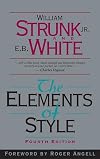
There's a lot to be said about this book in the other reviews here. Some people hate it, some people love it, others are ambivalent and can name better books on the same subject, and almost everyone has an opinion about whether or not this book is still relevant today.
Myself? I'm in the camp that it's still relevant today.
Unlike the usual reviews I do for fiction stories, I'm going to keep this pretty succinct for those who are scrolling through and want to see whether they agree with me, or show more an unbiased opinion, and happen to find my review. This book is great for UNDERSTANDING grammar and how to structure sentences and all that, but it's not the end-all, be-all of writing for fiction authors. It's an amazing foundation for understanding the rules and why certain things work and don't, but you can always break the rules if you want.
After all, it's better to break the rules when you know why something works rather than through ignorance. Though it is still full of good advice on how to structure sentences properly when something gets stuck, or feels 'wrong' when you revise and edit in the future.
Overall, you'll like this book if you want to brush up on your grammar and understanding of the English language. It's really just a textbook meant to be in easy reach and re-read every so often. show less
Myself? I'm in the camp that it's still relevant today.
Unlike the usual reviews I do for fiction stories, I'm going to keep this pretty succinct for those who are scrolling through and want to see whether they agree with me, or show more an unbiased opinion, and happen to find my review. This book is great for UNDERSTANDING grammar and how to structure sentences and all that, but it's not the end-all, be-all of writing for fiction authors. It's an amazing foundation for understanding the rules and why certain things work and don't, but you can always break the rules if you want.
After all, it's better to break the rules when you know why something works rather than through ignorance. Though it is still full of good advice on how to structure sentences properly when something gets stuck, or feels 'wrong' when you revise and edit in the future.
Overall, you'll like this book if you want to brush up on your grammar and understanding of the English language. It's really just a textbook meant to be in easy reach and re-read every so often. show less
http://nhw.livejournal.com/872531.html
This has been on my shelf for several years, and I took it down on Monday on impulse. It was a good impulse. This is a great little book, and should be read by anyone who writes for a living or in their spare time, ie pretty much anyone reading this. The one off-putting element for us on this side of the Atlantic is that it proclaims its American credentials loudly, but most of its grammar and usage points are relevant to any English idiom, and the tips show more on good and clear writing style are relevant to any language.
It is also beautifully written - and one suspects that the best bits came from the pen of the author of Charlotte's Web and Stuart Little. For instance:
"Writing is, for most, laborious and slow. The mind travels faster than the pen; consequently, writing becomes a question of learning to make occasional wing shots, bringing down the bird of thought as it flashes by. A writer is a gunner, sometimes waiting in the blind for something to come in, sometimes roaming the countryside hoping to scare something up. Like other gunners, the writer must cultivate patience, working many covers to bring down one partridge."
That's from the closing chapter on style in general. But some of the illustrations of the particular are memorable too. I remember once in a previous job sending a cross note to a colleague complaining about his use of colons: I wish I had been able to quote Strunk and White's lucid explanation of the topic. And this illustration of how to construct a sentence badly will linger in my mind:
"New York's first commercial human-sperm bank opened Friday with semen samples from eighteen men frozen in a stainless steel tank."
As the text goes on to say, "the reader's heart goes out to those eighteen poor fellows"!
Anyway, a tremendously useful read. I hope that I follow most of its recommendations instinctively, but it never does any harm to be reminded, to sharpen the saw as it were. I would say it's actually of greater relevance to the general writer than the Economist Style Guide, though the latter is also essential in my own line of work. show less
This has been on my shelf for several years, and I took it down on Monday on impulse. It was a good impulse. This is a great little book, and should be read by anyone who writes for a living or in their spare time, ie pretty much anyone reading this. The one off-putting element for us on this side of the Atlantic is that it proclaims its American credentials loudly, but most of its grammar and usage points are relevant to any English idiom, and the tips show more on good and clear writing style are relevant to any language.
It is also beautifully written - and one suspects that the best bits came from the pen of the author of Charlotte's Web and Stuart Little. For instance:
"Writing is, for most, laborious and slow. The mind travels faster than the pen; consequently, writing becomes a question of learning to make occasional wing shots, bringing down the bird of thought as it flashes by. A writer is a gunner, sometimes waiting in the blind for something to come in, sometimes roaming the countryside hoping to scare something up. Like other gunners, the writer must cultivate patience, working many covers to bring down one partridge."
That's from the closing chapter on style in general. But some of the illustrations of the particular are memorable too. I remember once in a previous job sending a cross note to a colleague complaining about his use of colons: I wish I had been able to quote Strunk and White's lucid explanation of the topic. And this illustration of how to construct a sentence badly will linger in my mind:
"New York's first commercial human-sperm bank opened Friday with semen samples from eighteen men frozen in a stainless steel tank."
As the text goes on to say, "the reader's heart goes out to those eighteen poor fellows"!
Anyway, a tremendously useful read. I hope that I follow most of its recommendations instinctively, but it never does any harm to be reminded, to sharpen the saw as it were. I would say it's actually of greater relevance to the general writer than the Economist Style Guide, though the latter is also essential in my own line of work. show less

Some of the advice in this sententious style book (note: not a grammar book) is solid, but it is also simplistic, misleading, and self-contradictory. Strunk's precepts, useful up to a point, have unfortunately been elevated to the status of dogma by generations of nitpicking pedants.
Lists
Awards


You May Also Like


Associated Authors
Statistics
- Works
- 20
- Members
- 26,022
- Popularity
- #801
- Rating
- 4.2
- Reviews
- 234
- ISBNs
- 195
- Languages
- 4
- Favorited
- 6
