On This Page
Description
"Caldecott Medalist Allen Say presents a stunning graphic novel chronicling his journey as an artist during WWII, when he apprenticed under Noro Shinpei, Japan's premier cartoonist. Drawing from memory is Allen Say's own story of his path to becoming the renowned artist he is today. Shunned by his father, who didn't understand his son's artistic leanings, Allen was embraced by Noro Shinpei, Japan's leading cartoonist and the man he came to love as his "spiritual father." As WWII raged, Allen show more was further inspired to consider questions of his own heritage and the motivations of those around him. He worked hard in rigorous drawing classes, studied, trained--and ultimately came to understand who he really is. Part memoir, part graphic novel, part narrative history, DRAWING FROM MEMORY presents a complex look at the real-life relationship between a mentor and his student. With watercolor paintings, original cartoons, vintage photographs, and maps, Allen Say has created a book that will inspire the artist in all of us"-- show lessTags
Recommendations






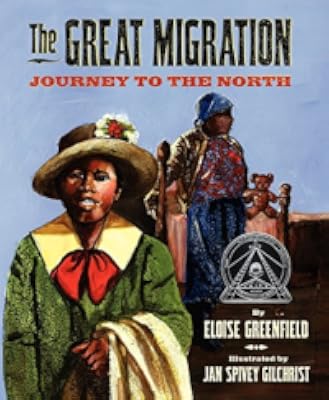
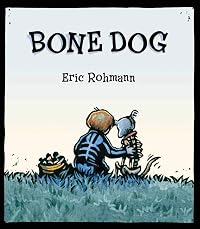
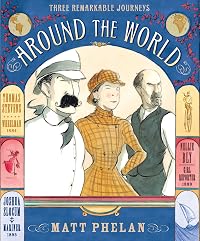

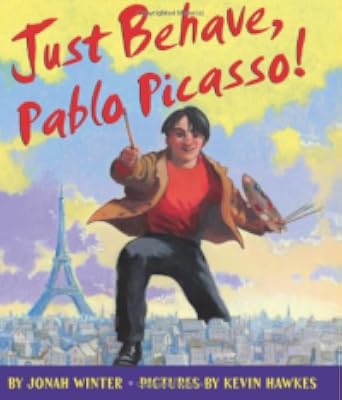


Member Recommendations
Member Reviews
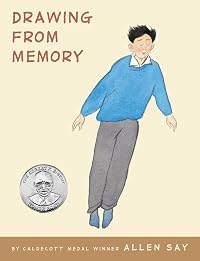
DRAWING FROM MEMORY
ALLEN SAY
Scholastic Press
$17.99 hardcover, available now
Rating: 5* of five
The Publisher Says: Caldecott Medalist Allen Say presents a stunning graphic novel chronicling his journey as an artist during WWII, when he apprenticed under Noro Shinpei, Japan’s premier cartoonist.
DRAWING FROM MEMORY is Allen Say's own story of his path to becoming the renowned artist he is today. Shunned by his father, who didn't understand his son's artistic leanings, Allen was embraced by Noro Shinpei, Japan's leading cartoonist and the man he came to love as his "spiritual father." As WWII raged, Allen was further inspired to consider questions of his own heritage and the motivations of those around him. He worked hard in rigorous show more drawing classes, studied, trained--and ultimately came to understand who he really is.
Part memoir, part graphic novel, part narrative history, DRAWING FROM MEMORY presents a complex look at the real-life relationship between a mentor and his student. With watercolor paintings, original cartoons, vintage photographs, and maps, Allen Say has created a book that will inspire the artist in all of us.
My Review: Allen Say's world doesn't exist anymore. This is the roughest part of getting truly old. The kind of universe where a twelve-year-old boy could be thought capable of living on his own is long gone. The kind of world where the famous cartoonist could be reached by the simple expedient of showing up at his place of work and saying, "I'd like to work for you," well! Need I belabor the point? Say wrote this book in a world that could be on a different planet than the one he grew up on. But from such foreign stones he built an exciting life, a life of art and creation and replete with stories that need telling.
This book, a graphic memoir I suppose, though it's less thoroughgoing than is Lynda Barry's work (eg Syllabus: Notes from an Accidental Professor), is no whit less sophisticated.
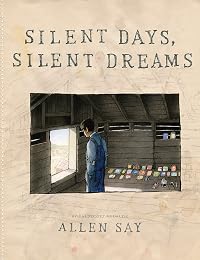
I recently read Artist Say's magisterial Silent Days, Silent Dreams. It was such a gorgeous visual feast and so deeply affecting a tale that I couldn't bear to leave his world for long. Look above, look below...do you blame me?
Look at the great simplicity of the lines you're tricked into believing are real, three-dimensional objects:
Look at the care and attention you're not smacked with, look at the invisible framing of each image that makes it the perfect size and the perfect space for exactly that moment of storytelling to be within.
See the colors? See the volume of each object, each space between objects?
See the texture of matte-coated paper, the way that it creates the same effect as a gallery's neutral wall color does? See the fruit of more than seventy years practicing what a master, a cicerone, a sensei was wise, prescient, generous enough to give the boy artist? We receive the gift's fruit.
There was never a truer aperçu proverbialized than, "A society grows great when old men plant trees whose shade they know they shall never sit in." To your private orchard you bring trees whose shade soothes you, yet almost never will you stop to regard still less thank the long-gone hands and long-past rains that made the tree into what it is now.
Take that moment now, be grateful to Noro Shinpei for himself and for the soothing shadows of Allen Say's talented evocation of a world we can never see any other way but through his eyes and by his hands. Let him plant you a tree. show less
Frustratingly concise... but I suppose explaining all of Japanese culture needed to give background would take a book bigger than Moby Dick. Anyway, the focus is tight on Say's adolescence learning to be a cartoonist. His mentor is by far the most important character, though the man doesn't actually come alive for me. The other apprentice, otoh, does. And I sure do want to know his mother better.
For children and families who have already loved Say's other stories... not for the littlest because it's just too complex.
For children and families who have already loved Say's other stories... not for the littlest because it's just too complex.
Celebrated Japanese-American children's artist Allen Say, who won the Caldecott Medal for Grandfather's Journey, a picture-book exploring his family's complicated history moving back and forth between Japan and the United States through the generations, chronicles his own youth and coming of age as an artist in this graphic novel/picture-book autobiography for young readers. Born in 1937 near Yokohama, Japan, Say was still a young child during WWII, and evacuated to a small village with his mother and sister. After the war, and his parents' subsequent divorce, Say was sent to live with his grandmother in Tokyo, where he was convinced to work hard at his schooling by the promise of his own lodgings. But although he did indeed succeed show more academically, getting in to the prestigious Aoyama Middle School, his true passion was art, and he managed to convince Noro Shinpei, the most famous cartoonist in Japan, to take him on as a student. Devoting himself to his studies, Say lived and worked alone from the age of thirteen. A number of years later, in July of 1953, Say left Japan, accepting his estranged father's offer of passage to America...
As informative as it is entertaining, Drawing from Memory is children's biography at its best, offering an immensely engaging look at the youth of a celebrated children's author and artist. I greatly enjoyed the opportunity to learn more about Say's early life, given the fact that I have enjoyed so many of his picture-books, which are often drawn from the history and life-stories of various Say family members. He has certainly lived an interesting life, to judge by the first sixteen years! I can't imagine a thirteen-year-old being given his own living situation today, outside of a supervised one such as would be provided by a boarding school. Nor can I imagine an ambitious young person easily convincing a master in his chosen discipline to teach and sponsor him, without some sort of introduction. However that may be, there is no doubt that Say was compelled to follow his dream to become an artist, a calling he felt from the time he was a small boy, and that the world has benefited from his work. Recommended to Allen Say fans, and to anyone looking for good biography/autobiography for middle-grade readers. For myself, I look forward to reading the next volume of Say's autobiography, The Inker's Shadow. show less
As informative as it is entertaining, Drawing from Memory is children's biography at its best, offering an immensely engaging look at the youth of a celebrated children's author and artist. I greatly enjoyed the opportunity to learn more about Say's early life, given the fact that I have enjoyed so many of his picture-books, which are often drawn from the history and life-stories of various Say family members. He has certainly lived an interesting life, to judge by the first sixteen years! I can't imagine a thirteen-year-old being given his own living situation today, outside of a supervised one such as would be provided by a boarding school. Nor can I imagine an ambitious young person easily convincing a master in his chosen discipline to teach and sponsor him, without some sort of introduction. However that may be, there is no doubt that Say was compelled to follow his dream to become an artist, a calling he felt from the time he was a small boy, and that the world has benefited from his work. Recommended to Allen Say fans, and to anyone looking for good biography/autobiography for middle-grade readers. For myself, I look forward to reading the next volume of Say's autobiography, The Inker's Shadow. show less
What a pleasure it was to read this book, both the words and the pictures. I have always admired Say's children's books. They are soulful and poignant. It is enlightening to read about his life growing up, how his father was estranged from him almost as soon as Say declared his love of art, and how he was left to fend for himself starting at the age of thirteen. There is a lonely quality to his work, a melancholy that suffuses his art. Now we understand why.
This book pays tribute to a very fine teacher, and reminds me of how important it is to find support where you can. Maybe your father is opposed to your ambition to be an artist. This leaves it up to you to find an artist and mentor who can give you the support you need.
This book pays tribute to a very fine teacher, and reminds me of how important it is to find support where you can. Maybe your father is opposed to your ambition to be an artist. This leaves it up to you to find an artist and mentor who can give you the support you need.
Super talented Caldecott Medal winner Allen Say uses photography, his own art, and the art of others to tell the story of how he became an artist. Born in Japan in 1937, Say knew at a young age he wanted to be a cartoonist, but his parents were not at all happy about his interest in art. Then the war came, and his parents got divorced, and Say ended up living alone in Tokyo at the age of 13! He turned his apartment into an art studio, tracked down his cartoonist hero, Noro Shinpei, and asked to be his apprentice, and soon began his career as an artist. Wow. Though the text was a little disjointed at times, the art is obviously awesome and the story is inspiring. A recurring theme is "Let your dear child journey," which is an old show more Japanese saying.
I was especially touched by the afterward, in which Say confesses that he always wanted to write a book with his sensei, but Noro Shinpei passed away before he had the chance, so he sees this book as a posthumous collaboration fulfilling that dream. show less
I was especially touched by the afterward, in which Say confesses that he always wanted to write a book with his sensei, but Noro Shinpei passed away before he had the chance, so he sees this book as a posthumous collaboration fulfilling that dream. show less
I propped open this graphic memoir on the dining room table when it arrived in the mail, and read a page or so each time I passed by on my way to/from the kitchen. Allen Say is an artist born in Japan in 1937. The story takes place mostly in the late 1940s and early 1950s. His parents divorced, his father remarried and took the children, and after a few years his mother's mother reclaimed the children and rewarded Allen with his own apartment when he passed the exam for acceptance into middle school at age 12. There he read in the newspaper that cartoonist Niro Shinpei had taken in a student, a 15 year old boy who had walked for two weeks to find him. Allen set out to find Noro Shinpei too, and did. The apprenticeship is described in show more words, and illustrated with drawings and photos, with practical and philosophical details about learning to draw, and hints of unrest in the surrounding post-war society. The story seemed rather spare and prosaic as I read it, but the author's note at the end, recounting his reunion with Noro Shinpei and family years later, conveys the intense emotion behind it. I surely missed things in a single pass through at sporadic moments.
(read 7 Jun 2012) show less
(read 7 Jun 2012) show less
Allen Say is an award winning children's book author and illustrator. This short little book (it's only 63 pages) tells much more of a story than its length would lead you to believe.
It's about his childhood before and after World War II in Japan. He knew he wanted to be a comic illustrator but his father did not want him to pursue a career as an artist. After his parents split up he lived with his grandmother who arranged for Allen to live on his own at the age of 12.
He became an apprentice to his favorite cartoonist after knocking on the man's door and introducing himself.
This book is a combination of narrative, graphic novel, and scrapbook with its text, drawings, and photos. It's extremely well done and interesting. While usually show more filed in the juvenile section of the library, it's a worthwhile read for adults too. I plan to pick up his follow up book The Inker's Shadow soon. show less
It's about his childhood before and after World War II in Japan. He knew he wanted to be a comic illustrator but his father did not want him to pursue a career as an artist. After his parents split up he lived with his grandmother who arranged for Allen to live on his own at the age of 12.
He became an apprentice to his favorite cartoonist after knocking on the man's door and introducing himself.
This book is a combination of narrative, graphic novel, and scrapbook with its text, drawings, and photos. It's extremely well done and interesting. While usually show more filed in the juvenile section of the library, it's a worthwhile read for adults too. I plan to pick up his follow up book The Inker's Shadow soon. show less
Members
- Recently Added By
Lists

Best Graphic Novel Nonfiction
199 works; 101 members

Precious People
119 works; 1 member

Robert F. Sibert Informational Book Medal
102 works; 1 member
Author Information

35+ Works 11,538 Members
Allen Say was born in 1937 in Yokohama, Japan and grew up during the war, attending seven different primary schools amidst the ravages of falling bombs. His parents divorced in the wake of the end of the war and he moved in with his maternal grandmother, with whom he did not get along with. She eventually let him move into a one room apartment, show more and Say began to make his dream of being a cartoonist a reality. He was twelve years old. Say sought out his favorite cartoonist, Noro Shinpei, and begged him to take him on as an apprentice. He spent four years with Shinpei, but at the age of 16 moved to the United States with his father. Say was sent to a military school in Southern California but then expelled a year later. He struck out to see California with a suitcase and twenty dollars. He moved from job to job, city to city, school to school, painting along the way, and finally settled on advertising photography and prospered. Say's first children's book was done in his photo studio, between shooting assignments. It was called "The Ink-Keeper's Apprentice" and was the story of his life with Noro Shinpei. After this, he began to illustrate his own picture books, with writing and illustrating becoming a sort of hobby. While illustrating "The Boy of the Three-year Nap" though, Say suddenly remembered the intense joy I knew as a boy in my master's studio and decided to pursue writing and illustrating full time. Say began publishing books for children in 1968. His early work, consisting mainly of pen-and-ink illustrations for Japanese folktales, was generally well received; however, true success came in 1982 with the publication of The Bicycle Man, based on an incident in Say's life. "The Boy of the Three-Year Nap" published in 1988, and written by Dianne Snyder, was selected as a 1989 Caldecott Honor Book and winner of The Boston Globe-Horn Book Award for best picture book. (Bowker Author Biography) show less
Awards and Honors
Awards
Distinctions
Notable Lists
Series

Common Knowledge
- Canonical title
- Drawing from Memory
- Original publication date
- 2011-09-01
Classifications
Statistics
- Members
- 573
- Popularity
- 51,595
- Reviews
- 54
- Rating
- (4.27)
- Languages
- English
- Media
- Paper, Ebook
- ISBNs
- 7
- ASINs
- 2