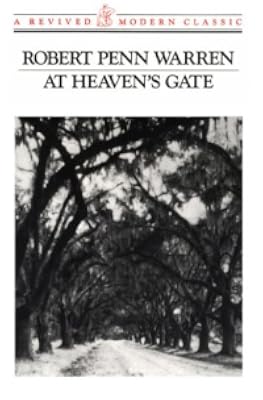
At Heaven's Gate
by Robert Penn Warren
On This Page
Description
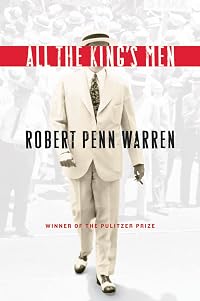
At Heaven's Gate, Robert Penn Warren's second novel, is a neglected classic of twentieth-century fiction. First published in 1943, it grew out of the author's years in Nashville during a period of political and financial scandals much like those later so memorably portrayed his Pulitzer-Prize-winning All The King's Men . Other formative elements, as he has said, came originally out of Dante by a winding path." During the winter of 1939-40 in Rome, where the first half of the book was show more written, one of the most touching characters, a "Christ-bit mountaineer," and his part of the story literally came full-blown to the author in a typhus-induced delirium. At Heaven's Gate is a novel of violence, of human beings struggling against a fate beyond their power to alter, of corruption, and of honor. It is the story of Sue Murdock, the daughter of an unscrupulous speculator who has created a financial empire in the South, and the three men with whom she tries to escape the dominance of her father and her father's world. The background is the capital of a Southern state in the late twenties and the promoters and politicians, the aristocrats and poor whites, the labor organizers and the dispossessed farmers, the backwoods prophets and university intellectuals who are drawn into its orbit. Warren's picture of the South is as fresh, dramatic, and powerful today as it was when the book was first published. Its plot structure is a tour de force. " show lessTags
Recommendations























Member Reviews
War hero, football star, banker, alcoholic, privileged daughter rejecting privilege, abortion, murder and evangelism, politics, labor unrest, academic snobbery, independence, aloofness, social yearning, ending with a bank failure. Fits in with 2008, very much a product of the Great Depression. Thinly veiled modeling of Sergeant York, in an unknown southern state that can only be Tennessee, "At Heaven's Gate" is very much a first novel. Lots of ideas, lots of structure, very good vignettes, and digression into post grad academic writing. This is practice for "All The King's Men."
Ratings
Members
- Recently Added By
Author Information

138+ Works 14,453 Members
Robert Penn Warren, the first Poet Laureate of the United States, was an unusually versatile writer who tried his hand at almost every kind of literature. In all of these forms, he achieved recognition and distinction, but it is as a poet, critic, and novelist that he was most widely known. Writing almost always about his native South, Warren show more produced 10 novels and a collection of short stories, The Circus in the Attic and Other Stories (1948). By far the most successful of his novels is All the King's Men (1946), the story of a southern politician and demagogue named Willie Stark, which Warren based on the rise and fall of Huey Long. Warren was considered one of the most influential of the New Critics, whose influence on the teaching of literature in American schools and universities during the late 1940s and 1950s could scarcely be overestimated. Because All the King's Men seemed to be the very epitome of what a good work of literature should be in New Critical terms---a complicated but highly readable narrative filled with irony and ambiguity---the novel came to be used widely in courses on modern fiction. It won both the Pulitzer Prize and the Southern Authors Award in 1947. Warren's other novels are disappointing by comparison. Following the success of All the King's Men, however, Warren seemed to turn to more loosely told stories about dramatic and romantic subjects, such as the interracial theme of Band of Angels (1955) or the natural catastrophes that serve as the crisis background for The Cave (1959) and Flood: A Romance of Our Time (1964). Wilderness: A Tale of the Civil War (1961) is an allegory of a man's spiritual quest for truth about himself and the world. Meet Me in the Green Glen (1971), the story of a tragic love affair, seemed to mark a return to the tighter structure and more complex artistry of Warren's earlier novels, but A Place to Come To (1977), his last novel, in which an elderly and renowned scholar who seems to owe much to Warren himself looks back on his family's past in an effort to find the meaning of his life, struck some reviewers as a confused and tired work. Sometime midway through his career as a novelist it is as if Warren stopped thinking of himself as a southern writer in the tradition of William Faulkner and turned instead to Thomas Wolfe for inspiration. Although in retrospect that switch must be regretted, no one can deny the immense influence of Robert Penn Warren on modern letters. Warren's poetry is intellectual, rich in powerful images, and has its roots in the pre-Civil War South. He continued to write impressive poetry almost until the time of his death. (Bowker Author Biography) show less
Common Knowledge
- Canonical title
- At Heaven's Gate
- First words*
- Il cielo aveva la lucentezza profonda, tranquilla del primo autunno.
- Last words*
- (Click to show. Warning: May contain spoilers.)Ecco lĂ il suo ritratto: le guance incavate sopra le mascelle arcigne, gli occhi infossati e torvi, il naso prepotente a becco e la cresta ispida dei capelli grigi, come un vecchio pappagallo.
*Some information comes from Common Knowledge in other languages. Click "Edit" for more information.
Classifications
Statistics
- Members
- 88
- Popularity
- 364,588
- Reviews
- 1
- Rating
- (3.31)
- Languages
- Czech, English
- Media
- Paper, Ebook
- ISBNs
- 5
- ASINs
- 6