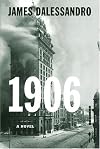
1906: A Novel
by James Dalessandro
On This Page
Description
Every disaster has a story, none more thrilling than this one. Set during the great San Francisco earthquake and fire, this tale of political corruption, vendettas, romance, rescue, and murder is based on recently uncovered facts that will forever change our understanding of what really happened. Told by Annalisa Passarelli, a feisty young reporter, the novel paints a vivid picture of the post-Victorian city, from the gilded ballrooms of Nob Hill to the seedy bars of the Barbary Coast; from show more the slave ships in the bay to the front row seats of Enrico Caruso's sold out performance. At its center is an ongoing battle, fought even as the city burns, that pits incompetent and unscrupulous politicians against a coalition of honest police officers, newspaper editors, citizens, and a lone federal prosecutor. show lessTags
Recommendations







Member Reviews
New Take on the 'Quake
This book is about the 1906 San Francisco earthquake. It tells the primary story from the perspective of a female opera critic and journalist and follows other stories of people who had the misfortune to end up in San Francisco right before the quake. The book was fast paced and held my interest. It was an attempt to correct some misconceptions about the event. While not 100 percent historically accurate (as acknowledged by the author), it adhered to the spirit of the era, combining some real people into one and inserting fictional characters to support the storyline. It was an enjoyable reading experience. If you like historical fiction, I recommend it. The book is also going to be the subject of a movie soon, so show more it will be interesting to see how it is adapted. show less
This book is about the 1906 San Francisco earthquake. It tells the primary story from the perspective of a female opera critic and journalist and follows other stories of people who had the misfortune to end up in San Francisco right before the quake. The book was fast paced and held my interest. It was an attempt to correct some misconceptions about the event. While not 100 percent historically accurate (as acknowledged by the author), it adhered to the spirit of the era, combining some real people into one and inserting fictional characters to support the storyline. It was an enjoyable reading experience. If you like historical fiction, I recommend it. The book is also going to be the subject of a movie soon, so show more it will be interesting to see how it is adapted. show less
When I borrowed this book from Overdrive I thought it was going to be entirely about the San Francisco Earthquake and Fire of 1906. I was a bit surprised when the story opened with an arts correspondent and a fledgling cop. For a moment, I thought I had borrowed the wrong book. But I was hooked fast.
Dalessandro opens by introducing us to a web of characters convening in San Francisco. With so many different personalities involved, it would have been easy to get lost. Dalessandro wove the multiple perspectives perfectly. We learn about the deep lines of corruption in government early in the book, and these villains follow into the disaster. It was so good.
Each character is well developed and interesting. I particularly liked the show more bright-eyed Kaitlin and fearless Annalisa. These two girls never needed rescuing, and bless her - Annalisa ran all across the city helping with the rescue operations in a ballgown and jewels. The variety of characters made the story rich and gave life to San Francisco at the turn of the century. I loved them all - from the little Chinese girl sold as a slave to the bellowing opera singer. Each person has been careful researched, carefully selected, and add a unique perspective to the city.
Instead of falling into the chaos of the disaster, Dalessandro follows Hunter and Annalisa as they track the villains, determined to both save their city and make sure justice is served. I don't want to give away too much of the story, but I will say this: the plot surged forward even at opportunities to fall into chaos. I was just as anxious to see the fire put out as to see the murderer caught.
The fire is where Dalessandro shines. Scenes of the rescue efforts are sharp and engulfing. He finds the perfect balance between detail and pacing. There is a particular scene near the end of the story where Hunter and Annalisa are trapped in a burning building - the writing is so vivid you can practically feel the heat. He has carefully constructed everything from the opera house to the waterfront... Delssandro is a world-building master.
This books was not what I expected, but I deeply enjoyed it. The only real complaint I can offer is that the audio recording I listened to was fairly poor quality - there was an echo to the speech that was distracting and annoying. Otherwise, this was a compelling story. There is child trafficking, attempted rape, and considerable violence - none of it is detailed, but it is there to illustrate the corruption of the city at the turn of the century. show less
Dalessandro opens by introducing us to a web of characters convening in San Francisco. With so many different personalities involved, it would have been easy to get lost. Dalessandro wove the multiple perspectives perfectly. We learn about the deep lines of corruption in government early in the book, and these villains follow into the disaster. It was so good.
Each character is well developed and interesting. I particularly liked the show more bright-eyed Kaitlin and fearless Annalisa. These two girls never needed rescuing, and bless her - Annalisa ran all across the city helping with the rescue operations in a ballgown and jewels. The variety of characters made the story rich and gave life to San Francisco at the turn of the century. I loved them all - from the little Chinese girl sold as a slave to the bellowing opera singer. Each person has been careful researched, carefully selected, and add a unique perspective to the city.
Instead of falling into the chaos of the disaster, Dalessandro follows Hunter and Annalisa as they track the villains, determined to both save their city and make sure justice is served. I don't want to give away too much of the story, but I will say this: the plot surged forward even at opportunities to fall into chaos. I was just as anxious to see the fire put out as to see the murderer caught.
The fire is where Dalessandro shines. Scenes of the rescue efforts are sharp and engulfing. He finds the perfect balance between detail and pacing. There is a particular scene near the end of the story where Hunter and Annalisa are trapped in a burning building - the writing is so vivid you can practically feel the heat. He has carefully constructed everything from the opera house to the waterfront... Delssandro is a world-building master.
This books was not what I expected, but I deeply enjoyed it. The only real complaint I can offer is that the audio recording I listened to was fairly poor quality - there was an echo to the speech that was distracting and annoying. Otherwise, this was a compelling story. There is child trafficking, attempted rape, and considerable violence - none of it is detailed, but it is there to illustrate the corruption of the city at the turn of the century. show less
I read this as part of my continued research on the Great San Francisco Earthquake. I've read a great deal of nonfiction, but I wanted a level of detail that can only be found in fiction. I found this book, published in 2005 not long before the centennial of the quake.
1906 struck me as extremely irritating and enlightening all at once.
To begin with the irritants: the perspectives of the story. It's a first person novel that uses omniscient third person to tell the tales of a broad cast of about a dozen. It head-hops from character to character, back and forth, within a single scene. This is considered a big no-no for writers, generally, and with reason--it can be extremely confusing and frustrating to track. At the end, the first person show more narrator, the gutsy journalist Annalissa Passarelli, justifies this by saying the narrative of "what really happened" is told in the style of her hero, Nellie Bly. That's all well and good, but there's probably a reason why modern readers read about reporter Nellie Bly rather than read her actual chronicles.
The novel is also morally heavy-handed. It actually reminded me of the 1930s Clark Gable movie San Francisco, which blatantly uses the message that San Francisco deserved to burn because it was an ungodly city like Sodom and Gomorrah and will be rebuilt as a godly modern wonder (yes, we can snicker now). There are very few nuanced characters in this book. I suppose it could be argued that since it's told by Annalissa, it's only right that the take is biased, but it just feels melodramatic and silly at times. Her love interest, Hunter, is about as paladin as you can get, complete with riding about on a motorcycle instead of a gallant white steed. The bad guys are very bad, though a lot of what they do is based on historical fact. Dalessandro just kind of compressed a full decade of wickedness into one book, complete with overwrought action during the earthquake that reminded me way too much of the silly escapades at the end of the movie Titanic.
Now, for the positives.
At the end, the author mentions that he spent six years researching the book. It shows. The attention to detail is astonishing, and he really does make San Francisco feel visceral and real, down to the perfume and vomit in the Barbary Coast. He also demonstrates a great intimacy with San Francisco, its streets, and its hills. I envy his knowledge, really. I found myself nodding along at several points as I recognized historical details he worked in that I've already encountered in other works. If anything, he crammed too much in, as it all added to the ridiculous, moral melodrama of the plot.
It's one of those books that I'm glad I read and I will keep it handy for research purposes, but overall I didn't like that much as an actual story. show less
1906 struck me as extremely irritating and enlightening all at once.
To begin with the irritants: the perspectives of the story. It's a first person novel that uses omniscient third person to tell the tales of a broad cast of about a dozen. It head-hops from character to character, back and forth, within a single scene. This is considered a big no-no for writers, generally, and with reason--it can be extremely confusing and frustrating to track. At the end, the first person show more narrator, the gutsy journalist Annalissa Passarelli, justifies this by saying the narrative of "what really happened" is told in the style of her hero, Nellie Bly. That's all well and good, but there's probably a reason why modern readers read about reporter Nellie Bly rather than read her actual chronicles.
The novel is also morally heavy-handed. It actually reminded me of the 1930s Clark Gable movie San Francisco, which blatantly uses the message that San Francisco deserved to burn because it was an ungodly city like Sodom and Gomorrah and will be rebuilt as a godly modern wonder (yes, we can snicker now). There are very few nuanced characters in this book. I suppose it could be argued that since it's told by Annalissa, it's only right that the take is biased, but it just feels melodramatic and silly at times. Her love interest, Hunter, is about as paladin as you can get, complete with riding about on a motorcycle instead of a gallant white steed. The bad guys are very bad, though a lot of what they do is based on historical fact. Dalessandro just kind of compressed a full decade of wickedness into one book, complete with overwrought action during the earthquake that reminded me way too much of the silly escapades at the end of the movie Titanic.
Now, for the positives.
At the end, the author mentions that he spent six years researching the book. It shows. The attention to detail is astonishing, and he really does make San Francisco feel visceral and real, down to the perfume and vomit in the Barbary Coast. He also demonstrates a great intimacy with San Francisco, its streets, and its hills. I envy his knowledge, really. I found myself nodding along at several points as I recognized historical details he worked in that I've already encountered in other works. If anything, he crammed too much in, as it all added to the ridiculous, moral melodrama of the plot.
It's one of those books that I'm glad I read and I will keep it handy for research purposes, but overall I didn't like that much as an actual story. show less
Starts three days prior to the quake and makes the case that much of the damage was preventable even at that point, particularly the devastating fires that swept the city. The picture painted in the book is of a city almost impossibly beautiful, alluring, charismatic -- with city government almost impossibly corrupt, callous and focused on lining their own pockets. The story is told partially in the first person through the eyes of Anna Passarelli, an opera critic for the newspaper (this of course gives the author a great excuse to work the famous visit of Enrico Caruso into the novel). Overall, the book was pretty good, but I got a little tired of the author's staccato writing style toward the end.
This book drew me because of my life-long appreciation of San Francisco. I don't usually read historical fiction, since true stories always so fascinating. Plus, with fiction, one never knows if the history is slightly adjusted to fit the storyline.
When I realized that I was learning much more than than what is usually written about the political troubles before, during, and after the 1906 earthquake, I became even more impressed with the book. An easy read that is much, much more than entertainment.
When I realized that I was learning much more than than what is usually written about the political troubles before, during, and after the 1906 earthquake, I became even more impressed with the book. An easy read that is much, much more than entertainment.
Excellent historical fiction with an interesting twist -- a combination of a mystery/police procedural (political corruption in San Francisco) then overwhelmed by the April 23, 2006 epic scale earthquake hitting just when the good guys were making their arrests. An elaborate and challenging plot which closely follows the actual events surrounding the earthquake and fire. All in all, a great read.
This book would have benefited from a map - even though I grew up in the Bay Area, it was still hard to picture all the running around the characters did... and then when they started describing the destruction and the path of the fires, it was even more difficult. I found this book to be an enjoyable read, but the writing wasn't much more than decent that the characters and style was a little too melodramatic and overwrought at times. I also didn't like how the author bounced back and forth between third person and first person in the same chapter - sometimes it worked, and sometimes it was really rather confusing and jarring. Still, the subject matter was certainly interesting and it was quite a different take on the '06 earthquake show more than what learned growing up. show less
Members
- Recently Added By
Author Information
8 Works 282 Members
Common Knowledge
- People/Characters
- Enrico Caruso
- Important places
- San Francisco, California, USA; California, USA
- Important events
- San Francisco Earthquake and Fire (1906-04-18)
Classifications
Statistics
- Members
- 235
- Popularity
- 138,435
- Reviews
- 11
- Rating
- (3.53)
- Languages
- English, French
- Media
- Paper, Audiobook, Ebook
- ISBNs
- 8
- UPCs
- 2
- ASINs
- 4