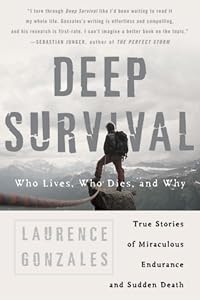
Deep Survival: Who Lives, Who Dies, and Why
by Laurence Gonzales
On This Page
Description
After her plane crashes, a seventeen-year-old girl spends eleven days walking through the Peruvian jungle. Against all odds, with no food, shelter, or equipment, she gets out. A better-equipped group of adult survivors of the same crash sits down and dies. What makes the difference? Examining such stories of miraculous endurance and tragic death-how people get into trouble and how they get out again (or not)-Deep Survival takes us from the tops of snowy mountains and the depths of oceans to show more the workings of the brain that control our behavior. Through close analysis of case studies, Laurence Gonzales describes the "stages of survival" and reveals the essence of a survivor-truths that apply not only to surviving in the wild but also to surviving life-threatening illness, relationships, the death of a loved one, running a business during uncertain times, and even war. In the end, he finds, it is what's in your heart, not what's in your pack, that separates the living from the dead. Fascinating and absolutely essential for anyone who hikes in the woods, this book will change the way we understand ourselves and the great outdoors. show lessTags
Recommendations






Member Recommendations

Member Reviews
Deep Survival: Who Lives, Who Dies, and Why, by Laurence Gonzales, was a pick of my monthly book club that I greeted with some ambivalence at first. As it turned out, it was a highly satisfying read that was nothing like what I anticipated from scanning the back cover.
The book is more or less divided into two parts, although there is no real hard division as such. The first half of the narrative tends to dwell on those who find themselves in critically dangerous arenas who make bad decisions and die. Surprisingly, it turns out that the worst survivors are the “Rambo-types” who don’t take danger very seriously at all. There is one story of comic-poignancy of a badass Army Ranger who is swept off of a raft and cavalierly ignores show more the efforts of a guide to save him, seemingly because he thought he could easily rescue himself: he was sucked under a boulder and drowned.
Gradually, the chapters flow into accounts of those who manage to survive, often under impossible circumstances, from aircraft crashes in the remote mountains to badly injured rock climbers to deep ocean lifeboat survivors. While the people who die often don’t have a great deal in common, the ones who survive do have apparent similarities in their outlook and their stubborn refusal to succumb. Frequently, it is luck alone that has spared them in the initial catastrophe, but it is their determination to survive and the practical and emotional steps they take to achieve that which contributes to that ultimate survival.
Gonzales, who seems to have spent his entire life chasing danger in every arena from motorcycles to rock climbing to flying stunt aircraft, tells us that he became interested in survival because of his own father’s experience as a severely injured World War II pilot, the lone survivor of his plane’s crash, who can credit both good luck and his own mental focus and perseverance for a long, painful, and unlikely survival in horrific conditions as a POW after being shot down. Laying there with his nose ripped off and most of the bones in his limbs broken, he literally stares death in the face again as the gun of a German farmer intent on executing him misfires before his proper capture by enemy troops. Inspired by his father’s almost incomprehensible survival, Gonzales not only dedicates his life to chasing danger, but also to the study of who is most likely to make it when the odds go way against you.
It is not just all an adventure tale, however. Gonzales injects into the storyline a number of esoteric scientific references to such things as chaos theory, as well as the physiological makeup of the brain and how it reacts to the less than optimal conditions many of his protagonists find themselves in before succumbing to their conditions or ultimately succeeding in getting out alive. He makes a convincing argument that mental focus and optimism is the most critical factor, that while even those with the best mental orientation who make all of the right decisions can still die, they are far less likely to than their peers who panic or treat danger with insouciance or simply give up. The narrative is also peppered with a wide range of literary references that reveal the author to be very well read in the humanities, from Herodotus to Remarque to the Tao Te Ching. It is obvious that he has long meditated upon the philosophical element of his central theme, and the interspersed turns to both science and literature not only provide a solid intellectual foundation but further underscore his own deep commitment to his conclusions as to which individuals are more likely to live or die.
Fortunately, I have never found myself in the kind of survival situations Gonzales discusses in this fine book, but as one who has done a bit of AT backpacking, I have indeed encountered places and events that could very well have provided the proving ground. I would recommend this book not only to those who go into the wild, but to every soul who walks the planet: you could be in an office building that catches fire or in your basement as a tornado dissolves your home. It is not only a good read, but the lessons Gonzales imparts here could very well save your life. show less
The book is more or less divided into two parts, although there is no real hard division as such. The first half of the narrative tends to dwell on those who find themselves in critically dangerous arenas who make bad decisions and die. Surprisingly, it turns out that the worst survivors are the “Rambo-types” who don’t take danger very seriously at all. There is one story of comic-poignancy of a badass Army Ranger who is swept off of a raft and cavalierly ignores show more the efforts of a guide to save him, seemingly because he thought he could easily rescue himself: he was sucked under a boulder and drowned.
Gradually, the chapters flow into accounts of those who manage to survive, often under impossible circumstances, from aircraft crashes in the remote mountains to badly injured rock climbers to deep ocean lifeboat survivors. While the people who die often don’t have a great deal in common, the ones who survive do have apparent similarities in their outlook and their stubborn refusal to succumb. Frequently, it is luck alone that has spared them in the initial catastrophe, but it is their determination to survive and the practical and emotional steps they take to achieve that which contributes to that ultimate survival.
Gonzales, who seems to have spent his entire life chasing danger in every arena from motorcycles to rock climbing to flying stunt aircraft, tells us that he became interested in survival because of his own father’s experience as a severely injured World War II pilot, the lone survivor of his plane’s crash, who can credit both good luck and his own mental focus and perseverance for a long, painful, and unlikely survival in horrific conditions as a POW after being shot down. Laying there with his nose ripped off and most of the bones in his limbs broken, he literally stares death in the face again as the gun of a German farmer intent on executing him misfires before his proper capture by enemy troops. Inspired by his father’s almost incomprehensible survival, Gonzales not only dedicates his life to chasing danger, but also to the study of who is most likely to make it when the odds go way against you.
It is not just all an adventure tale, however. Gonzales injects into the storyline a number of esoteric scientific references to such things as chaos theory, as well as the physiological makeup of the brain and how it reacts to the less than optimal conditions many of his protagonists find themselves in before succumbing to their conditions or ultimately succeeding in getting out alive. He makes a convincing argument that mental focus and optimism is the most critical factor, that while even those with the best mental orientation who make all of the right decisions can still die, they are far less likely to than their peers who panic or treat danger with insouciance or simply give up. The narrative is also peppered with a wide range of literary references that reveal the author to be very well read in the humanities, from Herodotus to Remarque to the Tao Te Ching. It is obvious that he has long meditated upon the philosophical element of his central theme, and the interspersed turns to both science and literature not only provide a solid intellectual foundation but further underscore his own deep commitment to his conclusions as to which individuals are more likely to live or die.
Fortunately, I have never found myself in the kind of survival situations Gonzales discusses in this fine book, but as one who has done a bit of AT backpacking, I have indeed encountered places and events that could very well have provided the proving ground. I would recommend this book not only to those who go into the wild, but to every soul who walks the planet: you could be in an office building that catches fire or in your basement as a tornado dissolves your home. It is not only a good read, but the lessons Gonzales imparts here could very well save your life. show less
A mostly engaging ride that stalls out intermittently: the book could have been improved by editing it down just a little. Instead of trying to weave three different stories (that of survivors, of his father’s survival, and his own risk taking) the author should have chosen two out of three for greater reader impact. Leave out either his father’s story, his own, or compress the two into a tighter narrative, a “flip side of the same coin” thing or study in contrasts. There was also some redundancy in the stories of survival. It’s incredibly tempting to want to share everything you’ve amassed but the best writers resist that urge.
Having said that, the book certainly is worthwhile and there are several strong insights into show more what personality traits set the best foundation for survival in any kind of situation, not just wilderness. In fact, the entire premise would have been better backed up by featuring survival stories that did NOT take place in an adventure scenario.
Gonzales writes: “One of the toughest steps a survivor has to take is to discard the hope of rescue, just as he discards the old world he left behind and accepts the new one. There is no other way for his brain to settle down. Although that idea seems paradoxical, it is essential.” If we do nothing else in enabling our survival, it is to “perceive and believe” the reality around us rather than fighting to make it conform to our mental maps of what should be, what should work; to turn fear into focus. show less
Having said that, the book certainly is worthwhile and there are several strong insights into show more what personality traits set the best foundation for survival in any kind of situation, not just wilderness. In fact, the entire premise would have been better backed up by featuring survival stories that did NOT take place in an adventure scenario.
Gonzales writes: “One of the toughest steps a survivor has to take is to discard the hope of rescue, just as he discards the old world he left behind and accepts the new one. There is no other way for his brain to settle down. Although that idea seems paradoxical, it is essential.” If we do nothing else in enabling our survival, it is to “perceive and believe” the reality around us rather than fighting to make it conform to our mental maps of what should be, what should work; to turn fear into focus. show less
I poached this one off a friend's reading list and I'm glad I did. This is an odd duck of a book. Its part survival stories, part tribute to the author's father, part how not to act stupid when lost in the woods, and part celebration of how wonderful it is to be alive. This is the kind of book that will inspire you to put blankets and matches in the trunk of your car - at the same time as it urges you to live life fully and taste all life has to offer.
I have written before about my love of travel and adventure books. Often, these are more accurately about misadventure - an expedition gone wrong, a plane crash, a shipwreck. Some people live, some die. Why did Robert Falcon Scott lose every member of his expedition, while Edmund Shackleton brought all of his crewmembers - including a stowaway - home safely? Why do experienced climbers die on "beginner" mountains while four-year-olds, lost in the woods, are found unharmed? Deep Survival attempts to answer some of those questions by looking at what goes into making someone a survivor.
Gonzales has lived a fascinating life and has ample experience to bring to this subject, but this isn't a book about survival techniques. You won't find show more tips on how to navigate by the stars, how to find water in the desert or keep warm in a blizzard. You will learn how we create emotional bookmarks, how we create mental maps that guide us, even when we don't realize it. You'll learn the importance of Positive Mental Attitude, even if the experts can't tell you exactly what comprises that attitude. These things are actually far more important, because they are lessons that you can apply to your everyday life.
My full review is here. show less
Gonzales has lived a fascinating life and has ample experience to bring to this subject, but this isn't a book about survival techniques. You won't find show more tips on how to navigate by the stars, how to find water in the desert or keep warm in a blizzard. You will learn how we create emotional bookmarks, how we create mental maps that guide us, even when we don't realize it. You'll learn the importance of Positive Mental Attitude, even if the experts can't tell you exactly what comprises that attitude. These things are actually far more important, because they are lessons that you can apply to your everyday life.
My full review is here. show less
"Deep Survival" is not just a series of flesh-eating tales of survival, it is a deep investigation into what it takes to survive in life-threatening situations. Gonzales deftly combines factors of psychology, emotionality, spirituality, and physicality as the premier forces that determine who lives, who dies, and why.
This book was a revelation to me. I chose it because I saw a "Buy 2 and Get 1 Free" sign and it looked interesting. That was the understatement of the year.
I did most of the reading in the Starbucks of NYC and was so amazed at the insights that I decided to read this book once per year for the rest of my life.
It masquerades as a book about survival situations, but in truth it delves in to the recesses of the mind and spirit. Gonzales has lived this book from the day he was born. He has been driven by the specter of the coolest living father to drive himself beyond all limits. In finding the limits, he has brought back information that the rest of us can use to live in a much more mundane world.
He freely quotes ancient sources, from show more Stoic philosphers to biblical authors. But the context is never dogma, only living interpretation. It reveals so much of why you have felt the way you have felt and reacted the way you have reacted. Not only that, it lays out a roadmap for understanding and mastering your physiological and psychological reactions, bringing you to the top of your game.
I am not sure if Gonzales could top it. It is his Magnum Opus. show less
I did most of the reading in the Starbucks of NYC and was so amazed at the insights that I decided to read this book once per year for the rest of my life.
It masquerades as a book about survival situations, but in truth it delves in to the recesses of the mind and spirit. Gonzales has lived this book from the day he was born. He has been driven by the specter of the coolest living father to drive himself beyond all limits. In finding the limits, he has brought back information that the rest of us can use to live in a much more mundane world.
He freely quotes ancient sources, from show more Stoic philosphers to biblical authors. But the context is never dogma, only living interpretation. It reveals so much of why you have felt the way you have felt and reacted the way you have reacted. Not only that, it lays out a roadmap for understanding and mastering your physiological and psychological reactions, bringing you to the top of your game.
I am not sure if Gonzales could top it. It is his Magnum Opus. show less
The author knows well how to paint a picture and turn a phrase. His passion is well understood through his narrative, as well as its source. I believe the scientific exposition/areas-of-the-mind approach to survival might actually be unprecedented here. This is bravura, commendable bookwriting. He teaches good, hard, important lessons any of us, especially immersed survivalists, should take to heart (and mind). I can't wait to tear in to more of his work. His fiction is stunning as well.
Members
- Recently Added By
Published Reviews
Would I recommend this book? Yes, especially if you have never had to employ a survivor mentality in your life. I would also recommend this book to those who are leaders as well as to those who teach outdoor skills or lead trips into the wilderness. Not a handbook by any means, this book does offer big picture advice with very diverse application. If I were to sum it up this book said to me show more (and these are my own words):
If you are going to do something “stupid” be smart about it. show less
If you are going to do something “stupid” be smart about it. show less
added by John_Vaughan
Lists

Top 100 to Read before you Die
109 works; 7 members
Author Information

16+ Works 2,443 Members
Laurence Gonzales is the author of Surviving Survival and Flight 232, among many other books. In 2016 he was named Miller Scholar at the Santa Fe Institute. He divides his time between Evanston, Illinois, and Santa Fe, New Mexico. The author's website can be found at deepsurvival.com.
Awards and Honors
Common Knowledge
- Canonical title
- Deep Survival: Who Lives, Who Dies, and Why
- Original title
- Deep Survival: Who Lives, Who Dies, and Why
- Original publication date
- 2003
- Dedication
- For my father
- Last words
- (Click to show. Warning: May contain spoilers.)He taught me the first rule of survival: to believe that anything is possible.
- Blurbers
- Junger, Sebastian; Roberts, David; Miller, Daryl; Sapolsky, Robert; LeDoux, Joseph; Purdy, Penelope
Classifications
- Genres
- Nonfiction, General Nonfiction, Science & Nature
- DDC/MDS
- 613.69 — Applied Science & Technology Medicine & health Personal health and Fitness Personal safety and special topics of health Hygiene of Travel and Exploration
- LCC
- GV200.5 .G66 — Geography, Anthropology and Recreation Recreation. Leisure Recreation. Leisure Outdoor life. Outdoor recreation Orienteering. Wilderness survival
- BISAC
Statistics
- Members
- 1,673
- Popularity
- 13,293
- Reviews
- 45
- Rating
- (3.73)
- Languages
- Czech, English, Italian, Spanish
- Media
- Paper, Audiobook, Ebook
- ISBNs
- 22
- ASINs
- 9