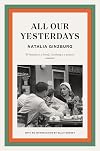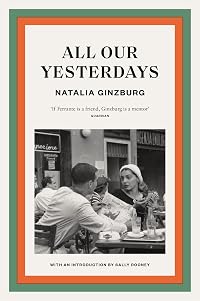
All Our Yesterdays
by Natalia Ginzburg
On This Page
Description
From "one of the most distinguished writers of modern Italy" (New York Review of Books), a classic novel of society in the midst of a war. This powerful novel is set against the background of Italy from 1939 to 1944, from the anxious months before the country entered the war, through the war years, to the allied victory with its trailing wake of anxiety, disappointment, and grief. In the foreground are the members of two families. One is rich, the other is not. In All Our Yesterdays, as in show more all of Ms. Ginzburg's novels, terrible things happen--suicide, murder, air raids, and bombings. But seemingly less overwhelming events, like a family quarrel, adultery, or a deception, are given equal space, as if to say that, to a victim, adultery and air raids can be equally maiming. All Our Yesterdays gives a sharp portrait of a society hungry for change, but betrayed by war. During the period described in the novel, Natalia Ginzburg was married to the writer Leone Ginzburg. Because of his underground activities, he was interned under Mussolini's reign, along with his family, in a restricted area in the Abruzzi. When the Ginzburgs later moved to Rome, Leone was arrested and tortured by the fascists, and killed, leaving Natalia alone to raise her three children. Skyhorse Publishing, as well as our Arcade, Yucca, and Good Books imprints, are proud to publish a broad range of books for readers interested in fiction--novels, novellas, political and medical thrillers, comedy, satire, historical fiction, romance, erotic and love stories, mystery, classic literature, folklore and mythology, literary classics including Shakespeare, Dumas, Wilde, Cather, and much more. While not every title we publish becomes a New York Times bestseller or a national bestseller, we are committed to books on subjects that are sometimes overlooked and to authors whose work might not otherwise find a home. show lessTags
Recommendations





















Member Reviews
In the novel All Our Yesterdays, published in 1952, Natalia Ginzburg presents the lives of two families in northern Italy through the years 1939 to 1944. In the first section, the personal turbulence in the families dominates the narrative, but lurking in the background is the political ferment of a fascist Italy and Nazi Germany’s expansion across Europe.
The book is a dense read, with a parade of a wide variety of characters. Even though the shadow of world events hangs over each of their lives, until later in the war, it is their personal concerns that propel the plot forward. These include a suicide, an unwanted pregnancy, and a marriage of convenience. It is a story where it is impossible to know which characters will survive the show more events described. Capturing the turmoil of the times, Ginzburg does not necessarily spare any of the individuals whom the reader may have come to feel sympathy for.
There are many novels written about this time period, but the author’s concentration on her characters’ personal lives is what drives home the horror of living under Italy’s fascist government and a world war’s impact on those just trying to get by on the sidelines. Through humdrum details of daily life, Ginzburg succeeds in highlighting the devastation inflicted by global events. Reading the book today, one is haunted by the specter of today’s headlines which could well affect each of our ordinary lives. show less
The book is a dense read, with a parade of a wide variety of characters. Even though the shadow of world events hangs over each of their lives, until later in the war, it is their personal concerns that propel the plot forward. These include a suicide, an unwanted pregnancy, and a marriage of convenience. It is a story where it is impossible to know which characters will survive the show more events described. Capturing the turmoil of the times, Ginzburg does not necessarily spare any of the individuals whom the reader may have come to feel sympathy for.
There are many novels written about this time period, but the author’s concentration on her characters’ personal lives is what drives home the horror of living under Italy’s fascist government and a world war’s impact on those just trying to get by on the sidelines. Through humdrum details of daily life, Ginzburg succeeds in highlighting the devastation inflicted by global events. Reading the book today, one is haunted by the specter of today’s headlines which could well affect each of our ordinary lives. show less
"This was a war in which no one would win or lose, in the end it would be seen that everyone had more or less lost."
This is a novel about what life was like for families in Italy during World War II. The focus is on two neighboring families whose children connect in various ways. One, with son Emanuel, daughter Amalia, and younger son Giuma, owns the factory in the small town in which they live, and is wealthy. They are headed by the rather flighty Mamacita. The other family is middle class and consists of four children. Concettina, the oldest, is constantly pursued by suitors, and ends up marrying a Black Shirt fascist (though the family itself is covertly anti-Mussolini). Eldest son Ippolito, who had 'the soul of a slave' waited hand show more and foot on their father while the father was still alive, and has a sad life indeed. Youngest son Giustino ends up being conscripted and having to fight. The younger daughter is most like the main character, although all play prominent roles, and we see much of the story from her pov.
I enjoyed this engaging look at life in Italy from 1939 to 1944. It was interesting that the author was able to convey how most people were usually able to just get on with their lives during the war, although these periods of mundaneness were regular intense brief interludes where the horror of war intruded.
3 1/2 stars show less
This is a novel about what life was like for families in Italy during World War II. The focus is on two neighboring families whose children connect in various ways. One, with son Emanuel, daughter Amalia, and younger son Giuma, owns the factory in the small town in which they live, and is wealthy. They are headed by the rather flighty Mamacita. The other family is middle class and consists of four children. Concettina, the oldest, is constantly pursued by suitors, and ends up marrying a Black Shirt fascist (though the family itself is covertly anti-Mussolini). Eldest son Ippolito, who had 'the soul of a slave' waited hand show more and foot on their father while the father was still alive, and has a sad life indeed. Youngest son Giustino ends up being conscripted and having to fight. The younger daughter is most like the main character, although all play prominent roles, and we see much of the story from her pov.
I enjoyed this engaging look at life in Italy from 1939 to 1944. It was interesting that the author was able to convey how most people were usually able to just get on with their lives during the war, although these periods of mundaneness were regular intense brief interludes where the horror of war intruded.
3 1/2 stars show less
[b:All Our Yesterdays|71165|All Our Yesterdays|Natalia Ginzburg|https://i.gr-assets.com/images/S/compressed.photo.goodreads.com/books/1347305070l/71165._SY75_.jpg|68918] is definitely an accomplished novel, yet somehow I find myself with very little to say about it. The setting is Fascist rural Italy before and during the Second World War; the narrative follows a teenage girl called Anna and her family. The pace is dilatory although there are some vivid scenes, especially towards the end. Perhaps reading it during a weekend break after having my brain blasted by [b:In the Country of Last Things|19486|In the Country of Last Things|Paul show more Auster|https://i.gr-assets.com/images/S/compressed.photo.goodreads.com/books/1328287715l/19486._SY75_.jpg|1010901] diminished its impact? Or maybe I just wasn't in the right mood to do it justice. I could tell intellectually that it was a good novel, yet did not feel it. The run-on sentences reminded me of [a:Elena Ferrante|44085|Elena Ferrante|https://images.gr-assets.com/authors/1635020942p2/44085.jpg], but somehow they didn't carry the same emotional weight as hers. Nonetheless, I appreciated the treatment of war and ideology:
[b:All Our Yesterdays|71165|All Our Yesterdays|Natalia Ginzburg|https://i.gr-assets.com/images/S/compressed.photo.goodreads.com/books/1347305070l/71165._SY75_.jpg|68918] very probably deserves more than three stars; my rating reflects my experience of it rather than the book's inherent qualities. I found the examination of war much more compelling than the family drama, which orbited around Anna while leaving her mostly an enigma. show less
He said that Emanuele, when he himself was on the point of going off to Russia, had made an angry scene with him, he was too young to be called up and could have stayed at home, and instead of that he was going as a volunteer to fight in a fascist war, he was going to help the fascists not lose this war of theirs, because he had perhaps believed all that rubbish about his country that fascism taught in the schools. But there wasn't a grain of truth in it, said Giustino, he had never dreamed of loving his country, he had never thought of any country whatever when he was at the war, firing at the enemy. Moreover, none of the men that were with him did think about it. Nor did anyone ever remember that it was against the Russians they were firing. It was just firing, neither for anybody nor against anybody, just firing with your feet like pieces of ice in your boots, and with your eyes dazzled by the snow. When he went away he had simply wanted to know what sort of a thing war was.
[b:All Our Yesterdays|71165|All Our Yesterdays|Natalia Ginzburg|https://i.gr-assets.com/images/S/compressed.photo.goodreads.com/books/1347305070l/71165._SY75_.jpg|68918] very probably deserves more than three stars; my rating reflects my experience of it rather than the book's inherent qualities. I found the examination of war much more compelling than the family drama, which orbited around Anna while leaving her mostly an enigma. show less
I read about 20% of this book and want to list it so that i am reminded that i have had enough of ginzburg and should not read her again!
Ginzburg schetst de kroniek van twee families die tegenover elkaar wonen, in een Noord-Italiaans stadje, de ene lichtjes verarmd, de andere rijk. We zijn de jaren 1930, de fascisten van Mussolini zijn aan de macht, een nieuwe oorlog gooit zijn schaduw vooruit, maar Ginzburg focust bijna helemaal op de banale lotgevallen van telkens twee jongeren uit die families (met naast hen een paar nevenfiguren). Ze doet dat in een droge, afstandelijke stijl, die louter registreert. Vaders sterven (de moeders zijn al gestorven), de kinderen gaan naar school, of beginnen in de fabriek (als arbeider of als directeur), ze hebben vriendschappen en al of niet gelukte relaties: het wordt allemaal zonder animo verteld. De politiek en de internationale show more situatie zijn zeker aanwezig, maar op de achtergrond.
Pas rond het midden van de roman komt er wat vaart in het verhaal, niet toevallig wanneer de oorlog echt uitbreekt, en de protagonisten meegetrokken worden. Maar ook nu weer blijft de vertelstijl nuchter en zakelijk, in een doorlopende stroom van relatief korte zinnen, beschrijvend, zonder dialogen, en vooral zonder veel emotie. Zelfs niet als er zich tegen het einde van de oorlog écht dramatische dingen voordoen. De hoofdfiguren ondergaan wat er gebeurt, begrijpen amper iets van wat er gaande is, hebben geen greep op hun leven.
Ik ga eerlijk zijn: al na 20 bladzijden had ik de neiging dit boek dicht te slaan. De vertelstijl, en het gebrek aan intrigerend verhaal, zetten niet echt aan om door te lezen. Maar ik deed het toch, en pas na 200 bladzijden begon deze roman te spreken. Niet spectaculair, uiteraard niet, maar toch. Vreemd is dit: Ginzburg heeft een experiment gewaagd met alleen maar antihelden, een familiekroniek zonder veel reliëf. Pas na wat doorzoeken, vond ik de sleutel: bij het begin plaatste Ginzburg een citaat van Shakespeare, uit Macbeth, dat begint met de woorden ‘and all our yesterdays’, meteen de titel van het boek. Merkwaardig genoeg zijn het vooral de daaropvolgende erg cynische regels (die ze niet vermeldt) die de betekenis van deze roman perfect weergeven:
“Life’s but a walking shadow, a poor player
That struts and frets his hour upon the stage,
And then is heard no more. It is a tale
Told by an idiot, full of sound and fury,
Signifying nothing.”
Als je deze roman vanuit dat licht leest, beginnen de eindeloze, opeenvolgende zinnen oorverdovend te spreken. En het is absoluut geen prettige boodschap die ze vertellen. Maar je hebt wel doorzettingsvermogen nodig om de roman uit te lezen en de boodschap te waarderen. show less
Pas rond het midden van de roman komt er wat vaart in het verhaal, niet toevallig wanneer de oorlog echt uitbreekt, en de protagonisten meegetrokken worden. Maar ook nu weer blijft de vertelstijl nuchter en zakelijk, in een doorlopende stroom van relatief korte zinnen, beschrijvend, zonder dialogen, en vooral zonder veel emotie. Zelfs niet als er zich tegen het einde van de oorlog écht dramatische dingen voordoen. De hoofdfiguren ondergaan wat er gebeurt, begrijpen amper iets van wat er gaande is, hebben geen greep op hun leven.
Ik ga eerlijk zijn: al na 20 bladzijden had ik de neiging dit boek dicht te slaan. De vertelstijl, en het gebrek aan intrigerend verhaal, zetten niet echt aan om door te lezen. Maar ik deed het toch, en pas na 200 bladzijden begon deze roman te spreken. Niet spectaculair, uiteraard niet, maar toch. Vreemd is dit: Ginzburg heeft een experiment gewaagd met alleen maar antihelden, een familiekroniek zonder veel reliëf. Pas na wat doorzoeken, vond ik de sleutel: bij het begin plaatste Ginzburg een citaat van Shakespeare, uit Macbeth, dat begint met de woorden ‘and all our yesterdays’, meteen de titel van het boek. Merkwaardig genoeg zijn het vooral de daaropvolgende erg cynische regels (die ze niet vermeldt) die de betekenis van deze roman perfect weergeven:
“Life’s but a walking shadow, a poor player
That struts and frets his hour upon the stage,
And then is heard no more. It is a tale
Told by an idiot, full of sound and fury,
Signifying nothing.”
Als je deze roman vanuit dat licht leest, beginnen de eindeloze, opeenvolgende zinnen oorverdovend te spreken. En het is absoluut geen prettige boodschap die ze vertellen. Maar je hebt wel doorzettingsvermogen nodig om de roman uit te lezen en de boodschap te waarderen. show less
Oct 26, 2020Dutch
1
Ratings
Members
- Recently Added By
Lists

Italian Literature
556 works; 41 members

Books Read in 2023
5,547 works; 145 members
Author Information

83+ Works 5,895 Members
Some Editions
Awards and Honors
Series
Belongs to Publisher Series
הספריה החדשה (1990 [11])
Work Relationships
Is contained in
Common Knowledge
- Original title
- Tutti i nostri ieri
- Alternate titles*
- ALL OUR YESTERDAYS
- Original publication date
- 1956
- People/Characters
- Leone Ginzburg; Natalia Ginzburg
- First words
- Their mother's portrait hung in the dining room: a woman seated on a chair, wearing a hat with feathers in it, and with a long, tired, frightened face.
- Last words
- (Click to show. Warning: May contain spoilers.)And they laughed a little and were very friendly together, the three of them, Anna, Emanuele and Giustino; and they were pleased to be together, the three of them, thinking of all those who were dead, and of the long warand the sorrow and the noise and confusion, and of the long, difficult life which they saw in front of them now, full of all the things they did not know how to do.
- Original language*
- Italiano
*Some information comes from Common Knowledge in other languages. Click "Edit" for more information.
Classifications
- Genres
- General Fiction, Fiction and Literature
- DDC/MDS
- 853.912 — Literature & rhetoric Italian, Romanian & related literatures Italian fiction 1900- 20th Century 1900-1945
- LCC
- PQ4817 .I5 .T813 — Language and Literature French, Italian, Spanish and Portuguese literatures Italian literature Individual authors, 1900-1960
- BISAC
Statistics
- Members
- 447
- Popularity
- 68,411
- Reviews
- 6
- Rating
- (3.40)
- Languages
- 10 — Danish, Dutch, English, French, German, Hebrew, Hungarian, Italian, Portuguese, Spanish
- Media
- Paper, Ebook
- ISBNs
- 35
- ASINs
- 9