On This Page
Description
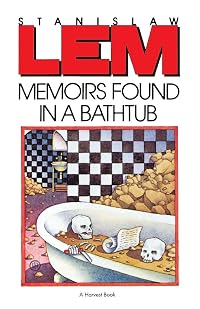
The year is 3149, and a vast paper destroying blight-papyralysis-has obliterated much of the planet's written history. Fortunately, these rare memoirs, preserved for centuries in a volcanic rock, record the strange life of a man trapped in a hermetically sealed underground community . . . From the Kafka Prize-winning author of Solaris, this is an entertaining and thought-provoking blend of politics, philosophy, humor, and science fiction. Translated by Michael Kandel and Christine Rose.Tags
Recommendations




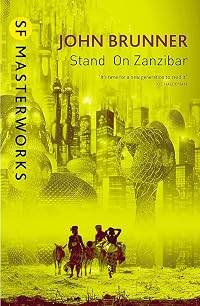

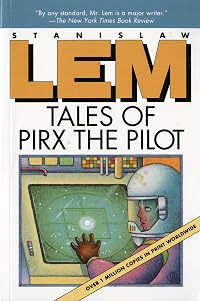
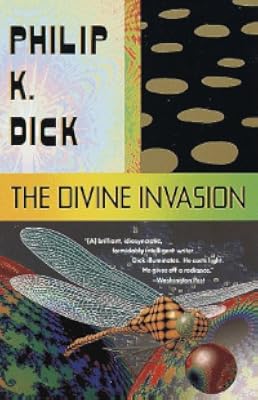

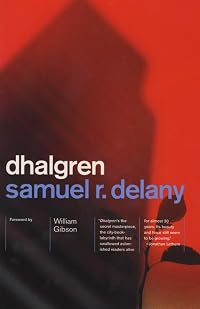























Member Recommendations

paradoxosalpha Epistemological disease in bureaucratic espionage
Member Reviews
Memoirs Found in a Bathtub caught my eye simply for the novelty of the title and that bizarre cover. This book is difficult to sum up or even to rate as it truly has no discernible plot. Lest you dismiss it immediately because of this fact, let me assure you that there's much to recommend this title. The word play and circuitous path of our main character (who remains nameless) is satire at its finest. Espionage, counterespionage, and counter-counterespionage abound in The Building where our character has been given a very important Mission...if only he knew what it was. He is continually beset by obstacles in the form of bureaucrats, winding halls with nondescript doors, and instructions that keep vanishing. What would happen if show more humanity was forced to abandon its cities and move into an underground bunker? Would society, culture, and technology survive and continue to advance? Lem weaves a provocative tale of paranoia, confusion, and ultimately betrayal. 5/10 but would have been higher had there been a plot to follow. show less
The twelve-page introduction is more overtly sfnal than the body text of this novel, which is a romp of epistemological ambiguity set in the dystopian Building. From the far-future documentary context of the intro we are led to understand that the Building contains a sort of continuity-of-government American microsociety in an underground site in the Rocky Mountains. And yet the exit from the windowless Building in the memoirs themselves is at the bottom rather than the top (185)--unless that "Gate" is merely a sham or a trap, as it may well be.
The narrator of the memoirs gives neither his name nor his origin. He begins in media res with an effort to "find the right room" (13) which quickly eventuates into his recruitment as an show more intelligence agent. Once he has achieved this status, the first parts of the book are concerned with his striving to acquire his "instructions," which he accomplishes in a sort of tentative and temporary fashion. Later passages are more focused on determining the actual authority and allegiances involved with his activities, which tend toward the scripted and ritualistic, implying all manner of codes and betrayals.
I was already reminded of the Kafkaesque British TV series The Prisoner (1967-8) when Major Erms said, "Be seeing you" (58). I guess any intentionality there must be ascribed to the 1973 English translators, since the Polish original was written in 1961. Another comparandum for me was Jeff VanderMeer's novel Authority.
I'm not sure what I was expecting when I picked up this book, but I was surprised to find satirical theodicy skirting the edge of nihilism in an anti-fantasy of espionage and authoritarianism. It's a short book, and I would read it again.
"I only know that you told me what they told you to tell me."
"And you wouldn't believe me if I denied that, and you shouldn't, because even if I did, it probably wouldn't be the truth. Who knows?" (169) show less
The narrator of the memoirs gives neither his name nor his origin. He begins in media res with an effort to "find the right room" (13) which quickly eventuates into his recruitment as an show more intelligence agent. Once he has achieved this status, the first parts of the book are concerned with his striving to acquire his "instructions," which he accomplishes in a sort of tentative and temporary fashion. Later passages are more focused on determining the actual authority and allegiances involved with his activities, which tend toward the scripted and ritualistic, implying all manner of codes and betrayals.
I was already reminded of the Kafkaesque British TV series The Prisoner (1967-8) when Major Erms said, "Be seeing you" (58). I guess any intentionality there must be ascribed to the 1973 English translators, since the Polish original was written in 1961. Another comparandum for me was Jeff VanderMeer's novel Authority.
I'm not sure what I was expecting when I picked up this book, but I was surprised to find satirical theodicy skirting the edge of nihilism in an anti-fantasy of espionage and authoritarianism. It's a short book, and I would read it again.
"I only know that you told me what they told you to tell me."
"And you wouldn't believe me if I denied that, and you shouldn't, because even if I did, it probably wouldn't be the truth. Who knows?" (169) show less
I thought that the most memorable bit of "Memoirs found in a Bathtub" was the stuff at the very beginning. Lem sets up a framing device in which an anthropological journal of the far future evaluates a text -- the eponymous memoirs -- that was found in the ruins of a subterranean capitalist-survivalist society that established itself under the Rocky Mountains after capitalism's eventual collapse. It's always delightful to read the past's future, but it's the studiously academic-yet-breezy tone here that gives this description its ironic bite.
The rest of the book, which purports to be the memoirs themselves, is something quite different: a critique of bureaucratic totalitarian systems, a cold war allegory, a mystery, and a farce all at show more once. It's got a lot to do with Kafka, with Orwell's "1984," and maybe with Koestler's "Darkness at Noon." As you can imagine, it's a somewhat claustrophobic, paranoid read, a narrative that constantly doubles back on itself as its protagonists' mental state deteriorates. I imagine that the political repression that Lem was writing under kept him from including too many specifics and this text, in the end, works against the book, I think: the work comes off as a bit more abstract and theoretical than it otherwise might have. Still, it might, I think, contain some sly criticism of mid-century American corporate culture: the book's filled with clean, well-lighted corridors, coffee cups, and paperwork. Of course, the massive, intractable bureaucracy described in "Memoirs" might as well describe some Soviet government department...but, well, it's hard to know. Still, even as it moves toward its inevitable end, the book manages to be, in places, weird, poignant, tricky and thoughtful. It's put Lem on my list of authors to track down. show less
The rest of the book, which purports to be the memoirs themselves, is something quite different: a critique of bureaucratic totalitarian systems, a cold war allegory, a mystery, and a farce all at show more once. It's got a lot to do with Kafka, with Orwell's "1984," and maybe with Koestler's "Darkness at Noon." As you can imagine, it's a somewhat claustrophobic, paranoid read, a narrative that constantly doubles back on itself as its protagonists' mental state deteriorates. I imagine that the political repression that Lem was writing under kept him from including too many specifics and this text, in the end, works against the book, I think: the work comes off as a bit more abstract and theoretical than it otherwise might have. Still, it might, I think, contain some sly criticism of mid-century American corporate culture: the book's filled with clean, well-lighted corridors, coffee cups, and paperwork. Of course, the massive, intractable bureaucracy described in "Memoirs" might as well describe some Soviet government department...but, well, it's hard to know. Still, even as it moves toward its inevitable end, the book manages to be, in places, weird, poignant, tricky and thoughtful. It's put Lem on my list of authors to track down. show less
‘Memoirs Found in a Bathtub’ is a strange novel, but its strangeness feels somehow familiar. It reminded me of Ishiguro’s [b:The Unconsoled|40117|The Unconsoled|Kazuo Ishiguro|https://images.gr-assets.com/books/1342193138s/40117.jpg|6372970], Kadare’s [b:The Palace of Dreams|797635|The Palace of Dreams|Ismail Kadare|https://images.gr-assets.com/books/1178472255s/797635.jpg|783601], the Terry Gilliam film ‘Brazil’, and [b:Through the Looking-Glass, and What Alice Found There|83346|Through the Looking-Glass, and What Alice Found There (Alice's Adventures in Wonderland, #2)|Lewis Carroll|https://images.gr-assets.com/books/1359299332s/83346.jpg|17240250]. It would probably also remind me of Kafka’s [b:The Trial|17690|The show more Trial|Franz Kafka|https://images.gr-assets.com/books/1320399438s/17690.jpg|2965832], if I’d read it. (I am going to - the library’s copy never seems to be on the shelf!) First published in 1971, Lem’s novel is an unsettling satire on the Cold War, in which an intelligence agency (the CIA?) has retreated into a massive underground bunker. The narration begins abruptly, in the middle of a sentence, without introducing the narrator. He seems to be an agent of some sort, tasked with an important mission that no-one is willing or able to explain to him. He travels from office to office, encounters a bizarre array of obfuscating persons and attempts to discern what the hell is going on. There are some recurring themes relating to astronomy and free will, as well as a framing conceit of the memoirs as a rare document recovered thousands of years later. By this point almost all paper has been obliterated by an epidemic of some sort, so historians struggle to understand what was going just on much as the narrator does.
The narrative has considerable momentum, closely resembling an anxiety dream in which you’re late, lost, and obscurely to blame for something. Thus it isn’t the most pleasant thing to read, although some of the writing is beautiful. Certain incidents are merely farcical or grotesque, but others feel profound. My favourite moment was this, towards the end:
I wasn’t entirely satisfied with the ending, though. show less
The narrative has considerable momentum, closely resembling an anxiety dream in which you’re late, lost, and obscurely to blame for something. Thus it isn’t the most pleasant thing to read, although some of the writing is beautiful. Certain incidents are merely farcical or grotesque, but others feel profound. My favourite moment was this, towards the end:
”A priest? You turned me over to Major Erms! You only wear a cassock to hide the uniform!”
“And do you only a wear a body to hide the skeleton? Try to understand. I am hiding nothing. You say I betrayed you. But everything here is illusion: betrayal, treason, even omniscience - for omniscience is not only impossible, but quite unnecessary when its counterfeit suffices, a fabrication of stray reports, allusions, words mumbled in one’s sleep or retrieved from the latrines… It is not omniscience but the faith in that matters.”
I wasn’t entirely satisfied with the ending, though. show less
Very funny introduction written by Lem as part of the story using his trademark neologisms. Baa-bel (Babel), Ammer-Ka (America), Kap-Eh-Taahl (Capital). Just like reading Ridley Walker, Acid House, or Clockwork orange, it takes some getting used to, but it is fun to decipher. I like the idea of a virus destroying all paper everywhere causing chaos across the world. The rest of the book was quite ordinary by contrast, and the scenario played out reminded me of The Third Policeman in that the protagonist was never really sure what was real. The repetitive corridors, rooms, confrontations with spies, made me feel quite claustrophobic and frustrated, and it was quite a relief to finish the book and leave the poor character stuck in the show more building. I particularly liked the deciphering of Shakespeare's Romeo and Juliet, which revealed Shakespeare harboured a grudge against someone by the name of Matthews! show less
“When you jump for joy, beware that no one moves the ground from beneath your feet.”
― Stanisław Lem
If you are up for writing with ample helpings of the polyglotomatic and metapsychodelic, Memoirs Found in a Bathtub, Stanislaw Lem’s 1961 novel of screwball bureaucratic misadventure will most certainly stir your brainwaves and set your neural neurons fizzing.
What a polyglot and metaphysician was our author - fluent in Polish, Latin, German, French, English, Russian, Ukrainian, Lem’s expertise ranged from medicine and biology, physics and astronomy, mathematics and robotics to philosophy, literature and linguistics. And added to this intellectual mix, such a protean imagination – numerous collections of highly provocative show more essays, dozens of short stories and seventeen science fiction novels, many judged among the best within the genre.
A twelve page Introduction (part of the novel) written hundreds of years into the future outlines how this manuscript, Notes from the Neogene, or its more commonly known title, Memoirs Found in a Bathtub, is a precious relic from Earth’s ancient past, "a period of decline which directly preceded the great Collapse," a time when paper was used extensively for writing. Among the numerous documented facts alluded to by this archaeologist of the future in his quest to discover the reasons behind the demise of that paper centered, bathroom centered, ancient civilization is a thriving cult revolving around Kap-Eh-Taahl, a deity denied supernatural existence. Yes, Kap-Eh-Taahl is “Capital,” one example of how the Introduction, scholarly and authoritative in tone, is a Stanislaw Lem-ish tour de force of word play, word blending, punning, spoonerisms, neologisms, double entendre, tongue-twisters and tongue-in-cheek.
Nevertheless these introductory remarks are picture-perfect as a set up to frame the narrative that follows, an extensive firsthand report authored by a newly assigned secret agent caught in an unending network of offices, corridors, stairs, elevators and bathrooms forming part of a vast underground military compound. If this strikes you as a Kafkaesque parable of little guy versus big bureaucracy, you hit the bulls-eye – much of the spirit of Lem's novel is captured in the above Jaroslav Rona sculpture located in Prague with natty Franz Kafka atop a headless, handless giant.
In the very first paragraph our disoriented narrator tells us he can’t locate the proper room amid multiple levels of departments and offices in this Pentagon-like Building as he attempts to press through crowds of marching military personnel, disguised agents and preoccupied secretaries. Kafka’s An Imperial Message comes immediately to mind, a tale where a messenger sent by the Emperor is trying to bring a special message for you alone but the messenger must push through a solid mass of humanity in an outer courtyard only to find another horde of people in the next courtyard blocking his way and so it continues, such that, alas, you will never receive your message. Anybody who has ever been obliged to deal with a bloated administrative system will hear a familiar ring.
The narrator wends his way to the office of powerfully built, bald, old General Kashenblade, Commander in Chief, only to be given an unidentified special mission. The more questions he asks about the specifics of his mission, the more indecipherable the explanations, even moving out to the stars, as when the old man pontificates, “And the spiral nebulae?! Well?! Don’t tell me you don’t know what that means! SPY-ral!! And the expanding universe, the retreating galaxies! Where are they going? What are they running from? And the Doppler shift to the red!! Highly suspicious – no more! A clear admission of guilt!!”
Such decidedly cerebral passages are reminiscent of another classic where imagination and erudite fancy mix with elements of physics, mathematics, astronomy and other sciences - t zero by Italo Calvino. Lem’s polyglot background frequently shines through with a light touch, a real treat for readers who enjoy heady subjects and brain teasers mixed in with their fiction.
Next stop, we follow our earnest special agent, now a man on a mission, to the main office where he is approached by a young officer who introduces himself as Lieutenant Blanderdash, the Chief’s undercover aide. Whoa, Stanislaw! Was that Blanderdash or Balderdash? Blanderdash proceeds to ask the agent if he yawns or snores (the department lost many people by snoring) before leading him to the Department of Collections to view, along with a multitude of other absurdities, cabinets with millions of cuff links and glass cases filled with artificial ears, noses, bridges, fingernails, warts, eyelashes, boils and humps.
Given such a display (no pun intended) of government and military intelligence brings to mind Moscow 2042 and other comic masterpieces by Vladimir Voinovich. Such a sharp satirical needle – too bad the archaeologist examining these memoirs assumes the narrator is entirely serious and completely reliable! He’s missing out on much of the irony and dark humor.
I’m reminded yet again of another author, Lewis Carroll and his Alice in Wonderland, most especially the Mad Hatter’s tea party. For the more I turned the pages, the more I had the feeling special agent Undereavesdropper Blassenkash (in Chapter 2 he answers to this title and name) is trapped in a building filled with a stream of Mad Hatters spouting sheer indecipherable nonsense. I actually found this one of the more amusing and more telling aspects of the tale since the madness is accentuated by our unfortunate narrator forever remaining the serious, formal straight man.
Perhaps agent Blassenkash finally comes to understand the underlying meaning of what’s going on: either all of this is a test for him to pass in his capacity as agent, or - fanfare tooted by Alice's White Rabbit on his tiny trumpet - everyone is a raving lunatic. Or, maybe he has been misled by enemy spies that have infiltrated the Building. Or, then again, his very presence in the Building is, in fact, his mission. Or a dozen other possibilities.
You will have to read for yourself to decipher the code. However, be aware – there could be more than one code. As a head Building official explains, “Now, there are calling codes, stalling codes, departmental codes, special codes, and – you’ll like this,” he grinned, “they’re changed every day. Each section, of course, has its own system, so the same word or name will have a different meaning on different levels.”
Stanisław Lem, age 50, at his typewriter in Kraków, Poland, 1971 show less
With Lem, you never know what you're going to get- you sit down with what sounds like a science fiction book, but will it actually be one of those, or something completely different? Make no mistake, besides the frame narrative this isn't so much a work of science fiction as it is Lem's take on Kafka.
It's a shame too, for two reasons: first, I was looking for a science fiction book and not Kafkaesque metafiction, and Second, the frame narrative sets up a very intriguing setting. Besides establishing the loss of the written word and the resulting dark ages, which don't end up mattering much going forward, the frame narrative also depicts a United States that lost the cold war, and the final bastion of the U.S. government sealed away in a show more vast underground base. Unfortunately (in my opinion), the rest of the book fails to capitalize on this setting.
Enter the narrative proper, a memoir of one of the inhabitants of this underground base written by a civilian agent assigned to carry out a mission of which he has not been informed of the details. But is there a mission at all? His journey takes him through incident after incident that leave him more and more confused about what is going on, both with himself and with the building. Is he being tested? Has the building been infiltrated by enemy agents? Is there any rhyme or reason to any of this at all? As is typical of books that take after Kafka, don't expect there to be any answers here. But is there meaning? Though the book is replete with religious symbols, I couldn't uncover anything about religion that the book was trying to say. Neither was there any political message here either, besides Cold War-paranoia writ-large and cranked up to eleven. The events themselves are barely connected, so there's no real story here besides the narrator's growing desperation. Eventually, after a certain number of incidents, it ends. After having finished, I don't consider the theme of invented meanings, narrative self-references, and omnipresent paranoia to be anything more than gimmicks.
I don't much care for Lem's take on Kafka, or his more experimental books in general (A Perfect Vacuum, for instance). If I wanted something of that sort I'd read Kafka himself, or Borges, or Dino Buzzati, or Michal Ajvaz, or Leo Perutz, or other writers who I think do that type of thing better than Lem does. Instead, I like Lem's more standard Science Fiction stories. That's what I expected to get out of this book, and was disappointed when I didn't. Even putting my personal expectations aside, however, I still don't think Memoirs Found in a Bathtub does Cold War Kafka particularly well, or says anything interesting with it. If you want Kafka with some very light science-fiction elements, I guess this could work for you, otherwise read one of the authors I've listed herein. show less
It's a shame too, for two reasons: first, I was looking for a science fiction book and not Kafkaesque metafiction, and Second, the frame narrative sets up a very intriguing setting. Besides establishing the loss of the written word and the resulting dark ages, which don't end up mattering much going forward, the frame narrative also depicts a United States that lost the cold war, and the final bastion of the U.S. government sealed away in a show more vast underground base. Unfortunately (in my opinion), the rest of the book fails to capitalize on this setting.
Enter the narrative proper, a memoir of one of the inhabitants of this underground base written by a civilian agent assigned to carry out a mission of which he has not been informed of the details. But is there a mission at all? His journey takes him through incident after incident that leave him more and more confused about what is going on, both with himself and with the building. Is he being tested? Has the building been infiltrated by enemy agents? Is there any rhyme or reason to any of this at all? As is typical of books that take after Kafka, don't expect there to be any answers here. But is there meaning? Though the book is replete with religious symbols, I couldn't uncover anything about religion that the book was trying to say. Neither was there any political message here either, besides Cold War-paranoia writ-large and cranked up to eleven. The events themselves are barely connected, so there's no real story here besides the narrator's growing desperation. Eventually, after a certain number of incidents, it ends. After having finished, I don't consider the theme of invented meanings, narrative self-references, and omnipresent paranoia to be anything more than gimmicks.
I don't much care for Lem's take on Kafka, or his more experimental books in general (A Perfect Vacuum, for instance). If I wanted something of that sort I'd read Kafka himself, or Borges, or Dino Buzzati, or Michal Ajvaz, or Leo Perutz, or other writers who I think do that type of thing better than Lem does. Instead, I like Lem's more standard Science Fiction stories. That's what I expected to get out of this book, and was disappointed when I didn't. Even putting my personal expectations aside, however, I still don't think Memoirs Found in a Bathtub does Cold War Kafka particularly well, or says anything interesting with it. If you want Kafka with some very light science-fiction elements, I guess this could work for you, otherwise read one of the authors I've listed herein. show less
Members
- Recently Added By
Lists

Best Science Fiction Novels
816 works; 430 members

Bureaucracies
25 works; 2 members

Found manuscripts
35 works; 2 members

Books With Interesting Titles
173 works; 14 members

Favorite Books in Translation
320 works; 133 members
Author Information

Polish science fiction writer Stanislaw Lem was born on September 12, 1921. A medical graduate of Cracow University, he is at home both in the sciences and in philosophy, and this broad erudition gives his writings genuine depth. He has published extensively, not only fiction, but also theoretical studies. His books have been translated into 41 show more languages and sold over 27 million copies. He gained international acclaim for The Cyberiad, a series of short stories, which was first published in 1974. A trend toward increasingly serious philosophical speculation is found in his later works, such as Solaris (1961), which was made into a Soviet film by Russian director Andrei Tarkovsky in 1972 and remade by Steven Soderbergh in 2002. He died on March 27, 2006 in Krakow at the age of 84. (Bowker Author Biography) show less
Some Editions
Series

Belongs to Publisher Series
Caminho de Bolso (1)
Dzieła Stanisława Lema (Wydawnictwo Gazety Wyborczej)
Work Relationships
Is contained in
Common Knowledge
- Canonical title*
- Memoiren, gefunden in der Badewanne
- Original title
- Pamiętnik znaleziony w wannie
- Original publication date
- 1961
- First words
- ...I couldn't seem to find the right room--none of them had the number designated on my pass. First I wound up at the Department of Verification, then the Department of Misinformation, then some clerk from the Pressure Sectio... (show all)n advised me to try level eight, but on level eight they ignored me, and later I got stuck in a crowd of military personnel--the corridors rang with their vigorous marching back and forth, the slamming of doors, the clicking of heels, and over that martial noise I could hear the distant music of bells, the tinkling of medals.
"Notes from the Neogene" is unquestionably one of the most precious relics of Earth's ancient past, dating from the very close of the Prechaotic, that period of decline which directly preceded the Great Collapse. It is indeed... (show all) a paradox that we know much more of the civilizations of the Early Neogene, the protocultures of Assyria, Egypt and Greece, than we do of the days of paleoatomics and rudimentary astrogation. - Last words
- (Click to show. Warning: May contain spoilers.)"Give me the razor!" I screamed, "Traitor! Bastard! Give me the razor!!"
- Original language
- Polish
*Some information comes from Common Knowledge in other languages. Click "Edit" for more information.
Classifications
- Genres
- Science Fiction, Fiction and Literature
- DDC/MDS
- 891.8537 — Literature & rhetoric Literatures of other languages East Indo-European and Celtic literatures West and South Slavic languages (Bulgarian, Slovene, Polish, Czech, Slovak, Serbo-Croatian, and Macedonian) Polish Polish fiction 1919–1989
- LCC
- PG7158 .L39 .P313 — Language and Literature Slavic languages and literatures. Baltic languages. Albanian language Slavic. Baltic. Albanian Slavic Polish
- BISAC
Statistics
- Members
- 1,166
- Popularity
- 21,591
- Reviews
- 20
- Rating
- (3.58)
- Languages
- 13 — Czech, Dutch, English, French, German, Italian, Japanese, Polish, Portuguese, Russian, Spanish, Swedish, Turkish
- Media
- Paper, Audiobook, Ebook
- ISBNs
- 38
- ASINs
- 19