
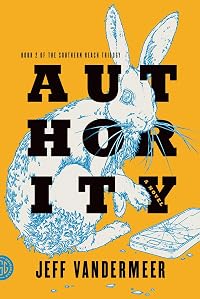
On This Page
Description
"In the second volume of the Southern Reach Trilogy, questions are answered, stakes are raised, and mysteries are deepened. In Annihilation, Jeff VanderMeer introduced Area X--a remote and lush terrain mysteriously sequestered from civilization. This was the first volume of a projected trilogy; well in advance of publication, translation rights had already sold around the world and a major movie deal had been struck. Just months later, Authority, the second volume, is here. For thirty years, show more the only human engagement with Area X has taken the form of a series of expeditions monitored by a secret agency called the Southern Reach. After the disastrous twelfth expedition chronicled in Annihilation, the Southern Reach is in disarray, and John Rodriguez, aka "Control," is the team's newly appointed head. From a series of interrogations, a cache of hidden notes, and hours of profoundly troubling video footage, the secrets of Area X begin to reveal themselves--and what they expose pushes Control to confront disturbing truths about both himself and the agency he's promised to serve. And the consequences will spread much further than that. The Southern Reach trilogy will conclude in fall 2014 with Acceptance"-- "In the second volume of the Southern Reach trilogy, Area X's most troubling questions are answered... but the answers are far from reassuring"-- show lessTags
Recommendations







































Member Recommendations

Tuirgin Despite the concept of Area X being strikingly similar to the Strugatsky's Roadside Picnic, there are also echos of Stanisław Lem's Solaris—the idea of a type of communication so alien to human modes of communication that it can be harmful to us.
31
paradoxosalpha Epistemological disease in bureaucratic espionage
Member Reviews
There is a scene late in Authority (FSG Originals, May 2014) in which one character explains to another the manic gyrations of a beetle the two them are observing: The pesticide with which the insect came into contact is suffocating it, causing it to stumble about in panic. It's dying. The character ends the beetle's suffering by crushing it beneath her heel. That scene is an apt metaphor for the experience of reading Authority: The reader is the bug writhing in the shadow of Jeff VanderMeer's foot.
Authority is the second book of VanderMeer's The Southern Reach Trilogy. While not exactly essential to follow the story in Authority, it's recommended that readers begin with Annihilation, published in February. And, although I hate to have show more to say it: Spoiler alert. Whoop, whoop, sirens go off.
Authority picks up less with where Annihilation lets off than it does more with a different thread. Here the story remains firmly outside of the mysterious "Area X," into which readers ventured in Annihilation. The setting is Florida, in a containment zone that comprises and cushions Area X from its surrounding environs. The Southern Reach, an obscure government department attached to Homeland Security, presides over Area X, investigating in a desultory fashion. The Southern Reach has learned very little about Area X over the previous two decades, and is still smarting from the loss of its most recent expedition. The organization is rudderless, its director having joined the expedition as the team psychologist. It's this situation that disgraced agent John Rodriguez, AKA "Control," inherits as the new director of the Southern Reach, perhaps due to the influence of his mother. (Control has serious mommy issues.)
Control immediately begins investigating the latest expedition, his efforts focused on (surprise!) the biologist, who returned from Area X just before his arrival. Between interrogating the defiant biologist, who insists that she is not herself, despite having memories of her life before her time in Area X, the director engages in office politics with the Assistant Director, Grace, and encounters some of the oddities that Area X generates, for instance, a plant in his desk drawer, placed there by the previous director, that just won't die. And, of course, there are the words scrawled in his closet: "Where lies the strangling fruit that came from the hand of the sinner..." Bad juju.
Ultimately, then, if Annihilation is something of a "journey into mystery," Authority is more of a spy novel, albeit one that is a comedy of errors. Rodriguez's choice of "Control" to serve as his handle is ironic; it's clear that he's out of his depth. The superior to whom Control reports, "the Voice," ineptly screams obscenities at him. Control visits the gateway to Area X, but the guards inform him that the commanding officer has stepped out. Control vomits into a toilet after a confrontation with Grace. My guess is that, for all the surreal goings-on, this is a more accurate portrayal of the life of spies than readers have otherwise encountered.
Of course, it isn't spycraft that interests VanderMeer, it's "the Weird." As with Annihilation, VanderMeer masterfully establishes an unsettling atmosphere. Nature itself seems to conspire against Control and his subordinates: The air is always muggy, and rains come and go every day. Then, too, there is the catalog of strangeness that builds up around any bureaucracy and in any office: The infighting, the awkward attempts at conviviality, the depressing tones of the carpets and trim, the smell of the wrong disinfectant. Area X is just miles away, and, after the scene in which Control watches footage of an experiment in which scientists forced rabbits across its border, the presence of that strange land looms like a threat.
Comparisons between Authority and Annihilation are inevitable. On the whole, Authority has been very well received, moreso than its predecessor. Still, individual taste being idiosyncratic, I have to admit that I liked Authority less than Annihilation. Part of it is temperament, of course; I liked being "on the ground" in Area X in Annihilation, and, as an office drone, some of the setting of Authority struck too close to home. In my opinion, though, Annihilation was the stronger of the two books because it was so compressed; VanderMeer distilled the Weird down to its very essence. Where Annihilation was tightly coiled, Authority meanders. It is a longer book, and, at times, seems to be unspooling: Scenes go on too long, or VanderMeer is more verbose than this reader would prefer. Because Control knows so little about Area X and even the Southern Reach, the narrative is told from his point of view, which involves a great deal of speculation. VanderMeer devotes considerable space to Control wondering along the lines of, "What is this? Could it be this? But then, it could also be this." The sense of uncertainty is palpable, but it becomes a thicket through which the reader must force his or her way, and, at times, it becomes exhausting.
This is not to in any way suggest that Authority is not worth the reader's time. Indeed, the second half of the book is briskly paced, and events unfold much faster than in previous chapters, to this reader's delight. As with Annihilation, VanderMeer, with Authority, remains at the top of his game. If Annihilation is one of the best books of 2014--we're halfway through, and I still maintain that it is--then Authority is a worthy successor. Highly recommended. show less
Authority is the second book of VanderMeer's The Southern Reach Trilogy. While not exactly essential to follow the story in Authority, it's recommended that readers begin with Annihilation, published in February. And, although I hate to have show more to say it: Spoiler alert. Whoop, whoop, sirens go off.
Authority picks up less with where Annihilation lets off than it does more with a different thread. Here the story remains firmly outside of the mysterious "Area X," into which readers ventured in Annihilation. The setting is Florida, in a containment zone that comprises and cushions Area X from its surrounding environs. The Southern Reach, an obscure government department attached to Homeland Security, presides over Area X, investigating in a desultory fashion. The Southern Reach has learned very little about Area X over the previous two decades, and is still smarting from the loss of its most recent expedition. The organization is rudderless, its director having joined the expedition as the team psychologist. It's this situation that disgraced agent John Rodriguez, AKA "Control," inherits as the new director of the Southern Reach, perhaps due to the influence of his mother. (Control has serious mommy issues.)
Control immediately begins investigating the latest expedition, his efforts focused on (surprise!) the biologist, who returned from Area X just before his arrival. Between interrogating the defiant biologist, who insists that she is not herself, despite having memories of her life before her time in Area X, the director engages in office politics with the Assistant Director, Grace, and encounters some of the oddities that Area X generates, for instance, a plant in his desk drawer, placed there by the previous director, that just won't die. And, of course, there are the words scrawled in his closet: "Where lies the strangling fruit that came from the hand of the sinner..." Bad juju.
Ultimately, then, if Annihilation is something of a "journey into mystery," Authority is more of a spy novel, albeit one that is a comedy of errors. Rodriguez's choice of "Control" to serve as his handle is ironic; it's clear that he's out of his depth. The superior to whom Control reports, "the Voice," ineptly screams obscenities at him. Control visits the gateway to Area X, but the guards inform him that the commanding officer has stepped out. Control vomits into a toilet after a confrontation with Grace. My guess is that, for all the surreal goings-on, this is a more accurate portrayal of the life of spies than readers have otherwise encountered.
Of course, it isn't spycraft that interests VanderMeer, it's "the Weird." As with Annihilation, VanderMeer masterfully establishes an unsettling atmosphere. Nature itself seems to conspire against Control and his subordinates: The air is always muggy, and rains come and go every day. Then, too, there is the catalog of strangeness that builds up around any bureaucracy and in any office: The infighting, the awkward attempts at conviviality, the depressing tones of the carpets and trim, the smell of the wrong disinfectant. Area X is just miles away, and, after the scene in which Control watches footage of an experiment in which scientists forced rabbits across its border, the presence of that strange land looms like a threat.
Comparisons between Authority and Annihilation are inevitable. On the whole, Authority has been very well received, moreso than its predecessor. Still, individual taste being idiosyncratic, I have to admit that I liked Authority less than Annihilation. Part of it is temperament, of course; I liked being "on the ground" in Area X in Annihilation, and, as an office drone, some of the setting of Authority struck too close to home. In my opinion, though, Annihilation was the stronger of the two books because it was so compressed; VanderMeer distilled the Weird down to its very essence. Where Annihilation was tightly coiled, Authority meanders. It is a longer book, and, at times, seems to be unspooling: Scenes go on too long, or VanderMeer is more verbose than this reader would prefer. Because Control knows so little about Area X and even the Southern Reach, the narrative is told from his point of view, which involves a great deal of speculation. VanderMeer devotes considerable space to Control wondering along the lines of, "What is this? Could it be this? But then, it could also be this." The sense of uncertainty is palpable, but it becomes a thicket through which the reader must force his or her way, and, at times, it becomes exhausting.
This is not to in any way suggest that Authority is not worth the reader's time. Indeed, the second half of the book is briskly paced, and events unfold much faster than in previous chapters, to this reader's delight. As with Annihilation, VanderMeer, with Authority, remains at the top of his game. If Annihilation is one of the best books of 2014--we're halfway through, and I still maintain that it is--then Authority is a worthy successor. Highly recommended. show less
2/5
Authority feels like it spins it's wheels most of it's 300 page length, unsure where it wants to go. Unfortunately, the main character, Area X itself, is no longer at center stage. What we get instead is a much more tedious and pointless office drama, designed mostly to build the backstory of character that I simply couldn't summon interest in. In Authority, we are wedged into the internal thoughts of the new director of the Southern Reach, Control, as he navigates the mystifying research of Area X that has accumulated over the past thirty years, and as he navigates tumultuous new relationships with other employees, who appear to be broken and changed by the process.
It's a sin that nothing of note happens within the first two thirds show more of the book. Most of the information gleaned during this time is a rehash of information we already knew from the first book, with flavor thrown on top as a consolation prize. Authority has a really bad case of middle book syndrome, as I'm certain that he felt much of this was necessary to support the concluding novel. VanderMeer's prose does the novel no favors either. Everything is couched in the same clumsy ambiguity; Control supposing a certain theory and immediately following it with "then again, maybe not", describing environments with opposing adjectives. This type of writing hits like a middle school student trying to write with depth for the first time. Certainly this is the worst his prose has been across the work that I've read.
The action does pick up in the final third of the novel and there are some interesting reveals, but importantly these are all predicated on knowledge that you must already posses from the first book. In no way would this book be satisfying on its own. I'm not saying that sequels must always stand on their own completely, but Authority is badly dependent on it's prequel to manufacture any kind of intrigue.
With all of this said, by far the worst thing the book did was make me ambivalent about subsequent books in the series, and the narrative of Area X as a whole. I regret journeying past the first book. In hindsight I feel like I was satisfied with what Annihilation offered, and though I'm sure if this novel had been better executed I might've changed my apathy, I don't feel like any follow up is truly necessary. Which in my opinion is a good thing. show less
Authority feels like it spins it's wheels most of it's 300 page length, unsure where it wants to go. Unfortunately, the main character, Area X itself, is no longer at center stage. What we get instead is a much more tedious and pointless office drama, designed mostly to build the backstory of character that I simply couldn't summon interest in. In Authority, we are wedged into the internal thoughts of the new director of the Southern Reach, Control, as he navigates the mystifying research of Area X that has accumulated over the past thirty years, and as he navigates tumultuous new relationships with other employees, who appear to be broken and changed by the process.
It's a sin that nothing of note happens within the first two thirds show more of the book. Most of the information gleaned during this time is a rehash of information we already knew from the first book, with flavor thrown on top as a consolation prize. Authority has a really bad case of middle book syndrome, as I'm certain that he felt much of this was necessary to support the concluding novel. VanderMeer's prose does the novel no favors either. Everything is couched in the same clumsy ambiguity; Control supposing a certain theory and immediately following it with "then again, maybe not", describing environments with opposing adjectives. This type of writing hits like a middle school student trying to write with depth for the first time. Certainly this is the worst his prose has been across the work that I've read.
The action does pick up in the final third of the novel and there are some interesting reveals, but importantly these are all predicated on knowledge that you must already posses from the first book. In no way would this book be satisfying on its own. I'm not saying that sequels must always stand on their own completely, but Authority is badly dependent on it's prequel to manufacture any kind of intrigue.
With all of this said, by far the worst thing the book did was make me ambivalent about subsequent books in the series, and the narrative of Area X as a whole. I regret journeying past the first book. In hindsight I feel like I was satisfied with what Annihilation offered, and though I'm sure if this novel had been better executed I might've changed my apathy, I don't feel like any follow up is truly necessary. Which in my opinion is a good thing. show less
Control is not his title, Control is a nickname given to him by his grandfather in a moment of mockery or affection, he's not sure which, but when he takes command of the Southern Reach facility he tells his subordinates to address him by it, and it becomes a name and a title and an ironic signifier. In the first Southern Reach volume all the members of the expedition were referred to only by their professional title. So this seems significant. Control is taking charge of a facility in mired in disastrous failure and ramshackle decline. Established to examine the sudden appearance of Area X thirty years before, it has gained a lot of data and lost a lot of lives and accumulated many mysteries but answered none, and now the previous show more Director has vanished having placed herself incognito on the most recent expedition and Control is there to take control. Or is he on an expedition into the heart of a strange, corrupted, decaying institutional landscape that will transform him or destroy him?
This is a kind of spy novel, about a technocratic intelligence agency spying on something incomprehensible and alien, something that spies back with its own assets and agents. Control must spy on both as he is opposed and undermined by his deputy director and finds an array of vague, eccentric scientists burned out by years of futile study. But this is a strange, haunted place, with walls behind doors covered in writing and strange things in locked drawers and mountains of intelligence but no clear answers.
Superbly written, spooky and strange with a sense of impending catastrophe and reality out of joint, this isn't as incisive and lean as Annihilation, but it sets the scene for the third and final volume which I can't wait to get my hands on. show less
This is a kind of spy novel, about a technocratic intelligence agency spying on something incomprehensible and alien, something that spies back with its own assets and agents. Control must spy on both as he is opposed and undermined by his deputy director and finds an array of vague, eccentric scientists burned out by years of futile study. But this is a strange, haunted place, with walls behind doors covered in writing and strange things in locked drawers and mountains of intelligence but no clear answers.
Superbly written, spooky and strange with a sense of impending catastrophe and reality out of joint, this isn't as incisive and lean as Annihilation, but it sets the scene for the third and final volume which I can't wait to get my hands on. show less
This second volume of VanderMeer's Southern Reach Trilogy starts in media res and ends with a cliffhanger. It displaces the focus to a new character and out of Area X proper to the Southern Reach facility where the investigations are based. The new protagonist is referenced mostly by the nickname "Control," and he is in a nominally executive position, but the story has him constantly at the mercy of greater and more obscure forces.
Compared to Annihilation, this sequel emphasizes the espionage dimension more. It reminds me somewhat of a grimmer Laundry Files--not for the yog-sothothery, but for the Kafkaesque intelligence bureaucracy with degraded resources, hidden factions and compromised leadership. Like Annihilation, it's very show more character-driven, with some clever ideas and limpid, evocative prose. It also has some startling and horrific surprises.
A physical feature of the book I read was at the start of each of the four major sections, where the text-free facing pages were progressively darkening shades of gray. It suited the theme nicely. show less
Compared to Annihilation, this sequel emphasizes the espionage dimension more. It reminds me somewhat of a grimmer Laundry Files--not for the yog-sothothery, but for the Kafkaesque intelligence bureaucracy with degraded resources, hidden factions and compromised leadership. Like Annihilation, it's very show more character-driven, with some clever ideas and limpid, evocative prose. It also has some startling and horrific surprises.
A physical feature of the book I read was at the start of each of the four major sections, where the text-free facing pages were progressively darkening shades of gray. It suited the theme nicely. show less
In my review of the first book of the Southern Reach trilogy, 'Annihilation', I commented on the various influences I saw in the text, and added "with a big dollop of Kafka". Well, this novel changes the focus, and can best be described as a mix of Kafka and le Carré.
A new director arrives at the headquarters of Southern Reach, with a remit to try to understand what happened to the Twelfth Expedition, unearth the motivations of his predecessor and to bring the organisation back under some sort of control. Indeed, in a nod to le Carré, this character refers to himself as 'Control' nearly all the way through the book. He is thwarted by his new colleagues, who are by turns insubordinate, enigmatic, obstructive and incomprehensible. Even show more on the occasions that they try to be helpful, Control finds that their actions can defy understanding.
Control also has the opportunity to debrief the biologist, protagonist of 'Annihilation'. This process is just as problematical; she is given to announcing that she "is not the biologist", though whether that means that there is a question of identity, a matter of the role that she is expected to fulfil, or indeed of her own self-understanding is open to question.
Control's own role is also not necessarily what it seems. His past comes back to haunt him; is he his own agent in this investigation, or is he a pawn in the hands of others?
We learn some more of the history of Area X; but then events begin to spiral out of Control's control and he has to strike out on his own and disregard his orders.
This is a dense and complex read, though not without some amusement at Vandermeer's wordplay. It is utterly unlike the previous book, and yet follows on so naturally. It is a slow burn of a novel, and certainly will not be to every reader's taste. And although we see more of the world outside Area X, and Control's interaction with it, it still reads as though Area X and the Southern Reach could be anywhere. The story ends on a cliff-hanger; it will be interesting to see where the final volume, 'Acceptance', takes us. show less
A new director arrives at the headquarters of Southern Reach, with a remit to try to understand what happened to the Twelfth Expedition, unearth the motivations of his predecessor and to bring the organisation back under some sort of control. Indeed, in a nod to le Carré, this character refers to himself as 'Control' nearly all the way through the book. He is thwarted by his new colleagues, who are by turns insubordinate, enigmatic, obstructive and incomprehensible. Even show more on the occasions that they try to be helpful, Control finds that their actions can defy understanding.
Control also has the opportunity to debrief the biologist, protagonist of 'Annihilation'. This process is just as problematical; she is given to announcing that she "is not the biologist", though whether that means that there is a question of identity, a matter of the role that she is expected to fulfil, or indeed of her own self-understanding is open to question.
Control's own role is also not necessarily what it seems. His past comes back to haunt him; is he his own agent in this investigation, or is he a pawn in the hands of others?
We learn some more of the history of Area X; but then events begin to spiral out of Control's control and he has to strike out on his own and disregard his orders.
This is a dense and complex read, though not without some amusement at Vandermeer's wordplay. It is utterly unlike the previous book, and yet follows on so naturally. It is a slow burn of a novel, and certainly will not be to every reader's taste. And although we see more of the world outside Area X, and Control's interaction with it, it still reads as though Area X and the Southern Reach could be anywhere. The story ends on a cliff-hanger; it will be interesting to see where the final volume, 'Acceptance', takes us. show less
This second book of Jeff Vandermeer's Southern Reach trilogy pulls back from the mysterious Area X, to examine the Southern Reach itself - the covert government agency tasked with understanding the phenomenon, located a few miles outside the border. After 30 years of sending in expeditions, the Reach has gotten nowhere. We follow the viewpoint of John, usually called "Control", who is due to become the new director; the previous director was the psychologist on the expedition in the first book, and did not return.
The newly arrived Control finds that the staff of the organization have low morale; some seem not quite sane, and hidden agendas abound. The assistant director resists the takeover. Control himself is a sort of hereditary show more covert-operations prince, shielded from the consequences of previous failures only because of the power wielded at very high levels by his mother. He needs to succeed here, success that seems ever more unlikely given the dysfunction he encounters.
The surveyor, the anthropologist, and the biolgist from the expedition recounted in Annihilation have returned. From that first book, we know that theymust not be the actual women who went in, but doppelgangers of some sort . Control doesn't know this, and begins to debrief them. But the assistant director moves the surveyor and the anthropologist outside the Reach, inaccessible to him, her objectives evidently having overridden those of the organization. Control's interviews with the biologist - the first book's viewpoint character - proceed slowly. She claims to have little memory of Area X.
The book presents a fine examination of an institution that has gone crazy because it can neither carry out its mission nor stop trying. As much effort goes to political infighting as to the mystery they face. As in the first book, actual scenes of horror are metered out sparingly. When Control views video recordings from the first expedition into Area X, long before, what he sees is made all the more terrible by Vandermeer's withholding of detail, but we do learn about the screaming.
I think the best explanation for what Vandermeer is doing here is in one statement by a minor character:
"We keep saying 'it' - and by 'it' I mean whatever initiated these processes (...) - is like this thing or like that thing. But it isn't - it is only itself. Whatever it is. Because our minds process information almost solely through analogy and categorization, we are often defeated when presented with something that fits no category and lies outside the realm of our analogies."
The other book I think of here is Solaris by Stanislaw Lem, in which humans will never understand the mysterious planet they explore. The explorations into the Zone in Arkady and Boris Strugatsky's Roadside Picnic also come to mind. We humans can only understand a few things. Area X cannot be understood.
But it can be experienced - or suffered. The book's end is satisfyingly suspenseful as Control pursues the escaped biologist through a rugged landscape. show less
The newly arrived Control finds that the staff of the organization have low morale; some seem not quite sane, and hidden agendas abound. The assistant director resists the takeover. Control himself is a sort of hereditary show more covert-operations prince, shielded from the consequences of previous failures only because of the power wielded at very high levels by his mother. He needs to succeed here, success that seems ever more unlikely given the dysfunction he encounters.
The surveyor, the anthropologist, and the biolgist from the expedition recounted in Annihilation have returned. From that first book, we know that they
The book presents a fine examination of an institution that has gone crazy because it can neither carry out its mission nor stop trying. As much effort goes to political infighting as to the mystery they face. As in the first book, actual scenes of horror are metered out sparingly. When Control views video recordings from the first expedition into Area X, long before, what he sees is made all the more terrible by Vandermeer's withholding of detail, but we do learn about the screaming.
I think the best explanation for what Vandermeer is doing here is in one statement by a minor character:
"We keep saying 'it' - and by 'it' I mean whatever initiated these processes (...) - is like this thing or like that thing. But it isn't - it is only itself. Whatever it is. Because our minds process information almost solely through analogy and categorization, we are often defeated when presented with something that fits no category and lies outside the realm of our analogies."
The other book I think of here is Solaris by Stanislaw Lem, in which humans will never understand the mysterious planet they explore. The explorations into the Zone in Arkady and Boris Strugatsky's Roadside Picnic also come to mind. We humans can only understand a few things. Area X cannot be understood.
But it can be experienced - or suffered. The book's end is satisfyingly suspenseful as Control pursues the escaped biologist through a rugged landscape. show less
This is a very slow burn of creeping, stifling dread. I was never bored by it, as other reviewers were, but I do admit that there's a fairly long middle section where you wonder, "Where is this going?" and when it finally goes there, it seems to speed up slightly abruptly. Having said that, I think the book's success lies in the fact that the main character, Control, always knows there's something slightly outside his grasp, and the audience who's already read Annihilation - while not exactly fully clued in - are at least a step or two ahead of him. You can tie a knot into your stomach waiting for the next penny to drop, because you - unlike Control - are fully conscious that it ultimately will.
I think that's about as successful as the show more middle entry of a trilogy can be, especially one that's double the length of the first book yet can't give away the full contents of the "mystery box." Authority doesn't really stand on its own but if you're committed to reading all three, the tone is consistent and it's going to eat at you as you work your way through it - which is the point, of course! show less
I think that's about as successful as the show more middle entry of a trilogy can be, especially one that's double the length of the first book yet can't give away the full contents of the "mystery box." Authority doesn't really stand on its own but if you're committed to reading all three, the tone is consistent and it's going to eat at you as you work your way through it - which is the point, of course! show less
Members
- Recently Added By
Lists

Best Science Fiction Novels
816 works; 430 members

Dystopian and Apocalyptic Literature
350 works; 74 members

Summer Reads 2014
207 works; 70 members

Books Read in 2015
3,299 works; 129 members
Books Read in 2016
4,666 works; 197 members

Books Read in 2018
4,360 works; 110 members

To Read
617 works; 7 members

Books Read in 2017
4,249 works; 130 members

Books Read in 2019
4,052 works; 110 members
Talk Discussions
Past Discussions
The Southern Reach in The Weird Tradition (January 2025)
Author Information

162+ Works 39,350 Members
Jeffrey Scott VanderMeer was born in Bellefonte, Pennsylvania on July 7, 1968. He is an editor, writer, teacher, and publisher. He is the founding editor and publisher of the Ministry of Whimsy Press. He is the author of several books including City of Saints, Madmen, Finch, and The Southern Reach Trilogy. His novel Annihilation won the Nebula show more Award for Best Novel in 2014. (Bowker Author Biography) show less
Some Editions
Series

Work Relationships
Is contained in
Common Knowledge
- Canonical title
- Authority
- Original title
- Authority
- Original publication date
- 2014-05-06
- People/Characters
- John Rodriguez / Control; Grace Stevenson; Mike Cheney; Whitby Allen; the biologist / Ghost Bird; Jackie Severance (show all 10); El Chorizo (cat); Jessica Hsyu; James Lowry; Jack Severance
- Important places
- Southern Reach; Area X (fictional); Rock Bay; Hedly; Bleakersville
- Dedication
- For Ann
- First words
- In Control's dreams it is early morning, the sky deep blue with just a twinge of light.
- Last words
- (Click to show. Warning: May contain spoilers.)Control jumped.
- Publisher's editor
- McDonald, Sean
- Blurbers
- Fowler, Karen Joy; Sloan, Robin; Evenson, Brian; Lydia Millet
- Original language
- English
Classifications
Statistics
- Members
- 4,135
- Popularity
- 3,712
- Reviews
- 197
- Rating
- (3.57)
- Languages
- 13 — Chinese, Czech, Danish, Dutch, English, Finnish, French, German, Italian, Polish, Portuguese, Romanian, Spanish
- Media
- Paper, Audiobook, Ebook
- ISBNs
- 41
- UPCs
- 1
- ASINs
- 16