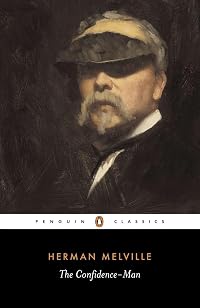
The Confidence-Man: His Masquerade
by Herman Melville 
On This Page
Description
The name Herman Melville is synonymous with the pinnacle of American literary achievement, and many regard his novel Moby-Dick as the quintessential work of American fiction. In The Confidence-Man, Melville's final major novel, the author explores the motivations, travails, and personalities of a group of boat passengers en route to New Orleans, as well as the mysterious trickster figure who riles things up at the margins of the group..
Tags
Recommendations


























Member Reviews
Baffling—and funny as hell if you're patient with all the dialogue. Once I got into the feel of the story, which was about midway through, it turned from a confusing slog into gloriously snowballing absurdity. If you're struggling through the beginning, as I sure was, have some you'll-know-what and try to hang on at least until the P.I.O. comes up; that chapter marks, probably not by chance, the exact midpoint of the book, and the second half presents more continuity than the first.
Really, this book is fun. It looks back to Tristram Shandy and forward to William Gaddis, and hitting the increasingly wacky twists in the second half I was more than once reminded of Graham Chapman's principle for sketch development, "How can we make this show more madder?". show less
Really, this book is fun. It looks back to Tristram Shandy and forward to William Gaddis, and hitting the increasingly wacky twists in the second half I was more than once reminded of Graham Chapman's principle for sketch development, "How can we make this show more madder?". show less
Herman Melville must have had royal fun writing The Confidence-Man: His Masquerade (1857). One imagines him laughing at his desk as the titular character passes through his costume-changes and works his serial frauds, each of the latter based on cajoling, shaming, or arguing his credulous marks into demonstrations of "confidence." Whether construed as trust, faith, sympathy, charity, generosity, fraternity, or something else, a show of "confidence" features a handing-over of cash. If such transactions were all the novel offered, it might be an amusing trifle fit for one reading and oblivion. Happily, The Confidence-Man is cunningly layered with satiric set-pieces that variously mock most of the 19th Century's conventional pieties, show more particularly its widely-held belief in human progress and implicit trust of the means designed to achieve it. If Emerson's Transcendentalism is not spared ridicule, so are more practical "philosophies" revealed as convenient and modish fictions by which men (and, presumably, women, although Melville does not single out any females as confidence-tricksters) flatter themselves and deceive their fellows. All aboard the Mississippi riverboat Fidèle eagerly participate in this vital dialectic.
Indeed, many of the characters we meet aboard the Fidèle seem to be types of confidence-men--and because the "confidence man" of the title is a chameleon in aspect and address, even possibly a shape-shifter (or just an expert of costume and disguise), it is easy to become lost in the narrative's shell-game of "now he's here, now he's there; first this one, now that one." For this reason, an ideal reading of this novel would be accomplished in single, total-immersion session that enabled the reader, to the best of his or her ability, to hold the entire thing in mind at once. Setting the book aside, and inevitably losing the string of a conversation (and a sense of the narrative's unity) amid the bits & pieces of one's own clamoring daily life diminishes the effect of Melville's fiction to such an extent that the bewildered, disoriented reader is likely to blame the book and, in exasperation, pronounce it "disorganized," "incoherent," "hodgepodge," and/or "disingenuously oblique." Alas, it is more likely the reader's life, not Melville's book, that fits these descriptives. By withholding one's full and sustained attention from the masquerade, the reader short-changes the book and cheats himself of a healthy dose of knowing laughter.
Is the deaf-mute dressed in cream colors who steps aboard the Fidèle early on the morning of April 1st a pious fraud sent as vanguard to soften the crowd for the main operator's advent and the deployment of his stratagems? Or is this meek-seeming young man merely that, and his rough handling by said crowd, even as he preaches charity via slate-board and chalk, a figurement of spiritual crucifixion? He survives in body, retires to a lonely spot, falls asleep, disappears--has he been raptured away? Has he disembarked unnoticed? Or has he assumed a fresh avatar of imposture?
A Negro cripple; a gentleman with a weed; a man dressed in gray and white; an agent of the Black Rapids Coal Company; an herb-doctor; a man with a brass plate, and so on, each possessed of a silver tongue and a parcel of plausible lies, engage a series of (more or less) innocent bystanders in innocuous-seeming conversation, all tending in short order toward violations of privacy and a personal appeal: "Give me twenty dollars." If the audacity of these proceedings is not insulting, it certainly is hilarious. Witness the con man's colloquy with "A charitable lady" (Chapter 8):
"You interest me," said the good lady, in mild surprise. "Can I in any way befriend you?"
"No one can befriend me, who has not confidence."
"But I--I have--at least to that degree--I mean that--"
"Nay, nay, you have none--none at all. Pardon, I see it. No confidence. Fool, fond fool that I am to seek it!"
"You are unjust, sir," rejoins the good lady with heightened interest; "but it may be that something untoward in your experiences has unduly biased you. Not that I would cast reflections. Believe me, I--yes, yes--I may say--that--that"
"That you have confidence? Prove it. Let me have twenty dollars."
"Twenty dollars!"
"There, I told you, madam, you had no confidence."
The lady was, in an extraordinary way, touched. She sat in a sort of restless torment, knowing not which way to turn.
If this is not a species of seduction, what is? The assumption of superiority, followed closely by feigned uninterest and overt rejection, resulting in the capture of the lady's interest, the winning of her solicitude, the gaining of her acquiescence and eventual submission. Meretricious talents of recent times have pretended to have discovered such technique as a foolproof means of luring charitable and uncharitable ladies to the destination most desired. A certain serviceable scrivener (whose name cannot appear in proximity to Herman Melville) was sometime ago notorious for limning the "Game" and how adept practitioners played it. Guess what, lad? It is not new. You have discovered nothing that has not been well-known since male has admired female, howevermuch your ignorance of your predecessors permits you to flatter yourself with a notion of originality.
But I digress. Serial ingratiation, deception, and solicitation tend to give Melville's narrative a static quality; the confidence-man's object is unvarying and each mark seems to be merely another dupe in a line of dupes. And yet, the procession is altogether amusing and Melville's ingenious variations of what is, essentially, a single-minded purpose are always entertaining and often dazzling. By the time we arrive at Chapter 24, A philanthropist undertakes to convert a misanthrope, but does not get beyond confuting him, we have played spectator to a parade of adaptable shams, each tailoring the tenor and tone of his address to the susceptibilities and demeanor of each audience of one. This core chapter, occurring almost exactly at the middle of the printed book, draws a bright line between healthy skepticism and presumptuous imposture. The misanthrope is proof against every specious argument; rebuffed, the confidence-man retreats without admitting defeat, his mask firmly in place.
Although Melville's last novel makes no appeal to the reader's emotions and will move no one to tears unless they are tears of laughter, it is a vastly satisfying performance by a great writer who continues to be unappreciated for his humor. The beautiful thing about this novel is its artful yet direct capacity to speak truth to power--the "power" here being the power of positive thinking, elsewhere encountered as uncritical, easy optimism. It is deeply satisfying to hear one plain-speaking dissenter after another give the lie to the confidence-man's facile and eloquent assurances of the essential goodness of humankind, the benevolence of nature, the blessings of progress, the nobility of the common man, and so forth. In its stone-cold delineations of real life's palpable circumstances, this book is a brightsider's nightmare. Only the most fatuous optimist--or a disingenuous one--could read it and believe that all shall be well, and all shall be well, and all manner of thing shall be well. The brilliance of Melville's rendition is the superficial plausibility of the con man's rich and various appeals; at first blush (and without thinking) the reader is nearly taken in. Reasonable counterarguments, however, posed by potential dupes expose the sophistry of the confidence-man's representations--set-downs he often reverses by assuming an air of moral offense in the face of such demonstrable impoverishment of trust, confidence, optimism, etc. Thus shamed for allowing his better judgement (and it is better) to gainsay the spirit of an optimism felt to be peculiarly American, the dupe, knowing better but feeling bad, antes up his cash; he, she is, in a word, seduced; and in another, much less congenial word, raped--in mind, feeling, and wallet. It is a queasy realization, the reader's creeping sense that each victim is complicit in his or her exploitation. That no one's body is coerced or violated is some comfort, yet a cold one. Understandings have been misled, sensibilities abused, and compassion practiced upon by purveyors of false faith and blandishments. It is Herman Melville's triumph, and his genius, to make such cynical presumption delightful. show less
Indeed, many of the characters we meet aboard the Fidèle seem to be types of confidence-men--and because the "confidence man" of the title is a chameleon in aspect and address, even possibly a shape-shifter (or just an expert of costume and disguise), it is easy to become lost in the narrative's shell-game of "now he's here, now he's there; first this one, now that one." For this reason, an ideal reading of this novel would be accomplished in single, total-immersion session that enabled the reader, to the best of his or her ability, to hold the entire thing in mind at once. Setting the book aside, and inevitably losing the string of a conversation (and a sense of the narrative's unity) amid the bits & pieces of one's own clamoring daily life diminishes the effect of Melville's fiction to such an extent that the bewildered, disoriented reader is likely to blame the book and, in exasperation, pronounce it "disorganized," "incoherent," "hodgepodge," and/or "disingenuously oblique." Alas, it is more likely the reader's life, not Melville's book, that fits these descriptives. By withholding one's full and sustained attention from the masquerade, the reader short-changes the book and cheats himself of a healthy dose of knowing laughter.
Is the deaf-mute dressed in cream colors who steps aboard the Fidèle early on the morning of April 1st a pious fraud sent as vanguard to soften the crowd for the main operator's advent and the deployment of his stratagems? Or is this meek-seeming young man merely that, and his rough handling by said crowd, even as he preaches charity via slate-board and chalk, a figurement of spiritual crucifixion? He survives in body, retires to a lonely spot, falls asleep, disappears--has he been raptured away? Has he disembarked unnoticed? Or has he assumed a fresh avatar of imposture?
A Negro cripple; a gentleman with a weed; a man dressed in gray and white; an agent of the Black Rapids Coal Company; an herb-doctor; a man with a brass plate, and so on, each possessed of a silver tongue and a parcel of plausible lies, engage a series of (more or less) innocent bystanders in innocuous-seeming conversation, all tending in short order toward violations of privacy and a personal appeal: "Give me twenty dollars." If the audacity of these proceedings is not insulting, it certainly is hilarious. Witness the con man's colloquy with "A charitable lady" (Chapter 8):
"You interest me," said the good lady, in mild surprise. "Can I in any way befriend you?"
"No one can befriend me, who has not confidence."
"But I--I have--at least to that degree--I mean that--"
"Nay, nay, you have none--none at all. Pardon, I see it. No confidence. Fool, fond fool that I am to seek it!"
"You are unjust, sir," rejoins the good lady with heightened interest; "but it may be that something untoward in your experiences has unduly biased you. Not that I would cast reflections. Believe me, I--yes, yes--I may say--that--that"
"That you have confidence? Prove it. Let me have twenty dollars."
"Twenty dollars!"
"There, I told you, madam, you had no confidence."
The lady was, in an extraordinary way, touched. She sat in a sort of restless torment, knowing not which way to turn.
If this is not a species of seduction, what is? The assumption of superiority, followed closely by feigned uninterest and overt rejection, resulting in the capture of the lady's interest, the winning of her solicitude, the gaining of her acquiescence and eventual submission. Meretricious talents of recent times have pretended to have discovered such technique as a foolproof means of luring charitable and uncharitable ladies to the destination most desired. A certain serviceable scrivener (whose name cannot appear in proximity to Herman Melville) was sometime ago notorious for limning the "Game" and how adept practitioners played it. Guess what, lad? It is not new. You have discovered nothing that has not been well-known since male has admired female, howevermuch your ignorance of your predecessors permits you to flatter yourself with a notion of originality.
But I digress. Serial ingratiation, deception, and solicitation tend to give Melville's narrative a static quality; the confidence-man's object is unvarying and each mark seems to be merely another dupe in a line of dupes. And yet, the procession is altogether amusing and Melville's ingenious variations of what is, essentially, a single-minded purpose are always entertaining and often dazzling. By the time we arrive at Chapter 24, A philanthropist undertakes to convert a misanthrope, but does not get beyond confuting him, we have played spectator to a parade of adaptable shams, each tailoring the tenor and tone of his address to the susceptibilities and demeanor of each audience of one. This core chapter, occurring almost exactly at the middle of the printed book, draws a bright line between healthy skepticism and presumptuous imposture. The misanthrope is proof against every specious argument; rebuffed, the confidence-man retreats without admitting defeat, his mask firmly in place.
Although Melville's last novel makes no appeal to the reader's emotions and will move no one to tears unless they are tears of laughter, it is a vastly satisfying performance by a great writer who continues to be unappreciated for his humor. The beautiful thing about this novel is its artful yet direct capacity to speak truth to power--the "power" here being the power of positive thinking, elsewhere encountered as uncritical, easy optimism. It is deeply satisfying to hear one plain-speaking dissenter after another give the lie to the confidence-man's facile and eloquent assurances of the essential goodness of humankind, the benevolence of nature, the blessings of progress, the nobility of the common man, and so forth. In its stone-cold delineations of real life's palpable circumstances, this book is a brightsider's nightmare. Only the most fatuous optimist--or a disingenuous one--could read it and believe that all shall be well, and all shall be well, and all manner of thing shall be well. The brilliance of Melville's rendition is the superficial plausibility of the con man's rich and various appeals; at first blush (and without thinking) the reader is nearly taken in. Reasonable counterarguments, however, posed by potential dupes expose the sophistry of the confidence-man's representations--set-downs he often reverses by assuming an air of moral offense in the face of such demonstrable impoverishment of trust, confidence, optimism, etc. Thus shamed for allowing his better judgement (and it is better) to gainsay the spirit of an optimism felt to be peculiarly American, the dupe, knowing better but feeling bad, antes up his cash; he, she is, in a word, seduced; and in another, much less congenial word, raped--in mind, feeling, and wallet. It is a queasy realization, the reader's creeping sense that each victim is complicit in his or her exploitation. That no one's body is coerced or violated is some comfort, yet a cold one. Understandings have been misled, sensibilities abused, and compassion practiced upon by purveyors of false faith and blandishments. It is Herman Melville's triumph, and his genius, to make such cynical presumption delightful. show less
"If he's Satan, he's also Krishna."
It was difficult to get on top of this book and balance, to feel confident in your hermeneutic agency. On the one hand, it's dreamy, allusive, full of hints of this and that, in particular Melville's fixations with the mystic history of the West, the mystic history of the East, the relation between our relations with one another and our relations with God, and the infinite possibilities of the American West as a canvas on which to play them out for good or heartbreak (Martin Chuzzlewit is referenced). The fabulous riverboat Fidèle definitely fits in the midsummer night or rabbit hole or a dark carnival or a broom ride over Moscow vein--things are different and you have no idea how, or who to trust, show more and trust, of course, is the thing.
On the other hand, it has an idee fixe quality--we are being manipulated, and by an operator so refined that it's hard even to catch hold sometimes, hard to recognize what valences the succession of encounters is stoking and how to engage in dialogue with them. Someone said, in a con game you always want to make sure to look where your attention is being directed away from, but I found that difficult--you get so befuddled that you grab onto whatever oar Melville extends, and you feel passivized. Just as the confidence-man always wins, pretending to engage straightfaced, always walks away with the purse, the monologic masquerading as the dialogic--so I sometimes felt like Melv was operating on levels that left me unsure how to proceed except by grabbing the low-hanging fruit, and that that was just what I was meant to do, and sometimes that sent me on an intoxicating ride as per the above and other times it just felt like being carried along by the river.
And so there's a magician's-nephew fascination to the tricksy and portentous with which the book is chock a block, but I'm left feeling a bit pawnlike, and also a bit like stuff flew over my head. it makes me think that there are some books that just demand more time; it makes me think that if Henry James were able to imply significance better instead of just wheezing dimly like he do I would like him better. I'll remember the characters most of all--the Confidence-Man like flies in honey; the Cosmopolitan, who feels friendly and good in a way that the C-M doesn't and that's more suspicious yet; barber and his sign, NO TRUST; the miser, the woodsman, the wicked takedown of Emerson and Thoreau. The Krishna angle--the way the C-M charges us to believe! and absolve our conscience, bare a clean breast to a world that's gonna take us for whatever we're worth under any circumstances--that fascinates, and I'd like to go through again with it more in mind. Joyce is here too, and the anxiety of words always meaning more than you can exhaust and never matching up properly to things, even with the best nest of intentions. This book is an enigma wrapped in a puzzle sailing down the Mississippi. show less
It was difficult to get on top of this book and balance, to feel confident in your hermeneutic agency. On the one hand, it's dreamy, allusive, full of hints of this and that, in particular Melville's fixations with the mystic history of the West, the mystic history of the East, the relation between our relations with one another and our relations with God, and the infinite possibilities of the American West as a canvas on which to play them out for good or heartbreak (Martin Chuzzlewit is referenced). The fabulous riverboat Fidèle definitely fits in the midsummer night or rabbit hole or a dark carnival or a broom ride over Moscow vein--things are different and you have no idea how, or who to trust, show more and trust, of course, is the thing.
On the other hand, it has an idee fixe quality--we are being manipulated, and by an operator so refined that it's hard even to catch hold sometimes, hard to recognize what valences the succession of encounters is stoking and how to engage in dialogue with them. Someone said, in a con game you always want to make sure to look where your attention is being directed away from, but I found that difficult--you get so befuddled that you grab onto whatever oar Melville extends, and you feel passivized. Just as the confidence-man always wins, pretending to engage straightfaced, always walks away with the purse, the monologic masquerading as the dialogic--so I sometimes felt like Melv was operating on levels that left me unsure how to proceed except by grabbing the low-hanging fruit, and that that was just what I was meant to do, and sometimes that sent me on an intoxicating ride as per the above and other times it just felt like being carried along by the river.
And so there's a magician's-nephew fascination to the tricksy and portentous with which the book is chock a block, but I'm left feeling a bit pawnlike, and also a bit like stuff flew over my head. it makes me think that there are some books that just demand more time; it makes me think that if Henry James were able to imply significance better instead of just wheezing dimly like he do I would like him better. I'll remember the characters most of all--the Confidence-Man like flies in honey; the Cosmopolitan, who feels friendly and good in a way that the C-M doesn't and that's more suspicious yet; barber and his sign, NO TRUST; the miser, the woodsman, the wicked takedown of Emerson and Thoreau. The Krishna angle--the way the C-M charges us to believe! and absolve our conscience, bare a clean breast to a world that's gonna take us for whatever we're worth under any circumstances--that fascinates, and I'd like to go through again with it more in mind. Joyce is here too, and the anxiety of words always meaning more than you can exhaust and never matching up properly to things, even with the best nest of intentions. This book is an enigma wrapped in a puzzle sailing down the Mississippi. show less
At first glance, The Confidence-Man appears to be just another episodic novel, where one thing happens after another. But be not deceived, Dear Reader. Melville's genius in structuring his novel is in full feather. Like a peacock displaying his dazzling tail fan, Melville hopes you won't get hung up on counting the eyes, for there is much more behind the entertainment value of a few gaudily attired, all be it humorous, vaudeville types.
And speaking of vaudeville and minstrel shows, the reader can easily imagine the silly pratfalls that are built into the novel's opening chapters. The scene is set on board a large Mississippi riverboat, meaningfully named the Fidèle, and one feels both the vicarious thrill of embarking on a journey and show more at the same time, the anticipation of sitting in a darkened theater. One cannot help laughing out loud at some of the antics and astonishing brazenness of our multifaceted confidence man and so many incredibly naive dupes.
The book drips with irony at every pore. Melville doesn't want his reader to miss that point. He alludes to the Fidèle as being a ship of fools. He mentions The Canterbury Tales, which conjures up images of a company of odd characters. The Fidèle provides the perfect setting for all that takes place. We are treated to a whole catalog of the ship's company who represent a veritable Noah's ark of humanity, half of whom may be assumed to be on the make in one way or another simply by Melville's dark-humored descriptions. Melville lists them for us at the beginning, hunters of this and hunters of that and hunters of the hunters. And then Melville proceeds to parade in front of us a succession of situations, each with a slightly different twist, and which enlightens the reader about the perfidy of the human race. Message: You'd better watch out.
It must be stated near the outset that Melville here fully utilized his deep and impressive erudition. And it is not that he had merely read the classics in his youth, but he fully absorbed them, enough so that he can use what he knows of Shakespeare, Milton, Ovid, Homer and the Bible to illustrate, parody, mimic and twist meanings to humorous — dare I say diabolic? — effect.
The overarching theme is the contrast between the fundamental Christian values of faith, hope and charity, on the one hand, and the Satanic values of doubt, fear, hate and "no trust," on the other. Melville constantly contrasts God to Satan, good to evil and confidence to deception. Our hero, who is masked by his many disguises, unmasks his marks to reveal their true Christian (Melville would say "naive") nature, and then proceeds to take advantage of their good will and fleece them of whatever he can get away with.
More than one commentator has suggested that the structure of The Confidence-Man is stolen directly from Milton's Paradise Lost, but disguised very cleverly so that most have not noticed. But I think it is the ultimate key to understanding Melville's little masterpiece. C.S. Lewis describes the fall of Satan in Paradise Lost: "From hero to general, from general to politician, from politician to secret service agent, and thence to a thing that peers in at bedroom or bathroom windows, and thence to a toad, and finally to a snake — such is the progress of Satan."
But the confidence man, who progresses from his earliest incarnations as, first, an abused, lamblike deaf mute dressed in cream colors, and, second, a black (blackface?) cripple, to our Cosmopolitan Citizen of the World, is privileged with the opposite course, being regularly prompted to more daring and more audacious swindles as the tale goes forward, until the final chapter, the darkest of the book, where he, at the height of his powers, seems to be accompanying his elderly mark to the very gates of Hell.
As Blake said perhaps unfairly of Milton, that he was of the Devil's School, so it was true of Melville, and it is in that context that the almost invisible Miltonic influence on The Confidence-Man causes one to say, Of course! Melville's disenchantment with the institutions of society is apparent throughout his writings and track with his life experience, but in The Confidence-Man, he zeros in on Christianity as practiced and capitalism (also as practiced) for his particular scorn. It seems to this reader that Melville was one of those people who searched all his life for something worth believing in but who in the end was disappointed. The result was a gradual descent into misanthropy. He despaired of Christianity, but he never stopped hoping for something to fill the void.
Our confidence man at the center of the action who eventually gets around to describing himself as a Cosmopolitan, a Citizen of the World, but at a simple allegorical level, is both Satan and God — at least in Melville's eyes. This will upset some readers, but there are useful lessons here, regardless of one's belief system, or the lack thereof. (At the very least, it should give one pause when a politician says: "Tonight, I speak to you not as a candidate for President, but as a citizen - a proud citizen of the United States, and a fellow citizen of the world.")
Complicating matters for the reader, rather than a reliable narrator, Melville has provided us with a know-nothing narrator who is very good at marking events with platitudes yet doesn't seem to notice that the string of con artists he parades before us, plying their trade, are actually one individual in a variety of costumes. This narrator seems content with presenting a succession of episodes in which the confidence man swindles a naive traveler — or not. This unreliable narrator helps to obscure the author's attitudes and requires the reader to pay close attention to who exactly is saying what.
Embellishing upon the aforementioned overarching theme, The Confidence-Man may be read on at least three levels: First, it may be read as a humorous story, of sorts, with many philosophical diversions and ironic overtones. Second, it may be interpreted as an overly simple-minded Christian tale as fleshed out by the evocation of Christian platitudes regarding faith, hope and charity. (Incidentally, "confidence" is a euphemism for "faith" in this novel.) And third, one may see a more sinister interpretation that involves Melville's subversion of said Christian values by upending them whenever possible to demonstrate his view of God's injustice towards man.
The question that seems to resurface over and over again is why Melville's book was so little appreciated or understood at the time of publication, and what motivated Melville to write a comedy with this particular combination of biting satire, cynicism and malice? That question will probably never be answered to everyone's satisfaction, but Melville has left us with a veritable philosophical — if irreligious — feast to chew on and digest. This is a five-star novel. show less
And speaking of vaudeville and minstrel shows, the reader can easily imagine the silly pratfalls that are built into the novel's opening chapters. The scene is set on board a large Mississippi riverboat, meaningfully named the Fidèle, and one feels both the vicarious thrill of embarking on a journey and show more at the same time, the anticipation of sitting in a darkened theater. One cannot help laughing out loud at some of the antics and astonishing brazenness of our multifaceted confidence man and so many incredibly naive dupes.
The book drips with irony at every pore. Melville doesn't want his reader to miss that point. He alludes to the Fidèle as being a ship of fools. He mentions The Canterbury Tales, which conjures up images of a company of odd characters. The Fidèle provides the perfect setting for all that takes place. We are treated to a whole catalog of the ship's company who represent a veritable Noah's ark of humanity, half of whom may be assumed to be on the make in one way or another simply by Melville's dark-humored descriptions. Melville lists them for us at the beginning, hunters of this and hunters of that and hunters of the hunters. And then Melville proceeds to parade in front of us a succession of situations, each with a slightly different twist, and which enlightens the reader about the perfidy of the human race. Message: You'd better watch out.
It must be stated near the outset that Melville here fully utilized his deep and impressive erudition. And it is not that he had merely read the classics in his youth, but he fully absorbed them, enough so that he can use what he knows of Shakespeare, Milton, Ovid, Homer and the Bible to illustrate, parody, mimic and twist meanings to humorous — dare I say diabolic? — effect.
The overarching theme is the contrast between the fundamental Christian values of faith, hope and charity, on the one hand, and the Satanic values of doubt, fear, hate and "no trust," on the other. Melville constantly contrasts God to Satan, good to evil and confidence to deception. Our hero, who is masked by his many disguises, unmasks his marks to reveal their true Christian (Melville would say "naive") nature, and then proceeds to take advantage of their good will and fleece them of whatever he can get away with.
More than one commentator has suggested that the structure of The Confidence-Man is stolen directly from Milton's Paradise Lost, but disguised very cleverly so that most have not noticed. But I think it is the ultimate key to understanding Melville's little masterpiece. C.S. Lewis describes the fall of Satan in Paradise Lost: "From hero to general, from general to politician, from politician to secret service agent, and thence to a thing that peers in at bedroom or bathroom windows, and thence to a toad, and finally to a snake — such is the progress of Satan."
But the confidence man, who progresses from his earliest incarnations as, first, an abused, lamblike deaf mute dressed in cream colors, and, second, a black (blackface?) cripple, to our Cosmopolitan Citizen of the World, is privileged with the opposite course, being regularly prompted to more daring and more audacious swindles as the tale goes forward, until the final chapter, the darkest of the book, where he, at the height of his powers, seems to be accompanying his elderly mark to the very gates of Hell.
As Blake said perhaps unfairly of Milton, that he was of the Devil's School, so it was true of Melville, and it is in that context that the almost invisible Miltonic influence on The Confidence-Man causes one to say, Of course! Melville's disenchantment with the institutions of society is apparent throughout his writings and track with his life experience, but in The Confidence-Man, he zeros in on Christianity as practiced and capitalism (also as practiced) for his particular scorn. It seems to this reader that Melville was one of those people who searched all his life for something worth believing in but who in the end was disappointed. The result was a gradual descent into misanthropy. He despaired of Christianity, but he never stopped hoping for something to fill the void.
Our confidence man at the center of the action who eventually gets around to describing himself as a Cosmopolitan, a Citizen of the World, but at a simple allegorical level, is both Satan and God — at least in Melville's eyes. This will upset some readers, but there are useful lessons here, regardless of one's belief system, or the lack thereof. (At the very least, it should give one pause when a politician says: "Tonight, I speak to you not as a candidate for President, but as a citizen - a proud citizen of the United States, and a fellow citizen of the world.")
Complicating matters for the reader, rather than a reliable narrator, Melville has provided us with a know-nothing narrator who is very good at marking events with platitudes yet doesn't seem to notice that the string of con artists he parades before us, plying their trade, are actually one individual in a variety of costumes. This narrator seems content with presenting a succession of episodes in which the confidence man swindles a naive traveler — or not. This unreliable narrator helps to obscure the author's attitudes and requires the reader to pay close attention to who exactly is saying what.
Embellishing upon the aforementioned overarching theme, The Confidence-Man may be read on at least three levels: First, it may be read as a humorous story, of sorts, with many philosophical diversions and ironic overtones. Second, it may be interpreted as an overly simple-minded Christian tale as fleshed out by the evocation of Christian platitudes regarding faith, hope and charity. (Incidentally, "confidence" is a euphemism for "faith" in this novel.) And third, one may see a more sinister interpretation that involves Melville's subversion of said Christian values by upending them whenever possible to demonstrate his view of God's injustice towards man.
The question that seems to resurface over and over again is why Melville's book was so little appreciated or understood at the time of publication, and what motivated Melville to write a comedy with this particular combination of biting satire, cynicism and malice? That question will probably never be answered to everyone's satisfaction, but Melville has left us with a veritable philosophical — if irreligious — feast to chew on and digest. This is a five-star novel. show less
I am not done with this book, and it is not done with me. This book is a cipher about ciphers, a deep peer into a world where each God is an avatar of all others, often in human form, and where the only distinction between the avatars of the gods and the impious humans may be in your imagination. The story is an importation of world religion into the service of the questioning of christianity, and of christianity into the questioning of world religions. It is a collection of biblical parables and zen koan, neat little stories, but woven into a more fundamental fabric, filled with impalpable images. I have tried but cannot explain what it is, because it is, in the end, the question answered with a question, the word that references the show more word.
So what is it that Melville does to conjure such frothy hype? He tells a few simple stories. That's it. Each story in and of itself is simple and straightforward. Yet, look with just a small bit of care and it becomes clear that the stories have little inconsistencies that require some sort of explanation. As soon as you look, clues begin jumping out at you. There are explanations possible and even proferred, all perhaps requiring some deus to ex machina. But none of the explanations are fully satisfying, and all lead to more searching. The simple stories become the ground for a wild hunt, without the reader really knowing how or why. And then, out of the blue, Melville acknowledges the game, and draws you into a direct discussion with him about exactly what he is doing to us and why, though even this discussion itself is unsatisfying and seems full of clues. After all, reality is indeed sufficiently confusing itself so a writer who writes it true will inevitably fail to fully expalin; the inconsistent is to be trusted as a more truthful rendition than the overly consistent. Once the game is on, there is no end to it, and never can be.
Melville's work began with a book about cannibal hosts who may or may not have been cannibals but who were likely more christian than their guest and certainly more christian than their guest's old companions; over a long and strange career, Melville's communion with nature and man never really progressed much beyond this theme, merely in presentation. Typee, Melville's first book, is a single long and simple parable of the human host; Moby Dick is a long and complex but ultimately comprehendable offering by Man and Melville to nature; Confidence Man a simply stated yet enigmatic genuflection of Man to his maker, and Clarel the longest and most inscrutable sacrifice to the Melvillian Gods living in their natural wasteland. This book leads me to the conclusion that all those who have suggested many Melvilles are dead wrong: there is one, regardless of his many avatars. It is a disservice to not see the fundamental unity of his work - a unification in the Confidence Man's ciphers.
Much discussion has occurred on whether or not this book might be "post-modern" or, before that category was born, "modernist". It is neither, for it challenges a more fundamental set of thoughts than each of these temporal forms. Let's think of it as epic, if we must, or, better yet, as biblical, if we are required to categorize the thing. It is no more post-modern than those fishes and loaves that Christ used to con the masses. show less
So what is it that Melville does to conjure such frothy hype? He tells a few simple stories. That's it. Each story in and of itself is simple and straightforward. Yet, look with just a small bit of care and it becomes clear that the stories have little inconsistencies that require some sort of explanation. As soon as you look, clues begin jumping out at you. There are explanations possible and even proferred, all perhaps requiring some deus to ex machina. But none of the explanations are fully satisfying, and all lead to more searching. The simple stories become the ground for a wild hunt, without the reader really knowing how or why. And then, out of the blue, Melville acknowledges the game, and draws you into a direct discussion with him about exactly what he is doing to us and why, though even this discussion itself is unsatisfying and seems full of clues. After all, reality is indeed sufficiently confusing itself so a writer who writes it true will inevitably fail to fully expalin; the inconsistent is to be trusted as a more truthful rendition than the overly consistent. Once the game is on, there is no end to it, and never can be.
Melville's work began with a book about cannibal hosts who may or may not have been cannibals but who were likely more christian than their guest and certainly more christian than their guest's old companions; over a long and strange career, Melville's communion with nature and man never really progressed much beyond this theme, merely in presentation. Typee, Melville's first book, is a single long and simple parable of the human host; Moby Dick is a long and complex but ultimately comprehendable offering by Man and Melville to nature; Confidence Man a simply stated yet enigmatic genuflection of Man to his maker, and Clarel the longest and most inscrutable sacrifice to the Melvillian Gods living in their natural wasteland. This book leads me to the conclusion that all those who have suggested many Melvilles are dead wrong: there is one, regardless of his many avatars. It is a disservice to not see the fundamental unity of his work - a unification in the Confidence Man's ciphers.
Much discussion has occurred on whether or not this book might be "post-modern" or, before that category was born, "modernist". It is neither, for it challenges a more fundamental set of thoughts than each of these temporal forms. Let's think of it as epic, if we must, or, better yet, as biblical, if we are required to categorize the thing. It is no more post-modern than those fishes and loaves that Christ used to con the masses. show less
Set on a steamboat trip down the Mississippi in the mid-19th century, this book is social satire told in a series of scenes of passengers engaging in dialogue and philosophical discussions. One of the passengers is the titular confidence-man. They chat about issues of the era (some of which are surprisingly relevant to today’s world). The confidence-man uses various disguises and ploys to attempt to “borrow” money.
A primary theme is trust, and the many ways it plays a role in being taken in by an imposter. It does not explicitly extend the metaphor, but it is obvious that the author intends it to be applied more broadly. Melville questions the very foundations of confidence in both commercial and spiritual matters. The author show more blurs the line between legitimate business and con artistry, between genuine Christian charity and hypocritical performance. It requires the reader’s close attention to decipher it. It contains long convoluted sentences typical of many novels of the 1800s. For example:
“If reason be judge, no writer has produced such inconsistent characters as nature herself has. It must call for no small sagacity in a reader unerringly to discriminate in a novel between the inconsistencies of conception and those of life. As elsewhere, experience is the only guide here; but as no one man’s experience can be coextensive with what is, it may be unwise in every case to rest upon it.”
Published in 1857, it is an early example of metafiction and there are many embedded literary references. I think it would make a good candidate for analysis in a literature class. The main drawback is that it is not particularly engaging. There is much philosophical pontification by the characters, and it gets a bit old after a while. It is undoubtedly clever but will not be everyone’s cup of tea. It is not my favorite of Melville’s books, but I am glad I read it.
3.5 show less
A primary theme is trust, and the many ways it plays a role in being taken in by an imposter. It does not explicitly extend the metaphor, but it is obvious that the author intends it to be applied more broadly. Melville questions the very foundations of confidence in both commercial and spiritual matters. The author show more blurs the line between legitimate business and con artistry, between genuine Christian charity and hypocritical performance. It requires the reader’s close attention to decipher it. It contains long convoluted sentences typical of many novels of the 1800s. For example:
“If reason be judge, no writer has produced such inconsistent characters as nature herself has. It must call for no small sagacity in a reader unerringly to discriminate in a novel between the inconsistencies of conception and those of life. As elsewhere, experience is the only guide here; but as no one man’s experience can be coextensive with what is, it may be unwise in every case to rest upon it.”
Published in 1857, it is an early example of metafiction and there are many embedded literary references. I think it would make a good candidate for analysis in a literature class. The main drawback is that it is not particularly engaging. There is much philosophical pontification by the characters, and it gets a bit old after a while. It is undoubtedly clever but will not be everyone’s cup of tea. It is not my favorite of Melville’s books, but I am glad I read it.
3.5 show less
A post-modern masterpiece; a century ahead of its time. Aboard a Mississippi steamboat you can see a pubescent America in the confidence, and lack of it, asked of and offered by the various hucksters, pamphleteers and visionaries. And the novel itself tests the confidence of the reader as each character slides away beneath the muddy prose waters of the river: should I trust him? Will he come back to bite me? Is this the same person who...? And all the while Melville baits his tortuous sentences with crazy vocab and linguistic gems.
Genius.
Genius.
Members
- Recently Added By
Lists

Top Five Books of 2015
811 works; 240 members

Best Horror Mega-List
342 works; 6 members

Jones and Newman's Horror: The 100 Best Books
100 works; 4 members

Franklit
95 works; 1 member
Author Information

657+ Works 78,419 Members
Herman Melville (August 1, 1819 - September 28, 1891) was born into a seemingly secure, prosperous world, a descendant of prominent Dutch and English families long established in New York State. That security vanished when first, the family business failed, and then, two years later, in young Melville's thirteenth year, his father died. Without show more enough money to gain the formal education that professions required, Melville was thrown on his own resources and in 1841 sailed off on a whaling ship bound for the South Seas. His experiences at sea during the next four years were to form in part the basis of his best fiction. Melville's first two books, Typee (1846) and Omoo (1847), were partly romance and partly autobiographical travel books set in the South Seas. Both were popular successes, particularly Typee, which included a stay among cannibals and a romance with a South Sea maiden. During the next several years, Melville published three more romances that drew upon his experiences at sea: Redburn (1849) and White-Jacket (1850), both fairly realistic accounts of the sailor's life and depicting the loss of innocence of central characters; and Mardi (1849), which, like the other two books, began as a romance of adventure but turned into an allegorical critique of contemporary American civilization. Moby Dick (1851) also began as an adventure story, based on Melville's experiences aboard the whaling ship. However, in the writing of it inspired in part by conversations with his friend and neighbor Hawthorne and partly by his own irrepressible imagination and reading of Shakespeare and other Renaissance dramatists Melville turned the book into something so strange that, when it appeared in print, many of his readers and critics were dumbfounded, even outraged. By the mid-1850s, Melville's literary reputation was all but destroyed, and he was obliged to live the rest of his life taking whatever jobs he could find and borrowing money from relatives, who fortunately were always in a position to help him. He continued to write, however, and published some marvelous short fiction pieces Benito Cereno" (1855) and "Bartleby, the Scrivener" (1853) are the best. He also published several volumes of poetry, the most important of which was Battle Pieces and Aspects of the War (1866), poems of occasionally great power that were written in response to the moral challenge of the Civil War. His posthumously published work, Billy Budd (1924), on which he worked up until the time of his death, became Melville's last significant literary work, a brilliant short novel that movingly describes a young sailor's imprisonment and death. Melville's reputation, however, rests most solidly on his great epic romance, Moby Dick. It is a difficult as well as a brilliant book, and many critics have offered interpretations of its complicated ambiguous symbolism. Darrel Abel briefly summed up Moby Dick as "the story of an attempt to search the unsearchable ways of God," although the book has historical, political, and moral implications as well. Melville died at his home in New York City early on the morning of September 28, 1891, at age 72. The doctor listed "cardiac dilation" on the death certificate. He was interred in the Woodlawn Cemetery in The Bronx, New York, along with his wife, Elizabeth Shaw Melville. (Bowker Author Biography) show less
Herman Melville has a Legacy Library. Legacy libraries are the personal libraries of famous readers, entered by LibraryThing members from the Legacy Libraries group.
Some Editions
Awards and Honors
Series
Belongs to Publisher Series
Work Relationships
Is contained in
Is abridged in
Common Knowledge
- Canonical title
- The Confidence-Man: His Masquerade
- Original publication date
- 1857-04-01
- First words
- At sunrise of a first of April, there appeared, suddenly as Manco Capac at the lake Titicaca, a man in cream-colors, at the water-side in the city of St. Louis.
- Last words
- (Click to show. Warning: May contain spoilers.)Something further may follow of this Masquerade.
Classifications
Statistics
- Members
- 1,366
- Popularity
- 17,413
- Reviews
- 15
- Rating
- (3.55)
- Languages
- 7 — Danish, Dutch, English, French, German, Italian, Portuguese
- Media
- Paper, Audiobook, Ebook
- ISBNs
- 124
- ASINs
- 43