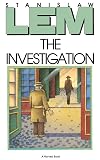
The Investigation
by Stanisław Lem
On This Page
Description
An eerie and offbeat mystery by a Kafka Prize-winning author. A young officer at Scotland Yard is assigned to investigate a puzzling and eerie case of missing-and apparently resurrected-bodies. To unravel the mystery, Lt. Gregory consults scientific, philosophical, and theological experts, who supply him with a host of theories and clues.Tags
Recommendations

























Member Recommendations
Member Reviews
"As long as there are human beings facts don't exist in a void" -- Armour Black, a fictitious writer in Lem's "The Investigation" who puts in a brief appearance to offer up such writerly tidbits of wisdom
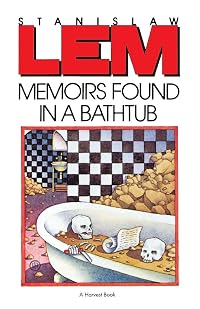
I have always enjoyed Lem though it is probably 25 years since I last read one of his works, his "Memoirs Found in a Bathtub". Lem's books when available are shelved in the science fiction section for lack of a better place to put them but most are difficult to classify if not sui generis.
Reading Lem is like swimming in a soup of Borges, Kafka, Zoshchenko, Cortazar, Gogol, Fowles, the Strugatsky brothers (Definitely, Maybe), and even Dostoyevsky (Gregory, the main character in this novel, spends a great time wondering around in a fog show more much like Raskolnikov). You get the general idea if you have read even a few of these authors. Good company to be in but I do think one must have a taste for this kind of thing. In many ways this book is an investigation that will separate those who need a relatively straight line from incident to satisfying solution from those who are interested in the process of getting from 'A' to ...well, to where? To 'H'? To 'P'? To 'Y'?
This book begins with what appears to be a supernatural phenomenon and explores the terrain between the natural and supernatural. Lem is interested in how we tackle the spectacularly unfamiliar and how we embrace the categories available to hand and attempt to pigeonhole data using them. In all of this, Lem's own perspective is anything but absolutist but he is not unsympathetic to those of us who must deploy the categories at hand and do so simply to get on with living in a fashion that works for each of us.
Dr. Sciss, who views the data through a statistician's lens offers up this indictment of those around him stuck in the muck of common sense : "So-called common sense relies on programmed nonperception, concealment, or ridicule of everything that doesn't fit into the conventional nineteenth century vision of the world that can be explained down to the last detail."
Having retrieved a few more Lem paperback novels from my basement with their very colorful covers, I will keep them handy and pick them up when the mood for more Lem coincides with the need for a book that actually is an old-fashioned paperback size.
If you have not read Lem, you should. This might not be the best novel of his to start with but it is representative of his particular flavor. show less
I have always enjoyed Lem though it is probably 25 years since I last read one of his works, his "Memoirs Found in a Bathtub". Lem's books when available are shelved in the science fiction section for lack of a better place to put them but most are difficult to classify if not sui generis.
Reading Lem is like swimming in a soup of Borges, Kafka, Zoshchenko, Cortazar, Gogol, Fowles, the Strugatsky brothers (Definitely, Maybe), and even Dostoyevsky (Gregory, the main character in this novel, spends a great time wondering around in a fog show more much like Raskolnikov). You get the general idea if you have read even a few of these authors. Good company to be in but I do think one must have a taste for this kind of thing. In many ways this book is an investigation that will separate those who need a relatively straight line from incident to satisfying solution from those who are interested in the process of getting from 'A' to ...well, to where? To 'H'? To 'P'? To 'Y'?
This book begins with what appears to be a supernatural phenomenon and explores the terrain between the natural and supernatural. Lem is interested in how we tackle the spectacularly unfamiliar and how we embrace the categories available to hand and attempt to pigeonhole data using them. In all of this, Lem's own perspective is anything but absolutist but he is not unsympathetic to those of us who must deploy the categories at hand and do so simply to get on with living in a fashion that works for each of us.
Dr. Sciss, who views the data through a statistician's lens offers up this indictment of those around him stuck in the muck of common sense : "So-called common sense relies on programmed nonperception, concealment, or ridicule of everything that doesn't fit into the conventional nineteenth century vision of the world that can be explained down to the last detail."
Having retrieved a few more Lem paperback novels from my basement with their very colorful covers, I will keep them handy and pick them up when the mood for more Lem coincides with the need for a book that actually is an old-fashioned paperback size.
If you have not read Lem, you should. This might not be the best novel of his to start with but it is representative of his particular flavor. show less
The Investigation is beautifully written, even in translation. Scenes are described with a clarity that I can almost touch. Lighting is especially described vividly. I put this on my detective/mystery shelf, because those are the genre tropes Lem is playing in, but it's not really a genre book. Specifically, many people read detective/mystery because they like that the mystery is solved in a tidy package at the end, and that doesn't happen here. It's more of a commentary on the human condition, especially the conditions of emotional isolation, uncertainty, and inability to connect/communicate with other people. It took me forever to read this book because I figured out early on that the resolution that makes me enjoy a genre book wasn't show more going to be there.So I only gave the book 3 stars because I didn't enjoy it that much, but as a work of literature it probably deserves 4 stars at least.It's been a long time since I read [a:Stanisław Lem|10991|Stanisław Lem|http://photo.goodreads.com/authors/1209242384p2/10991.jpg]'s other famous book, [b:Solaris|95558|Solaris|Stanisław Lem|http://photo.goodreads.com/books/1171303683s/95558.jpg|3333881], but my impression is that Lem's themes worked better for me in that book, because I am used to those themes being played with in the science fiction genre. show less
En las cercanías de Londres se están produciendo unos hechos extraños: varios cadáveres han desaparecido de forma misteriosa. Al principio simplemente eran cuerpos movidos, pero esto ha ido en aumento con la desaparición sin más de los cadáveres. La investigación del caso recae en manos del teniente Gregory, de Scotland Yard, al que le asisten su inspector jefe y algún que otro ayudante invitado, como el doctor Sciss, que intenta resolver el caso mediante la estadística. De este modo, Gregory se enfrenta a este gran problema, observando y analizando todos los datos de que dispone.
‘La investigación’ (Sledztwo, 1959), del escritor polaco Stanislaw Lem, es una novela policíaca con tintes metafísicos y filosóficos. La show more historia no me llega a convencer en ninguno de estos apartados, siendo las partes que más me han gustado esas en las que el detective Gregory transita de noche por las calles, al igual que esos extraños ruidos nocturnos de su casa, todo ello muy kafkiano. show less
‘La investigación’ (Sledztwo, 1959), del escritor polaco Stanislaw Lem, es una novela policíaca con tintes metafísicos y filosóficos. La show more historia no me llega a convencer en ninguno de estos apartados, siendo las partes que más me han gustado esas en las que el detective Gregory transita de noche por las calles, al igual que esos extraños ruidos nocturnos de su casa, todo ello muy kafkiano. show less
Indagini ai confini della realtà
Ambientato a Scotland Yard, tutto è fuorchè un poliziesco tradizionale. Non è la conclusione dell'indagine a fornire risposte, ma sono le domande che il tenente Gregory si pone nel mentre a squarciare il velo di tante possibili verità. Fantastico Lem e senza tempo, come "Solaris".
Ambientato a Scotland Yard, tutto è fuorchè un poliziesco tradizionale. Non è la conclusione dell'indagine a fornire risposte, ma sono le domande che il tenente Gregory si pone nel mentre a squarciare il velo di tante possibili verità. Fantastico Lem e senza tempo, come "Solaris".
This would have to be the only crime fiction work of Stanislaw Lem. Well, he had a good shot at it.
The action is set in 1970s/80s (future at the time of writing)and the main character is a middleaged would be austronaut for the mission to Mars. He has been brought in to figure out a string of apparent accidental deaths occuring to middle aged gentlemen staying at Italian penziones. This seemingly cliche setting quickly turns into a fascinating fury of bizzare events, dead end trials, science and culminates in the climax worthy of Space Oddyssey 2001.
The action is set in 1970s/80s (future at the time of writing)and the main character is a middleaged would be austronaut for the mission to Mars. He has been brought in to figure out a string of apparent accidental deaths occuring to middle aged gentlemen staying at Italian penziones. This seemingly cliche setting quickly turns into a fascinating fury of bizzare events, dead end trials, science and culminates in the climax worthy of Space Oddyssey 2001.
This is a seriously weird book.
Novela policíaca de Lem.
No me gustó.
No me gustó.
Members
- Recently Added By
Lists

Harold Bloom - The Western Canon: D. The Chaotic Age
833 works; 24 members

Paranormal investigators and space detectives
274 works; 9 members
Author Information

Polish science fiction writer Stanislaw Lem was born on September 12, 1921. A medical graduate of Cracow University, he is at home both in the sciences and in philosophy, and this broad erudition gives his writings genuine depth. He has published extensively, not only fiction, but also theoretical studies. His books have been translated into 41 show more languages and sold over 27 million copies. He gained international acclaim for The Cyberiad, a series of short stories, which was first published in 1974. A trend toward increasingly serious philosophical speculation is found in his later works, such as Solaris (1961), which was made into a Soviet film by Russian director Andrei Tarkovsky in 1972 and remade by Steven Soderbergh in 2002. He died on March 27, 2006 in Krakow at the age of 84. (Bowker Author Biography) show less
Some Editions
Series
Belongs to Publisher Series
ハヤカワ文庫 SF (306)
suhrkamp taschenbuch (0435)
Impedimenta (45)
Work Relationships
Is contained in
Common Knowledge
- Canonical title
- The Investigation
- Original title
- Śledztwo
- Alternate titles*
- L'indagine del tenente Gregory
- Original publication date
- 1959
- First words
- Rattling rhythmically at each floor, the old-fashioned elevator moved upward past glass doors decorated with etchings of flowers.
- Last words
- (Click to show. Warning: May contain spoilers.)"I'll be there."
- Blurbers
- Sturgeon, Theodore
- Original language
- Polish
*Some information comes from Common Knowledge in other languages. Click "Edit" for more information.
Classifications
- Genres
- Fiction and Literature, Science Fiction, Mystery
- DDC/MDS
- 891.8537 — Literature & rhetoric Literatures of other languages East Indo-European and Celtic literatures West and South Slavic languages (Bulgarian, Slovene, Polish, Czech, Slovak, Serbo-Croatian, and Macedonian) Polish Polish fiction 1919–1989
- LCC
- PG7158 .L39 .S4513 — Language and Literature Slavic languages and literatures. Baltic languages. Albanian language Slavic. Baltic. Albanian Slavic Polish
- BISAC
Statistics
- Members
- 697
- Popularity
- 40,759
- Reviews
- 11
- Rating
- (3.52)
- Languages
- 9 — Czech, English, German, Italian, Japanese, Polish, Russian, Spanish, Turkish
- Media
- Paper, Ebook
- ISBNs
- 31
- ASINs
- 6