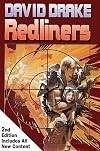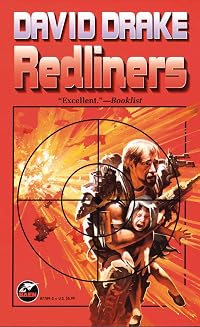
Redliners
by David Drake
On This Page
Description
They were the toughest fighters in the galaxy-until they got used up.
The mission: redemption-or death,
The troops were walking dead already,
so there wasn't much of a downside.
Major Arthur Farrell and the troops of Strike Force Company C41 had seen too much war with the alien Kalendru. They had too many screaming memories to be fit for combat again, but they were far too dangerous to themselves and others to be returned to civilian life.
The bureaucracy that administered human affairs show more arranged a final mission with the same ruthless efficiency as it conducted the war against the Kalendru. C41 would guard a colony being sent to a hell planet. If the troops succeeded, they might be ready to return to human society.
When the mission went horribly wrong, Art Farrell and his troops found their lives on the line as never before, protecting civilians to whom bureaucratic injustice was a new experience. And there was one more thing...
A story of soldiers and civilians,
of hope and, possibly, redemption.
At the publisher's request, this title is sold without DRM (Digital Rights Management).
. show less
Tags
Recommendations







Member Recommendations
by knownever
Member Reviews
I read this book for the first time in 2005. Story of the burned out (in military parlance, redlined) members of the crack assault armor infantry unit C41, assigned to help the civilian colonization efforts gripped me from page one to the very end.
And almost twenty years after I re-read the book (and to make it more interesting this time I picked up the twentieth anniversary edition :)) and I enjoyed it a lot although some things did resonate quite differently than 20 years ago.
Looking at it now, this story is very profoundly ruthless when it comes to treatment of shell shocked line troops, from whom lots of expected but very little is given to. People ran to the ground from one battlefield to another, desensitized by the horrendous show more flurry of combat, seeing fellow troopers obliterated in a second and not given any time to come to terms with what just happened, always ordered forward into the fray until that period of quiet that is transition to another battlefield. As time passes is it strange that survivors of these crack units become nothing else than automatons, not because they like it but because they dont have any other means of coping with hell they went through and are constantly pushed into. They feel that everything they have is each other and everyone else is seen as non-understanding and in need of the lesson. But when everyday activities include only use of deadly weapons and techniques what to expect from these people than extreme violence and reaction that can only be described as condemnation and disgust from the "civilized people", very people on whose behalf these troops became what they are now.
In order to save them, Unity administration decides to execute the most radical experiment - to mix this volatile people with civilians mobilized (not of their own volition) to set up a colony on the hellish world that would make Alien Xenomorph run for the hills. What happens is that soldiers of C41 finally find they are appreciated and, on the other hand, civilians finally see what it takes to make sure they are safe in this hellish landscape. This is akin to taking the blunt but heavy and deadly broadsword and then burning it down to the rapier level - it is not that C41 will return to civilian view of the world, it is just that they will be given a chance to be made part of greater community again, unfortunately not without sacrifices. Unity needs blades and C41 will remain the blade, but at least this blade will not be "demonically possessed".
There is no happy ending as such, C41 will continue soldiering on, but at least they have found anchor to keep their sanity.
For me this approach to burned out personnel is very radical, but in situations of out of hell combat and casualties there just does not seem to be another way than burning the snake poison of battlefield hell. In one way this approach reminds me of Modesty Blaise story where she saves Willie from sanatorium where he is mentally destroyed and as a result hallucinates all the time. Only way to save him is to make him sweat it out - this is done by Modesty forcing him to save her while climbing down the very nasty steep mountain. Very risky, but again shows the trust between the parties, because if there is no trust everything falls down.
One other element that makes this story SF story, story of fiction, aside from the effort to recover one of the many assault companies, is that Unity administration actually participates. Can you imagine any of the contemporary politicians doing the same? Heh, me neither.
Highly recommended. show less
And almost twenty years after I re-read the book (and to make it more interesting this time I picked up the twentieth anniversary edition :)) and I enjoyed it a lot although some things did resonate quite differently than 20 years ago.
Looking at it now, this story is very profoundly ruthless when it comes to treatment of shell shocked line troops, from whom lots of expected but very little is given to. People ran to the ground from one battlefield to another, desensitized by the horrendous show more flurry of combat, seeing fellow troopers obliterated in a second and not given any time to come to terms with what just happened, always ordered forward into the fray until that period of quiet that is transition to another battlefield. As time passes is it strange that survivors of these crack units become nothing else than automatons, not because they like it but because they dont have any other means of coping with hell they went through and are constantly pushed into. They feel that everything they have is each other and everyone else is seen as non-understanding and in need of the lesson. But when everyday activities include only use of deadly weapons and techniques what to expect from these people than extreme violence and reaction that can only be described as condemnation and disgust from the "civilized people", very people on whose behalf these troops became what they are now.
In order to save them, Unity administration decides to execute the most radical experiment - to mix this volatile people with civilians mobilized (not of their own volition) to set up a colony on the hellish world that would make Alien Xenomorph run for the hills. What happens is that soldiers of C41 finally find they are appreciated and, on the other hand, civilians finally see what it takes to make sure they are safe in this hellish landscape. This is akin to taking the blunt but heavy and deadly broadsword and then burning it down to the rapier level - it is not that C41 will return to civilian view of the world, it is just that they will be given a chance to be made part of greater community again, unfortunately not without sacrifices. Unity needs blades and C41 will remain the blade, but at least this blade will not be "demonically possessed".
There is no happy ending as such, C41 will continue soldiering on, but at least they have found anchor to keep their sanity.
For me this approach to burned out personnel is very radical, but in situations of out of hell combat and casualties there just does not seem to be another way than burning the snake poison of battlefield hell. In one way this approach reminds me of Modesty Blaise story where she saves Willie from sanatorium where he is mentally destroyed and as a result hallucinates all the time. Only way to save him is to make him sweat it out - this is done by Modesty forcing him to save her while climbing down the very nasty steep mountain. Very risky, but again shows the trust between the parties, because if there is no trust everything falls down.
One other element that makes this story SF story, story of fiction, aside from the effort to recover one of the many assault companies, is that Unity administration actually participates. Can you imagine any of the contemporary politicians doing the same? Heh, me neither.
Highly recommended. show less
In a ragged group of frontline soldiers, all of them clinging to the fringes of sanity, if they haven't fallen completely over, the greatest mind in the galaxy finds his chance for penance and a colony is born.
Drake's style often reminds me somewhat of Andre Norton, in that his characters lack much in the way of softness, and fraternal relationships are built not on blood, but on shared hardship, loyalty, service, etc. The main characters here aren't exactly three dimensional, but they do seem more human. Stellar read, in spite of a few annoying plot holes.
Drake's style often reminds me somewhat of Andre Norton, in that his characters lack much in the way of softness, and fraternal relationships are built not on blood, but on shared hardship, loyalty, service, etc. The main characters here aren't exactly three dimensional, but they do seem more human. Stellar read, in spite of a few annoying plot holes.
David Drake, who served in some dangerous places during the Vietnam War, is known for hard-hitting military science fiction, most notably the Hammer’s Slammers series about a company of future tankers. He has said that Redliners hits closest to home of all his books. It deals with post-traumatic stress and the difficulty soldiers have in rejoining society.
The plot involves a battle-weary unit assigned to guard a group of white-collar civilians shanghaied into colonizing a planet where almost every tree in the forest wants to kill you. The soldiers have hair-trigger combat reflexes, and the colonists have no idea how to relate to them. No one is prepared for the threats the planet has to offer.
There is lots of bloody action, but none show more of it is gratuitous. show less
The plot involves a battle-weary unit assigned to guard a group of white-collar civilians shanghaied into colonizing a planet where almost every tree in the forest wants to kill you. The soldiers have hair-trigger combat reflexes, and the colonists have no idea how to relate to them. No one is prepared for the threats the planet has to offer.
There is lots of bloody action, but none show more of it is gratuitous. show less
This was the first book I read by David Drake, and I have to admit that I was not really expecting much because even as a huge science fiction fan, I find that so much of he military science fiction is really high on the cheese meter. Not so with David Drake, and while none of his other books have been as dear to me as this one, I am a huge fan of his work because his characters and their experience of war are written from a place of truth and personal experience.What draws me back to this novel again and again are the characters. This novel, more than the others I have read of his, is character driven. The reader is given a front row seat to the character's physiological experience of the action. We experience the book through the eyes show more of these over worked and psychologically broken men and women as they struggle to carry out their mission in the worst circumstances possible. The world they inhabit is secondary in the novel, and serves only to explore the different character's psychological state and how it effects their present set of circumstances.Drake crafted these characters lovingly, and so it is easy to empathize with them. I found myself worrying about and hoping they would survive their mission. And this for me is one of the marks of a well written novel or story. When the fate of the main characters has an emotional impact on the reader, then no matter what, the author has done a good job. Drake did an amazing job here. I tend not reread to many science fiction novels even though I am a fan, and only a handful get left of my reading shelf, but I had to buy a new copy because I read the original so many times it was falling apart. show less
This title is great. The first thing I read by [Drake] was the short story collection [[Hammer's Slammers]], which I hated for its shallow, wooden characters, lovingly detailed homophobia (a psychotic killer is fey; doors "sphincter" open and closed for him), and jumbled plots.
[[Redliners]] however is a standout in the military sci fi genre (itself a relatively cramped, poorly writen, and stupidly characterized field so this isn't a piece of great literature). The plot revolves around some soldiers who, following a traumatic battle where like half of them get killed, are "redlined" (aka totally freaking out, aka pushed past the redline, aka denied loans via a system of geographic racism...no just playing on that last one). The future show more government's plan to rehabilitate them involves sending the unit? platoon? company? in any case it doesn't even matter because what's left of them gets sent to a suicidally hostile planet filled with malevolent, sentient plants. And even worse they have to guard a bunch of rich civilians who were drafted to colonize the planet.
There is some fancy tech with computers implanted in people's brains and an evil alien race that humans are warring against show up, but the meat of the story (and the reason it's good) is the relationships that develop between the civilians and the soldiers. Cute girl children are adopted by stoic soldier men, useless civilian hotties are boned by stoic soldier women. Basically, the civilians toughen up and learn to respect soldiers and the soldiers all grow human hearts again so everybody wins. Obviously, there is cliche corn here, but it works and is fun and doesn't stereotype/pick on any one group too bad.
Although, [Redliners] isn't part of a series, I'm hoping some of his other books pick up with these same characters/setting. show less
[[Redliners]] however is a standout in the military sci fi genre (itself a relatively cramped, poorly writen, and stupidly characterized field so this isn't a piece of great literature). The plot revolves around some soldiers who, following a traumatic battle where like half of them get killed, are "redlined" (aka totally freaking out, aka pushed past the redline, aka denied loans via a system of geographic racism...no just playing on that last one). The future show more government's plan to rehabilitate them involves sending the unit? platoon? company? in any case it doesn't even matter because what's left of them gets sent to a suicidally hostile planet filled with malevolent, sentient plants. And even worse they have to guard a bunch of rich civilians who were drafted to colonize the planet.
There is some fancy tech with computers implanted in people's brains and an evil alien race that humans are warring against show up, but the meat of the story (and the reason it's good) is the relationships that develop between the civilians and the soldiers. Cute girl children are adopted by stoic soldier men, useless civilian hotties are boned by stoic soldier women. Basically, the civilians toughen up and learn to respect soldiers and the soldiers all grow human hearts again so everybody wins. Obviously, there is cliche corn here, but it works and is fun and doesn't stereotype/pick on any one group too bad.
Although, [Redliners] isn't part of a series, I'm hoping some of his other books pick up with these same characters/setting. show less
fascinating book until the end, when it became obvious drake either didn't know how to end it, or didn't care. there was a truly half-ass explanation of what was going on, as if he was going to turn this into more books, to explain what hadn't been explained in each... as much as i liked it to that point, this cavalier attitude will not endear me to read more of drake... for what it's worth, robert silverberg did a much better rendition of the drake "world" much earlier with "the man in the maze"
Quite enjoyable if you don't mind character casts dying off faster than you can blink. Here, it was far from gratuitous though. A minor niggle was the ending, a bit "Huh, that's it ?".
Members
- Recently Added By
Lists

Best Military Science Fiction
57 works; 26 members

Baen Free Library
72 works; 2 members
Author Information

269+ Works 34,928 Members
David Drake was born on September 24, 1945, in Dubuque, Iowa. He attended University of Iowa, where he graduated with a degree in History (with honors) and Latin. He then attended Duke Law School. He was drafted out of law school, served in the army for two years and then returned to school. He worked as an Assistant Town Attorney of Chapel Hill show more and then part-time as a city bus driver before he became a full-time writer. Drake is considered a master of Science Fiction and Fantasy. The Hammer's Slammers, military science fiction, was his first published series. His other titles include Northworld series, The Dragon Lord, Starliner, Ranks of Bronze, and Redliners. In recognition of his work, he won a World Fantasy award in 1976. He currently resides in North Carolina. (Bowker Author Biography) show less
Some Editions
Common Knowledge
- Canonical title
- Redliners
- Original publication date
- 1996-08
- People/Characters
- Major Arthur Farrell; Captain Nadia Broz; Kurt Leinsdorf; Horgen; Sergeant Guilio Abbado; Flea Glasebrook (show all 15); Striker Esther Meyer; Sergeant-Gunner Bloch; Santini; Striker Caius Blohm; Sergeant Gabrilovitch; Lieutenant Kuznetsov; Lieutenant Whichard; Jefferson; Foyle
- Important places
- Maxus 377; Earth
- First words
- Prologue:
When I entered Category 4 of the Unity civil service thirty-seven years ago, I gave up my former name and life to become a servant dedicated to all mankind.
Story:
Major Arthur Farrell's bones vibrated to the howls of the generators braking the captured Kalendru starship to a soft landing in the main military port of the world Unity planners had labeled Maxus 377.
Epilogue:
The psychology of the Kalendru required them to battle the Unity for primacy where another human society would have been willing to coexist with us. - Last words
- (Click to show. Warning: May contain spoilers.)Prologue:
And they are all of them correct.
(Click to show. Warning: May contain spoilers.)Story:
The three of them stood before the giant tree, contemplating the future.
(Click to show. Warning: May contain spoilers.)Epilogue:
For we are all human.
Classifications
Statistics
- Members
- 550
- Popularity
- 53,926
- Reviews
- 14
- Rating
- (3.78)
- Languages
- Czech, English
- Media
- Paper, Ebook
- ISBNs
- 7
- ASINs
- 4