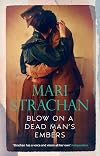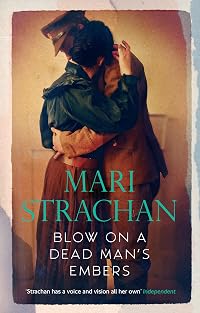
Blow on a Dead Man's Embers
by Mari Strachan
On This Page
Description
With her husband shattered by the war, does one young woman have the strength to bring him back to life.Tags
Recommendations

















Member Reviews
It is 1921 and Non (Rhiannon) Davies is one of the lucky ones. Her husband has returned from the Great War but not all injuries are physical and he is no longer the man she once knew. Stepmother to his two children from a previous marriage, with an adopted child, a nephew, in-laws and neighbours who all need something from her can she manage to find a way to get her husband back. Mari Strachan has created a vivid picture of post war Wales. Non is a believable and strong protagonist; the secondary characters are fully realised and the life and times ring true.
I loved this novel. Mari Strachan has obviously done her research and the pace and style of her writing is perfect at creating a slice of life. This is an emotional piece of work show more and, for a subject that could be harrowing, she has included enough light and shade; touches of humour and believable characters that it deserves the full five stars I am giving it. Simply wonderful! show less
I loved this novel. Mari Strachan has obviously done her research and the pace and style of her writing is perfect at creating a slice of life. This is an emotional piece of work show more and, for a subject that could be harrowing, she has included enough light and shade; touches of humour and believable characters that it deserves the full five stars I am giving it. Simply wonderful! show less
Mari Strachan has the gift to make her characters rise fully fleshed and alive from her writing. I believed them in “The Earth Hums in B Flat” and she has made me believe them again in her second book, “Blow on a Dead Man’s Embers”. She knows these people in this small town in Wales, knows them, lives with them, and speaks their Welsh language. She knows their hearts. I do enjoy a story where the characters ring so true.
The time is just after World War I, that devastating horror which sent men home maimed, shell-shocked, useless and unemployed, if it didn’t bury them in the mire of France. It was a war which still forced armies to shoot their own men for cowardice or abandonment. And it was the war which killed forever the show more myth that war was any kind of glory. Rhiannon “Non” Davies has had her husband return in body but his spirit has been damaged by what he has seen and experienced. She repeatedly finds him under the kitchen table, going through a ritual with an imaginary rifle, looking through her with what they call in the psychiatric hospitals “the thousand-yard stare”.
Non has “the sight”, a gift which enables her to see sickness in others but she can’t see what it is that has damaged her Davey so. When a letter falls into her hands by chance, she begins to see how she might unravel the mystery but it isn’t easy and the way certainly isn’t clear.
Woven into this tale are the various threads of neighbours and family, wonderful characters like the snooping Maggie Ellis and the wise, tough Lizzie German. Her mother-in-law Catherine Davies is a horrid woman, yet Strachan manages to engender a pity for her despite all her terrible ways. Women with “the sight” are given respect as befits a Celtic culture, the old ways peeping from behind the walls of science and the encroaching modern era. Yet science is given its due as well. A beautiful balance is maintained throughout.
In another writer’s hands this material could be unrelentingly grim and dour but Mari Strachan loves her characters so she imbues them with tremendous kindness, powerful honesty , stoic courage and a deep sense of honour. Non Davies is a wonderful character but so is her husband, and the members of her family. I had to read this book in one sitting for, believing in them so utterly, I couldn’t leave them until I knew how it would end.
This book gives us hope and humour, optimism and a view of that wonderful courage that faces down life’s slings and arrows, but without a drop of anything maudlin or syrupy. Strachan also gives us some wonderful twists and turns, to keep us fascinated and wondering. This was a splendid story. show less
The time is just after World War I, that devastating horror which sent men home maimed, shell-shocked, useless and unemployed, if it didn’t bury them in the mire of France. It was a war which still forced armies to shoot their own men for cowardice or abandonment. And it was the war which killed forever the show more myth that war was any kind of glory. Rhiannon “Non” Davies has had her husband return in body but his spirit has been damaged by what he has seen and experienced. She repeatedly finds him under the kitchen table, going through a ritual with an imaginary rifle, looking through her with what they call in the psychiatric hospitals “the thousand-yard stare”.
Non has “the sight”, a gift which enables her to see sickness in others but she can’t see what it is that has damaged her Davey so. When a letter falls into her hands by chance, she begins to see how she might unravel the mystery but it isn’t easy and the way certainly isn’t clear.
Woven into this tale are the various threads of neighbours and family, wonderful characters like the snooping Maggie Ellis and the wise, tough Lizzie German. Her mother-in-law Catherine Davies is a horrid woman, yet Strachan manages to engender a pity for her despite all her terrible ways. Women with “the sight” are given respect as befits a Celtic culture, the old ways peeping from behind the walls of science and the encroaching modern era. Yet science is given its due as well. A beautiful balance is maintained throughout.
In another writer’s hands this material could be unrelentingly grim and dour but Mari Strachan loves her characters so she imbues them with tremendous kindness, powerful honesty , stoic courage and a deep sense of honour. Non Davies is a wonderful character but so is her husband, and the members of her family. I had to read this book in one sitting for, believing in them so utterly, I couldn’t leave them until I knew how it would end.
This book gives us hope and humour, optimism and a view of that wonderful courage that faces down life’s slings and arrows, but without a drop of anything maudlin or syrupy. Strachan also gives us some wonderful twists and turns, to keep us fascinated and wondering. This was a splendid story. show less
Blow on a Dead Man's Embers is set in Wales in 1921. Non Davies is the main character and her husband, Davey, has started to have flashbacks to his time in the war, which involve him hiding under the kitchen table and shouldering an imaginary rifle. Non decides to try to find out what has brought these episodes on three years after he returned home.
This is one of those rare books that comes along every so often that I just find so beautifully written. The writing has a lyrical feel to it, and is so completely evocative of time and place that I found myself reading the dialogue in my head in a Welsh accent.
The characterisations are superb too. Non and her family are brilliantly drawn, and then there is also the busybody neighbour, Maggie show more Ellis, who is so well portrayed, and Catherine Davies, Davey's mother who is a rather unpleasant woman. The characters came alive for me and were very much three-dimensional.
I found myself savouring every single word of this brilliant book. It's a book that is driven by characters and place, rather than plot, and I became totally immersed in the whole thing whilst I was reading it.
I'm definitely going to read Mari Strachan's first novel now, and I hope she carries on producing works of such greatness. show less
This is one of those rare books that comes along every so often that I just find so beautifully written. The writing has a lyrical feel to it, and is so completely evocative of time and place that I found myself reading the dialogue in my head in a Welsh accent.
The characterisations are superb too. Non and her family are brilliantly drawn, and then there is also the busybody neighbour, Maggie show more Ellis, who is so well portrayed, and Catherine Davies, Davey's mother who is a rather unpleasant woman. The characters came alive for me and were very much three-dimensional.
I found myself savouring every single word of this brilliant book. It's a book that is driven by characters and place, rather than plot, and I became totally immersed in the whole thing whilst I was reading it.
I'm definitely going to read Mari Strachan's first novel now, and I hope she carries on producing works of such greatness. show less
Full of feeling.
I loved The Earth Hums in B Flat and could see the resemblance in this book, with the emotional descriptions of Davey's fearful episodes after his return from WWI. Mari Strachan seems to be particularly good at this type of writing.
Again set in Wales, the story centres around Non (Rhiannon) Davies and her husband Davey. He has two children from a previous marriage and a younger son, Osian, who he mysteriously turns up with, as a baby, one day. Osian shows signs of autism, though at that time such disabilities would not have been recognised. Soon after their marriage, Davey goes off to war and although he is one of the few that came back apparently uninjured, his mental turmoil is just as damaging.
Non is an endearing show more character who is always ready to help her friends and neighbours, yet she seems unable to help her husband. Then a letter turns up in Davey's pocket and Non ventures to London in the hope of some answers.
This was every bit as good as Ms Strachan's first book, full of feeling and emotion - hopefully there will be many more to come. show less
I loved The Earth Hums in B Flat and could see the resemblance in this book, with the emotional descriptions of Davey's fearful episodes after his return from WWI. Mari Strachan seems to be particularly good at this type of writing.
Again set in Wales, the story centres around Non (Rhiannon) Davies and her husband Davey. He has two children from a previous marriage and a younger son, Osian, who he mysteriously turns up with, as a baby, one day. Osian shows signs of autism, though at that time such disabilities would not have been recognised. Soon after their marriage, Davey goes off to war and although he is one of the few that came back apparently uninjured, his mental turmoil is just as damaging.
Non is an endearing show more character who is always ready to help her friends and neighbours, yet she seems unable to help her husband. Then a letter turns up in Davey's pocket and Non ventures to London in the hope of some answers.
This was every bit as good as Ms Strachan's first book, full of feeling and emotion - hopefully there will be many more to come. show less
number 2: [De laatste vonken] by [[Mari Strachan]], english title [Blow on a dead man's embers]. An emotional story about a husband suffering from his experiences in the first World War. His wife can not accept how he changed and searches, sometimes beyond the acceptable in those days, for the reasons.
I do have mixed feelings about this book:
First there is the brilliantly depicted atmosphere in the book which is already dual:
we get a good insight in family relations, more specific between husband and wife, the evocation of the problems, the social situation, the psychological wounds caused by the war, the unlimited love ... and the "paranormal" or "extranormal" aspects in the mind of the main character. For me they are meant to give show more us, readers, the feeling that in the psyche of mankind there is more then we know, or that we knew in that time.
This positive viewpoint is then nuanced by the author who surely also wants to tell us that war is a horror, that men and women can be cruel for one another, that family is not always a blessing and that people do not always have the best intentions.
As in her first book, Mari Strachan is very good in this atmospheric descriptions: the light, the noises, the perfumes of flowers, the dust caused by woodcarving ..
My mixed feelings are provoked by the other aspect of a novel: not the subject but the form, the writing style and story build up. And here i can not be as positive. It is slow, almighty slow. At first it seems smart, each very brief chapter goes so slow, but every change of chapter gives also a jump in time, sometimes just the next morning, sometimes more and in one odd occasion partially a flashback on the night before.
But that's all, there is nothing more. The expected suspense on what provokes the behaviour of the husband is so clear that you can see it coming from a distance. Even when you think, oh this was not all, there is a second drama building up, it ends so predictable ...
So, wrapping up, this book is very good for me because i like careful settings, i like well described characters, and i like very much good descriptions of what goes around in peoples heads. Added to this comes the good illustration of Celtic traditions disappearing in the need to integrate in England for the Welshmen. But it's not a brilliant book due to it being too slow and too predictable.
[The earth hums in B flat], the debut of Mari Strachan, was better. show less
I do have mixed feelings about this book:
First there is the brilliantly depicted atmosphere in the book which is already dual:
we get a good insight in family relations, more specific between husband and wife, the evocation of the problems, the social situation, the psychological wounds caused by the war, the unlimited love ... and the "paranormal" or "extranormal" aspects in the mind of the main character. For me they are meant to give show more us, readers, the feeling that in the psyche of mankind there is more then we know, or that we knew in that time.
This positive viewpoint is then nuanced by the author who surely also wants to tell us that war is a horror, that men and women can be cruel for one another, that family is not always a blessing and that people do not always have the best intentions.
As in her first book, Mari Strachan is very good in this atmospheric descriptions: the light, the noises, the perfumes of flowers, the dust caused by woodcarving ..
My mixed feelings are provoked by the other aspect of a novel: not the subject but the form, the writing style and story build up. And here i can not be as positive. It is slow, almighty slow. At first it seems smart, each very brief chapter goes so slow, but every change of chapter gives also a jump in time, sometimes just the next morning, sometimes more and in one odd occasion partially a flashback on the night before.
But that's all, there is nothing more. The expected suspense on what provokes the behaviour of the husband is so clear that you can see it coming from a distance. Even when you think, oh this was not all, there is a second drama building up, it ends so predictable ...
So, wrapping up, this book is very good for me because i like careful settings, i like well described characters, and i like very much good descriptions of what goes around in peoples heads. Added to this comes the good illustration of Celtic traditions disappearing in the need to integrate in England for the Welshmen. But it's not a brilliant book due to it being too slow and too predictable.
[The earth hums in B flat], the debut of Mari Strachan, was better. show less
Kort na de Eerste wereldoorlog heeft een echtpaar uit Wales moeite om de draad van het leven weer op te pakken.
Hey lezen van dit boek is echt zonde van de tijd!!!!!
Hey lezen van dit boek is echt zonde van de tijd!!!!!
Ratings
Members
- Recently Added By
Author Information

3 Works 677 Members
Common Knowledge
- Original title
- Blow on a Dead Man's Embers
- Alternate titles
- Dead Man's Embers
- Original publication date
- 2011-08-04
- People/Characters
- Non Davies; Davy Davies
- Important places
- Wales, UK; London, England, UK; England, UK
- Important events
- World War I
- Dedication
- Adam, Llio, Cai, a Rachel
hefo cariad mawr - First words
- Something is weighing on her breast, squeezing her heart.
Classifications
Statistics
- Members
- 63
- Popularity
- 492,287
- Reviews
- 6
- Rating
- (3.53)
- Languages
- Dutch, English
- Media
- Paper, Ebook
- ISBNs
- 10
- ASINs
- 2