On This Page
Description
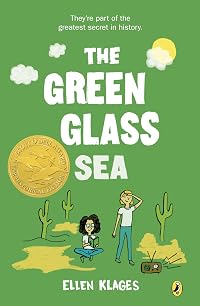
It is 1943, and 11-year-old Dewey Kerrigan is traveling west on a train to live with her scientist father--but no one will tell her exactly where he is. When she reaches Los Alamos, New Mexico, she learns why: he's working on a top secret government program.Tags
Recommendations

















Member Recommendations
Member Reviews
And I did enjoy it a lot. Dewey is a great character, and I love how Klages got the girls *right* - she did a great job of depicting smart girls of that age.
That said: every other day or so, the fan fiction world has a warnings debate, and inevitably someone says, "You wouldn't get warnings in a published novel!" To which my response is always: "Yes. And that's one of the reasons I love fan fiction so much." This novel contains major character death, and for
(And if anyone reading this wants to know who dies, let me know.)
As I've grown older, it's rare that a young adult novel makes me cry, but this Scott O'Dell award winner had me ugly crying.
It takes place near the end of WWII and follows an almost 11-year-old girl named Dewey Kerrigan as she has to leave her childhood home due to her grandmother’s poor health and rejoin her father who is a scientist working for the government. She travels alone to Los Alamos, New Mexico and reunites with her father in a secret compound of physicists, engineers, chemists, mathematicians, and general military personnel. The Hill doesn’t officially exist and no one is allowed to know about the families living there. The scientists spend all of their waking hours working on a super-secret project that is known show more amongst the children as “the gadget”. Historical figures like Enrico Fermi, Richard Feynman, and Robert Oppenheimer make appearances in the book. An astute reader familiar with history knows they are working on The Manhattan Project, but it is never officially stated.
The books skews towards a mature audience because it makes a lot of assumptions that the readers will get the WWII figures, references, and context. It’s beautifully written and the complex layers in the plot gives readers a lot to think about. The characters are interesting and very well written. Dewey has a disability and possibly has autism, but she does not let her disability hinder her in any way. The children living in The Hill all have believable personalities and their personal relationships are what make this novel accessible to young readers. The story teaches us about compassion, bullying, right and wrong choices, the ethics of war, and feelings of not fitting in. The author does a wonderful job of showing growth in a character via another young girl, Suze Gordon.
If you’re looking for a historical fiction novel to supplement a WWII unit and would like to have layered discussions with your students, this is a good choice. show less
It takes place near the end of WWII and follows an almost 11-year-old girl named Dewey Kerrigan as she has to leave her childhood home due to her grandmother’s poor health and rejoin her father who is a scientist working for the government. She travels alone to Los Alamos, New Mexico and reunites with her father in a secret compound of physicists, engineers, chemists, mathematicians, and general military personnel. The Hill doesn’t officially exist and no one is allowed to know about the families living there. The scientists spend all of their waking hours working on a super-secret project that is known show more amongst the children as “the gadget”. Historical figures like Enrico Fermi, Richard Feynman, and Robert Oppenheimer make appearances in the book. An astute reader familiar with history knows they are working on The Manhattan Project, but it is never officially stated.
The books skews towards a mature audience because it makes a lot of assumptions that the readers will get the WWII figures, references, and context. It’s beautifully written and the complex layers in the plot gives readers a lot to think about. The characters are interesting and very well written. Dewey has a disability and possibly has autism, but she does not let her disability hinder her in any way. The children living in The Hill all have believable personalities and their personal relationships are what make this novel accessible to young readers. The story teaches us about compassion, bullying, right and wrong choices, the ethics of war, and feelings of not fitting in. The author does a wonderful job of showing growth in a character via another young girl, Suze Gordon.
If you’re looking for a historical fiction novel to supplement a WWII unit and would like to have layered discussions with your students, this is a good choice. show less
Two girls spend a year in Los Alamos as their parents work on the secret gadget that will end World War II. Dewey is a mechanically minded 10-year-old who gets along fine with the scientists at the site, but is teased by girls her own age. When her mathematician father is called away, she moves in with Suze, who initially detests her new roommate. The two draw closer, though, and their growing friendship is neatly set against the tenseness of the Los Alamos compound as the project nears completion. Clear prose brings readers right into the unusual atmosphere of the secretive scientific community, seen through the eyes of the kids and their families. Dewey is an especially engaging character, plunging on with her mechanical projects and show more ignoring any questions about gender roles. Occasional shifts into first person highlight the protagonist's most emotional moments, including her journey to the site and her reaction to her father's unexpected death. After the atomic bomb test succeeds, ethical concerns of both youngsters and adults intensify as the characters learn how it is ultimately used. Many readers will know as little about the true nature of the project as the girls do, so the gradual revelation of facts is especially effective, while those who already know about Los Alamos's historical significance will experience the story in a different, but equally powerful, way. show less
The Green Glass Sea reminded me just how much I love middle grade books. There is just something magical about that transition age of 11 years of age. Simply put, I adored this book and zoomed through it, and I know I would have loved it when I was a kid, too. It has a fantastic mix: a backdrop of the World War II home front, with most of the book taking place on "the Hill" aka Los Alamos, New Mexico; kids who really sound like kids, complete the meanness and ribald song lyrics about Hitler; and a deep sense of history and place, down to describing the chili served in an open bag of Frito's down in Santa Fe.
The book utilizes two vantage points of view: Dewey and Suze. The two girls are very different and start out as enemies. As a show more reader, you know things will change and they'll become friends, but I was very pleased with how Klages handles this. Their friendship wasn't some instantaneous thing. It felt real--like the characters matured as the months passed.
This is really an excellent book for any girl interested in the sciences. Dewey is a genius with machines, a girl who is wearing a copy of The Boy Mechanic to tatters. She's an outsider, a freak, to the outside world, but in Los Alamos she's surrounded by the most brilliant minds in the world. The other kids don't accept her, but the adults do. Meanwhile, Suze is an outsider who is desperate to fit in with the in-crowd, and she really matures a great deal and she discovers herself as part of her growing friendship with Dewey. Their interpersonal dramas play out against the secret of what their parents are really working on in their day to day jobs: the atomic bomb. show less
The book utilizes two vantage points of view: Dewey and Suze. The two girls are very different and start out as enemies. As a show more reader, you know things will change and they'll become friends, but I was very pleased with how Klages handles this. Their friendship wasn't some instantaneous thing. It felt real--like the characters matured as the months passed.
This is really an excellent book for any girl interested in the sciences. Dewey is a genius with machines, a girl who is wearing a copy of The Boy Mechanic to tatters. She's an outsider, a freak, to the outside world, but in Los Alamos she's surrounded by the most brilliant minds in the world. The other kids don't accept her, but the adults do. Meanwhile, Suze is an outsider who is desperate to fit in with the in-crowd, and she really matures a great deal and she discovers herself as part of her growing friendship with Dewey. Their interpersonal dramas play out against the secret of what their parents are really working on in their day to day jobs: the atomic bomb. show less
"Green Glass Sea" was awesome. The best thing to dive into straight after HP7--proof that great literature is being published in the YA category.
The book is from the point of view of the children who lived on The Hill, the ultra-secret base for the Los Alamos tests during WWII; how they spent their time, what they cared about, how they felt about the unique environment they lived in.
Klages' book also asks tough questions about war, and the social & ethical responsibilities of scientists.
But it's her main protagonists that truly stand out; Dewey & Suze just come alive, full of contradictions and hopes and fears.
A book with thoroughly engrossing characters, a wealth of heretofore unknown historical tidbits, and The Atomic Bomb!? It can't show more be beat. show less
The book is from the point of view of the children who lived on The Hill, the ultra-secret base for the Los Alamos tests during WWII; how they spent their time, what they cared about, how they felt about the unique environment they lived in.
Klages' book also asks tough questions about war, and the social & ethical responsibilities of scientists.
But it's her main protagonists that truly stand out; Dewey & Suze just come alive, full of contradictions and hopes and fears.
A book with thoroughly engrossing characters, a wealth of heretofore unknown historical tidbits, and The Atomic Bomb!? It can't show more be beat. show less
Dewey gets to live with her father on The Hill in Los Alamos during World War II. Her father is a scientist working on the invention of what is referred to in the book as the gadget. Her mother abandoned the family when Dewey was an infant. When Dewey's dad, Jimmy, has to go to Washington DC, Dewey stays with the Gordon family. The Gordon's daughter, Suze, and Dewey don't get along so well at first.
I was pleasantly surprised and absorbed by this historical book that gives insight into the lives of the people working on developing the atomic bomb during World War II and living in the secret Los Alamos. The Green Glass Sea refers to the mineral that is created as a result of the test of the gadget. A lot of people and events are simply show more alluded to in the story, which is great because it doesn't slow the story down, but I wonder how much middle school students will connect events and people in the story with historical events and people. show less
I was pleasantly surprised and absorbed by this historical book that gives insight into the lives of the people working on developing the atomic bomb during World War II and living in the secret Los Alamos. The Green Glass Sea refers to the mineral that is created as a result of the test of the gadget. A lot of people and events are simply show more alluded to in the story, which is great because it doesn't slow the story down, but I wonder how much middle school students will connect events and people in the story with historical events and people. show less
Wonderful insights into the Los Alamos experience between 1943-1945 from a children's point of view. The scientist's kids had lots of freedom at this top-secret site because it was safe for them. Yet they felt the pressure from their parents, who were trying to end the war with the development of the "gadget." The hard-to-put-down story follows Dewey Kerrigan, daughter of a mathematician. Dewey loves radios and science, so she is right at home among all the scientists who can answer her questions. Her love of science and obsession with radios at first alienates her from many of the kids, especially the girls, but she befriends two boys, and eventually a girl who is also a bit of an outcast. Dewey is an interesting character, a good kid, show more a loving daughter. I liked her very much. I would like to read the sequel, White Sands, Red Menace. show less
Members
- Recently Added By
Lists


Author Information

44+ Works 2,939 Members
Ellen Klages (The Green Glass Sea; White Sands, Red Menace) is the recipient of the World Fantasy, Nebula, Scott O'Dell, and California Book awards. Her short fiction has been on the final ballot for numerous literary and genre awards and has been translated into a dozen languages. Klages has a degree in Philosophy from the University of Michigan, show more leading to many odd jobs that began with the letter P (proofreader, photographer, painter, pinball arcade manager). She lives in San Francisco in a small house full of strange and wondrous things. show less
Some Editions
Awards and Honors
Awards
Distinctions
Series

Common Knowledge
- Original publication date
- 2006
- People/Characters
- Dewey Kerrigan; Suze Gordon; Richard Feynman; Jimmy Kerrigan
- Important places
- Los Alamos, New Mexico, USA
- Important events
- Trinity; Manhattan Project; World War II (1939 | 1945)
- Dedication
- To Jane Heller, for childhood talks on the shelf and pearls in the creek.
To Delia Sherman, my writing sister, who knows when it's time to send the Goon.
And to my dad, Jack Klages, who lived through the war I'... (show all)ve only read about. - First words
- Dewey Kerrigan sits on the concrete front steps of Mrs. Kovack's house in St. Louis, waiting for her father.
- Last words
- (Click to show. Warning: May contain spoilers.)"Nothing but war news," she said, clicking it off. "We can always get that later."
Classifications
Statistics
- Members
- 1,350
- Popularity
- 17,757
- Reviews
- 74
- Rating
- (4.11)
- Languages
- English
- Media
- Paper, Audiobook, Ebook
- ISBNs
- 20
- ASINs
- 7