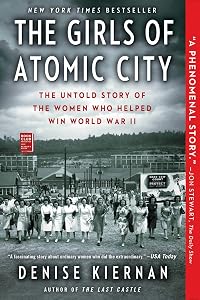
The Girls of Atomic City: The Untold Story of the Women Who Helped Win World War II
by Denise Kiernan
On This Page
Description
In this book the author traces the story of the unsung World War II workers in Oak Ridge, Tennessee through interviews with dozens of surviving women and other Oak Ridge residents. This is the story of the young women of Oak Ridge, Tennessee, who unwittingly played a crucial role in one of the most significant moments in U.S. history. The Tennessee town of Oak Ridge was created from scratch in 1942. One of the Manhattan Project's secret cities, it did not appear on any maps until 1949, and show more yet at the height of World War II it was using more electricity than New York City and was home to more than 75,000 people, many of them young women recruited from small towns across the South. Their jobs were shrouded in mystery, but they were buoyed by a sense of shared purpose, close friendships, and a surplus of handsome scientists and Army men. But against this wartime backdrop, a darker story was unfolding. The penalty for talking about their work, even the most innocuous details, was job loss and eviction. One woman was recruited to spy on her coworkers. They all knew something big was happening at Oak Ridge, but few could piece together the true nature of their work until the bomb "Little Boy" was dropped over Hiroshima, Japan, and the secret was out. The shocking revelation: the residents of Oak Ridge were enriching uranium for the atomic bomb. Though the young women originally believed they would leave Oak Ridge after the war, many met husbands there, made lifelong friends, and still call the seventy-year-old town home. The reverberations from their work there, work they did not fully understand at the time, are still being felt today. show lessTags
Recommendations


















Member Recommendations
lemontwist It's pretty clear that Julia Watts read The Girls of Atomic City before writing Secret City.

Member Reviews
In The Girls of Atomic City: The Untold Story of the Women Who Helped Win World War II, Denise Kiernan describes the construction of the Oak Ridge facility during the Manhattan Project and how it attracted women from throughout the United States to a makeshift, highly secretive town to perform every type of work from janitorial services to calibration to office work and chemistry, all in support of a goal that only a few understood. Kiernan writes, “Women infused the job site with life, their presence effortlessly defying all attempts to control and plan and shape every aspect of day-to-day existence at Oak Ridge. The Project may not have known what was to become of the town after the war, but the women knew that while they were show more there, they would not only work as hard as the men, but they would make it home. The Project probably never saw this coming. The government wasn’t interested in social experiments, didn’t give a second thought to the cultural-anthropological ramification of the world they had set in motion… The military may have been in charge, but the irrepressible life force that is woman – that was well beyond their control” (p. 98). Kiernan continues, “The most ambitious war project in military history rested squarely on the shoulders of tens of thousands of ordinary people, many them young women” (p. 108).
Despite the funds pouring into the project, the women still faced the same shortages as their counterparts throughout the country, perhaps more so due to the secretive nature of their location. Kiernan writes of the advice columns, “They taught the value of all forms of protein and how to reproduce juicy, meaty flavors with the clever use of easier-to-come-by staples like potatoes and oatmeal, lessons modern-day vegans still use today. Advice columns and friendly tips were echoed in the Oak Ridge Journal, and were the refrain of many a man or woman who had grown up during the Depression” (p. 165). Even amid restrictions, the women found ways to improvise. Kattie, facing racial discrimination in housing that denied her the ability to live with her husband and a living space without a kitchen, made a home nonetheless. Kiernan writes, “From the warped, discarded metal of a top secret war plant to her hands came a simple pan and some fresh biscuits. She gave them to that guard, kept him happy, kept him quiet, and kept herself at Willie's hut a little longer, relatively free of hassle, blissfully free of stomach cramps” (p. 171). Spouses found the routine of day-to-day life strained by the restrictions of the project. Vi Warren and her husband Stafford had had a comfortable life in Rochester, NY, but his work on the Project made it impossible for him to tell her anything about his trips and his workday (p. 183).
The Oak Ridge community developed the social life that was found in more organic communities, though the secretive nature of it pervaded. Kiernan writes, “War had brought them together, in dorms and at dances, at work and on buses. But another, elusive and unspoken link—Tubealloy – brought together their efforts, and was completely dependent upon their abilities” (p. 189). The secret of Oak Ridge finally came out following the bombing of Hiroshima (p. 256-257). According to Kiernan, “What had for so long been a drought of information came now as a flood. But people who worked in the plants at CEW still wondered what, exactly, they might have been doing all this time. The specific details of their roles in the Oak Ridge story did not always trickle down. The complete story would, for many of them, remain beyond their grasp for decades to come” (p. 260). The people of Oak Ridge “found themselves recasting discussions and experiences in light of the new information. Oak Ridge's precise role was not entirely clear to many. Some assumed they had built the bomb itself. That they had actually been helping create the atomic bomb's fuel source was too abstruse for many to comprehend. And most details remained top secret” (p. 261).
The story of the women at Oak Ridge both expands upon the narrative of women during World War II and complicates it due to the unique conditions of the town. Kiernan writes, “Women – well over a million by 1942 – had gone into factories and offices, and countless others rationed, collected scrap metal, bought war bonds, and danced with soldiers at the USO. While the entire country erupted, Oak Ridge was in a particular state of exuberance. Relief and pride mixed with shock and pensive consideration at the news of a second bombing… For others, knowing was too much. One young K-25 worker left the singing and celebrating and retired to her dorm room. She sat there, thinking about the small role she had played in the bombings, and cried” (p. 272-273). Further, Oak Ridge foreshadowed the ethically dubious actions of the atomic age and early Cold War. As Kiernan notes, “Ebb Cade was not the only test subject. It turned out that between 1945 and 1947, 18 people were injected with plutonium, specifically: 11 at Rochester, New York, 3 at the University of Chicago, 3 at UC San Francisco, and 1, Ebb Cade, at Oak Ridge. Several thousand human radiation experiments were conducted between 1944 and 1974” (p. 293). Finally, these women’s actions were downplayed in official histories of the Manhattan Project, just as other women like Lise Meitner had their “contributions to the discovery of fission remained obscured” (p. 294). Despite it all, Kiernan concludes, “Oak Ridgers had kept the most amazing secret ever” (p. 268). show less
Despite the funds pouring into the project, the women still faced the same shortages as their counterparts throughout the country, perhaps more so due to the secretive nature of their location. Kiernan writes of the advice columns, “They taught the value of all forms of protein and how to reproduce juicy, meaty flavors with the clever use of easier-to-come-by staples like potatoes and oatmeal, lessons modern-day vegans still use today. Advice columns and friendly tips were echoed in the Oak Ridge Journal, and were the refrain of many a man or woman who had grown up during the Depression” (p. 165). Even amid restrictions, the women found ways to improvise. Kattie, facing racial discrimination in housing that denied her the ability to live with her husband and a living space without a kitchen, made a home nonetheless. Kiernan writes, “From the warped, discarded metal of a top secret war plant to her hands came a simple pan and some fresh biscuits. She gave them to that guard, kept him happy, kept him quiet, and kept herself at Willie's hut a little longer, relatively free of hassle, blissfully free of stomach cramps” (p. 171). Spouses found the routine of day-to-day life strained by the restrictions of the project. Vi Warren and her husband Stafford had had a comfortable life in Rochester, NY, but his work on the Project made it impossible for him to tell her anything about his trips and his workday (p. 183).
The Oak Ridge community developed the social life that was found in more organic communities, though the secretive nature of it pervaded. Kiernan writes, “War had brought them together, in dorms and at dances, at work and on buses. But another, elusive and unspoken link—Tubealloy – brought together their efforts, and was completely dependent upon their abilities” (p. 189). The secret of Oak Ridge finally came out following the bombing of Hiroshima (p. 256-257). According to Kiernan, “What had for so long been a drought of information came now as a flood. But people who worked in the plants at CEW still wondered what, exactly, they might have been doing all this time. The specific details of their roles in the Oak Ridge story did not always trickle down. The complete story would, for many of them, remain beyond their grasp for decades to come” (p. 260). The people of Oak Ridge “found themselves recasting discussions and experiences in light of the new information. Oak Ridge's precise role was not entirely clear to many. Some assumed they had built the bomb itself. That they had actually been helping create the atomic bomb's fuel source was too abstruse for many to comprehend. And most details remained top secret” (p. 261).
The story of the women at Oak Ridge both expands upon the narrative of women during World War II and complicates it due to the unique conditions of the town. Kiernan writes, “Women – well over a million by 1942 – had gone into factories and offices, and countless others rationed, collected scrap metal, bought war bonds, and danced with soldiers at the USO. While the entire country erupted, Oak Ridge was in a particular state of exuberance. Relief and pride mixed with shock and pensive consideration at the news of a second bombing… For others, knowing was too much. One young K-25 worker left the singing and celebrating and retired to her dorm room. She sat there, thinking about the small role she had played in the bombings, and cried” (p. 272-273). Further, Oak Ridge foreshadowed the ethically dubious actions of the atomic age and early Cold War. As Kiernan notes, “Ebb Cade was not the only test subject. It turned out that between 1945 and 1947, 18 people were injected with plutonium, specifically: 11 at Rochester, New York, 3 at the University of Chicago, 3 at UC San Francisco, and 1, Ebb Cade, at Oak Ridge. Several thousand human radiation experiments were conducted between 1944 and 1974” (p. 293). Finally, these women’s actions were downplayed in official histories of the Manhattan Project, just as other women like Lise Meitner had their “contributions to the discovery of fission remained obscured” (p. 294). Despite it all, Kiernan concludes, “Oak Ridgers had kept the most amazing secret ever” (p. 268). show less
Very enjoyable read. Although I am fairly well versed in the history of the development of the atomic bomb, this book gave me a better insight into the way everyday Americans felt about life during WWII.
I just want to add, after reading some of the other reviews of this book, that I truly appreciate the author's decision not to delve into the thoughts and feelings of the women she focuses on throughout her book. In the author interview, at the end of the book, the author is asked if she saw a lot of bitterness from women who were involved in Oak Ridge. Her response in part is "Again, I have found that this was not a generation of complainers."
It seems obvious to me, that people who were able to flourish in the specific milieu of Oak show more Ridge during this period were people whose personalities are particularly suited to being flexible about their living conditions, about hardship and probably less interested in wondering why they or those around them would choose to do what they were doing. If they had been a different sort of person, they wouldn't have lasted there. So the author's choice not to speculate about the internal musings of the people in her book strike me as exactly the right decision to remain faithful to the story she is telling.
And, as for those readers who are struck by the lack of regret about developing the bomb that is held by many of the people discussed in these pages, I would argue that this is one of the best parts of this book. Looking back at historic events from a modern POV is always problematic; there is no way for a modern reader to understand how someone could feel who didn't have knowledge about final outcomes. The fact that many people who witnessed the results can still believe that using the bomb was justified is the best proof of how frightening living through the war was, in a way that younger readers (like myself) can simply not understand.
I think that this insight is one of the most important and difficult elements of being a student of history, and I appreciate the reminder that arises from this book.
Excerpt From: "The Girls of Atomic City: The Untold Story of the Women Who Helped Win World War II" by Denise Kiernan. Scribd.
This material may be protected by copyright.
Read this book on Scribd: https://www.scribd.com/book/224282780 show less
I just want to add, after reading some of the other reviews of this book, that I truly appreciate the author's decision not to delve into the thoughts and feelings of the women she focuses on throughout her book. In the author interview, at the end of the book, the author is asked if she saw a lot of bitterness from women who were involved in Oak Ridge. Her response in part is "Again, I have found that this was not a generation of complainers."
It seems obvious to me, that people who were able to flourish in the specific milieu of Oak show more Ridge during this period were people whose personalities are particularly suited to being flexible about their living conditions, about hardship and probably less interested in wondering why they or those around them would choose to do what they were doing. If they had been a different sort of person, they wouldn't have lasted there. So the author's choice not to speculate about the internal musings of the people in her book strike me as exactly the right decision to remain faithful to the story she is telling.
And, as for those readers who are struck by the lack of regret about developing the bomb that is held by many of the people discussed in these pages, I would argue that this is one of the best parts of this book. Looking back at historic events from a modern POV is always problematic; there is no way for a modern reader to understand how someone could feel who didn't have knowledge about final outcomes. The fact that many people who witnessed the results can still believe that using the bomb was justified is the best proof of how frightening living through the war was, in a way that younger readers (like myself) can simply not understand.
I think that this insight is one of the most important and difficult elements of being a student of history, and I appreciate the reminder that arises from this book.
Excerpt From: "The Girls of Atomic City: The Untold Story of the Women Who Helped Win World War II" by Denise Kiernan. Scribd.
This material may be protected by copyright.
Read this book on Scribd: https://www.scribd.com/book/224282780 show less
“The Untold Story” strikes again. Denise Kiernan's telling of the history of Oak Ridge, Tennessee is so good that the subtitle is almost all that I can find to criticize—and I do realize that the title may well be a creation of the publisher, not that of the author. As has become de rigueur these days, her book carries a two-part title--The Girls of Atomic City: The Untold Story of the Women Who Helped Win World War II. I've recently read more books whose subtitles begin with “The Untold Story of” than I care to enumerate. Well, of course, the story is untold! Why would anyone write (or buy) a book that had already been done? Modern authors desperately need publishers with more imagination where choosing a title is concerned. show more Having gotten that off my chest, let's see what's actually in this 1940s history and how it adds to the rather voluminous collection of books about the coming of the Atomic Age.
Kiernan's approach is, I believe, a novel one as well as one that could not have waited much longer, for she has interviewed a number of women who were actually employed at the brand new, government-created town of Oak Ridge during the years between 1943 and 1945. Her book has the cachet of authenticity in that much of it is based on the first-person memories of those who were there. The author goes beyond the barren facts of Oak Ridge's creation and operation and enables readers to experience life in the secretive, guarded, and spy-filled town through the recollections of the now-aging women who, as much younger women, lived and worked there (and whose numbers are rapidly dwindling).
We see the quickly thrown-together housing, the unpaved muck that served as “roads” and “sidewalks,” the recreation facilities and social life of the fenced-in town, the forced separation of husbands and wives, some of whom had to live in sexually segregated housing, the equally forced racial segregation of Black employees, who faced the very same discrimination in the government-created town as did those in the outside communities, the doubts and suspicions of the residents who knew that “creeps” (fellow employees recruited to spy on their peers) were watching and listening for any act or word that could be construed as a threat to the tight-lipped security in the town, and the insular working conditions that prevented employees from knowing what the “Product” of their labors might be. Of all the books that exist on the so-called Atomic City, Kiernan's may be the only one that examines the sociological and psychological aspects of working there.
If readers are not already well versed in the history of Oak Ridge, Kiernan's book can also be quite instructive in a goodly number of historical facts that may not be otherwise known. I confess that my education never acquainted me with Tubealloy (also spelled Tuballoy), the natural uranium that was the raw material for the enrichment processes inside the Oak Ridge plants. I learned that even the word “uranium,” was forbidden in the community and that employees left their free speech rights at the guarded entrance gates. Even the name of the government-contracted company that operated the fenced-in town of Oak Ridge, the Clinton Engineer Works (CEW), was a new bit of knowledge for me.
Speaking of leaving Constitutional rights behind when working for CEW, readers will blanch at the treatment of a Black employee named Ebb Cade. After he ended up in the Oak Ridge hospital following a vehicle accident, he became the unknowing lab rat for the medical doctors and physicists who were studying the effects of radiation on the human body. Keeping Cade hospitalized, injecting him with plutonium, and pulling his teeth for examination was their prerogative. Somehow, I don't believe that facts like these have ended up in many histories.
Overall, The Girls of Atomic City is adroitly written, and Kiernan shows herself an accomplished and effective writer. In fact, in the entire 315 page book (not including peritext) I noticed only two obvious faux pas. On page 122, we are told that construction workers “welded a constant flow of two-by-fours together.” Somehow, I remain dubious that dimensioned wood was being welded. Nailed or bolted perhaps, but certainly not welded. Then on page 134, readers are informed that “Americans were making due [sic] everywhere. The correct phrase, obviously, is “making do.” Other than these blatant errors, however, the text is a delight to read.
The absence of a bibliography or “additional recommended reading” in the peritext is disappointing, and one must read through all of the chapter notes to discover other published works that contribute to the topic. There is at least a convenient index. By the way, in addition to the photographs reproduced in the book, additional photos of the people of Oak Ridge are online at https://www.denisekiernan.com/goac and provide nice illustrations for the text.
Most people likely know that the Enola Gay was the aircraft that carried the nuclear bomb that incinerated much of Hiroshima. Quickly, now, name the aircraft that ferried the other bomb to decimate Nagasaki. For bonus points, identify the essential difference between the two bombs. Answers are in The Girls of Atomic City. Kiernan's is a highly readable history that held my attention with very little difficulty throughout and is well worth the hours from the reader's lifetime that will be devoted to its reading. Those interested in an inside look at the turmoil within the Japanese government as nuclear bombs fell will also find Road to Surrender by Evan Thomas very much worth their time to read. show less
Kiernan's approach is, I believe, a novel one as well as one that could not have waited much longer, for she has interviewed a number of women who were actually employed at the brand new, government-created town of Oak Ridge during the years between 1943 and 1945. Her book has the cachet of authenticity in that much of it is based on the first-person memories of those who were there. The author goes beyond the barren facts of Oak Ridge's creation and operation and enables readers to experience life in the secretive, guarded, and spy-filled town through the recollections of the now-aging women who, as much younger women, lived and worked there (and whose numbers are rapidly dwindling).
We see the quickly thrown-together housing, the unpaved muck that served as “roads” and “sidewalks,” the recreation facilities and social life of the fenced-in town, the forced separation of husbands and wives, some of whom had to live in sexually segregated housing, the equally forced racial segregation of Black employees, who faced the very same discrimination in the government-created town as did those in the outside communities, the doubts and suspicions of the residents who knew that “creeps” (fellow employees recruited to spy on their peers) were watching and listening for any act or word that could be construed as a threat to the tight-lipped security in the town, and the insular working conditions that prevented employees from knowing what the “Product” of their labors might be. Of all the books that exist on the so-called Atomic City, Kiernan's may be the only one that examines the sociological and psychological aspects of working there.
If readers are not already well versed in the history of Oak Ridge, Kiernan's book can also be quite instructive in a goodly number of historical facts that may not be otherwise known. I confess that my education never acquainted me with Tubealloy (also spelled Tuballoy), the natural uranium that was the raw material for the enrichment processes inside the Oak Ridge plants. I learned that even the word “uranium,” was forbidden in the community and that employees left their free speech rights at the guarded entrance gates. Even the name of the government-contracted company that operated the fenced-in town of Oak Ridge, the Clinton Engineer Works (CEW), was a new bit of knowledge for me.
Speaking of leaving Constitutional rights behind when working for CEW, readers will blanch at the treatment of a Black employee named Ebb Cade. After he ended up in the Oak Ridge hospital following a vehicle accident, he became the unknowing lab rat for the medical doctors and physicists who were studying the effects of radiation on the human body. Keeping Cade hospitalized, injecting him with plutonium, and pulling his teeth for examination was their prerogative. Somehow, I don't believe that facts like these have ended up in many histories.
Overall, The Girls of Atomic City is adroitly written, and Kiernan shows herself an accomplished and effective writer. In fact, in the entire 315 page book (not including peritext) I noticed only two obvious faux pas. On page 122, we are told that construction workers “welded a constant flow of two-by-fours together.” Somehow, I remain dubious that dimensioned wood was being welded. Nailed or bolted perhaps, but certainly not welded. Then on page 134, readers are informed that “Americans were making due [sic] everywhere. The correct phrase, obviously, is “making do.” Other than these blatant errors, however, the text is a delight to read.
The absence of a bibliography or “additional recommended reading” in the peritext is disappointing, and one must read through all of the chapter notes to discover other published works that contribute to the topic. There is at least a convenient index. By the way, in addition to the photographs reproduced in the book, additional photos of the people of Oak Ridge are online at https://www.denisekiernan.com/goac and provide nice illustrations for the text.
Most people likely know that the Enola Gay was the aircraft that carried the nuclear bomb that incinerated much of Hiroshima. Quickly, now, name the aircraft that ferried the other bomb to decimate Nagasaki. For bonus points, identify the essential difference between the two bombs. Answers are in The Girls of Atomic City. Kiernan's is a highly readable history that held my attention with very little difficulty throughout and is well worth the hours from the reader's lifetime that will be devoted to its reading. Those interested in an inside look at the turmoil within the Japanese government as nuclear bombs fell will also find Road to Surrender by Evan Thomas very much worth their time to read. show less
This is one of those "How have I never heard of this before?!" Oak Ridge TN was built specifically to build the atomic bomb, but the 75,000+ people who lived and worked there did not know what they were building.
It is amazing to read about the women from all walks of life -- thousands of rural Tennessee girls as well as female chemists and physicists from around the country.
I did get a little lost in the science. It needed some diagrams! Also, sometimes the transitions between the women characters was jarring, but still a very good non-fiction read.
It is amazing to read about the women from all walks of life -- thousands of rural Tennessee girls as well as female chemists and physicists from around the country.
I did get a little lost in the science. It needed some diagrams! Also, sometimes the transitions between the women characters was jarring, but still a very good non-fiction read.
I love all things World War II, yet I had never heard of Oak Ridge, Tennessee before seeing the author on The Daily Show. That short interview was fascinating, and I waited until my library got the book...totally worth the wait.
The stories of the women who worked at Oak Ridge were interesting, but what I didn't know about the discovery of atomic energy was that it was two women--Lise Meitner and Ida Naddock--who built off the work of male scientists and figured out that fission was possible.
I had two major running thoughts as I read this book. First, despite a strict adherence to gender roles at that time, I feel like women actually had a bit more respect then than we do now. I can't quite explain why I think that, but as I listen to show more podcasts about women in the late 19th century, and read books like this, it seems like women were just less apologetic for doing what they wanted to, even if it meant delaying marriage or children or whatever.
The second major thought I had was a bit political, so stop reading if that kind of thinking bothers you. As the author goes into detail about the secrecy of Oak Ridge, and the sacrifices people made during World War II, I couldn't help but wonder if the politicians who embroiled us in the Vietnam War, Desert Storm, and the recent wars in Iraq and Afghanistan KNEW those wars were unjust. Otherwise, wouldn't we have been asked to sacrifice more than husbands, brothers, uncles, sons, and nephews? If to support the wars, the government had imposed rations or run propaganda similar to WWII, doesn't that add legitimacy to the reasoning behind the war in the first place? It's something that has bothered me since 2001--it's as if Congress and the President(s) knew these wars would not be popular, so best not ask the folks at home to give up sugar or meat, lest they revolt. Anyway.
I loved this book. Really, really loved learning about this major component of the nuclear age, and loved discovering the large role women played in it. show less
The stories of the women who worked at Oak Ridge were interesting, but what I didn't know about the discovery of atomic energy was that it was two women--Lise Meitner and Ida Naddock--who built off the work of male scientists and figured out that fission was possible.
I had two major running thoughts as I read this book. First, despite a strict adherence to gender roles at that time, I feel like women actually had a bit more respect then than we do now. I can't quite explain why I think that, but as I listen to show more podcasts about women in the late 19th century, and read books like this, it seems like women were just less apologetic for doing what they wanted to, even if it meant delaying marriage or children or whatever.
The second major thought I had was a bit political, so stop reading if that kind of thinking bothers you. As the author goes into detail about the secrecy of Oak Ridge, and the sacrifices people made during World War II, I couldn't help but wonder if the politicians who embroiled us in the Vietnam War, Desert Storm, and the recent wars in Iraq and Afghanistan KNEW those wars were unjust. Otherwise, wouldn't we have been asked to sacrifice more than husbands, brothers, uncles, sons, and nephews? If to support the wars, the government had imposed rations or run propaganda similar to WWII, doesn't that add legitimacy to the reasoning behind the war in the first place? It's something that has bothered me since 2001--it's as if Congress and the President(s) knew these wars would not be popular, so best not ask the folks at home to give up sugar or meat, lest they revolt. Anyway.
I loved this book. Really, really loved learning about this major component of the nuclear age, and loved discovering the large role women played in it. show less
Kiernan explores the role women played in World War II’s Manhattan Project Oak Ridge, Tennessee location. The plant and the town of Oak Ridge sprang up nearly overnight as the project went into high gear. Women were involved in every aspect of its operations, including secretarial work, human resources, statistics, chemical analysis, equipment monitoring, janitorial work, nursing, and journalism. There is some selection bias since the women profiled were still living at the time Kiernan began work on this book. Many of the women still live in Oak Ridge or its vicinity, but some of the women had moved on to other locations.
Since I’m a Knoxville native, this is local history for me. Oak Ridge has not been a secret in my lifetime. show more I’ve always been able to go there, either with my family or on school field trips to the children’s museum or the Museum of Science and Energy. I’ve always been curious about its secret history, and this book didn’t disappoint!
One minor quibble. Kiernan includes the story of Ebb Cade, an African American construction worker who was subjected to medical experimentation without his consent. Cade wasn’t one of the “girls” of Atomic City, nor were the doctors who experimented on him, so he doesn’t belong in this book. He deserves his own book, but it seems that it hasn’t yet been written. show less
Since I’m a Knoxville native, this is local history for me. Oak Ridge has not been a secret in my lifetime. show more I’ve always been able to go there, either with my family or on school field trips to the children’s museum or the Museum of Science and Energy. I’ve always been curious about its secret history, and this book didn’t disappoint!
One minor quibble. Kiernan includes the story of Ebb Cade, an African American construction worker who was subjected to medical experimentation without his consent. Cade wasn’t one of the “girls” of Atomic City, nor were the doctors who experimented on him, so he doesn’t belong in this book. He deserves his own book, but it seems that it hasn’t yet been written. show less
The Girls of Atomic City by Denise Kieran I wanted to like it but in the end I felt cheated. I read this cover to cover and kept waiting for the story about the "girls" to begin. The title proclaims the story of the women who helped make the first atomic bomb but in reality that is not what is really going on here.
What this is really about is the story of the atomic bomb because that is what the narrative is all about. Yes, women are mentioned here and there but this story is not really about them. It is about the bomb and the men who invented it and the men who made it happen.
You know how some books begin a paragraph with the first letter of the first sentence really big, say going over 2 or 3 lines then the following letters being show more normal size? Well that is called drop caps. The women in this book were like drop caps, introduced big but no follow up really.
Shame because it could have been good. show less
What this is really about is the story of the atomic bomb because that is what the narrative is all about. Yes, women are mentioned here and there but this story is not really about them. It is about the bomb and the men who invented it and the men who made it happen.
You know how some books begin a paragraph with the first letter of the first sentence really big, say going over 2 or 3 lines then the following letters being show more normal size? Well that is called drop caps. The women in this book were like drop caps, introduced big but no follow up really.
Shame because it could have been good. show less
Members
- Recently Added By
Lists

Non-Fiction Worth Reading
1,016 works; 262 members

Recommend the 20 best books you've read in the last five years
2,168 works; 601 members

Books about World War II
241 works; 22 members

Non-Fiction Nuclear History
28 works; 1 member

al.vick-parents books
301 works; 1 member

Simon & Schuster
136 works; 4 members

Books Read in 2022
5,226 works; 112 members

THE WAR ROOM
813 works; 24 members

Women in War
7 works; 1 member
Author Information

25 Works 4,432 Members
Denise Kiernan is the author of Signing Their Lives Away and Signing Their Rights Away. Her work has appeared in The New York Times, The Wall Street Journal, The Village Voice, Discover, Ms., and other national publications.
Some Editions
Awards and Honors
Distinctions
Notable Lists
Common Knowledge
- Canonical title
- The Girls of Atomic City: The Untold Story of the Women Who Helped Win World War II
- Original publication date
- 2013-03
- People/Characters
- Celia Szapka; Toni Peters; Jane Greer; Kattie Strickland; Virginia Spivey; Colleen Rowan (show all 10); Dorothy Jones; Helen Hall; Rosemary Meiers; Lise Meitner
- Important places
- Oak Ridge, Tennessee, USA; Los Alamos, New Mexico, USA
- Important events
- Manhattan Project; World War II (1939 | 1945); Hiroshima Bombing
- Dedication
- For Joe.
- First words
- (Introduction) There have long been secrets buried deep in the southern Appalachians, covered in layers of shale and coal, lying beneath the ancient hills of the Cumberlands, and lurking in the shadow of the Smokies at the ta... (show all)il end of the mountainous spine that ripples down the East Coast.
That morning, the excitement coursing throughout the complex known as the Castle was infectious. - Last words
- (Click to show. Warning: May contain spoilers.)Dot took the lei she had carried with her and tossed the ring of blossoms out into the open water, knowing it was not only the first but likely the last time she would ever place flowers on her brother's grave.
(Click to show. Warning: May contain spoilers.)(Epilogue) I roll down the window and wash my hands in the clouds. - Publisher's editor
- Howry, Michelle
- Original language
- English
Classifications
Statistics
- Members
- 2,254
- Popularity
- 8,924
- Reviews
- 91
- Rating
- (3.63)
- Languages
- English, Polish
- Media
- Paper, Audiobook, Ebook
- ISBNs
- 12
- UPCs
- 2
- ASINs
- 11