A Rage to Live
by John O'Hara
On This Page
Description
Grace Caldwell Tate, the head of the leading family of Fort Penn, Pennsylvania, survives affairs, scandals, and disasters through her sheer determination.Tags
Recommendations











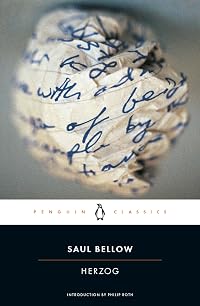
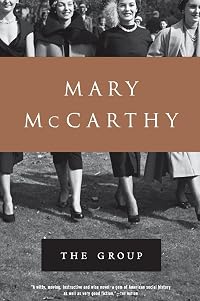


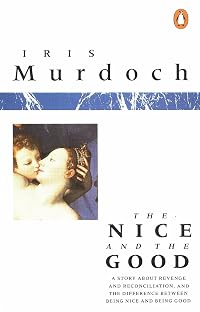
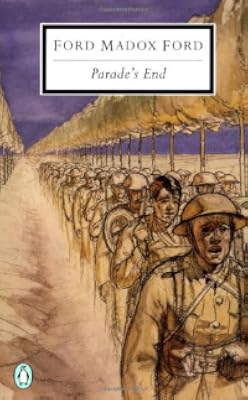


Member Recommendations
Member Reviews
Ah, such excruciating detail on the small-town elite of imagined Fort Allen, PA! O'Hara deserves credit for this detailed setting, and I was surprised for the matter-of-fact and fairly explicit sex scenes of an early 60s book. Was O'Hara ahead of his time? Did the work get banned here and there?
I thought from the movie Grace would be an unbridled nymphomaniac, more just someone that seemed damaged in a way and gave in to the expectation that she would "put out"... She seemed slightly tragic, her husband Sidney dying of a broken heart lamely so, and Richard Bannon like Greek tragedy.
I thought the ending with documentary-style where-are-they-now of the key dramatis personae was weak and the book overlong and slow.
I thought from the movie Grace would be an unbridled nymphomaniac, more just someone that seemed damaged in a way and gave in to the expectation that she would "put out"... She seemed slightly tragic, her husband Sidney dying of a broken heart lamely so, and Richard Bannon like Greek tragedy.
I thought the ending with documentary-style where-are-they-now of the key dramatis personae was weak and the book overlong and slow.
I read this a few months ago and the characters of Grace Caldwell and Sidney Tate remain vivid. Grace can come across as a sex maniac but she is not one-dimensional. Her husband Sidney seems to have everything in the world but he is actually a lonely man. The moment that Grace realised this when she saw him polishing his shoes forlornly, is to me a milestone scene, and one that is unforgettable.
John O’Hara’s opus of fictional writing, "A Rage to Live", is the story of a young woman with high social ranking in a small town of Pennsylvania in the early 1900s. The fictional town of Fort Penn is modeled after John O’Hara’s home town of Harrisburg, but he provides a special note on Page 1 of the 1949 First Edition that says all characters are purely fictional- “anyone who thinks they recognize themselves or anyone else they know personally in the novel is completely wrong.” Perhaps he makes a point of that distinction because his rich, young, debutante lady protagonist, Grace Caldwell, is a nymphomaniac. This creates havoc and fodder for gossip in the otherwise conservative, but somewhat hypocritical community. show more
Nymphomaniac? When is the last time you heard that term? When the book was first printed it was unimaginable that a normal woman could have the same sexual appetite as a man. Thus, she must be some kind of a maniac. Not that John O’Hara dubbed Grace with that nasty epithet. It was the literary critics that defined her as such. The irony is that all she really wants in life is to live a simple quiet unpretentious life in the country. But she has a tendency to like physical passion which attracts the bad boys- and unscrupulous men. Grace makes a few very damaging mistakes in her life which result in tragic consequences.
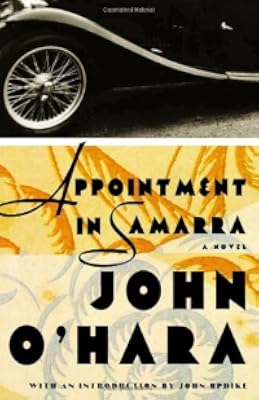
John O’Hara tells his narrative objectively from the various points of view of several different characters, including Grace’s husband, her best friend, and one of her lovers. And the beauty of the novel is in the story telling. "A Rage to Live" is not a quick read. There are lengthy descriptions of customs, rituals and social etiquette. And as stated in my review of O’Hara’s award-winning novel "Appointment to Samarra"- his expertise lies in his ability to create natural dialogue where his characters each carry their own distinct way of communicating; intonation, language, and expression. He takes the reader to the heart of Pennsylvania Dutch country and illustrates an authentic depiction of the way people of that era behaved, thought, talked, and lived their lives.
Regardless of the fact that "A Rage to Live" was a literary success and best seller worthy of converting to a Hollywood film, it now suffers mediocre reviews. Perhaps because the film version (typical of Hollywood) was banal and trashy, sensationalized sex, and turned the real-to-life characters into one dimensional caricatures. Or maybe today’s readers are jaded. At the time of publication, "A Rage to Live" was an original scathing tale of a “fallen woman”. However, by today’s standards, it may be just another outdated novel. show less
Nymphomaniac? When is the last time you heard that term? When the book was first printed it was unimaginable that a normal woman could have the same sexual appetite as a man. Thus, she must be some kind of a maniac. Not that John O’Hara dubbed Grace with that nasty epithet. It was the literary critics that defined her as such. The irony is that all she really wants in life is to live a simple quiet unpretentious life in the country. But she has a tendency to like physical passion which attracts the bad boys- and unscrupulous men. Grace makes a few very damaging mistakes in her life which result in tragic consequences.
John O’Hara tells his narrative objectively from the various points of view of several different characters, including Grace’s husband, her best friend, and one of her lovers. And the beauty of the novel is in the story telling. "A Rage to Live" is not a quick read. There are lengthy descriptions of customs, rituals and social etiquette. And as stated in my review of O’Hara’s award-winning novel "Appointment to Samarra"- his expertise lies in his ability to create natural dialogue where his characters each carry their own distinct way of communicating; intonation, language, and expression. He takes the reader to the heart of Pennsylvania Dutch country and illustrates an authentic depiction of the way people of that era behaved, thought, talked, and lived their lives.
Regardless of the fact that "A Rage to Live" was a literary success and best seller worthy of converting to a Hollywood film, it now suffers mediocre reviews. Perhaps because the film version (typical of Hollywood) was banal and trashy, sensationalized sex, and turned the real-to-life characters into one dimensional caricatures. Or maybe today’s readers are jaded. At the time of publication, "A Rage to Live" was an original scathing tale of a “fallen woman”. However, by today’s standards, it may be just another outdated novel. show less
wow.
there is an introduction in my edition here, which states that O’Hara was considered in the same circle as Faulkner and Hemingway and Fitzgerald during his time. I was immediately intrigued, as I’m a huge fan of Faulkner, and of course I’ve studied Hemingway and Fitzgerald, but I hadn’t so much as heard of O’Hara.
more’s the pity! what an excellent author! I should have known; the read was suggested by none other than John McWhorter , who also suggested The Murder of Helen Jewett . I loved that book as well. they’re not the same kind of book, by any means, but this linguist knows his literature!
thank you Professor McWhorter ;)
A Rage to Live is an epic, to say the least. 700 pages. but more than just length… it’s not show more just length that blabs on and on and on and tries to impress the reader with big words or endear its characters by means of archetypal dramas. no, this is 100% pure, real Americana. straight-forward, undiluted, real people, the way real people act, talk, and go about their lives justifying their actions and their behavior to themselves.
the setting is the turn of the century, 1900, Pennsylvania. I’ve never been to Pennsylvania, and pardon me but I’ve never thought much about it either. not that I think much about New York or Vermont or the West Indes. it just hadn’t come up. but O’Hara puts you there. and the vista from which you experience it is not just from the upper class, not just the middle class, not just the poor and the servants. you experience life from all levels, and it’s just like you’ve grown up there watching it unfold before your very eyes. from life on the farm to life in the city, perfectly natural. from the eyes of the craftsman to the eyes of the newspaperman to the eyes of the idle gentry. from the native’s perspective to the foreigner’s perspective. from the Irish view point to the Pennsylvanian Dutch view point to the Black American view point. from the child to the adult.
if there is a universal truth about Americans, it is that we are all so darn independent and we all have our own views, independent from each other (comparatively, considering other cultures in the world), and that there are so many different kinds of us. O’Hara captures this perfectly and conveys it in a straight-shooting manner that makes no character evil or pure (but sometimes both); in other words: real.
the Caldwells are a prominent, practically the founding, family in the fictional Pennsylvanian capital of Fort Penn. (O’Hara’s replacement for Harrisburg.) to sum up very very quickly, the story covers their daughter, Grace Caldwell, from early childhood to her later life, and documents the events leading to the inevitable fall of the Caldwell family; and also how at no point in time does Grace herself ever consider herself fallen or defeated, or even, one might interpret, responsible. O’Hara starts the narrative in media res, and then, when our attention has been seized by the collar, backs up and explains things (very deftly) while building up momentum towards the revelation of secrets we just almost guessed and, even though we see where it all must lead in the end, we read on in apt fascination.
highly recommended!
O’Hara was highly praised for his short stories especially; I’ll have to go read them all now :D
see further commentary here: http://miasbooklist.blogspot.com/2007/06/more-on-rage-to-live-by-john-ohara.html show less
there is an introduction in my edition here, which states that O’Hara was considered in the same circle as Faulkner and Hemingway and Fitzgerald during his time. I was immediately intrigued, as I’m a huge fan of Faulkner, and of course I’ve studied Hemingway and Fitzgerald, but I hadn’t so much as heard of O’Hara.
more’s the pity! what an excellent author! I should have known; the read was suggested by none other than John McWhorter , who also suggested The Murder of Helen Jewett . I loved that book as well. they’re not the same kind of book, by any means, but this linguist knows his literature!
thank you Professor McWhorter ;)
A Rage to Live is an epic, to say the least. 700 pages. but more than just length… it’s not show more just length that blabs on and on and on and tries to impress the reader with big words or endear its characters by means of archetypal dramas. no, this is 100% pure, real Americana. straight-forward, undiluted, real people, the way real people act, talk, and go about their lives justifying their actions and their behavior to themselves.
the setting is the turn of the century, 1900, Pennsylvania. I’ve never been to Pennsylvania, and pardon me but I’ve never thought much about it either. not that I think much about New York or Vermont or the West Indes. it just hadn’t come up. but O’Hara puts you there. and the vista from which you experience it is not just from the upper class, not just the middle class, not just the poor and the servants. you experience life from all levels, and it’s just like you’ve grown up there watching it unfold before your very eyes. from life on the farm to life in the city, perfectly natural. from the eyes of the craftsman to the eyes of the newspaperman to the eyes of the idle gentry. from the native’s perspective to the foreigner’s perspective. from the Irish view point to the Pennsylvanian Dutch view point to the Black American view point. from the child to the adult.
if there is a universal truth about Americans, it is that we are all so darn independent and we all have our own views, independent from each other (comparatively, considering other cultures in the world), and that there are so many different kinds of us. O’Hara captures this perfectly and conveys it in a straight-shooting manner that makes no character evil or pure (but sometimes both); in other words: real.
the Caldwells are a prominent, practically the founding, family in the fictional Pennsylvanian capital of Fort Penn. (O’Hara’s replacement for Harrisburg.) to sum up very very quickly, the story covers their daughter, Grace Caldwell, from early childhood to her later life, and documents the events leading to the inevitable fall of the Caldwell family; and also how at no point in time does Grace herself ever consider herself fallen or defeated, or even, one might interpret, responsible. O’Hara starts the narrative in media res, and then, when our attention has been seized by the collar, backs up and explains things (very deftly) while building up momentum towards the revelation of secrets we just almost guessed and, even though we see where it all must lead in the end, we read on in apt fascination.
highly recommended!
O’Hara was highly praised for his short stories especially; I’ll have to go read them all now :D
see further commentary here: http://miasbooklist.blogspot.com/2007/06/more-on-rage-to-live-by-john-ohara.html show less
Interesting saga taking place in the WWI era in Harrisburg, PA (Fort Penn in the novel) near where i grew up as a kid. I enjoyed very much the daily life and social structure routine detail that one typically finds in O'Hara's books. Plenty of Pennsylvania Dutch references and names that i am very familiar with, but never encounter in my new home in Maine. And there was plenty of politics tucked away here as well, and the perspective is very interesting....i mean all the talk of the corruption and unfairness in today's political world pales in comparison to the truly corrupt backroom chicanery that went on in those days of smoke-filled backroom deals, and at a time when women still could not even vote. Believe me, things have changed a show more lot, and seemingly for the better, a fact quite often lost on too many.
The tale was kept interesting for me as it followed the trials and tribulations of the well-to-do Caldwell/Tate family, since it was full of completely unexpected twists and turns that i always seemed unprepared for. That in itself was a good thing, but it also sometimes left me wondering where are we going with this.....but then again, is not that also very true of our own lives? I'm an old car guy and there was lots of very specific descriptive, and accurate, i might add, references to wonderful old cars of the era, and that will always win you points in my book! I have usually enjoyed the O'Hara i have read thus far, and this was no exception. I have almost everything he wrote, so i look forward to the next one i pull from the shelf, whenever that will be. show less
The tale was kept interesting for me as it followed the trials and tribulations of the well-to-do Caldwell/Tate family, since it was full of completely unexpected twists and turns that i always seemed unprepared for. That in itself was a good thing, but it also sometimes left me wondering where are we going with this.....but then again, is not that also very true of our own lives? I'm an old car guy and there was lots of very specific descriptive, and accurate, i might add, references to wonderful old cars of the era, and that will always win you points in my book! I have usually enjoyed the O'Hara i have read thus far, and this was no exception. I have almost everything he wrote, so i look forward to the next one i pull from the shelf, whenever that will be. show less
Perhaps in 1949 this would have ground-breaking fiction, but in 2016 it's ground that has been gone over and has gone stale. Worth reading just to on a time travel trip to early twentieth-century Pennsylvania and experience the lives of these people but no earth shattering look into the human psyche. Maybe there is a reason why Mr. O' Hara has faded from the canvas of American writers. He's good but not great and certainly not timeless.
An interesting look at the evolution of females in society, and the prejudices which exist in smaller areas of America. I wasn't sure of this one in the beginning but it turned out to be quite good.
Members
- Recently Added By
Lists

Publisher's Weekly Bestsellers - Part II - 1940 - 1979
355 works; 6 members
Author Information

132+ Works 6,769 Members
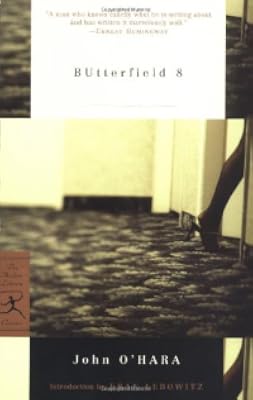
John Henry O'Hara was born in Pottsville, Pennsylvania on January 31, 1905. Many of his novels and short stories were set in fictionally named Pennsylvania towns with the main themes centering on class conflict and status. He began writing for the New Yorker in 1928; and during his life, sold 225 stories to the magazine. His first collection, The show more Doctor's Son and Other Stories (1935) was followed by twelve more. Pal Joey (1940) was made into a Broadway musical by Richard Rodgers and Lorenz Hart and later was adapted into a film starring Frank Sinatra and Rita Hayworth. Some of his published novels include Appointment in Samarra (1934), A Rage to Live (1949), The Lockwood Concern (1965), and The Good Samaritan and Other Stories (published posthumously in 1974). Ten North Frederick (1955) won the National Book Award and Butterfield 8 (1935) and From the Terrace (1958) were adapted into movies in 1960. He died from cardiovascular disease on April 11, 1970. (Bowker Author Biography) show less
Some Editions
Awards and Honors
Distinctions
Series
Belongs to Publisher Series
Common Knowledge
- Canonical title
- A Rage to Live
- Original title
- A rage to live
- Original publication date
- 1949
- People/Characters
- Roger Bannon; Brock Caldwell; Grace Caldwell; Charlie Jay; Sidney Tate
- Important places
- New Penn, Pennsylvania
- Epigraph
- On his tombstone in New Jersey in the Princeton Cemetery: Better than anyone else, he told the truth about his time, the first half of the twentieth century. He was a professional. He wrote honestly and well.
- First words*
- Am Mittwoch, dem vierten Juli 1817, regnete es morgens, und das Festkomitee trat zusammen, um darüber zu beraten, ob man das Fest nicht lieber auf den Sonnabend verschieben sollte, auch wenn der vierte Juli in diesem Jahr au... (show all)f einen Mittwoch fiel.
- Last words*
- (Click to show. Warning: May contain spoilers.)Gute Nacht, Grace.
*Some information comes from Common Knowledge in other languages. Click "Edit" for more information.
Classifications
- Genres
- General Fiction, Fiction and Literature, Historical Fiction
- DDC/MDS
- 813.52 — Literature & rhetoric American literature in English American fiction in English 1900-1999 1900-1945
- LCC
- PZ3 .O3677 — Language and Literature Fiction and juvenile belles lettres Fiction and juvenile belles lettres Fiction in English
- BISAC
Statistics
- Members
- 249
- Popularity
- 130,746
- Reviews
- 8
- Rating
- (3.77)
- Languages
- English, German, Italian, Spanish
- Media
- Paper
- ISBNs
- 10
- ASINs
- 15