On This Page
Description
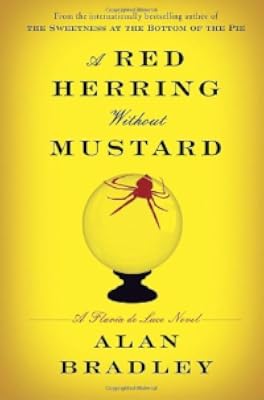
Flavia's discovery of an old Gypsy woman who's been attacked in her wagon sends the girl off on an investigation that will reveal more of Buckshaw's secrets as well as new information about Harriet, the mother Flavia never knew.Tags
Recommendations










Member Recommendations
Member Reviews
"A Red Herring Without Mustard" is a third strong offering in the Flavia De Luce series.
Like it's predecessors, "The Sweetness At The Bottom Of The Pie" and "The Weed That Strings The Hangman's Bag" it follows eleven-year-old Flavia de Luce as she uses chemistry, her insatiable curiosity and her almost sociopathic determination to solve the crimes associated with the dead bodies that turn up with frightening regularity at her Father's country house before the police can.
In this case, Flavia is one a hunt that includes a gipsy fortune-teller, an unscrupulous remittance man, the remnants of a local Dissenter sect and some truly eccentric water features.
The plots are twisty enough to be satisfying and honest enough not to be annoying but show more the true power of the book continues to come from seeing the world through the eyes of the inimitable and irrepressible Flavia De Luce.
Flavia has always been a recklessly brave, brilliantly but disturbingly analytical loner with a grief-stricken father, abusive older sisters, and hole in her life where her mother should be. Her only positive relationships seem to be with Dogger, the war-damaged family retainer, Gladys, her bicycle on whom she projects a personality and the local Police Inspector with whom she enters into a mutually respectful rivalry.
What I like most about this book was that I saw Flavia grow. She and her father reach a deeply-felt but barely expressed mutual respect. She learns more about her mother and starts to feel some of her mother's spirit in herself. Her relationship with her sisters remains twisted and sometimes hateful but Flavia is aware of the mutual love beneath the sandpaper surface. Flavia also makes a friend, albeit a rather enigmatic, sometimes violent and often absent friend who is socially completely inappropriate but that is perhaps how it should be.
I find myself caring more for Flavia with each book. We see her whole world through her eyes and sometimes what we see touches home. I understand exactly the feeling Flavia refers to when she says:
"ALONE AT LAST!
Whenever I’m with other people, part of me shrinks a little. Only when I am alone can I fully enjoy my own company."
The way she and Dogger deal with each other shows a great deal of compassion and affection. It tells us a lot about Flavia's character and her experience of intimacy that she likes sitting with Dogger because he supports her without demanding more information from her than she is willing to give. She says,
"The very best people are like that. They don’t entangle you like flypaper."
Flavia's new friend, Porcelain gives Flavia someone to talk to and a chance to understand how she is seen by others. I liked Porcelain's comments on familial love. She says,
“Love’s not some big river that flows on and on forever, and if you believe it is, you’re a bloody fool. It can be dammed up until nothing’s left but a trickle …”
I would read the books just to spend time with Flavia Alan Bradley delivers more than a fan-fest. His plots are strong. All of his characters feel real and form a richly detailed ensemble cast. His sense of period and of Englishness never seems to stumble, which is all the more impressive given that he is a contemporary Canadian writing about 1950s English rural gentry.
I've already ordered the next book in the series. show less
Like it's predecessors, "The Sweetness At The Bottom Of The Pie" and "The Weed That Strings The Hangman's Bag" it follows eleven-year-old Flavia de Luce as she uses chemistry, her insatiable curiosity and her almost sociopathic determination to solve the crimes associated with the dead bodies that turn up with frightening regularity at her Father's country house before the police can.
In this case, Flavia is one a hunt that includes a gipsy fortune-teller, an unscrupulous remittance man, the remnants of a local Dissenter sect and some truly eccentric water features.
The plots are twisty enough to be satisfying and honest enough not to be annoying but show more the true power of the book continues to come from seeing the world through the eyes of the inimitable and irrepressible Flavia De Luce.
Flavia has always been a recklessly brave, brilliantly but disturbingly analytical loner with a grief-stricken father, abusive older sisters, and hole in her life where her mother should be. Her only positive relationships seem to be with Dogger, the war-damaged family retainer, Gladys, her bicycle on whom she projects a personality and the local Police Inspector with whom she enters into a mutually respectful rivalry.
What I like most about this book was that I saw Flavia grow. She and her father reach a deeply-felt but barely expressed mutual respect. She learns more about her mother and starts to feel some of her mother's spirit in herself. Her relationship with her sisters remains twisted and sometimes hateful but Flavia is aware of the mutual love beneath the sandpaper surface. Flavia also makes a friend, albeit a rather enigmatic, sometimes violent and often absent friend who is socially completely inappropriate but that is perhaps how it should be.
I find myself caring more for Flavia with each book. We see her whole world through her eyes and sometimes what we see touches home. I understand exactly the feeling Flavia refers to when she says:
"ALONE AT LAST!
Whenever I’m with other people, part of me shrinks a little. Only when I am alone can I fully enjoy my own company."
The way she and Dogger deal with each other shows a great deal of compassion and affection. It tells us a lot about Flavia's character and her experience of intimacy that she likes sitting with Dogger because he supports her without demanding more information from her than she is willing to give. She says,
"The very best people are like that. They don’t entangle you like flypaper."
Flavia's new friend, Porcelain gives Flavia someone to talk to and a chance to understand how she is seen by others. I liked Porcelain's comments on familial love. She says,
“Love’s not some big river that flows on and on forever, and if you believe it is, you’re a bloody fool. It can be dammed up until nothing’s left but a trickle …”
I would read the books just to spend time with Flavia Alan Bradley delivers more than a fan-fest. His plots are strong. All of his characters feel real and form a richly detailed ensemble cast. His sense of period and of Englishness never seems to stumble, which is all the more impressive given that he is a contemporary Canadian writing about 1950s English rural gentry.
I've already ordered the next book in the series. show less
“I had already learned that sisterhood, like Loch Ness, has things that lurk unseen beneath the surface, but I think it was only now that I realized of all the invisible strings that tied the three of us together, the dark ones were the strongest.“
Have you met sleuth Flavia de Luce? She is cunning, witty, sharp as a whip and a bit of a mad scientist. She lives in the crumbling old estate Buckshaw with her father and two sisters where she concocts experiments in an old laboratory. Her two evil sisters are to be found often reading, playing instruments or torturing Flavia. They might tie her up in the cellar, but she’ll get back at them in her own manner. Once she had her revenge by distilling the essence of poison out of a plant, show more mixing it with a melted lipstick and then molding the lipstick back into its original shape for her sister to use. Yea, shes that brilliant. Did I mention she is 11-years-old?
I have often heard people call Flavia “unrealistic” and complain about her being so darn smart (jealousy I tell you!) But really, did you complain when Peter, Edmund, Lucy and Susan walked through the wardrobe into Narnia? NO! You just sat there wishing that a lamppost would appear in YOUR forest. So stop complaining. Books don’t need to be realistic, its why we love them.
Anyway, back to the Herring without Mustard. The third in the Flavia de Luce novels is yet another murder mystery. It starts when Flavia has her fortune told by a gypsy and accidentally sets her tent on fire. She is only 11 after all, accidents happen. In her remorse and I suspect, for a bit of fun, she invites the gypsy to come rest on the Buckshaw estate for the evening. Later that night in a fit of wakefulness Flavia travels out to the Gypsy’s caravan and finds her bleeding to death. Thankfully, the gypsy lives but the mystery continues.
Don’t be disappointed, I did say murder mystery. Not all the characters in this story are as lucky as the gypsy. A local vagabond dies shortly thereafter and Flavia is once again pedaling Gladys, her trusty bicycle, around the countryside in search of clues.
This book will not shake your soul or change your life but it will make you laugh, chuckle and turn the pages to see what scrapes she gets into next. I always enjoy my time with Flavia, I think you would too.
(Recommendation: If you haven’t read Flavia’s exploits before, start with The Sweetness at the Bottom of the Pie and then The Weed that Strings the Hangman’s Bag. ) show less
Have you met sleuth Flavia de Luce? She is cunning, witty, sharp as a whip and a bit of a mad scientist. She lives in the crumbling old estate Buckshaw with her father and two sisters where she concocts experiments in an old laboratory. Her two evil sisters are to be found often reading, playing instruments or torturing Flavia. They might tie her up in the cellar, but she’ll get back at them in her own manner. Once she had her revenge by distilling the essence of poison out of a plant, show more mixing it with a melted lipstick and then molding the lipstick back into its original shape for her sister to use. Yea, shes that brilliant. Did I mention she is 11-years-old?
I have often heard people call Flavia “unrealistic” and complain about her being so darn smart (jealousy I tell you!) But really, did you complain when Peter, Edmund, Lucy and Susan walked through the wardrobe into Narnia? NO! You just sat there wishing that a lamppost would appear in YOUR forest. So stop complaining. Books don’t need to be realistic, its why we love them.
Anyway, back to the Herring without Mustard. The third in the Flavia de Luce novels is yet another murder mystery. It starts when Flavia has her fortune told by a gypsy and accidentally sets her tent on fire. She is only 11 after all, accidents happen. In her remorse and I suspect, for a bit of fun, she invites the gypsy to come rest on the Buckshaw estate for the evening. Later that night in a fit of wakefulness Flavia travels out to the Gypsy’s caravan and finds her bleeding to death. Thankfully, the gypsy lives but the mystery continues.
Don’t be disappointed, I did say murder mystery. Not all the characters in this story are as lucky as the gypsy. A local vagabond dies shortly thereafter and Flavia is once again pedaling Gladys, her trusty bicycle, around the countryside in search of clues.
This book will not shake your soul or change your life but it will make you laugh, chuckle and turn the pages to see what scrapes she gets into next. I always enjoy my time with Flavia, I think you would too.
(Recommendation: If you haven’t read Flavia’s exploits before, start with The Sweetness at the Bottom of the Pie and then The Weed that Strings the Hangman’s Bag. ) show less
In this third book of the series, Flavia gets her fortune told by a gypsy at the village fete and promptly sets the old woman's tent on fire. Trying to make it up to her, Flavia invites the gypsy to set up her caravan on the grounds of Buckshaw, Flavia's ancestral home. When Flavia goes back to check on her, she finds that the woman has been beaten nearly to death, and so Flavia, the eleven year-old genius, is once again at the center of a crime, which embarrasses her family and aggravates Inspector Hewitt.
Spending time with Flavia is so fun, whether she's asking nosy questions, experimenting in her laboratory or getting even with her older sisters.
Spending time with Flavia is so fun, whether she's asking nosy questions, experimenting in her laboratory or getting even with her older sisters.
A Red Herring Without Mustard is Alan Bradley's third Flavia de Luce mystery, following The Sweetness at the Bottom of the Pie and The Weed that Strings the Hangman's Bag. In her latest outing, young Flavia meets a Gypsy at her village's fete, a meeting that leads to attempted murder, murder and the revealing of a past crime. Flavia is in the thick of it, of course, and as a budding-genius chemist, she uses her scientific knowledge and understanding of the scientific method to develop and test her hypotheses concerning the culprits involved in these mysteries. She does that even while fending off the depradations of older sisters Feely and Daffy, and while making the acquaintance of another young lady, Porcelain, who is related to the show more Gypsy woman and who appears and disappears mysteriously, at will. Can Flavia discover the truth before Inspector Hewitt does? Or will she find her unknown foes more than she can handle? Once again, it is a delight to read 11-year-old Flavia's story - she is an utterly charming narrator, without being in the least bit sentimental or cloying. The depiction of small town England in the early 1950s is well done, as are the class distinctions so prevalent in that time and place. An absolute joy to read - and you don't have to have read the earlier books to get into this one (though of course it's always helpful to have more information!). I can't wait for Flavia to come my way again. Highly recommended! show less
This, the third volume in the Flavia de Luce mystery series, might be the best yet as far as the mystery part is concerned. With a tangle of deaths, a multiplicity of suspects, a myriad of secret doors, a couple of gypsies, and a fair amount of tea and biscuits, it certainly kept one jumping. The character aspects were also a bit deeper this round, though I found that the particular developments made me a little sad. In this book, rather than giggling madly at Flavia's antics and asides all the time, we start to see a little more of the damage she has suffered from the family dynamics and tragedy (both recent and past) to which she has been exposed. In many ways, this is a shade more serious than I remember the previous installments show more being, but for me that makes the narrative richer. Flavia is still quite herself, cheekily pursuing her own criminal and chemical investigations with attitude. I adore these books and started reading the next as soon as I finished this one, so that should tell you something. show less
Flavia de Luce, precocious eleven year old chemistry whiz and amateur sleuth, has gotten involved in yet another crime. Flavia decides to get her fortune told at the village fair and ends up burning down the tent of the gypsy fortune teller. It was just an accident but Flavia wants to make it up to her by taking her to Buckshaw (the family's crumbling estate) and letting her park her caravan while she recovers from the effects of smoke inhalation. When Flavia goes back to check on her she finds Fennella bludgeoned almost to death. It's not long before Brookie Harewood is found hanging from the Poseidon fountain soon after Flavia finds him skulking in the drawing room. Flavia begins to pursue her own investigation and soon uncovers show more rumors of an ancient religious group, tales of a kidnapped baby, and valuable antiques disappearing and then reappearing.
Flavia is precocious, witty, sneaky and impish but there's an underlying sadness and loneliness around her. She makes me laugh and I feel sad at the same time. Flavia takes her trusty bike, Gladys, and uses charming subterfuge to give her an advantage over the local police detective, Inspector Hewitt. “How I adore that man”, says Flavia with relish.
The charm of the series is really the delightful Flavia and her interaction with her distant father and torturous older sisters, the crumbling mansion they live in, and the charming English village of Bishop's Lacey in the 1950s.
The audio is narrated by Jayne Entwhistle who does a fabulous job of bringing the characters to life. You can hear the glee in her voice as she captures Flavia perfectly. Appealing characters and an intriguing mystery make this a delightful series. show less
Flavia is precocious, witty, sneaky and impish but there's an underlying sadness and loneliness around her. She makes me laugh and I feel sad at the same time. Flavia takes her trusty bike, Gladys, and uses charming subterfuge to give her an advantage over the local police detective, Inspector Hewitt. “How I adore that man”, says Flavia with relish.
The charm of the series is really the delightful Flavia and her interaction with her distant father and torturous older sisters, the crumbling mansion they live in, and the charming English village of Bishop's Lacey in the 1950s.
The audio is narrated by Jayne Entwhistle who does a fabulous job of bringing the characters to life. You can hear the glee in her voice as she captures Flavia perfectly. Appealing characters and an intriguing mystery make this a delightful series. show less
I love Flavia de Luce and I really love her chemistry lab. I had to make do with a little kit from the Sears catalogue down in the basement when I was Flavia's age. (I wonder what happened to it?) Despite her interest in chemistry it is really her deductive reasoning abilities (which, of course, come in handy for a chemist) that allows her to solve this mystery.
At the beginning of the book Flavia is at the church fete and goes to have her fortune read. The gypsy surprises her with one of her pronouncements and Flavia knocks over the candle on the table causing the whole tent to go up in flames. The gypsy isn't seriously hurt but Flavia does feel badly so she offers her a spot on the Buckshaw grounds where the gypsies camped while her show more mother was alive. Later that night Flavia goes back to the gypsy's caravan and finds her with her head smashed in. The gypsy isn't yet dead so Flavia hops on her horse and rides for the doctor, thus saving the gypsy's life. Her granddaughter, who shows up the next day, is very grateful and Flavia offers to put her up at the Buckshaw house. On their way they come across a gruesome discovery, local poacher and probable thief, Brookie Haywood has been impaled on the trident of a statue of Poseidon. Are the two crimes connected? Do they have anything to do with a baby that disappeared years ago? Is there an active group of Hobblers, a dissenting religious group, in Bishop's Lacey and does that have anything to do with the crimes? And why does a fishy smell seem to linger everywhere? What is a red herring and what is a real clue? Only Flavia can help sort everything out. show less
At the beginning of the book Flavia is at the church fete and goes to have her fortune read. The gypsy surprises her with one of her pronouncements and Flavia knocks over the candle on the table causing the whole tent to go up in flames. The gypsy isn't seriously hurt but Flavia does feel badly so she offers her a spot on the Buckshaw grounds where the gypsies camped while her show more mother was alive. Later that night Flavia goes back to the gypsy's caravan and finds her with her head smashed in. The gypsy isn't yet dead so Flavia hops on her horse and rides for the doctor, thus saving the gypsy's life. Her granddaughter, who shows up the next day, is very grateful and Flavia offers to put her up at the Buckshaw house. On their way they come across a gruesome discovery, local poacher and probable thief, Brookie Haywood has been impaled on the trident of a statue of Poseidon. Are the two crimes connected? Do they have anything to do with a baby that disappeared years ago? Is there an active group of Hobblers, a dissenting religious group, in Bishop's Lacey and does that have anything to do with the crimes? And why does a fishy smell seem to linger everywhere? What is a red herring and what is a real clue? Only Flavia can help sort everything out. show less
Members
- Recently Added By
Lists

Crime and Mysteries to Read
746 works; 31 members

Female Protagonist
1,056 works; 57 members

Teresa's favorite mystery series and authors
55 works; 2 members

Favourite Books
1,820 works; 308 members

Books Read in 2012 (Numbered)
168 works; 6 members

#JustTheFacts2023Silver
60 works; 1 member

#MysteryBingo2024Silver(Revised)
31 works; 1 member
#MysteryBingo2024Silver(Original)
32 works; 1 member

Books Read in 2023
5,638 works; 147 members

Books Read in 2018
4,360 works; 110 members

Best books read in 2011
200 works; 51 members

Books Read in 2015
3,299 works; 129 members

A Rainbow of Books: Colors in the Title
570 works; 24 members

Books Read in 2014
2,344 works; 89 members

Books whose title names an object usually found in the kitchen
171 works; 14 members

Books Read in 2013
1,630 works; 51 members

Books Read in 2011
684 works; 19 members

Books Read in 2024
4,727 works; 128 members
Author Information

21 Works 27,953 Members
Some Editions
Awards and Honors
Series

Work Relationships
Common Knowledge
- Canonical title
- A Red Herring Without Mustard
- Original title
- A Red Herring Without Mustard
- Original publication date
- 2011-02-08
- People/Characters
- Flavia de Luce; Ophelia de Luce; Daphne de Luce; Haviland de Luce; Arthur Wellesley Dogger; Mrs. Mullet (show all 24); Ned Cropper; Dr. Darby; Inspector Hewitt; Denwyn Richardson; Fenella Faa; Porcelain Lee; Brookie Harewood; Colin Prout; Dieter Schrantz; Tilda Mountjoy; Vanetta Harewood; Reginald Pettibone; Edward Sampson; Dr. Kissing; Timofey Bull; Margaret Bull; Tom Bull; Gry
- Important places
- Bishop's Lacey, England, UK; Buckshaw, Bishop's Lacey, England, UK
- Epigraph
- ...a cup of ale without a wench, why, alas, 'tis like an egg without salt or a red herring without mustard.
- A Looking Glasse, for London and Englande, by Thomas Lodge and Robert Greene (1592) - Dedication
- For John and Janet Harland
- First words
- "You frighten me," the Gypsy said.
- Quotations
- It was Ophelia, the older of my two sisters. Feely was seventeen, and ranked herself right up there with the Blessed Virgin Mary, although the chief difference between them, I'm willing to bet, is that the BVM doesn't spend t... (show all)wenty-three hours a day peering at herself in a looking glass while picking away at her face with a pair of tweezers.
- Last words
- (Click to show. Warning: May contain spoilers.)Father knows it's there and I know it's there, and for now, that's all that counts.
- Original language
- English
Classifications
- Genres
- Fiction and Literature, Mystery, Historical Fiction, Teen, Young Adult
- DDC/MDS
- 813.6 — Literature & rhetoric American literature in English American fiction in English 2000-
- LCC
- PR9199.4 .B7324 .R43 — Language and Literature English English Literature English literature: Provincial, local, etc.
- BISAC
Statistics
- Members
- 2,877
- Popularity
- 6,310
- Reviews
- 193
- Rating
- (3.95)
- Languages
- 11 — Czech, Dutch, English, Finnish, French, German, Hungarian, Italian, Polish, Portuguese, Spanish
- Media
- Paper, Audiobook, Ebook
- ISBNs
- 42
- ASINs
- 17