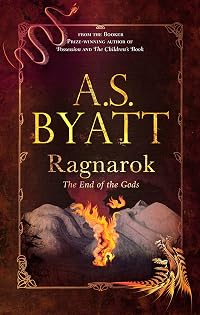
On This Page
Description
As the bombs of the Blitz rain down on Britain, one young girl is evacuated to the countryside. She is struggling to make sense of her new wartime life. Then she is given a copy of Asgard and the Gods -- a book of ancient Norse myths -- and her inner and outer worlds are transformed.Tags
Recommendations






Member Recommendations

Member Reviews
Byatt, through the eyes of a christianity-raised child encountering Norse myths for the first time, writes a wonderfully evocative tale of enchantment and fascination with a grim and imaginative mythological cycle that she finds more exciting than stories about a milksop Jesus.
With a superb sense of poetic diction Byatt paints the inside of your skull with vicarious allure. Recommended.
With a superb sense of poetic diction Byatt paints the inside of your skull with vicarious allure. Recommended.
It's no big surprise that, when asked to retell a myth, Byatt chose the Norse story of the great, destructive battle that marks the end of the gods, Ragnarök. From Possession onwards, she's often mentioned her early fascination with the Norse myths, sparked off by a book she was given as a child.
In this book, she looks at the myth through the eyes of this earlier version of herself, "the thin child," growing up in rural Yorkshire during the war, and using her reading of the myths to deal with her rational and irrational fears about the war going on around her and the long absence of her father on active service. She adds further value to the myth itself through grown-up critical insights into the thinking of the 19th century German show more scholars who compiled her edition of Asgard and the gods, through occasional sardonic bits of characterisation, and — inevitably — the insertion of a huge amount of zoological and botanical detail. And of course she doesn't want anything to do with any silly medieval idea of Ragnarök as the end of the pagan age and the prelude to a Christian rebirth: this Ragnarök is a very 21st century one, with the Midgard Serpent turning into a colossal metaphor for human destruction of the planet. show less
In this book, she looks at the myth through the eyes of this earlier version of herself, "the thin child," growing up in rural Yorkshire during the war, and using her reading of the myths to deal with her rational and irrational fears about the war going on around her and the long absence of her father on active service. She adds further value to the myth itself through grown-up critical insights into the thinking of the 19th century German show more scholars who compiled her edition of Asgard and the gods, through occasional sardonic bits of characterisation, and — inevitably — the insertion of a huge amount of zoological and botanical detail. And of course she doesn't want anything to do with any silly medieval idea of Ragnarök as the end of the pagan age and the prelude to a Christian rebirth: this Ragnarök is a very 21st century one, with the Midgard Serpent turning into a colossal metaphor for human destruction of the planet. show less
For the first 58 pages of this book, I had a difficult time staying awake. It was the lists that got me. And the comma splices, which made even independent clauses seem list-y.
As other reviewers have mentioned, especially during those "creation-of-the-world" sections early on, the lists could easily run the length of a page. And if you're not familiar with a comma splice, it's the term that was written multiple times in red on nearly every undergraduate English paper I turned in. I got my B.A. in English; comma splices were the bane of my existence. I can recognize them now and they haunt me in other people's writing, a legacy passed to me by my professors.
In Byatt's Ragnarok, the shift came when the giant snake Jormundgandr arrived on show more the scene. The lists seemed to be shorter and come less frequently. The comma splices continued but commas were occasionally exchanged for semi-colons or, oddly, colons, which offered some variety. But mostly, the descriptions of Jormundgandr really caught my imagination. Finally, I could see what the thin child saw in the old Norse myths. I no longer struggled to stay awake.
Ragnarok the myth is both vivid and bleak. It's not a story of hope. It's a story of beings acting out a chain of events that has always been on the page. Even when one makes an effort to change fate, it's clear that it is just that: fate. It ends in The End. It cannot be changed.
There's the bleak.
The vivid is in the descriptions of the gods and monsters, both their appearance and their emotions: these are big creatures both physically and emotionally. Of Jormungandr, Byatt writes:
It's description like this that I read and say, "Ah! There's the language people rave about when they talk about Byatt's work!" I have a clear image of what Jormungandr looks like (even if I can't pronounce her name), and thanks to the lush descriptions, I have the same for most of the other gods and monsters. The only tale with which I was familiar was the one about Baldur's death, and even that Byatt told in such a way that I saw the scene and the intricacies of the characters more clearly than I had reading other versions of the story.
Byatt tells the myths alongside the story of "the thin child," a character who represents Byatt's own wartime childhood in the English countryside. The thin child is drawn to the old Norse stories in large part because they echo her life both in the vividness and the bleakness. The thin child is in the middle of this time of both great freedom (from her asthma which is better out of the pollution of London, from the social roles of peacetime, the "dailiness," as she calls it) and great fear (of the possibility that her father won't return, of the "enemy" whose bombs rumble even this far outside the city). She deals with this by expecting that her father, off fighting the war, will not return. She accepts this, as the gods in the myth accept that the end of the world is inevitable. I think she finds a kinship and a comfort in this hopelessness.
And then the myth ends and the war ends and, it seems to me, the thin child is left to herself. Perhaps it's her age and would have happened anyway, but Byatt links this feeling of malaise and confusion with the end of the war and her family's return to their London home, and Ragnarok and the end of the world and the end of the myth. The world didn't end, and that seems to inspire a feeling akin to disappointment in the thin child.
The "black thing" to which Byatt refers here is the image at the end of the myth and the end of everything, but the "black thing" is also the fear and the feeling of inevitability that her father will not return. She carries the black of both with her even past her need for them, and every future experience is shadowed by it.
So, as you can see, while I felt the book had a slow start, I stayed awake long enough and it caught me eventually. I'm not going to go all gaga over A.S. Byatt, but I can certainly see what all the fuss is about. show less
As other reviewers have mentioned, especially during those "creation-of-the-world" sections early on, the lists could easily run the length of a page. And if you're not familiar with a comma splice, it's the term that was written multiple times in red on nearly every undergraduate English paper I turned in. I got my B.A. in English; comma splices were the bane of my existence. I can recognize them now and they haunt me in other people's writing, a legacy passed to me by my professors.
In Byatt's Ragnarok, the shift came when the giant snake Jormundgandr arrived on show more the scene. The lists seemed to be shorter and come less frequently. The comma splices continued but commas were occasionally exchanged for semi-colons or, oddly, colons, which offered some variety. But mostly, the descriptions of Jormundgandr really caught my imagination. Finally, I could see what the thin child saw in the old Norse myths. I no longer struggled to stay awake.
Ragnarok the myth is both vivid and bleak. It's not a story of hope. It's a story of beings acting out a chain of events that has always been on the page. Even when one makes an effort to change fate, it's clear that it is just that: fate. It ends in The End. It cannot be changed.
There's the bleak.
The vivid is in the descriptions of the gods and monsters, both their appearance and their emotions: these are big creatures both physically and emotionally. Of Jormungandr, Byatt writes:
"The flung snake fell through the firmament in shifting shapes. With her spine locked she was a javelin, swift and smooth, her mane of flesh-fronds streaming back from her sharp skull, her fangs glinting...She was a sensuous beast: the rush of air pleased her: she snuffed up the scent of pine forests, heathland, hot desert, the salt of the sea."
It's description like this that I read and say, "Ah! There's the language people rave about when they talk about Byatt's work!" I have a clear image of what Jormungandr looks like (even if I can't pronounce her name), and thanks to the lush descriptions, I have the same for most of the other gods and monsters. The only tale with which I was familiar was the one about Baldur's death, and even that Byatt told in such a way that I saw the scene and the intricacies of the characters more clearly than I had reading other versions of the story.
Byatt tells the myths alongside the story of "the thin child," a character who represents Byatt's own wartime childhood in the English countryside. The thin child is drawn to the old Norse stories in large part because they echo her life both in the vividness and the bleakness. The thin child is in the middle of this time of both great freedom (from her asthma which is better out of the pollution of London, from the social roles of peacetime, the "dailiness," as she calls it) and great fear (of the possibility that her father won't return, of the "enemy" whose bombs rumble even this far outside the city). She deals with this by expecting that her father, off fighting the war, will not return. She accepts this, as the gods in the myth accept that the end of the world is inevitable. I think she finds a kinship and a comfort in this hopelessness.
"Imagining the end of things, when you are a child, is perhaps impossible. The thin child, despite the was that was raging, was more afraid of eternal boredom, of doing nothing that really mattered, of day after day going nowhere, than she was of death or the end of things."
And then the myth ends and the war ends and, it seems to me, the thin child is left to herself. Perhaps it's her age and would have happened anyway, but Byatt links this feeling of malaise and confusion with the end of the war and her family's return to their London home, and Ragnarok and the end of the world and the end of the myth. The world didn't end, and that seems to inspire a feeling akin to disappointment in the thin child.
"This is how myths work. They are things, creatures, stories, inhabiting the mind. They cannot be explained and do not explain; they are neither creeds nor allegories. The black thing was now in the thin child's head and was part of the way she took in every new thing she encountered."
The "black thing" to which Byatt refers here is the image at the end of the myth and the end of everything, but the "black thing" is also the fear and the feeling of inevitability that her father will not return. She carries the black of both with her even past her need for them, and every future experience is shadowed by it.
So, as you can see, while I felt the book had a slow start, I stayed awake long enough and it caught me eventually. I'm not going to go all gaga over A.S. Byatt, but I can certainly see what all the fuss is about. show less
This is a remarkably good book, that I somehow failed to enjoy as much as I wanted or expected, but I think the failing is mine, rather than Byatt's, and reading my notes below, I'm puzzled that I liked and admired, rather than loved it (all-too familiar in my relationship with Byatt).
"The thin child in wartime"
The child is a semi-autobiographical version of Byatt herself. She is given a book of Norse legends, that she treasures. Those stories are retold through her eyes and thoughts, interspersed with snippets about her own life, told in a similar epic, mythical, Silmarillionish style, weaving occasional lines of liturgy and hymns into the prose (as myths weave into each other and ourselves). It dips in and out of myth, but the show more narrative pull is weak.
The parallels between the thin child's life and what she reads are clear (Ragnarok is the end of the world, and WW2 seemed as if it would be too), but mostly subtle.
Layers of myth and fictionalised biography
Image: Ragnarök by Collingwood. (Source)
She is a thoughtful child, with a vivid imagination and an analytical questioning mind, comparing the gods of legend with the Christian one she learns about at school and church.
"In the story told in the stone church a grandfatherly figure who resented presumption had spent six delectable days making things."
She notices that characters come in threes, that there are two ways to win battles ("to be surprisingly strong, or to be a gallant forlorn hope"), and rules in stories exist to be broken. She treats all myths, including Christianity, like fairy stories:
"These offered the pleasure to the mind that the unreal offers when it is briefly more real than the visible world can ever be."
The only thing alive in the church is the English language.
She has fun with the gods' quirks, especially Loki's mischievousness:
"Chaos pleased him... He would provoke turbulence to please himself and tried to understand it in order to make more of it. He was in burning columns of smoke in battlefields. He was in the fury of rivers bursting their banks, or the waterfalls of high tides throwing themselves over flood defences, bringing down ships and houses."
The war brings intellectual conflict, as well as more visceral fears, especially for her fighting father:
"She asked herself who were the good and wise Germans who had written 'Asgard and the Gods'"
and wondered how she could trust.
"The storytelling voice that gripped her imagination, and tactfully suggest explanations."
Byatt the storyteller
If young Byatt really thought as the thin child does, it's no wonder she became a storyteller.
"Part of the delight and mystery of this book was that everything was told several times, in different orders and in different tones of voice... It is told in the present tense, a prophetic vision of the future, seen as though it was Now. The think child became an onlooker in the death of the world... It felt different from Christian accounts of the end of things... Here the gods themselves were judged and found wanting."
And to show her erudition as well as her empathy, there is an essay about mythology at the back of the book.
Beauty within
The language is is rich, vivid and beautiful, especially when describing plants, animals and water ("The flung snake fell through the firmament in shifting shapes... her mane of fresh-fronds streaming back from her sharp skull, her fangs glinting."), but I expect that from Byatt.
It is bound, printed and laid out with a strong eye for aesthetics.
There are a few lovely pen and ink drawings to add to the images she conjures in the reader's mind.
Closing thoughts
I can't fault this at any level, other than that it disappointed me, or perhaps that my reaction disappointed me. Perhaps I shouldn't try:
"This is how myths work. They are things, creatures, stories, inhabiting the mind. They cannot be explained and do not explain; they are neither creeds nor allegories."
Byatt and biography
Byatt is a novelist who loves the academic approach to biography, applied to fiction and semi-fiction. This passion is reflected in all four of her novels I’ve now read, with varying degrees of success. Less so in the short stories.
* The Children's Book, 4*. See my review HERE.
* Possession, 3*. See my review HERE.
* The Biographer’s Tale, 2*. See my very old review HERE.
* The Little Black Book Of Stories, 4*. See my very old review HERE. show less
"The thin child in wartime"
The child is a semi-autobiographical version of Byatt herself. She is given a book of Norse legends, that she treasures. Those stories are retold through her eyes and thoughts, interspersed with snippets about her own life, told in a similar epic, mythical, Silmarillionish style, weaving occasional lines of liturgy and hymns into the prose (as myths weave into each other and ourselves). It dips in and out of myth, but the show more narrative pull is weak.
The parallels between the thin child's life and what she reads are clear (Ragnarok is the end of the world, and WW2 seemed as if it would be too), but mostly subtle.
Layers of myth and fictionalised biography
Image: Ragnarök by Collingwood. (Source)
She is a thoughtful child, with a vivid imagination and an analytical questioning mind, comparing the gods of legend with the Christian one she learns about at school and church.
"In the story told in the stone church a grandfatherly figure who resented presumption had spent six delectable days making things."
She notices that characters come in threes, that there are two ways to win battles ("to be surprisingly strong, or to be a gallant forlorn hope"), and rules in stories exist to be broken. She treats all myths, including Christianity, like fairy stories:
"These offered the pleasure to the mind that the unreal offers when it is briefly more real than the visible world can ever be."
The only thing alive in the church is the English language.
She has fun with the gods' quirks, especially Loki's mischievousness:
"Chaos pleased him... He would provoke turbulence to please himself and tried to understand it in order to make more of it. He was in burning columns of smoke in battlefields. He was in the fury of rivers bursting their banks, or the waterfalls of high tides throwing themselves over flood defences, bringing down ships and houses."
The war brings intellectual conflict, as well as more visceral fears, especially for her fighting father:
"She asked herself who were the good and wise Germans who had written 'Asgard and the Gods'"
and wondered how she could trust.
"The storytelling voice that gripped her imagination, and tactfully suggest explanations."
Byatt the storyteller
If young Byatt really thought as the thin child does, it's no wonder she became a storyteller.
"Part of the delight and mystery of this book was that everything was told several times, in different orders and in different tones of voice... It is told in the present tense, a prophetic vision of the future, seen as though it was Now. The think child became an onlooker in the death of the world... It felt different from Christian accounts of the end of things... Here the gods themselves were judged and found wanting."
And to show her erudition as well as her empathy, there is an essay about mythology at the back of the book.
Beauty within
The language is is rich, vivid and beautiful, especially when describing plants, animals and water ("The flung snake fell through the firmament in shifting shapes... her mane of fresh-fronds streaming back from her sharp skull, her fangs glinting."), but I expect that from Byatt.
It is bound, printed and laid out with a strong eye for aesthetics.
There are a few lovely pen and ink drawings to add to the images she conjures in the reader's mind.
Closing thoughts
I can't fault this at any level, other than that it disappointed me, or perhaps that my reaction disappointed me. Perhaps I shouldn't try:
"This is how myths work. They are things, creatures, stories, inhabiting the mind. They cannot be explained and do not explain; they are neither creeds nor allegories."
Byatt and biography
Byatt is a novelist who loves the academic approach to biography, applied to fiction and semi-fiction. This passion is reflected in all four of her novels I’ve now read, with varying degrees of success. Less so in the short stories.
* The Children's Book, 4*. See my review HERE.
* Possession, 3*. See my review HERE.
* The Biographer’s Tale, 2*. See my very old review HERE.
* The Little Black Book Of Stories, 4*. See my very old review HERE. show less
Rating: 1* of five (p41)
"...Airmen were the Wild Hunt. They were dangerous. If any hunter dismounted, he crumbled to dust, the child read. It was a good story, a story with meaning, fear and danger were in it, and things out of control."
I have Byatted for the last time. I love the Norse myths, and this precious twitzy-twee retelling of them through "the child"'s horrible little beady eyes made me want to Dickens up all over the place.
I tried. I really tried. I read some of Possession. It was like having an estrogen drip placed directly into my testicles. I tried Angels and Insects and, horrified and repulsed, put it down (as in "down the crapper" down) even before I found out it was about brother/sister incest.
I think her writing is show more ghastly, I dislike the stories she tells, and I won't be coerced, shamed, convinced, asked, begged, guilt-instilled, or required to pick up any damn thing else this Woman-with-a-capital-W writes in this incarnation. show less
"...Airmen were the Wild Hunt. They were dangerous. If any hunter dismounted, he crumbled to dust, the child read. It was a good story, a story with meaning, fear and danger were in it, and things out of control."
I have Byatted for the last time. I love the Norse myths, and this precious twitzy-twee retelling of them through "the child"'s horrible little beady eyes made me want to Dickens up all over the place.
I tried. I really tried. I read some of Possession. It was like having an estrogen drip placed directly into my testicles. I tried Angels and Insects and, horrified and repulsed, put it down (as in "down the crapper" down) even before I found out it was about brother/sister incest.
I think her writing is show more ghastly, I dislike the stories she tells, and I won't be coerced, shamed, convinced, asked, begged, guilt-instilled, or required to pick up any damn thing else this Woman-with-a-capital-W writes in this incarnation. show less
This retelling struck me as abstract and dry. I know some readers always find Byatt abstract and dry, but the intellectual quality of her writing is one of the characteristics I usually find most appealing. Here, however, it wasn’t effective—it sucked all the vibrancy out of what I find is an earthy mythos. Unlike others in the Canongate's The Myths series that I’ve read, Byatt didn’t “retell” the myth, but simply told the myth literally, under a thin veneer of a girl who, during World War II in the UK, likes to read Norse mythology. I’ve recently read Neal Gaiman’s Norse Mythology, and frankly it was far more enjoyable, if far less academic.
I originally bought this book to read with my book group - for one reason or another I didn't actually read it at the time, but I'm having a bit of Viking moment so I picked it up again.
It is part of the Canongate Myths series, in which well-known writers were invited to reinterpret the great myths for new readers.
AS Byatt approaches this task inventively, returning to her own childhood as an evacuee, a passionate reader and imaginer, free to roam in 'the ordinary paradise of the English countryside', and free to roam in her own mind too.
The young Byatt discovered the world of the Norse gods through an academic book called 'Asgard and the gods.' As can happen with such children, this became her special book, the one that she read at show more just the right time for it to have an intense and particular influence on her mind, and she explores this influence and inspiration alongside the retelling of the creation and destruction myths of Norse mythology. This juxtaposition is a brilliant device that enables Byatt to tell the story and explain her own reactions to it at the same time. I enjoyed it enormously.
But this is not all that this book is about. Norse mythology tells of the great final battle of Ragnarok, when all is utterly destroyed and ended. There is no glimmer of hope: the world and the gods began, and they will end. It is a grim vision, but Byatt found it more convincing, in the face of war and horror, than the Christian promise of everlasting life (gentle Jesus, meek and mild proved a particular stumbling block).
All the way through the book there are descriptions of the profusion of life that she encountered as a child - delighting in knowing the names of flowers and birds, walking to school through fields of cowslips - and these, though beautifully evocative, made me sad as I read them because I can see that since my own childhood in the 60s and 70s the natural world has retreated, and even then it was much reduced from the 1940s state described here.
Byatt ends the with an essay on the nature of myth and her reasons for writing Ragnarok. We can see the Fimblewinter - the dreadful, unending winter that precedes Ragnarok - beginning around us as the world is ravaged by our cleverness and greed. 'The Norse gods,' she writes, ' are peculiarly human...They are human because they are limited and stupid...They know Ragnorok is coming but are incapable of imagining any way to fend it off, or change the story. They know how to die gallantly, but not how to make a better world.' Here we are, killing the world - are we able to stop ourselves? show less
It is part of the Canongate Myths series, in which well-known writers were invited to reinterpret the great myths for new readers.
AS Byatt approaches this task inventively, returning to her own childhood as an evacuee, a passionate reader and imaginer, free to roam in 'the ordinary paradise of the English countryside', and free to roam in her own mind too.
The young Byatt discovered the world of the Norse gods through an academic book called 'Asgard and the gods.' As can happen with such children, this became her special book, the one that she read at show more just the right time for it to have an intense and particular influence on her mind, and she explores this influence and inspiration alongside the retelling of the creation and destruction myths of Norse mythology. This juxtaposition is a brilliant device that enables Byatt to tell the story and explain her own reactions to it at the same time. I enjoyed it enormously.
But this is not all that this book is about. Norse mythology tells of the great final battle of Ragnarok, when all is utterly destroyed and ended. There is no glimmer of hope: the world and the gods began, and they will end. It is a grim vision, but Byatt found it more convincing, in the face of war and horror, than the Christian promise of everlasting life (gentle Jesus, meek and mild proved a particular stumbling block).
All the way through the book there are descriptions of the profusion of life that she encountered as a child - delighting in knowing the names of flowers and birds, walking to school through fields of cowslips - and these, though beautifully evocative, made me sad as I read them because I can see that since my own childhood in the 60s and 70s the natural world has retreated, and even then it was much reduced from the 1940s state described here.
Byatt ends the with an essay on the nature of myth and her reasons for writing Ragnarok. We can see the Fimblewinter - the dreadful, unending winter that precedes Ragnarok - beginning around us as the world is ravaged by our cleverness and greed. 'The Norse gods,' she writes, ' are peculiarly human...They are human because they are limited and stupid...They know Ragnorok is coming but are incapable of imagining any way to fend it off, or change the story. They know how to die gallantly, but not how to make a better world.' Here we are, killing the world - are we able to stop ourselves? show less
Members
- Recently Added By
Published Reviews
ThingScore 75
Ragnarök is een sympathiek boek (met een verhelderend nawoord), maar tegelijkertijd is het wat taai, omdat Byatt de mythen meer aandacht geeft dan de belevenissen van het kind. Al die mythische passages krijgen op den duur iets eentonigs, omdat ze worden verteld in plechtstatig, ronkend proza waarin clichés en bijvoeglijke naamwoorden niet worden geschuwd.
In dat geval mis je wel iets, want show more als je dit proza hardop aan jezelf voorleest, blijkt het opeens toch diepte en meeslependheid te bezitten. Geen wonder – die mythen waren bedoeld om te worden voorgedragen, niet om stilletjes in een hoekje te worden gelezen. De lezer die zijn schaamte overwint en zijn stem verheft, wint er een dimensie bij. show less
In dat geval mis je wel iets, want show more als je dit proza hardop aan jezelf voorleest, blijkt het opeens toch diepte en meeslependheid te bezitten. Geen wonder – die mythen waren bedoeld om te worden voorgedragen, niet om stilletjes in een hoekje te worden gelezen. De lezer die zijn schaamte overwint en zijn stem verheft, wint er een dimensie bij. show less
added by sneuper
What she has made in this case – thanks to a rare fusion of imagination and intellect, sensual poetry and cerebral prose, youthful joy and elderly wisdom – is an entire world, compressed but energetically alive in all its details. When we have artists like this, who needs gods
added by souloftherose
Lists

Myth (Reuse and Retelling)
188 works; 24 members

Books Read in 2016
4,666 works; 199 members
Books Read in 2015
3,299 works; 129 members

Interesting books
9 works; 2 members

Books Read in 2021
5,361 works; 114 members
Author Information

83+ Works 38,263 Members
A.S. Byatt was born on August 24, 1936 in Sheffield, England. She received a B.A. from Newnham College, Cambridge in 1957, did graduate study at Bryn Mawr College from 1957-58, and attended Somerville College, Oxford from 1958-59. She was a staff member in the extra-mural department at the University of London from 1962-71. From 1968-69, she was show more also a part-time lecturer in the liberal studies department of the Central School of Art and Design, London. She was a lecturer at University College from 1972-80 and then senior lecturer from 1981-83. She became a full-time writer in 1983. Her works include The Biographer's Tale, The Virgin in the Garden, Babel Tower, A Whistling Woman, and The Children's Book. She also wrote numerous collections of short stories including Sugar and Other Stories, The Matisse Stories, The Djinn in the Nightingale's Eye, Elementals, and Little Black Book of Stories. Byatt received the English Speaking Union fellowship in 1957-58, the Fellow of the Royal Society of Literature in 1983, the Silver Pen Award for Still Life, and the Booker Prize for Possession: A Romance in 1990. (Bowker Author Biography) show less
Some Editions
Awards and Honors
Awards
Distinctions
Series

Belongs to Publisher Series
Work Relationships
Common Knowledge
- Canonical title
- Ragnarok: The End of the Gods
- Original title
- Ragnarok: The End of the Gods
- Original publication date
- 2011
- People/Characters
- Loki; Odin; Frigg; Balder; Midgard Serpent (or Jormungandr); Hel (show all 8); Thor; Fenris
- Important places
- Asgard; Midgard; Helheim; Yggdrasil
- Important events
- Ragnarok
- Dedication
- For my mother, K.M. Drabble, who gave me Asgard and the Gods
- First words
- There was a thin child, who was three years old when the world war began.
- Last words
- (Click to show. Warning: May contain spoilers.)As it is, the world ends because neither the all too human gods, with their armies and quarrels, nor the fiery thinker know how to save it.
- Publisher's editor
- Bickmore, Francis
- Blurbers
- Binding, Paul; Le Guin, Ursula K.; Conrad, Peter
Classifications
Statistics
- Members
- 1,016
- Popularity
- 25,639
- Reviews
- 64
- Rating
- (3.67)
- Languages
- 9 — Danish, Dutch, English, Finnish, German, Italian, Norwegian (Bokmål), Portuguese, Turkish
- Media
- Paper, Audiobook, Ebook
- ISBNs
- 41
- UPCs
- 1
- ASINs
- 8