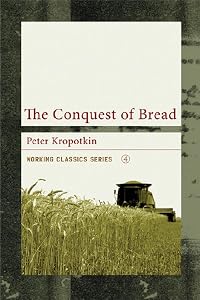
The Conquest of Bread
by Peter Kropotkin
On This Page
Description
Born a Russian prince, Peter Kropotkin (1842-1921) rejected his title and wealth to spend his life in pursuit of social justice and equality. His last major work, The Conquest of Bread, surveys economic methods for the satisfaction of human needs. The 1892 treatise also outlines the revolutionary path to his vision of utopia: an anarchist communist society. Kropotkin criticizes the effects of feudalism and capitalism, noting that both systems exacerbate poverty and promote privilege, even in show more times of abundance. Citing the human propensity toward voluntary cooperation, he proposes the establishment of free, self-sufficient anarchic communes and outlines practical considerations of production and distribution. The author supports his theories with examples from the French rebellions of 1789, 1848, and 1871, and his reasoning anticipates aspects of twentieth-century revolutions in Russia, Germany, and Spain. At a time when many thinkers employed the new Darwinian concept of "survival of the fittest" to justify their capitalist and imperialist goals, Kropotkin pointed out the historic patterns of humanity's best success under cooperative circumstances. A century later, his economic analysis remains fresh and relevant. show lessTags
Recommendations








































Member Reviews
On the last page of The Conquest of Bread, Peter Kropotkin laments the state of humanity's response to new ideas.
Kropotkin's most famous work contains very few surprises. When you think about how nice it would be to provide everyone with enough to not just cover their needs but also satisfy many of show more their wants, all without having to deal with a big government, you've got to expect that Kropotkin didn't come up with a feasible plan to bring this about. Otherwise, it already would have happened. We'd have all stormed the White House with bayonets and shit a long time ago.
In his introduction to my Penguin Classics Edition, David Priestland lays out some very important questions that Kropotkin leaves unanswered.
Thankfully, Kroptkin's utility as a thinker comes independent of the revolution he failed to bring about. Name any modern political philosopher of note that would be willing to put both of these thoughts in the same book:
Now take those passages to heart, and imagine living like you believed them. If I recognize the debt I owe to both the people that came before me and the people that surround me, I'm going to be far likelier to support those around me who should be benefitting in the same way I do. And to avoid putting the burden of service on the state, which has earned its reputation as unhelpful and untrustworthy, I'm going to hold myself individually responsible for providing that assistance. No revolution required!
Is Kropotkin's view of human nature too optimistic? Perhaps. But rather than accept that he's wrong, why don't we try proving him right? We won't see the system of governance he hoped to see, but we can certainly be the species he believed us to be. show less
With our minds already narrowed in our youth and enslaved by the past in our mature age, we hardly dare to think. If a new idea is mentioned - before venturing on an opinion of our own, we consult musty books a hundred years old, to know what ancient masters thought on the subject.Well, Peter, when I first heard about anarcho-communism, I consulted an old book written by an old dude, which was you. I hope you don't take too much offense.
Kropotkin's most famous work contains very few surprises. When you think about how nice it would be to provide everyone with enough to not just cover their needs but also satisfy many of show more their wants, all without having to deal with a big government, you've got to expect that Kropotkin didn't come up with a feasible plan to bring this about. Otherwise, it already would have happened. We'd have all stormed the White House with bayonets and shit a long time ago.
In his introduction to my Penguin Classics Edition, David Priestland lays out some very important questions that Kropotkin leaves unanswered.
For instance, how easy would it be for the whole people to stage a revolution and expropriate the propertied classes without extensive conflict and violence? How can the sophisticated technological innovation he saw as so necessary for his society be assured in the absence of market incentives and modern finance? Can democratic assemblies really hope to run the economy smoothly and efficiently, and how will conflicts between different producer communities be resolved? Finally, how can people guard against the potential tyranny of the collective?Since The Conquest of Bread doesn't answer these questions, my guess is that the answers are, respectively, not easy at all, it can't, they shouldn't, they won't, and I don't know, a really big moat?
Thankfully, Kroptkin's utility as a thinker comes independent of the revolution he failed to bring about. Name any modern political philosopher of note that would be willing to put both of these thoughts in the same book:
The development of individualism during the last three centuries is explained by the efforts of the individual to protect himself from the tyranny of capital and of the state.
Science and industry, knowledge and application, discovery and practical realization leading to new discoveries, cunning of brain and of hand, toil of mind and muscle - all work together. Each discovery, each advance, each increase in the sum of human riches, owes its being to the physical and mental travail of the past and the present. By what right then can anyone whatever appropriate the least morsel of this immense whole and say - This is mine, not yours?Both are true! Isn't it refreshing to find a thinker with concerns about the power of the state who doesn't want to grind poor people into sausage?
Now take those passages to heart, and imagine living like you believed them. If I recognize the debt I owe to both the people that came before me and the people that surround me, I'm going to be far likelier to support those around me who should be benefitting in the same way I do. And to avoid putting the burden of service on the state, which has earned its reputation as unhelpful and untrustworthy, I'm going to hold myself individually responsible for providing that assistance. No revolution required!
Is Kropotkin's view of human nature too optimistic? Perhaps. But rather than accept that he's wrong, why don't we try proving him right? We won't see the system of governance he hoped to see, but we can certainly be the species he believed us to be. show less
Well, this was interesting to look over. Especially after my big focus on Chinese authoritarian capitalism over the past few weeks.
Kropotkin advocates a unique ideology, which might now be classified as 'anarcho-communism'. This combination was jarring, from my biased American viewpoint, especially because communism is immediately associated with central planning and statism. Kropotkin, to his credit, immediately identifies some of the problems with central planned economies.
After this, he constructs his new ideal society with loving detail, moving from the basic necessities (food, clothing, shelter), to wages and the structure and distribution of goods, and education. He avoids much hard economic detail, and this book is made for mass show more discussion.
Now I find myself in agreement with him in more areas that I would have thought. Mechanization, technology, and planning have made many previously awful jobs much more reasonable and efficient. Women need to be brought out and made equal, of course, of course. Cooperation has worked in some fields, particularly with modern technology and the internet. I could go on about crowd-sourcing, the public domain, GNU, Creative Commons Licenses, and so forth. I agree that happy and autonomous workers are best, in terms of production, and happiness. Not to mention that there has been an empirically shown biological imperative for altruism. (see: Stephen Jay Gould's essay for further detail)
However, I confess I am distrustful that people will willingly buy into such ideas, what after the spread of the idea of rugged individualism. Or whether if people are simply good enough to willingly move over to communes, or participate in group or community thinking. Or if any moneyed interests will conspire to make such a society impossible. And this is coming from an avowed idealist/optimist. Although I'd much prefer this society to a Social Darwinist 'every man for himself' arena. Only too often have I seen evolution, a wonderful biological theory, tarnished by being used as a justification for societal misfortunes and inequalities.
Will such a utopia work? Perhaps. I'm not really sure. My inner empirical scientist wants to say 'try it out and let's see'. Perhaps that's the only way to be sure. show less
Kropotkin advocates a unique ideology, which might now be classified as 'anarcho-communism'. This combination was jarring, from my biased American viewpoint, especially because communism is immediately associated with central planning and statism. Kropotkin, to his credit, immediately identifies some of the problems with central planned economies.
After this, he constructs his new ideal society with loving detail, moving from the basic necessities (food, clothing, shelter), to wages and the structure and distribution of goods, and education. He avoids much hard economic detail, and this book is made for mass show more discussion.
Now I find myself in agreement with him in more areas that I would have thought. Mechanization, technology, and planning have made many previously awful jobs much more reasonable and efficient. Women need to be brought out and made equal, of course, of course. Cooperation has worked in some fields, particularly with modern technology and the internet. I could go on about crowd-sourcing, the public domain, GNU, Creative Commons Licenses, and so forth. I agree that happy and autonomous workers are best, in terms of production, and happiness. Not to mention that there has been an empirically shown biological imperative for altruism. (see: Stephen Jay Gould's essay for further detail)
However, I confess I am distrustful that people will willingly buy into such ideas, what after the spread of the idea of rugged individualism. Or whether if people are simply good enough to willingly move over to communes, or participate in group or community thinking. Or if any moneyed interests will conspire to make such a society impossible. And this is coming from an avowed idealist/optimist. Although I'd much prefer this society to a Social Darwinist 'every man for himself' arena. Only too often have I seen evolution, a wonderful biological theory, tarnished by being used as a justification for societal misfortunes and inequalities.
Will such a utopia work? Perhaps. I'm not really sure. My inner empirical scientist wants to say 'try it out and let's see'. Perhaps that's the only way to be sure. show less
A classic anarchist book. An advocate of decentralized communist society, free of coercion and based on voluntary associations. The term "mutual aid" comes straight out of Kropotkin. This book, "The Conquest Of Bread", spells out how this would take place and why it should. What comes through stronger than the content is his sheer idealism (later dampened somewhat by his moving to Russia after the Revolution) and the sense of his enormous generosity and love of the poor. He walked the walk. He lived and wrote in exile from his homeland for 41 years. Kropotkin was a big influence on Emma Goldman. He critiqued capitalism AND state communism, as well as, disagreeing with key parts of Marxism. There is a lot of information in this book. I show more feel I might have to reread it to help me retain the details, but I do get the gist. show less
I obviously agree with Kropotkin's general rhetoric in this, but that is also what makes it such an unengaging piece. The somewhat lack of any theoretical basis - that isn't just restating the obvious points of any better piece of theory - removes a lot of the grounding this sort of thing needs. Summing up the faults of Marx and other left-wing groups as just a nebulous "Socialism" makes all of Kropotkin's potentially profound social critique really dull and the contradiction of disregarding a Leninist transient state but then reiterating that an anarchist revolution would also be a slow process anyway really confused me. The slightly chauvinist attitudes he displays towards women and "savages" is also incredibly immature, especially in show more a work that is supposed to be about the nature and equality of humans - any talk of "civilised society" makes me roll my eyes.
The chapters 'Food', 'Means & Ways' and 'The Need for Luxury' are particular highlights but everything else is a massive superfluity especially given Kropotkin's styleless, repetitive writing. There are very few chapters that are actually presenting new ideas to me either theoretically or philosophically so my experience of this book was akin to just revising the basics of left-wing theory like a dryly translated Lenin. Maybe a good introduction to theory but for me this was essentially a waste of time. show less
The chapters 'Food', 'Means & Ways' and 'The Need for Luxury' are particular highlights but everything else is a massive superfluity especially given Kropotkin's styleless, repetitive writing. There are very few chapters that are actually presenting new ideas to me either theoretically or philosophically so my experience of this book was akin to just revising the basics of left-wing theory like a dryly translated Lenin. Maybe a good introduction to theory but for me this was essentially a waste of time. show less
I completely disagree but this is worth a read. Author was ahead of its time. By about 1000 years. I'm sure he'll be vindicated once machines take over.
Technology promised us easier lives. *Looks down at notes*
Wait a second...
Wait a second...
La palabra "anarquista" suena hoy menos tremebunda que extraña, como si se mencionara un animal que no ha sido avistado en décadas, y que en otras épocas fuera cazado en abundancia y sometido a continuas batidas policiales.
Se comprenderá que un movimiento de ideas tan radical haya nacido casi extinto. Sus tareas eran las de un Hércules, sus enemigos antiguos e inmensos como pirámides; y sus fuerzas, limitadas y, al fin, fatigadas. Hubo una época en que el anarquismo era sinónimo de libertad, no de caos inmotivado, y una historia de la disidencia y de las luchas por libertades negadas o conculcadas necesariamente debe tenerlo en cuenta. Los anarquistas fueron sus cabezas de tormenta. De no haber existido anarquistas nuestra show more imaginación política sería más escuálida, y más miserable aún. show less
Se comprenderá que un movimiento de ideas tan radical haya nacido casi extinto. Sus tareas eran las de un Hércules, sus enemigos antiguos e inmensos como pirámides; y sus fuerzas, limitadas y, al fin, fatigadas. Hubo una época en que el anarquismo era sinónimo de libertad, no de caos inmotivado, y una historia de la disidencia y de las luchas por libertades negadas o conculcadas necesariamente debe tenerlo en cuenta. Los anarquistas fueron sus cabezas de tormenta. De no haber existido anarquistas nuestra show more imaginación política sería más escuálida, y más miserable aún. show less
Dec 20, 2022Spanish
Members
- Recently Added By
Lists

essential pol.phil
17 works; 1 member

Library Wishlist
46 works; 1 member

Patriarchy and white supremacy de-programming
69 works; 1 member

The Plague and I's bookshelf in the sanatorium
16 works; 1 member

el
1,139 works; 1 member
Author Information

178+ Works 5,751 Members
Some Editions
Series
Belongs to Publisher Series
Work Relationships
Is contained in
Common Knowledge
- Canonical title
- The Conquest of Bread
- Original title
- La Conquête du Pain
- Original publication date
- 1892
- Original language
- French
Classifications
- Genres
- Nonfiction, General Nonfiction, Economics, Philosophy, Politics and Government, History
- DDC/MDS
- 335.83 — Society, government, & culture Economics Socialism and related systems Other systems Anarchism
- LCC
- HX632 .K7613 — Social sciences Socialism. Communism. Anarchism Socialism. Communism. Anarchism Communism: Utopian socialism, collective
- BISAC
Statistics
- Members
- 1,247
- Popularity
- 19,698
- Reviews
- 11
- Rating
- (4.12)
- Languages
- 11 — Dutch, English, Finnish, French, German, Italian, Portuguese, Serbian, Spanish, Swedish, Turkish
- Media
- Paper, Audiobook, Ebook
- ISBNs
- 77
- UPCs
- 1
- ASINs
- 19