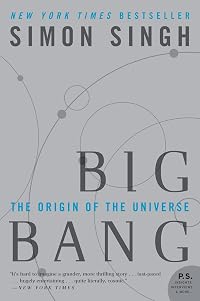
Big Bang: The Origin of the Universe
by Simon Singh
On This Page
Description
Shares the stories of Big Bang theorists who fought against establishment beliefs about an eternal and unchanging universe to investigate the universe's origins, and continues with an explanation of the Big Bang theory.Tags
Recommendations




Member Recommendations
Member Reviews
The comedian Severn Darden, in his persona as Professor Walther von der Vogelweide, did a routine titled “The Metaphysics Lecture” or “A Short Talk on the Universe”. He starts “Now, why, you will ask me, have I chosen to speak on the Universe rather than some other topic. Well, it's very simple, heh. There isn't anything else.”
So it is with Simon Singh’s Big Bang. This is not a discussion of the details of Big Bang cosmology (although the Big Bang figures in the final chapters), but rather a history of the history of the universe, starting with miscellaneous mythologies through the Greeks to Archbishop Ussher to Einstein and eventually the Cosmic Microwave Background versus Fred Hoyle. Capsule biographies of the various show more participants are included, with a number of important ones I’d never heard of.
All of this is quite clearly explained; Singh is even brave enough to include graphs and equations in a book intended for a popular audience (I remember reading a claim somewhere that every graph, equation or footnote in a book cuts sales by 10%). For me, the single most impressive accomplishment of the book is the way Singh deals with usual lay questions (which, to my considerable embarrassment, often puzzled me):
What was going on before the Big Bang?
How can galaxies be moving away from us faster than the speed of light?
What’s outside the edge of the Universe that it’s expanding into?
By explaining that the Big Bang, despite the possibly unfortunate name, is not the explosion of matter into previously empty space which had been sitting around waiting for the event for some indeterminate time but the explosion of intimately linked matter and space and time. Thus “before” the Big Bang has no meaning – there was no time “before” the Big bang, time starts then; galaxies can be moving away from us faster than the speed of light because the Universe is expanding that fast (there is a limit to how fast matter can move through space, but there is no apparent limit to how fast space can expand); and there is no “edge” of the Universe because, heh, there isn’t anything else. (OK, I’ve heard that there are cosmological models where the question of what was there before the Big bang actually has some meaning. I’ll have to wait for another book.)
Highly recommended. show less
So it is with Simon Singh’s Big Bang. This is not a discussion of the details of Big Bang cosmology (although the Big Bang figures in the final chapters), but rather a history of the history of the universe, starting with miscellaneous mythologies through the Greeks to Archbishop Ussher to Einstein and eventually the Cosmic Microwave Background versus Fred Hoyle. Capsule biographies of the various show more participants are included, with a number of important ones I’d never heard of.
All of this is quite clearly explained; Singh is even brave enough to include graphs and equations in a book intended for a popular audience (I remember reading a claim somewhere that every graph, equation or footnote in a book cuts sales by 10%). For me, the single most impressive accomplishment of the book is the way Singh deals with usual lay questions (which, to my considerable embarrassment, often puzzled me):
What was going on before the Big Bang?
How can galaxies be moving away from us faster than the speed of light?
What’s outside the edge of the Universe that it’s expanding into?
By explaining that the Big Bang, despite the possibly unfortunate name, is not the explosion of matter into previously empty space which had been sitting around waiting for the event for some indeterminate time but the explosion of intimately linked matter and space and time. Thus “before” the Big Bang has no meaning – there was no time “before” the Big bang, time starts then; galaxies can be moving away from us faster than the speed of light because the Universe is expanding that fast (there is a limit to how fast matter can move through space, but there is no apparent limit to how fast space can expand); and there is no “edge” of the Universe because, heh, there isn’t anything else. (OK, I’ve heard that there are cosmological models where the question of what was there before the Big bang actually has some meaning. I’ll have to wait for another book.)
Highly recommended. show less
‘Curiosity’ is a curious thing! It’s the only quality that differentiates humans from all the other living organisms (well, at least on the surface of Earth!). Solely driven by this ‘exclusive feature’, Man has discovered the intricate design of nature and invented his way to mimic it. If one speculates enough, he will find that all our technologies are simply based on the happenings going on around us in the nature. If you are a romantic one and like to see the nature’s creation as a Grand Opera, then perhaps, it won’t be too wrong to say that our technologies represent our rendition of this opera. The key to this derivation process is just raising a simple question, “How did this happen?” and raising questions is show more science. Science is a direct descendent of philosophy. While philosophy asks “Why?”, science asks “How?”. There are too many "How?" questions. The idea is if we can gather enough answers to these questions, they will eventually lead us to the “Why”. Finding an answer to one “How?” reveals that there are lots of other “Hows” lurking in the darkness. It’s like solving a ginormous cryptic puzzle. The clues are right before our eyes but they are way too scattered. You pick one wrong clue, you are horribly led astray and this is a very frequent case. Throughout the course of civilization, humans often forgot to raise questions, picked up the wrong clues and acted upon doctrinal views. These were (and still are) the obstacles in the way of finding the answers of “How”. The point today science is standing at, is achieved by walking through such an uneven path and the history is often bloody as well. Starting from the Greek philosophers’ era to the modern times, people have been wondering about the origin of everything and the idea of a "Big Bang" seems to give us the answers, finally. Today Big Bang has become a very common concept and almost everyone you find on the streets can spend a few words on it. Like many other science theories, Big Bang also had to fight a tough battle to survive. It might sound a little exaggerated, but Big Bang theory is said to be human kind’s greatest achievement (accumulating all the philosophical and scientific disciplines). So, one naturally can ask now how this great idea, that explains the creation’s origin, was conceived?
British science writer Simon Singh produces a weighty tome on the history of Big Bang that tells the enthralling tales of the origin of the universe. There is science and there is history, a lot of history. Singh proves himself to be a great story teller who makes the highly complicated ideas very much accessible, literally to anyone. This book proves again that one doesn't have to be a science major to learn the science. You will have a good idea how scientists are calculating the enormous distances from our planet to the stars just by reading few paragraphs. No mathematical manipulation, no tedious calculation, nothing! You will be badly hooked on this book once you start it, I can almost bet on it! The way the book is organized also allows you to keep things in mind without much stress. The tales of the mavericks, the mad scientists, based on whose contributions the Big Bang model is established, are very inspiring and fascinating. Famous astronomer Carl Sagan’s “Cosmos” inspired many to become real life astronomers. I think it won’t be surprising if Singh’s “Big Bang: The Origin of The Universe” plays a similar role. For aspiring astronomers, physicists, even science writers, this book will be a great head start.
The Universe is quite old. The Big Bang model gives us an average age of 13.8 billion years, as of today. Once people asked how we were created and many centuries later we found that Big Bang is probably the answer. Now another question has already been raised. “What happened before Big Bang?” Well, this certainly will give birth to a very hot philosophical (and religious too) debate and I do not possess enough knowledge and audacity (probably the scientists do not either!) to continue this discussion. Instead, I will simply quote St. Augustine (b. 354 AD) as Singh himself did in the epilogue of the book. I am putting it here for the sheer fun of it and nothing serious!
“What was God doing before He created the Universe? Before He created Heaven and Earth, God created hell to be used for people such as you who ask this kind of question”! show less
British science writer Simon Singh produces a weighty tome on the history of Big Bang that tells the enthralling tales of the origin of the universe. There is science and there is history, a lot of history. Singh proves himself to be a great story teller who makes the highly complicated ideas very much accessible, literally to anyone. This book proves again that one doesn't have to be a science major to learn the science. You will have a good idea how scientists are calculating the enormous distances from our planet to the stars just by reading few paragraphs. No mathematical manipulation, no tedious calculation, nothing! You will be badly hooked on this book once you start it, I can almost bet on it! The way the book is organized also allows you to keep things in mind without much stress. The tales of the mavericks, the mad scientists, based on whose contributions the Big Bang model is established, are very inspiring and fascinating. Famous astronomer Carl Sagan’s “Cosmos” inspired many to become real life astronomers. I think it won’t be surprising if Singh’s “Big Bang: The Origin of The Universe” plays a similar role. For aspiring astronomers, physicists, even science writers, this book will be a great head start.
The Universe is quite old. The Big Bang model gives us an average age of 13.8 billion years, as of today. Once people asked how we were created and many centuries later we found that Big Bang is probably the answer. Now another question has already been raised. “What happened before Big Bang?” Well, this certainly will give birth to a very hot philosophical (and religious too) debate and I do not possess enough knowledge and audacity (probably the scientists do not either!) to continue this discussion. Instead, I will simply quote St. Augustine (b. 354 AD) as Singh himself did in the epilogue of the book. I am putting it here for the sheer fun of it and nothing serious!
“What was God doing before He created the Universe? Before He created Heaven and Earth, God created hell to be used for people such as you who ask this kind of question”! show less
Well-written exposition on a potentially very hard topic to understand.
Singh's track record is 100% - every book by him has been an entertaining and informative one.
The sole minus for the book was its reliance on ancient history - giving more pages to recent discoveries and thus far unproven theories would have made it an even more enjoyable tome.
Singh's track record is 100% - every book by him has been an entertaining and informative one.
The sole minus for the book was its reliance on ancient history - giving more pages to recent discoveries and thus far unproven theories would have made it an even more enjoyable tome.
Simon Singh has written the most readable account of the "story" of the Big Bang. He writes of the characters, some of them rogues, the arguments, the lows and the highs, just as if it were a story. He writes with such clarity that anyone who has even the vaguest interest in wanting to know about the Big Bang but little in the way of a science education, should read this book as they will be gripped. Thank you Simon
I'm a sucker for readable tomes explicating theoretical physics/ cosmology for the non-mathematically trained and feel compelled to pump up my puny understanding of the field every now and then. Singh kept me engaged almost all the way through The Big Bang(the book slacks off a bit toward the end)as he ran through the history of the science leading up to and encompassing the acceptance of The Big Bang theory as the most accurate description we now have of the origin and evolution of the universe. Most of the material here won't be new to anyone who has been paying attention or who has read such books as Brian Greene's Elegant Universe and/ or The Fabric of the Cosmos, but The Big Bang still provides a good review of the subject and an show more enjoyable read as well, with such anecdotes as the following to keep a reader amused: "One tall tale explains how an astronomer driving to his observatory tried to use the Doppler effect to outwit the police. Having been caught jumping a red light, the astronomer argued that the light had appeared green to him because he was moving towards it and consequently it was blueshifted. The police officer excused him the ticket for running a red light, and instead doubled the fine and gave him a speeding ticket. To achieve such a dramatic wavelength shift, the astronomer would have had to be driving at roughly 200,000,000 km/h." show less
Singh has written a very good piece of popular science in Big Bang. While I knew the science he introduced, I loved the way he laid it out for the general reader with clear explanations, good illustrations, and a minimum of equations. Told in chronological order from the Greek philosophers to the cosmologists of today, Big Bang is also a history of science and an explanation of how science is done. It was also a good review for me of relativity and cosmology.
To me, the really great thing was all the details about the people and how they explored their ideas that I had not run across before reading this book. Additionally there were a wealth of quotes from scientists and non-scientists to introduce and illuminate the various show more sections.
Recommended. show less
To me, the really great thing was all the details about the people and how they explored their ideas that I had not run across before reading this book. Additionally there were a wealth of quotes from scientists and non-scientists to introduce and illuminate the various show more sections.
Recommended. show less
For this reader with a lot formal education, but very little of it in the physical sciences, Simon Singh's `Big Bang' was phenomenally interesting, engaging, intellectually stimulating, readable, and educational. Others with more background in cosmology may find it too basic. Singh takes the reader through the history of cosmology as he builds toward an explanation of the Big Bang theory. The opening chapter explains the ancient's earth-centered (and common sensical) view of the universe and its downfall at the hands of Copernicus, Brahe, Kepler and Galileo. Later chapters follow the disproof of ether, Einstein's special and general theories of relativity, and the `great debate' between the supporters of a static universe and Lemaitre show more and others who supported the idea of an expanding (Big Bang) universe.
A large portion of the book follows the scientific efforts to gather evidence to support one view or the other. The renowned Edwin Hubble and the less so Henrietta Leavitt played key roles in finally providing enough evidence supporting the Big Bang theory to at least make it a credible argument. The remainder of the book follows the debate between the solid state theorists led by Fred Hoyle and the Big Bang backers led first by Gamow and Alpher, but later by others who resolved some of the nagging doubts about the theory, for example, the crucial 1992 proof of tiny variations in cosmic microwave background radiation.
Each chapter (at least in the P.S. version) has handy summary notes. Singh provides a useful glossary as well as recommended further readings for each chapter.
I generally read 50-75 books a year and rate The Big Bang as one of my top five books of the year. Five measly stars don't do it justice. I will resist the temptation to rate as a supernova, but this book greatly enhanced my understanding of the world around us and was a joy to read.
Absolutely the highest recommendation. show less
A large portion of the book follows the scientific efforts to gather evidence to support one view or the other. The renowned Edwin Hubble and the less so Henrietta Leavitt played key roles in finally providing enough evidence supporting the Big Bang theory to at least make it a credible argument. The remainder of the book follows the debate between the solid state theorists led by Fred Hoyle and the Big Bang backers led first by Gamow and Alpher, but later by others who resolved some of the nagging doubts about the theory, for example, the crucial 1992 proof of tiny variations in cosmic microwave background radiation.
Each chapter (at least in the P.S. version) has handy summary notes. Singh provides a useful glossary as well as recommended further readings for each chapter.
I generally read 50-75 books a year and rate The Big Bang as one of my top five books of the year. Five measly stars don't do it justice. I will resist the temptation to rate as a supernova, but this book greatly enhanced my understanding of the world around us and was a joy to read.
Absolutely the highest recommendation. show less
Members
- Recently Added By
Lists

2014
7 works; 1 member

Blue Pyramid 1,276 Best Books of All Time
1,248 works; 32 members

Author Information

18+ Works 15,504 Members
Simon Singh was born in Great Britain in 1964 and educated at Imperial College and the University of Cambridge (where he received a Ph. D. in particle physics). He worked at the European Centre for Particle Physics and the BBC's science department. At the BBC, he worked on Tomorrow's World. Singh and John Lynch produced and directed an show more award-winning documentary on Fermat's Last Theory. He later published a book on the same topic. (Bowker Author Biography) show less
Awards and Honors
Awards
Distinctions
Series
Belongs to Publisher Series
Common Knowledge
- Canonical title
- Big Bang: The Origin of the Universe
- Alternate titles
- Big Bang
- Original publication date
- 2004
- Epigraph
- This book would not have been possible without Carl Sagan, James Burke, Magnus Pyke, Heinz Wolff, Patrick Moore, Johnny Ball, Rob Buckman, Miriam Stoppard, Raymond Baxter, and all the science TV producers and directors who in... (show all)spired my interest in science.
- First words
- Our universe is dotted with over 100 billion galaxies, and each one contains roughly 100 billion stars. It is unclear how many planets are orbiting these stars, but it is certain that at least one of them has evolved life. In... (show all) particular, there is a life form that has had the capacity and audacity to speculate about the origin of this vast universe.
- Quotations
- *** 1) Place three grains of sand inside a great cathedral, and the cathedral will be more closely packed with sand than space is with stars. -- James Jeans *** 2) The effort to understand the universe is one of the very few ... (show all)things that lifts humans a little above the level of farce, and gives it some of the grace of tragedy. -- Steven Weinberg *** 3) In science one tries to tell people, in such a way as to be understood by everyone, something that no one ever knew before. But in poetry, it's the exact opposite. -- Paul Dirac *** 4) Tthe most incomprehensible thing about the universe is that it is comprehensible. -- Albert Einstein
- Last words
- (Click to show. Warning: May contain spoilers.)In his autobiography, Confessions, written about AD 400, the philosopher and theologian St Augustine quotes an answer he has heard to the theological equivalent of 'What came before the Big Bang?': "What was God doing before He created the Universe? Before He created Heaven and Earth, God created hell to be used for such people as you who ask this kind of question."
- Blurbers
- Nasar, Sylvia; Gleik, James
Classifications
Statistics
- Members
- 2,044
- Popularity
- 10,194
- Reviews
- 31
- Rating
- (4.18)
- Languages
- 18 — Czech, Danish, Dutch, English, Finnish, French, German, Hebrew, Hungarian, Italian, Japanese, Korean, Norwegian (Bokmål), Portuguese, Romanian, Slovenian, Spanish, Swedish
- Media
- Paper, Ebook
- ISBNs
- 34
- UPCs
- 1
- ASINs
- 9