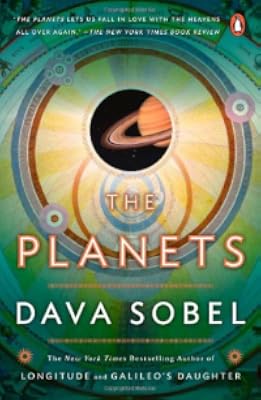
The Planets
by Dava Sobel
On This Page
Description
The sun's family of planets become a familiar place in this personal account of the lives of other worlds. With her gift for weaving difficult scientific concepts into a compelling story, Sobel explores the planets' origins and oddities through the lens of popular culture, from astrology, mythology, and science fiction to art, music, poetry, biography, and history.--From publisher description.Tags
Recommendations














Member Recommendations
Member Reviews
What a great book! Dava Sobel writes about the 9 planets (yes, Pluto is included - this was written in 2006 after all), plus the sun and the moon, in a way that is both lyrical and scientific. I learned a lot about the origins and compositions of the celestial bodies of our solar system while at the same time gaining an understanding about the absolutely bananas way scientists, astronomers, and explorers figured out what the heck was going on in our universe with super basic tools and knowledge. Sobel could have just written about these things like in a textbook, but instead she brings a creative non-fiction style that enabled me to just blaze through this; she explores the origins of Mercury through mythology, the composition of Venus show more through the poets who rhapsodized about her beauty, the understanding of Earth through cartography, the evolution of Mars as "told" by an actual Martian rock that fell to Earth, and the song of Saturn's rings through music. I love space and the beauty of the written word, and this book combines the best of both! show less
This is a delightful little book. Pure, simple, sweet; elegant, poetic, and full of wonder. It's not a science book, though it's full of science. It's also full of poetry, pop culture, history, and personality. Call it "Ode to a Planetary System". It's a love story in a way, a romance with the wonder of our celestial neighborhood, and the journey to discover it.
Very, very enjoyable. This isn't heavy stuff, it's an appetizer. Light and tantalizing.
Very, very enjoyable. This isn't heavy stuff, it's an appetizer. Light and tantalizing.
The Planets is quick and comprehensible look at the wondrous celestial bodies roaming that big black void we call the night sky. It is not the most in-depth book out there, but neither is it a strenuous or difficult read. What we have here is a light and enjoyable outline of the planets in our solar system, a chapter dedicated to each (except Uranus and Neptune naturally being combined) and bonus chapters on the moon and a look into the Cassini spacecraft landing on Titan, one of Saturn's many moons.
The book is intended for the casual reader, as you do not have to worry about difficult jargon or astronomical numbers here. Instead you get short and sweet chapters that give you a brief yet memorable overview of the planets nearest to our show more own. It definitely makes the book more approachable.
What sets the book apart, and what I think Dava Sobel did best here, was give each planet a distinct personality. For example, the chapter on Venus is complimented with romantic poetry written about her, and the chapter about Earth is partially historical nonfiction about those thinkers who wondered if Earth wasn't at the center of the universe after all. Her ability to make each planet distinguishable, not only by describing what about the planet makes it such an individual but by also formatting the chapters in so many different ways, really helped make each planet unique in my mind.
I think The Planets is perfect for anyone who has an offhand fascination with the solar system but is weary of diving into a topic that can be dense and difficult to understand for many. I think there is plenty here to make it worth reading for those more knowledgeable as well, if not simply for the history of how each planet was discovered, but I think those of a more casual interest in the subject will get the most out of this one. As for me, I thought it was very enjoyable. 4 stars! show less
The book is intended for the casual reader, as you do not have to worry about difficult jargon or astronomical numbers here. Instead you get short and sweet chapters that give you a brief yet memorable overview of the planets nearest to our show more own. It definitely makes the book more approachable.
What sets the book apart, and what I think Dava Sobel did best here, was give each planet a distinct personality. For example, the chapter on Venus is complimented with romantic poetry written about her, and the chapter about Earth is partially historical nonfiction about those thinkers who wondered if Earth wasn't at the center of the universe after all. Her ability to make each planet distinguishable, not only by describing what about the planet makes it such an individual but by also formatting the chapters in so many different ways, really helped make each planet unique in my mind.
I think The Planets is perfect for anyone who has an offhand fascination with the solar system but is weary of diving into a topic that can be dense and difficult to understand for many. I think there is plenty here to make it worth reading for those more knowledgeable as well, if not simply for the history of how each planet was discovered, but I think those of a more casual interest in the subject will get the most out of this one. As for me, I thought it was very enjoyable. 4 stars! show less
I'm not usually into pop science books but was attracted by the volume's presentation, which is, in a word, gorgeous. The paper is thick and creamy, the text peppered with full color illustrations that reminded me of the Voyager Tarot. So that is what initially caught my eye, but the writing drew me in. Far from some bare bones astronomy textbook retread, Sobel's "Planets" takes all nine (at that time) of its namesakes as starting points for unexpected forays into poetry, free (though never far-straying) association, and storytelling, so that Mercury's chapter is about Greek mythology, Neptune's about two little-known female astronomers, and Earth's about the development of geography. Good stuff. The writing is airy and beautiful; Sobel show more reminds me very much of Ciaran Carson--one of my all time favorite authors. I will definitely be checking out her other works. show less
A lovely little book as fluent in the science of the planets as it is the mythology, the music (!), the literature and the language of outer space. The nomenclature alone in here is worth the price of purchase-- from the many moods of the moon's features ("The Sea of Crises", "The Lake of Fear", "The Sea of Calm") to Jupiter's hold over our sanguine selves and thus the "jovial" (!) disposition of Jupiterians vs. their mercurial, martial, and saturnine counterparts. A nice narrative companion to other mythological histories of the heavens like "Star Names and their Meanings" and a very sympathetic, anthropomorphic guide to outer space.
Dava Sobel offers interesting takes on the familiar objects in the night sky. Each planets occupies a cultural niche in society and she explores them all. From the allusions to Venus's beauty to the discovery of Neptune, she develops very apt portraits of each of the planets. There is also a fair amount of science and geology in each chapter, but she tries very hard not to make the planets as cold as they seem to be. If you don't want to go out and buy a telescope after reading this book, stick with Grisham and Koontz.
A fun, informative journey through the planets (and Earth's moon), each essay written with a different creative hook. I particularly loved the Mars essay, which was written as an autobiography & a history of Mars from the perspective of a Martian rock discovered in Antarctica, and the Jupiter essay, which draws heavily on astrology, but in a cheeky - not cheesy - way to tell the life story of Galileo and the Jupiter probe named for him - going so far as to cast the probe's star chart, using its launch date & time as its birthday. Not straightforward non-fiction science writing at all, but something highly lyrical, poetic, fun and informative. I wish I had read the illustrated version though, as other reviewers seem to have commented on show more fantastic pictures & my book had none. show less
Members
- Recently Added By
Lists

Best Science Books for Non-Scientists
113 works; 57 members

For Science!
39 works; 5 members

Science: Astronomy
62 works; 2 members

The r/AskScience Reading List
159 works; 3 members
Author Information

27+ Works 22,036 Members
Dava Sobel was born in the Bronx, New York on June 15, 1947. She received a B.A. from the State University of New York at Binghamton in 1969. She is a former New York Times science reporter and has contributed articles to Audubon, Discover, Life, Harvard Magazine, and The New Yorker. She has written several science related books including Letters show more to Father, The Planets, and A More Perfect Heaven: How Copernicus Revolutionized the Cosmos. Longitude: The True Story of a Lone Genius Who Solved the Greatest Scientific Problem of His Time won the Harold D. Vursell Memorial Award from the American Academy of Arts and Letters. Galileo's Daughter: A Historical Memoir of Science, Faith, and Love won the 1999 Los Angeles Times Book Prize for science and technology and a 2000 Christopher Award. She has co-authored six books with astronomer Frank Drake including Is Anyone Out There? She also co-authored with William J. H. Andrewes The Illustrated Longitude. Because her work provides awareness of science and technology to the general public, she has received the Individual Public Service Award from the National Science Board in 2001, the Bradford Washburn Award in 2001,the Klumpke-Roberts Award in 2008, and the Eduard Rhein Foundation in Germany in 2014. (Bowker Author Biography) show less
Some Editions
Common Knowledge
- Canonical title
- The Planets
- Original publication date
- 2005
- Important places
- Solar System
- Epigraph
- At night I lie awake
in the ruthless Unspoken,
knowing that plaents
come to life, bloom,
and die away,
like day-lilies opening
one after another
in every nook and cranny
of the Univer... (show all)se....
-Diane Ackerman, from The Planets: A Cosmic Pastoral
In all the history of mankind, there will be only one generation that will be first to explore the Solar System, on generation for which, in childhood, the planets are distant and indistinct discs moving through the night sky... (show all), and for which, in old age, the planets are places, diverse new worlds in the course of exploration.
-Carl Sagan, from The Cosmic Connection; An Extraterrestrial perspective - Dedication
- Dedicated with worldfuls of love to my big brothers, Michael V. Sobel, M.D., who named out family cat Captain Marvel, and Stephen Sobel, D.D.S., who bunked with me in Space Camp.
- First words
- My planet fetish began, as best I can recall, in third grade, at age eight---right around the time I learned that Earth had siblings in space, just as I had older brothers in high school and college.
- Last words
- (Click to show. Warning: May contain spoilers.)For myself, I confess that none of the truly staggering data I have been privileged to share here has altered the planets' fundamental appeal to me as an assortment of magic beans or precious gems in a little private cabinet of wonder - portable, evocative, and swirled in beauty.
Classifications
Statistics
- Members
- 2,181
- Popularity
- 9,304
- Reviews
- 53
- Rating
- (3.50)
- Languages
- 9 — Catalan, Dutch, English, German, Italian, Norwegian (Bokmål), Portuguese, Romanian, Spanish
- Media
- Paper, Audiobook, Ebook
- ISBNs
- 32
- ASINs
- 12