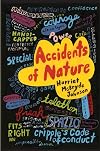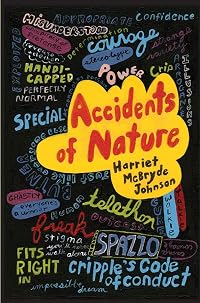
Accidents of Nature
by Harriet McBryde Johnson
On This Page
Description
Having always prided herself on blending in with "normal" people despite her cerebral palsy, seventeen-year-old Jean begins to question her role in the world while attending a summer camp for children with disabilities.Tags
Recommendations

































Member Recommendations


Member Reviews
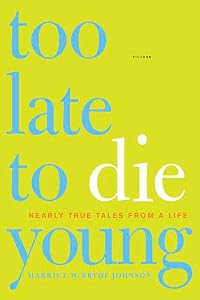
Harriet McBryde Johnson may have looked at her life as being "too late to die young;" however, she died younger than she should have and her unique, powerful voice was lost to us. I tend to be skeptical about freshman novels, skeptical about the first person, skeptical about authorial self-inserts and skeptical about manifestos parading as novels. Accidents of Nature falls into all of the above categories; however, it is transcendent.
First and foremost, for a lawyer with no formal training on creative writing, Johnson has an unbelievable knack with characterization. Her characters are understated, but unique; flawed but sympathetic. Even characters that disagree with her point of view are granted strengths. The message in Accidents of show more Nature is very similar to that of "Too Late to Die Young;" however, in novel format, it is somehow easier to understand -- that Johnson is suggesting an approach that is taken to all people with disabilities, not just razor sharp Southern ADA lawyers who happen to be disabled. And while groups such as Disability is Natural are beginning to champion similar movements, Johnson is one of the first and one of the loudest to take her approach to the disability movement. Accidents of Nature is guaranteed to challenge how all of us think disability and Johnson makes it clear, by inserting a caricature of herself, that even she is not above reproach.
I read this in a sitting, but it will stay with me for a long, long time. show less
First and foremost, for a lawyer with no formal training on creative writing, Johnson has an unbelievable knack with characterization. Her characters are understated, but unique; flawed but sympathetic. Even characters that disagree with her point of view are granted strengths. The message in Accidents of show more Nature is very similar to that of "Too Late to Die Young;" however, in novel format, it is somehow easier to understand -- that Johnson is suggesting an approach that is taken to all people with disabilities, not just razor sharp Southern ADA lawyers who happen to be disabled. And while groups such as Disability is Natural are beginning to champion similar movements, Johnson is one of the first and one of the loudest to take her approach to the disability movement. Accidents of Nature is guaranteed to challenge how all of us think disability and Johnson makes it clear, by inserting a caricature of herself, that even she is not above reproach.
I read this in a sitting, but it will stay with me for a long, long time. show less
Nuanced and engaging portrait of that moment in time before people got that telethons suck. Also before people got that "mixing the races" was no big deal. The narrator's syrupy southern accent was a bit distracting, as were the Mary Sue tendencies of Sara, but overall I enjoyed the story of Jean's awakening. I dug the insight into the struggles of Jean, who has CP, to communicate, and how it felt when her body didn't go along with the wishes of her mind.
In the audio version reader Jenna Lamia brings the story to full, well-rounded life. At this disability summer camp, the kids are not to be pitied or praised for their courage, but accepted as who they are, foibles and all. Very sharp story; characters are funny and human.
Jean has cerebral palsy and attends a regular high school in North Carolina. In the summer of 1970 she attends a camp for kids with various disabilities. It's her first experience being around so many others who are also handicapped. She meets Sara who has muscular dystrophy and is in her eighth summer at Camp Courage. Sara is an intelligent, opinionated activist when it comes to demanding respect for people with disabilities. She agitates in the camp against the show more patronizing, everyone-is-a-winner attitude of the camp staff. Jean, who has more experience in the "norm" world than Sara, doesn't always agree with her ideas but they do change her perspective on the world as a "crip." Author is also disabled. show less
Jean has cerebral palsy and attends a regular high school in North Carolina. In the summer of 1970 she attends a camp for kids with various disabilities. It's her first experience being around so many others who are also handicapped. She meets Sara who has muscular dystrophy and is in her eighth summer at Camp Courage. Sara is an intelligent, opinionated activist when it comes to demanding respect for people with disabilities. She agitates in the camp against the show more patronizing, everyone-is-a-winner attitude of the camp staff. Jean, who has more experience in the "norm" world than Sara, doesn't always agree with her ideas but they do change her perspective on the world as a "crip." Author is also disabled. show less
Reviewed by Mechele R. Dillard for TeensReadToo.com
Jean feels fantastic about her place in the world. Why shouldn’t she? She’s seventeen, an honor student at Crosstown High School, her friends are great, and her family supports all of her dreams. But this summer, Jean spreads her wings, away from the cocoon of her parents, friends, and her small town, and spends time at Camp Courage--“Crip Camp,” as the campers sarcastically refer to it--a camp for children with physical and mental disabilities, and she finds her confidence is shaken. For the first time, Jean must admit that, because of her cerebral palsy, she is different from the other kids at her high school.
Set in 1970 with an epilogue to bring the reader into the year 2000, show more ACCIDENTS OF NATURE is an excellent overview of how kids with a range of challenges--cerebral palsy, muscular dystrophy, amputations, autism, asthma, multiple sclerosis, epilepsy--feel condescended to by the world. For example, to make sure no one feels bad at the camp carnival, everyone
wins a prize at the games. Jean and her friend Sara refuse to play, on the basis that there is no challenge in playing a game if one is certain to win. The games then become a metaphor for Crip life, as Jean muses:
"When the games are rigged, does it make everyone a winner--or no one? … I believe in competition. The program seems to be that handicapped people aren’t up to it; we can only pretend to be winners. I don’t want to pretend. I want to achieve, really achieve. Or I will take my disappointments just like anyone else."
Johnson captures the pain, anger, and fear of being shunned by the “normal” world in the character of Sara, and explores the naiveté of thinking that no one notices one’s differences in the character of Jean. Weaving the two together through the bond of friendship, Johnson creates a captivating, educational storyline.
The overwhelming negative of this book--and the reason I am awarding four stars instead of five--is the epilogue. Without giving away the ending, I’ll say that I’m not sure what the author was thinking when she wrote this epilogue; I can think of no other way to describe it but as frustrating, aggravating, and absolutely annoying. Ms. Johnson, what were you thinking?
Still, ACCIDENTS OF NATURE is an excellent book, overall, and well worth a reader’s time; I recommend it with a strong four stars. show less
Jean feels fantastic about her place in the world. Why shouldn’t she? She’s seventeen, an honor student at Crosstown High School, her friends are great, and her family supports all of her dreams. But this summer, Jean spreads her wings, away from the cocoon of her parents, friends, and her small town, and spends time at Camp Courage--“Crip Camp,” as the campers sarcastically refer to it--a camp for children with physical and mental disabilities, and she finds her confidence is shaken. For the first time, Jean must admit that, because of her cerebral palsy, she is different from the other kids at her high school.
Set in 1970 with an epilogue to bring the reader into the year 2000, show more ACCIDENTS OF NATURE is an excellent overview of how kids with a range of challenges--cerebral palsy, muscular dystrophy, amputations, autism, asthma, multiple sclerosis, epilepsy--feel condescended to by the world. For example, to make sure no one feels bad at the camp carnival, everyone
wins a prize at the games. Jean and her friend Sara refuse to play, on the basis that there is no challenge in playing a game if one is certain to win. The games then become a metaphor for Crip life, as Jean muses:
"When the games are rigged, does it make everyone a winner--or no one? … I believe in competition. The program seems to be that handicapped people aren’t up to it; we can only pretend to be winners. I don’t want to pretend. I want to achieve, really achieve. Or I will take my disappointments just like anyone else."
Johnson captures the pain, anger, and fear of being shunned by the “normal” world in the character of Sara, and explores the naiveté of thinking that no one notices one’s differences in the character of Jean. Weaving the two together through the bond of friendship, Johnson creates a captivating, educational storyline.
The overwhelming negative of this book--and the reason I am awarding four stars instead of five--is the epilogue. Without giving away the ending, I’ll say that I’m not sure what the author was thinking when she wrote this epilogue; I can think of no other way to describe it but as frustrating, aggravating, and absolutely annoying. Ms. Johnson, what were you thinking?
Still, ACCIDENTS OF NATURE is an excellent book, overall, and well worth a reader’s time; I recommend it with a strong four stars. show less
This book, set on top of the twisted pine trees that survive NOT because they are the fittest, but are the fittest because they survive is a significant book, even asking us "norms" to question our assumptions about things as basic as walking. It is summer time and Jean is at Crip Camp. Soon the “norms” will come and sing about impossible dreams. They will pretend to be exactly the same on the inside and then go live their better life when camp is through. Despite the serious nature of this book, I found myself laughing and celebrating, mainly with Sara. I loved her mixing of socialism and Biblical truth. Sara forces Jean to reconsider whom she is and what she wants to do with her life, which is vastly different from the show more expectations her family has. This one will keep me thinking and talking for a long while. I loved Sara’s scathing review of Jerry Lewis and her interpretation of the “Impossible Dream.” The poignant epilog is such a different and beautiful love letter! I am very surprised that this did not win the Schneider Family award for older readers. This exceptional book deserves an extremely wide audience. Highly recommended for high school libraries. show less
I really enjoyed this – Sara, the agitator who helps Jean start questioning is unabashed in her disgust with the way she and the other campers are treated – like theirs is a burden always, and they can never have ‘good’ lives. She may be a bit much, but I really felt like my own eyes were opened while reading this, though the only historical aspects are the mentions of telethons and the fact that they cannot expect to go to college – physical disability is equal to mental disability to the ‘normals’ in this book.
Having always prided herself on blending in with “normal” people despite her cerebral palsy, seventeen-year-old Jean begins to question her role in the world while attending a summer camp for children with disabilities.
Thought-provoking story that challenges the reader’s prejudices and assumptions about people with disabilities. Written by real-life advocate, Harriet McBryde Johnson, who herself attended cross-disability summer camps as a teenager.
A funny, angry, iconoclastic camp story not just for young adults. The only caveat I have is that the publishers have not made it clear that the time is the 1970s. References to MRs (mentally retarded people) and a tendency to condescend towards the African American campers will seem show more egregious to the modern-day reader if not forewarned.
The title comes from Eleanor Roosevelt:
“Beautiful young people are accidents of nature, But beautiful old people are works of art”
7.5 Hopefully this book will pique your curiosity about the author who was also a, lawyer, public speaker, disability rights activist, famous for (among other things) boycotting the Jerry Lewis Muscular Dystrophy telethons. show less
Thought-provoking story that challenges the reader’s prejudices and assumptions about people with disabilities. Written by real-life advocate, Harriet McBryde Johnson, who herself attended cross-disability summer camps as a teenager.
A funny, angry, iconoclastic camp story not just for young adults. The only caveat I have is that the publishers have not made it clear that the time is the 1970s. References to MRs (mentally retarded people) and a tendency to condescend towards the African American campers will seem show more egregious to the modern-day reader if not forewarned.
The title comes from Eleanor Roosevelt:
“Beautiful young people are accidents of nature, But beautiful old people are works of art”
7.5 Hopefully this book will pique your curiosity about the author who was also a, lawyer, public speaker, disability rights activist, famous for (among other things) boycotting the Jerry Lewis Muscular Dystrophy telethons. show less
Members
- Recently Added By
Lists

Best books read in 2011
200 works; 51 members

Camps, disabilities -- children's/young adult fiction
20 works; 2 members

Cerebral palsy -- children's/young adult fiction
24 works; 5 members

Camps -- children's/young adult fiction
324 works; 9 members

Wheelchairs -- children's/young adult fiction
49 works; 4 members
Author Information

3+ Works 357 Members
Harriet McBryde Johnson has been a lawyer in Charleston, South Carolina, Since 1985. She holds the world endurance record (fourteen years without interruption) for protesting the Jerry Lewis telethon for the Muscular Dystrophy Association
Awards and Honors
Awards
Distinctions
Notable Lists
Common Knowledge
- Original publication date
- 2006
- People/Characters
- Jean; Sara; Willie; Margie; Denise; Carole (show all 7); Sue
- Important places
- Camp Courage, North Carolina, USA
- First words
- In the middle of North Carolina, there is a beach that has no ocean.
Classifications
- Genres
- Teen, Fiction and Literature, Tween, Children's Books, Young Adult
- DDC/MDS
- 813.6 — Literature & rhetoric American literature in English American fiction in English 2000-
- LCC
- PZ7 .J631942 .A — Language and Literature Fiction and juvenile belles lettres Fiction and juvenile belles lettres Juvenile belles lettres
- BISAC
Statistics
- Members
- 235
- Popularity
- 138,019
- Reviews
- 19
- Rating
- (3.87)
- Languages
- English
- Media
- Paper, Audiobook, Ebook
- ISBNs
- 8
- ASINs
- 2