On This Page
Description
Spenser is "the sassiest, funniest, most-enjoyable-to-read-about private eye around today ... the legitimate heir to the Hammett-Chandler-Macdonald tradition"--The Cincinnati post. Spenser is "tougher, stronger, better educated, and far more amusing than Sam Spade, Phil Marlowe, or Lewis Archer ... Spenser gives the connoisseur of that rare combination of good detective fiction and good literature a chance to indulge himself"--The Boston globe.Tags
Recommendations














Member Reviews
Explores some issues that you don't commonly see in this sort of noir fiction. Tough guy Spenser is hired as a bodyguard to a militant feminist, and I must say I thought the feminist was right in character as well as spot-on with her analysis of Spenser's behavior as a protective alpha male. As well, Spenser, who is a live-and-let-live kind of guy, gets exactly as uncomfortable with his client's homosexual proclivities as I would have expected. Nicely handled. Who would have thought you'd get this sort of character sketch in a little potboiler like this?
I wasn't sure I was going to be able to read this one when the militant feminist lesbian client says (on page 9!) "John has warned me that you are a jokester. Well, I am not. If we are to have any kind of successful association you'd best understand right now that I do not enjoy humor." Oh man, I thought the portrayal of the militant women's libbers in Promised Land were bad. Still, I gave it another 20 pages and found Spenser confronting a picket line of bigots trying to bar the lesbian author from her speaking engagement:
"As we approached the group they joined arms in front of us, blocking the entrance. In the center of the line was a large man with a square jaw and thick brown hair. Looked like he'd been a tight end perhaps, at show more Harvard. He wore a dark suit and a pale gray silk tie. His cheeks were rosy, and his eye was clear. Probably still active in his alumni association. A splendid figure of a man, the rock upon which the picket line was anchored. Surely a foe of atheism, Communism, and faggotry. Almost certainly a perfect asshole."
Ok, I'm in. show less
"As we approached the group they joined arms in front of us, blocking the entrance. In the center of the line was a large man with a square jaw and thick brown hair. Looked like he'd been a tight end perhaps, at show more Harvard. He wore a dark suit and a pale gray silk tie. His cheeks were rosy, and his eye was clear. Probably still active in his alumni association. A splendid figure of a man, the rock upon which the picket line was anchored. Surely a foe of atheism, Communism, and faggotry. Almost certainly a perfect asshole."
Ok, I'm in. show less
Though one of the early Spensers, there are elements here which make this one rank surprisingly low within the Spenser canon. First, we have too much Susan Silverman. While she isn’t plopping down in the bathroom sink, so that she can be close to a mirror while putting on her makeup, as in Hugger Mugger, a little of her still goes a looong way for this reader. Also, there is no Hawk, as even towards the end, Spenser wants to do this one on his own. As yet there is no Vinnie, my favorite of the Parker posse.
The real problem with this one, however, is the thoroughly dislikable Rachel Wallace. She is a caustically angry and hostile gay feminist whose few valid points are muted by her own chip-on-the-shoulder hatred towards men, and show more anything related to them. As Spenser explains to her when her publisher hires him to protect her — because of threats about a book she is releasing — her being lesbian isn’t a problem for him, but her being angry and impossible to work for, and get along with, might become an issue. And it does, because even back when Parker wrote this, the "victim" culture so prevalent today had begun to surface.
While the dialog and story are average to above average for the series, and there are some nice moments, having such an unlikable client wears on the reader more than it does the very Boston-liberal/libertarian Spenser. Frankly, when Rachel Wallace fires Spenser, the reader wants to breathe a sigh of relief that she won’t be in the story any longer. Her absence, however, drives the second half of the book, because unlike the reader, Spenser feels obligated to go find her.
Spenser’s sense of guilt seems a literary contrivance on this occasion. It simply gave Spenser a reason to go looking for her — and therefore give us a resolution — something the reader did not always get in later Spenser entries. The good part is that because she’s been kidnapped, Rachel Wallace and her palpable anger isn’t in the second half of the story until Spenser finds her. The bad part is that her presence is always abrasive and in some way unpleasant for both the reader, and Spenser.
The psychobabble and gobbledygook at the end of the book is just eye-rollingly inane. Other than learning that Parker must have been on a Syrian bread kick around this time — Spenser must eat it at least three times in the book — there was nothing new when I went back to read this again after many years. It's rare for one of the earlier Spenser novels to rank as low as a small handful toward the end of this great series do, but this one unfortunately does. I have friends who like this one more than I do, but it wasn’t my favorite when I first read it many years ago, and having read so many great ones in the series since then, it really pales in comparison now. show less
The real problem with this one, however, is the thoroughly dislikable Rachel Wallace. She is a caustically angry and hostile gay feminist whose few valid points are muted by her own chip-on-the-shoulder hatred towards men, and show more anything related to them. As Spenser explains to her when her publisher hires him to protect her — because of threats about a book she is releasing — her being lesbian isn’t a problem for him, but her being angry and impossible to work for, and get along with, might become an issue. And it does, because even back when Parker wrote this, the "victim" culture so prevalent today had begun to surface.
While the dialog and story are average to above average for the series, and there are some nice moments, having such an unlikable client wears on the reader more than it does the very Boston-liberal/libertarian Spenser. Frankly, when Rachel Wallace fires Spenser, the reader wants to breathe a sigh of relief that she won’t be in the story any longer. Her absence, however, drives the second half of the book, because unlike the reader, Spenser feels obligated to go find her.
Spenser’s sense of guilt seems a literary contrivance on this occasion. It simply gave Spenser a reason to go looking for her — and therefore give us a resolution — something the reader did not always get in later Spenser entries. The good part is that because she’s been kidnapped, Rachel Wallace and her palpable anger isn’t in the second half of the story until Spenser finds her. The bad part is that her presence is always abrasive and in some way unpleasant for both the reader, and Spenser.
The psychobabble and gobbledygook at the end of the book is just eye-rollingly inane. Other than learning that Parker must have been on a Syrian bread kick around this time — Spenser must eat it at least three times in the book — there was nothing new when I went back to read this again after many years. It's rare for one of the earlier Spenser novels to rank as low as a small handful toward the end of this great series do, but this one unfortunately does. I have friends who like this one more than I do, but it wasn’t my favorite when I first read it many years ago, and having read so many great ones in the series since then, it really pales in comparison now. show less
Rachel Wallace is not the easiest person to get along with. Prickly is a mild description. Due to her stand on Feminism, her outspoken Lesbianism, and the fact that she has written a book naming names of those who practice unequality in the workplace, she needs a bodyguard. The last thing she wants in her life is a macho, smart-aleck bodyguard. Introducing Spencer. He is all that, but he is also more if you have eyes to see.
Spencer is a thoughtful man who hides behind a wise-cracking exterior (my favorite kind of hero). The issues in the book were tough. Feminism, lesbianism, human rights and what makes up the identity of a man. It could all have been trite or preachy, but it never was.
As for the mystery, well, it was more of a noir show more crime novel than a mystery. Some great literary references in there, and new word or two to me. This is an author I am happy to have found, and I look forward to reading more of his books. show less
Spencer is a thoughtful man who hides behind a wise-cracking exterior (my favorite kind of hero). The issues in the book were tough. Feminism, lesbianism, human rights and what makes up the identity of a man. It could all have been trite or preachy, but it never was.
As for the mystery, well, it was more of a noir show more crime novel than a mystery. Some great literary references in there, and new word or two to me. This is an author I am happy to have found, and I look forward to reading more of his books. show less
A decent, dated (1980) tough-guy thriller with an unusually heavy psychological undercurrent. Spenser is hired to bodyguard a feminist author who doesn't want him around; so in addition to the usual physical challenges, there's a lot of push-pull and discussion about the politics and utility of positive vs. negative male violence. To Parker's credit, the feminist side of the issue is given nearly equal weight, even if it turns out that the author does need Spenser's help (as could hardly be otherwise, given the genre).
This is the first Robert B. Parker I've read, and while his style has neither the resonance of Ross MacDonald and Raymond Chandler or the surprising sophistication of John D. MacDonald, it's amusing enough. One of my show more favorite quotes, when Spenser accompanies Wallace to a corporate cafeteria appearance:
"The cafeteria had a low ceiling with a lot of fluorescent panels in it. The walls were painted a brilliant yellow on three sides with a bank of windows looking out over Back Bay on the fourth side. The bright yellow paint was almost painful. Music filtered through the cafeteria noise. It sounded like Mantovani, but it always does.
“Working with a writer, you get into the glamour scene. After we left here, we’d probably go down to Filene’s basement and autograph corsets. Maybe Norman would be there, and Truman and Gore.” show less
This is the first Robert B. Parker I've read, and while his style has neither the resonance of Ross MacDonald and Raymond Chandler or the surprising sophistication of John D. MacDonald, it's amusing enough. One of my show more favorite quotes, when Spenser accompanies Wallace to a corporate cafeteria appearance:
"The cafeteria had a low ceiling with a lot of fluorescent panels in it. The walls were painted a brilliant yellow on three sides with a bank of windows looking out over Back Bay on the fourth side. The bright yellow paint was almost painful. Music filtered through the cafeteria noise. It sounded like Mantovani, but it always does.
“Working with a writer, you get into the glamour scene. After we left here, we’d probably go down to Filene’s basement and autograph corsets. Maybe Norman would be there, and Truman and Gore.” show less
This originally appeared at The Irresponsible Reader.
---
“What is it you want to know?”
“Why you engage in things that are violent and dangerous.”
I sipped half a glass of beer. I took another bite of veal. “Well,” I said, "the violence is a kind of side-eiffect, I think. I have always wanted to live life on my own terms. And I have always tried to do what I can do. I am good at certain kinds of things; I have tried to go in that direction.”
"The answer doesn’t satisfy me,” Rachel said.
"It doesn’t have to. It satisfies me.”
“What he won’t say,” Susan said, "and what he may not even admit to himself is that he’d like to be Sir Gawain. He was born five hundred years too late. If you understand that, you show more understand most of what you are asking.”
"Six hundred years,” I said.
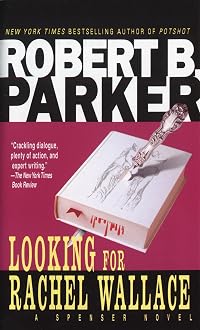
WHAT'S LOOKING FOR RACHEL WALLACE ABOUT?
Spenser is hired to act as a bodyguard for Rachel Wallace. Wallace is a no-nonsense feminist activist and lesbian author. There have been threats made against her if her book exposing the discriminatory practices of several New England companies is published. The threats make little sense since the galleys have already been released (and therefore the material is out there), but they're still there.
Despite clashing in their first meeting, Wallace agrees to her publisher's choice in Spenser and he agrees to try not to annoy her. The two continue to squabble for the first eighty or so pages. Wallace keeps trying to provoke Spenser, questioning his professionalism, wanting to debate her brand of feminism with him. Spenser really doesn't care about all that—and as much as he's willing to discuss and think about those issues at other times (he'd read Wallace's previous work before going to work for her)t—this is about work for him. He doesn't care who she sleeps with, what she thinks, he's about keeping her as safe as he can.
There is a moment where Wallace knows she's going into somewhat hostile territory and tells Spenser to stand down beforehand. When security guards arrive to drag her off, and she goes limp to make it hard for them, Spenser intervenes. Which robs Wallace of the opportunity to make her statement, get the attention she wants, and hopefully a hearing with her target-audience. Wallace takes this as an insult, thinking Spenser's machismo forced him to protect a (seemingly) helpless woman. And, yes, that's true. But it's also true, that if Wallace had been a male academic attracting this kind of response, he'd have done the same thing.
It was the wrong thing for Spenser to do regardless, which he admits later. Wallace fires him—and apparently doesn't replace him. A couple of months later, she's kidnapped. Belson* brings Spenser in for his perspective—and of course, that just spurs Spenser into his own investigation. He blames himself for not being a better employee, so he wasn't around to protect her.
* It's never explained why a homicide detective is brought in to discuss an abduction, but let that pass.
Spenser has very little to go off of here. He has one name, from a minor incident on his first day with Wallace to look into, and he essentially spends a lot of time trying to find evidence to tie this guy to the kidnapping. There's also a KKK leader that Spenser arrested back when he was a law enforcement officer and hasn't lost track of. Working off the assumption that a racist is going to operate in the same circles as a militant misogynist, Spenser harasses him for information. It works out (to a degree), but watching Spenser bully this guy on less than a hunch really bothered me.
Almost randomly, the one piece of evidence that Spenser (and Belson, to be fair) needs to tie everything together is essentially dropped into their lap. As a record blizzard descends on Boston, Spenser decides to walk (almost all roads are closed) fifteen miles to make the best of that piece of information. And well, you can guess the rest.
I FEEL COMPELLED TO SHARE THIS QUOTATION THAT HAS NOTHING TO DO WITH THE PLOT
The Main Entrance to the Boston Public Library used to face Copley Square across Dartmouth Street. There was a broad exterior stairway and inside there was a beautiful marble staircase leading up to the main reading room with carved lions and high-domed ceilings. It was always a pleasure to go there. It felt like a library and looked like a library, and even when I was going in there to look up Duke Snider’s lifetime batting average, I used to feel like a scholar.
Then they grafted an addition on and shifted the main entrance to Boylston Street. Faithful to the spirit, the architect had probably said. But making a contemporary statement, I bet he said. The addition went with the original like Tab goes with pheasant. Now, even if I went into study the literary influence of Eleanor of Aquitaine, I felt like I’d come out with a pound of hamburger and a loaf of Wonder bread.
SO, WHAT DID I THINK ABOUT LOOKING FOR RACHEL WALLACE?
I guess I've made it clear that this isn't my favorite Spenser. But it's not that I dislike it. I enjoy spending time with Spenser and Susan. I liked when Wallace and Spenser engaged with each other—seeing Spenser in these settings tells a lot about him, as does the way he reacts to Wallace. At the same time, it's interesting seeing Spenser through her eyes (as mistaken as I think her estimation of him is, it's not merit-less). The dialogue is great, Spenser verbally sparring with Wallace's publisher and a prosecutor looking into her disappearance is just fun to read. I can't forget there are some pretty good action scenes (even if Spenser does bring a handgun to a pie fight).
It's just that this is the first one since The Godwulf Manuscript that I have to add provisos to my enjoyment. I have had the impression on many re-reads (including this time), that Parker was more interested in bringing up some of Wallace's ideas, positions, and practices than he was in telling a good story. At the very least, he was frequently distracted during the telling.
Do I recommend it? Yeah, it's a good read. It's a great way to understand the character, and the story is okay. Am I in the same kind of fan-boy mode for it as I was for Mortal Stakes, The Judas Goat or Promised Land? Nope. Still, I'll take this over almost Spenser novel from the 2000's. show less
---
“What is it you want to know?”
“Why you engage in things that are violent and dangerous.”
I sipped half a glass of beer. I took another bite of veal. “Well,” I said, "the violence is a kind of side-eiffect, I think. I have always wanted to live life on my own terms. And I have always tried to do what I can do. I am good at certain kinds of things; I have tried to go in that direction.”
"The answer doesn’t satisfy me,” Rachel said.
"It doesn’t have to. It satisfies me.”
“What he won’t say,” Susan said, "and what he may not even admit to himself is that he’d like to be Sir Gawain. He was born five hundred years too late. If you understand that, you show more understand most of what you are asking.”
"Six hundred years,” I said.
WHAT'S LOOKING FOR RACHEL WALLACE ABOUT?
Spenser is hired to act as a bodyguard for Rachel Wallace. Wallace is a no-nonsense feminist activist and lesbian author. There have been threats made against her if her book exposing the discriminatory practices of several New England companies is published. The threats make little sense since the galleys have already been released (and therefore the material is out there), but they're still there.
Despite clashing in their first meeting, Wallace agrees to her publisher's choice in Spenser and he agrees to try not to annoy her. The two continue to squabble for the first eighty or so pages. Wallace keeps trying to provoke Spenser, questioning his professionalism, wanting to debate her brand of feminism with him. Spenser really doesn't care about all that—and as much as he's willing to discuss and think about those issues at other times (he'd read Wallace's previous work before going to work for her)t—this is about work for him. He doesn't care who she sleeps with, what she thinks, he's about keeping her as safe as he can.
There is a moment where Wallace knows she's going into somewhat hostile territory and tells Spenser to stand down beforehand. When security guards arrive to drag her off, and she goes limp to make it hard for them, Spenser intervenes. Which robs Wallace of the opportunity to make her statement, get the attention she wants, and hopefully a hearing with her target-audience. Wallace takes this as an insult, thinking Spenser's machismo forced him to protect a (seemingly) helpless woman. And, yes, that's true. But it's also true, that if Wallace had been a male academic attracting this kind of response, he'd have done the same thing.
It was the wrong thing for Spenser to do regardless, which he admits later. Wallace fires him—and apparently doesn't replace him. A couple of months later, she's kidnapped. Belson* brings Spenser in for his perspective—and of course, that just spurs Spenser into his own investigation. He blames himself for not being a better employee, so he wasn't around to protect her.
* It's never explained why a homicide detective is brought in to discuss an abduction, but let that pass.
Spenser has very little to go off of here. He has one name, from a minor incident on his first day with Wallace to look into, and he essentially spends a lot of time trying to find evidence to tie this guy to the kidnapping. There's also a KKK leader that Spenser arrested back when he was a law enforcement officer and hasn't lost track of. Working off the assumption that a racist is going to operate in the same circles as a militant misogynist, Spenser harasses him for information. It works out (to a degree), but watching Spenser bully this guy on less than a hunch really bothered me.
Almost randomly, the one piece of evidence that Spenser (and Belson, to be fair) needs to tie everything together is essentially dropped into their lap. As a record blizzard descends on Boston, Spenser decides to walk (almost all roads are closed) fifteen miles to make the best of that piece of information. And well, you can guess the rest.
I FEEL COMPELLED TO SHARE THIS QUOTATION THAT HAS NOTHING TO DO WITH THE PLOT
The Main Entrance to the Boston Public Library used to face Copley Square across Dartmouth Street. There was a broad exterior stairway and inside there was a beautiful marble staircase leading up to the main reading room with carved lions and high-domed ceilings. It was always a pleasure to go there. It felt like a library and looked like a library, and even when I was going in there to look up Duke Snider’s lifetime batting average, I used to feel like a scholar.
Then they grafted an addition on and shifted the main entrance to Boylston Street. Faithful to the spirit, the architect had probably said. But making a contemporary statement, I bet he said. The addition went with the original like Tab goes with pheasant. Now, even if I went into study the literary influence of Eleanor of Aquitaine, I felt like I’d come out with a pound of hamburger and a loaf of Wonder bread.
SO, WHAT DID I THINK ABOUT LOOKING FOR RACHEL WALLACE?
I guess I've made it clear that this isn't my favorite Spenser. But it's not that I dislike it. I enjoy spending time with Spenser and Susan. I liked when Wallace and Spenser engaged with each other—seeing Spenser in these settings tells a lot about him, as does the way he reacts to Wallace. At the same time, it's interesting seeing Spenser through her eyes (as mistaken as I think her estimation of him is, it's not merit-less). The dialogue is great, Spenser verbally sparring with Wallace's publisher and a prosecutor looking into her disappearance is just fun to read. I can't forget there are some pretty good action scenes (even if Spenser does bring a handgun to a pie fight).
It's just that this is the first one since The Godwulf Manuscript that I have to add provisos to my enjoyment. I have had the impression on many re-reads (including this time), that Parker was more interested in bringing up some of Wallace's ideas, positions, and practices than he was in telling a good story. At the very least, he was frequently distracted during the telling.
Do I recommend it? Yeah, it's a good read. It's a great way to understand the character, and the story is okay. Am I in the same kind of fan-boy mode for it as I was for Mortal Stakes, The Judas Goat or Promised Land? Nope. Still, I'll take this over almost Spenser novel from the 2000's. show less
Now we're getting into a dialectic hidden in mystery prose. I have to admit I liked this one quite a bit. Machisimo vs. Militant Feminism, Sir Galad vs. Adriene Rich. Mix in some serious growing respect between the two and we've got a real jem of a story.
Members
- Recently Added By
Lists

Page Turners
185 works; 11 members
Author Information

126+ Works 72,849 Members
Robert Brown Parker is an American fiction writer of mysteries. He was born in Springfield, Massachusetts and earned his BA degree from Colby College in Waterville, Maine. He went on to earn his master's degree in English literature from Boston University. He started his career working in advertising. After some years, he went back to school to show more earn his PhD in English from Boston University in 1971. He then began his writng career while teaching at Northeastern University. He decided to become a full-time writer in 1979. His most popular works were the 40 novels written about the private detective Spenser. The ABC Television Network developed the television series "Spenser: For Hire", based on the character in the mid-1980s. Parker also wrote nine novels based on the character Jesse Stone and six novels based on the character Sunny Randall. On January 18, 2010, Robert Parker died suddenly of a heart attack at his home in Cambridge Massachusetts. (Bowker Author Biography) show less
Some Editions
Awards and Honors
Notable Lists
Series

Work Relationships
Common Knowledge
- Canonical title
- Looking for Rachel Wallace
- Original publication date
- 1980
- People/Characters
- Spenser; Susan Silverman; Rachel Wallace
- Important places
- Boston, Massachusetts, USA
- Dedication
- For Joan, David and Daniel---my good fortune.
- First words
- Locke-Ober's Restaurant is on Winter Place, which is an alley off Winter Street just down from the Common.
- Quotations
- "S-p-e-n-s-e-r. like the English poet"
- Last words
- (Click to show. Warning: May contain spoilers.)Much later we heard Rachel cry out in her sleep, and I got off the couch and went in and sat on the bed beside her, and she took my hand and held it until nearly dawn.
- Blurbers
- Wakefield, Dan
Classifications
Statistics
- Members
- 1,190
- Popularity
- 21,021
- Reviews
- 22
- Rating
- (3.81)
- Languages
- 6 — Dutch, English, Finnish, French, German, Spanish
- Media
- Paper, Audiobook, Ebook
- ISBNs
- 24
- ASINs
- 10