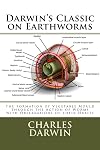
The Formation of Vegetable Mould Through the Action of Worms
by Charles Darwin 
On This Page
Description
This book, published in 1881, was the result of many years of experimentation and observation by Darwin in the open-air laboratory of his garden at Down House in Kent. As he wrote in his introduction, the subject of soil disturbance by worms 'may appear an insignificant one, but we shall see that it possesses some interest'. He goes on to demonstrate the immensity - in size and over time - of the accumulated tiny movements of soil by earthworms, and their vital role in aerating the soil and show more breaking down vegetable material to keep the topsoil, the growing medium for all plant life and thus vital to human existence, fertile and healthy. At a time when there is huge interest in growing food organically and without using artificial fertilisers, Darwin's insights are as important, and his descriptions of his experiments as fascinating, as they were in the late nineteenth century. show lessTags
Recommendations


















Member Reviews
Darwin’s little book on earthworms was the last of his scientific works, published in the year before his death in 1882 and more than 20 years after the great work, On the Origin of Species. The Formation of Vegetable Mould has an autumnal feeling; much of it is based on observations and experiments by Darwin and his sons William and Horace in the gardens and fields surrounding their home, Down House in Kent. Darwin’s interest in worms and their contribution to the geology of landforms long preceded the formulation of his evolutionary theory. He first published on worms in 1837 and concluded that the entirety of the vegetable humus that constitutes the surface soil of England has passed many times and continued to pass through their show more intestinal canals. Millions upon millions of tons each year, in his estimate. In this last work Darwin links evolutionary theory and geology in his response to Mr DT Fish who disputed his account of the magnitude of the effects of bioturbation of the English land surface by worms. Fish thought worms too small and weak to be capable of the ‘stupendous’ work attributed to them. Darwin responded:
‘Here we have an instance of that inability to sum up the effects of a continually recurrent cause, which has so often retarded the progress of science, as formerly in the case of geology, and more recently in that of the principle of evolution’.
Though Darwin was mainly concerned with effects of bioturbation of the soil by worms his observation of their habits led him wonder ‘how far they acted consciously, and how much mental power they displayed.” In his second chapter he discusses the question of their intelligence at some length, concluding that their behaviour in manoeuvring leaves to shield the mouths of their burrows showed a degree of adaptability in their behaviour suggestive of a capacity to learn by experience. He tested them by restricting their choice of leaves to unfamiliar varieties and small triangles of paper and observing the attempts to draw the unfamiliar leaves and paper into their burrows. He concluded that, deaf and blind as they were, the worms acquired a tactile notion of the shape of these objects and learned by experience the ways in which they might be manipulated. His observations led him to surmise that they might ‘deserve to be called intelligent, for they then act in nearly the same manner as would a man in similar circumstances’.
There is much else besides, in praise of worms. Darwin devotes another chapter to the ways in which the remnants of Roman buildings, in particular their tessellated floors, have been preserved under the steady accumulation of vegetable mould from worm casts.
Darwin must have enjoyed writing this last little book about worms. There is a sense of quiet exuberance in his prose. And moments of delight for the reader, as in the sinuous Latinity of his discussion of their gizzards: ‘In the same manner as gallinaceous and struthious birds swallow stones to aid in the trituration of their foods, so it appears to be with terricolous worms. The gizzards of thirty eight of our common worms were opened…’
My edition of The Formation of Vegetable Mould, which I rescued from the discard pile of a charity bookshop, is a curiosity in its own right. It was published in California in 1976 by the Bookworm Publishing Company, an imprint apparently now defunct with a catalogue that included such titles as ‘Harnessing the Earthworm’, ‘Let an Earthworm be your Garbageman’ and ’Raising the African Night Crawler’. show less
‘Here we have an instance of that inability to sum up the effects of a continually recurrent cause, which has so often retarded the progress of science, as formerly in the case of geology, and more recently in that of the principle of evolution’.
Though Darwin was mainly concerned with effects of bioturbation of the soil by worms his observation of their habits led him wonder ‘how far they acted consciously, and how much mental power they displayed.” In his second chapter he discusses the question of their intelligence at some length, concluding that their behaviour in manoeuvring leaves to shield the mouths of their burrows showed a degree of adaptability in their behaviour suggestive of a capacity to learn by experience. He tested them by restricting their choice of leaves to unfamiliar varieties and small triangles of paper and observing the attempts to draw the unfamiliar leaves and paper into their burrows. He concluded that, deaf and blind as they were, the worms acquired a tactile notion of the shape of these objects and learned by experience the ways in which they might be manipulated. His observations led him to surmise that they might ‘deserve to be called intelligent, for they then act in nearly the same manner as would a man in similar circumstances’.
There is much else besides, in praise of worms. Darwin devotes another chapter to the ways in which the remnants of Roman buildings, in particular their tessellated floors, have been preserved under the steady accumulation of vegetable mould from worm casts.
Darwin must have enjoyed writing this last little book about worms. There is a sense of quiet exuberance in his prose. And moments of delight for the reader, as in the sinuous Latinity of his discussion of their gizzards: ‘In the same manner as gallinaceous and struthious birds swallow stones to aid in the trituration of their foods, so it appears to be with terricolous worms. The gizzards of thirty eight of our common worms were opened…’
My edition of The Formation of Vegetable Mould, which I rescued from the discard pile of a charity bookshop, is a curiosity in its own right. It was published in California in 1976 by the Bookworm Publishing Company, an imprint apparently now defunct with a catalogue that included such titles as ‘Harnessing the Earthworm’, ‘Let an Earthworm be your Garbageman’ and ’Raising the African Night Crawler’. show less
Most amazing...Darwin's theories in a nutshell, but also this is perhaps the one work in his oeuvre where the reader can most easily discover a sense of the man and his astute powers of observation and reason -- his mind at work, his humanity, and his love for nature.
His last book, it outsold "Origin of the Species" during his lifetime.
His last book, it outsold "Origin of the Species" during his lifetime.
This little book is much shorter and more easily readable than most of Darwin's works. One of his final works, it is not as bound up in the wordy Victorian style, but still he manages to have the unmistakable Darwin style, packing the small volume with myriad examples, drawings, and tons of evidence. One of the first major works on earthworms, Darwin helped establish this humble creature in its proper place as an ecologically important species.
Ten page introduction is by one of the founders of the organic agriculture movement and a key figure in permaculture, and is both highly technical and very interesting. https://en.wikipedia.org/wiki/Albert_Howard
Third Thousand, 1881, Full green, polished leather
Fascinating and, someway, poetic.
For what I know, it was Darwin's last work. Of course it is a technical essay, stuffed with calculations and descriptions of experiments, but it transmits the wonder Darwin felt in front of nature, the same way On The Origin of Species does.
Actually, it was one of the first scientific works to prove the fundamental role of earthworms in nature.
For what I know, it was Darwin's last work. Of course it is a technical essay, stuffed with calculations and descriptions of experiments, but it transmits the wonder Darwin felt in front of nature, the same way On The Origin of Species does.
Actually, it was one of the first scientific works to prove the fundamental role of earthworms in nature.
Jul 31, 2024 (Edited)English (UK)
Ratings
Members
- Recently Added By
Author Information

348+ Works 32,784 Members
Charles Robert Darwin, born in 1809, was an English naturalist who founded the theory of Darwinism, the belief in evolution as determined by natural selection. Although Darwin studied medicine at Edinburgh University, and then studied at Cambridge University to become a minister, he had been interested in natural history all his life. His show more grandfather, Erasmus Darwin, was a noted English poet, physician, and botanist who was interested in evolutionary development. Darwin's works have had an incalculable effect on all aspects of the modern thought. Darwin's most famous and influential work, On the Origin of Species, provoked immediate controversy. Darwin's other books include Zoology of the Voyage of the Beagle, The Variation of Animals and Plants Under Domestication, The Descent of Man, and Selection in Relation to Sex. Charles Darwin died in 1882. (Bowker Author Biography) show less
Charles Darwin has a Legacy Library. Legacy libraries are the personal libraries of famous readers, entered by LibraryThing members from the Legacy Libraries group.
Some Editions
Series
Belongs to Publisher Series
Heibonsha Library (56)
Work Relationships
Common Knowledge
- Original publication date
- 1881
- First words
- The share which worms have taken in the formation of the layer of vegetable mould, which covers the whole surface of the land in every moderately humid country, is the subject of the present volume.
- Last words
- (Click to show. Warning: May contain spoilers.)It may be doubted whether there are many other animals which have played so important a part in the history of the world, as have these lowly organised creatures. Some other animals, however, still more lowly organised, namely corals, have done far more conspicuous work in having constructed innumerable reefs and islands in the great oceans; but these are almost confined to the tropical zones.
Classifications
Statistics
- Members
- 146
- Popularity
- 225,568
- Reviews
- 6
- Rating
- (4.35)
- Languages
- 6 — English, German, Italian, Japanese, Spanish, Turkish
- Media
- Paper, Ebook
- ISBNs
- 36
- ASINs
- 12