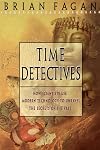
Time Detectives: How Archaeologists Use Technology to Recapture the Past
by Brian Fagan
On This Page
Description
The focus of archeology has changed from collecting artifacts to using advanced technology to learn more about how our ancestors lived.Tags
Recommendations




















Member Reviews
I really, really enjoyed this archaelogy book. The focus is on the techniques and methods sifters and seekers use to date remains, re-assemble them, and read the history from such ancient scraps as debitage (the flakes left over from making stone age tools.) Such stunning tales include rebuilding source rocks out of debitage to ascertain two, differnet-handed tool makers sat side-by-side and putting together a cannibalized skeleton to retell events of human butchery and boiling.
The excessive off-the-cliff mass kills of buffalo by Native Americans, far in excess of their survival needs was enlightening (reminding me that all humanity is at times gluttons) as was the epigraphy of deciphering Mayan.
The only complaints that kept me from show more giving it 5 starts:
1] I needed more pictures and illustrations
and,
2] For the epigraphy topics, like Mayan and the day-to-day writings of Roman soldiers posted at Hadrian's Wall, I wanted more actual quotes, regardless of how mundane. show less
The excessive off-the-cliff mass kills of buffalo by Native Americans, far in excess of their survival needs was enlightening (reminding me that all humanity is at times gluttons) as was the epigraphy of deciphering Mayan.
The only complaints that kept me from show more giving it 5 starts:
1] I needed more pictures and illustrations
and,
2] For the epigraphy topics, like Mayan and the day-to-day writings of Roman soldiers posted at Hadrian's Wall, I wanted more actual quotes, regardless of how mundane. show less
This book is a collection of 13 essays on modern archaeology and how technology is changing that field of study. It is also about how the use of many different scientific disciplines (scientists in different fields of study working at dig sites and in the lab) can bring out much more information than an archaeologist working alone with ancient artifacts. The book is divided into three sections: Hunters and Gathers, Farmers, and Civilizations, and covers discoveries from all across the world. The history of the world’s civilizations is the history of each one of us and I found each article interesting and very much worth reading. Another important aspect of this book is that we can learn so much more by working together than by working show more alone. An important message for the world we live in today! show less
What ages would I recommend it too? – Twelve and up.
Length? – Several days read.
Characters? – None.
Setting? – Our world throughout history.
Written approximately? – 1995.
Does the story leave questions in the readers mind? – Ready to read more.
Any issues the author (or a more recent publisher) should cover? No.
Short storyline: The "Time Detectives" does an excellent job of blending storytelling how a certain set of artifacts may have come into being at a time and place in the past. Many locations throughout the world are discovered under the guidance of the author. At the end, are chapter separated sections for all of the written documents the authors used to write the chapter. Discussion of new and interesting archeological show more and dating techniques are discussed in chapters as relevant to the specific digs.
Notes for the reader: show less
Ratings
Members
- Recently Added By
Lists

Best Science Books for Non-Scientists
113 works; 57 members
Author Information

118+ Works 9,571 Members
Brian Fagan is emeritus professor of anthropology at the University of California, Santa Barbara. A former Guggenheim fellow, he has written many internationally acclaimed, popular books about archaeology, including The Little Ice Age, The Great Warming, and The Lang Summer. He lives in Santa Barbara, California.
Classifications
Statistics
- Members
- 363
- Popularity
- 86,615
- Reviews
- 3
- Rating
- (3.48)
- Languages
- English
- Media
- Paper
- ISBNs
- 3
- ASINs
- 2