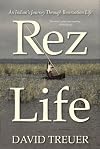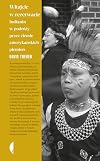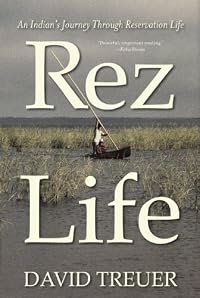
Rez Life: An Indian's Journey Through Reservation Life
by David Treuer
On This Page
Description
Novelist David Treuer examines Native American reservation life--past and present--illuminating misunderstood contemporary issues of sovereignty, treaty rights, and natural-resource conservation while also exploring crime and poverty, casinos and wealth, and the preservation of native language and culture.Tags
Recommendations



















Member Reviews
“Like reservations themselves, this book is a hybrid. It has elements of journalism, history, and memoir. As such it is meant to be suggestive rather than exhaustive. It is meant to capture some of the history and some of the truth of reservation life—which is not any one thing but many things depending on where you’re looking and to whom you’re talking.” – Dave Treuer, Rez Life
Based on the author’s above-stated purpose, I think he succeeds. Treuer starts the book with his personal experience growing up on a reservation. He then relates the results of many interviews that offer insights on what “rez” life is like today. In the process, he delivers a history of reservations, including past treaties, violations, and show more major changes in the law since conception. His primary focus is on his own tribe, the Ojibwe in the Great Lakes region, but he visits other tribes as well.
The book is structured around people and their stories. This works for the most part, though it can occasionally seem disjointed and allows for many digressions into side topics. Content includes the origins of casinos on Indian land, treaty rights, tribal sovereignty, and the various states of Indian cultures – some thriving and others dwindling. It highlights ongoing social problems on reservations such as poverty, violence, and substance abuse. It clears up many misconceptions. The author is obviously proud of his heritage. He remains optimistic, while not glossing over the challenges faced by reservation residents. show less
Based on the author’s above-stated purpose, I think he succeeds. Treuer starts the book with his personal experience growing up on a reservation. He then relates the results of many interviews that offer insights on what “rez” life is like today. In the process, he delivers a history of reservations, including past treaties, violations, and show more major changes in the law since conception. His primary focus is on his own tribe, the Ojibwe in the Great Lakes region, but he visits other tribes as well.
The book is structured around people and their stories. This works for the most part, though it can occasionally seem disjointed and allows for many digressions into side topics. Content includes the origins of casinos on Indian land, treaty rights, tribal sovereignty, and the various states of Indian cultures – some thriving and others dwindling. It highlights ongoing social problems on reservations such as poverty, violence, and substance abuse. It clears up many misconceptions. The author is obviously proud of his heritage. He remains optimistic, while not glossing over the challenges faced by reservation residents. show less
A 4.5, it loses a half point for some organizational issues, but otherwise this is stellar. Treuer addresses not just the problems on the reservations, though he does not ignore those, but also so much that is vital about these communities. While focusing primarily (but not solely) on his own Ojibwe community on the Red Lake rez in Minnesota and the nearby reservations in the parts of this that look at modern life for Indians, Treuer also tackles a good deal of the history of Native Americans after the arrival of Europeans on US soil in a way that shows Indians as victims and warriors, as statesmen and isolationists, and as people of generosity and greed. There is a grit, an honesty, and a historical rigor here that is admirable, but show more its also a super enjoyable read. I have never read anything like it. show less
I scrolled down through my ereader library and found On the Rez by David Treuer. It was an interesting book, combining several genres as Treuer wove his own story as well as those of others into the larger history of Native Americans with a focus on reservations. Treuer is an enrolled Ojibwe and is actively working, along with his brother, to preserve the language.
I have done a fair amount of reading about Native American history but wasn't familiar with how the reservation system continues to be part of the discussion. Treuer grew up on Leech Lake Reservation in Minnesota, and many of the stories revolve around fishing rights and the walleye industry in particular. He spends a fair amount of time on the how the past history, show more particularly the boarding schools, were designed to force assimilation and the eradication of Native Americans. But, he also explores the complicated relationships among Native Americans and the difficulty of defining who is a Native American at all.
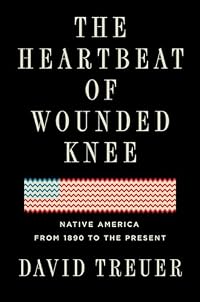
I wasn't familiar with Treuer but plan to explore his books, particularly The Heartbeat of Wounded Knee: Native America from 1890 to the Present, which was a National Book Award finalist in 2019. show less
I have done a fair amount of reading about Native American history but wasn't familiar with how the reservation system continues to be part of the discussion. Treuer grew up on Leech Lake Reservation in Minnesota, and many of the stories revolve around fishing rights and the walleye industry in particular. He spends a fair amount of time on the how the past history, show more particularly the boarding schools, were designed to force assimilation and the eradication of Native Americans. But, he also explores the complicated relationships among Native Americans and the difficulty of defining who is a Native American at all.
I wasn't familiar with Treuer but plan to explore his books, particularly The Heartbeat of Wounded Knee: Native America from 1890 to the Present, which was a National Book Award finalist in 2019. show less
Through historical accounts and depictions of reservations across the U.S. in the present-day, David Treuer reveals the ways in which reservation life has been for Native Americans simultaneously tragically bleak and yet surprisingly hopeful. The number and variety of laws and regulations regarding taxes, the use of natural resources, education, courts and self-government, are remarkably complex, and it was personally eye-opening to learn how reservations function on some level almost as sovereign nations, with many citizens opting to travel abroad on reservation passports rather than a U.S. passport. Though there is some repetition and errors that should have been caught by Treuer's editors, this is an important book, especially for show more fellow Minnesotans. show less
Difficult to read... not only to learn about even more nastiness that the white government still inflicts upon the different native peoples, but technically difficult because of the structure of the book. The blurb reminds us that Treuer has written successful fiction, but it lies when making the claim relevant. There is no narrative, and there is no story arc, and there is no happily ever after. History, journalism, and a bit of memoir, are used to illustrate six encompassing facets of what it's like to be a 21st century Indian.
It's obviously just a starting point, really. For example, urban Indians are only briefly mentioned. There are a lot of numbers, but a lot are missing, too: eg, a certain tribe has only a tiny enrollment... but show more how many tribes are there, and what is the 'average' enrollment, and which are growing? How many Indians *do* successfully graduate from college? What was he talking about when he tried to explain why some Indians don't like immersion schools that raise the children in the language, attempting to preserve aspects of traditional culture?
(rhetorical questions; I don't need y'all to try to answer)
In the epilogue a "feud" with another Indian writer is mentioned. I wonder who it is, and what they disagree about. Because, certainly, other folks will have other perspectives.
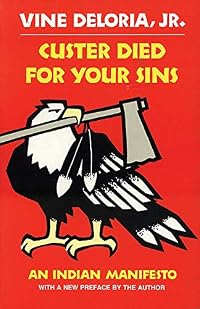
In any case, this is the most eye-opening book on Indian life I've read since [a:Vine Deloria Jr.|6729028|Vine Deloria Jr.|https://d.gr-assets.com/authors/1392547280p2/6729028.jpg]'s [b:Custer Died for Your Sins: An Indian Manifesto|197753|Custer Died for Your Sins An Indian Manifesto|Vine Deloria Jr.|https://d.gr-assets.com/books/1320821739s/197753.jpg|1295352].
There is a short list of books for further reading, but unfortunately no index. A good book to read on your e-reader, then, so you can easily find 'what was that other thing he said about that one thing...".
Maybe only 3.5 stars. Depends on what other book you might choose to read instead, iow, compared to ... what? show less
It's obviously just a starting point, really. For example, urban Indians are only briefly mentioned. There are a lot of numbers, but a lot are missing, too: eg, a certain tribe has only a tiny enrollment... but show more how many tribes are there, and what is the 'average' enrollment, and which are growing? How many Indians *do* successfully graduate from college? What was he talking about when he tried to explain why some Indians don't like immersion schools that raise the children in the language, attempting to preserve aspects of traditional culture?
(rhetorical questions; I don't need y'all to try to answer)
In the epilogue a "feud" with another Indian writer is mentioned. I wonder who it is, and what they disagree about. Because, certainly, other folks will have other perspectives.
In any case, this is the most eye-opening book on Indian life I've read since [a:Vine Deloria Jr.|6729028|Vine Deloria Jr.|https://d.gr-assets.com/authors/1392547280p2/6729028.jpg]'s [b:Custer Died for Your Sins: An Indian Manifesto|197753|Custer Died for Your Sins An Indian Manifesto|Vine Deloria Jr.|https://d.gr-assets.com/books/1320821739s/197753.jpg|1295352].
There is a short list of books for further reading, but unfortunately no index. A good book to read on your e-reader, then, so you can easily find 'what was that other thing he said about that one thing...".
Maybe only 3.5 stars. Depends on what other book you might choose to read instead, iow, compared to ... what? show less
In the author’s notes of Rez Life, David Treuer calls his book a combination of memoir, journalism, and history, and that’s exactly how it reads. Treuer grew up on an Ojibwe reservation in Minnesota, and he uses his personal background and knowledge to explore the Native American experience. He illuminates many of the modern circumstances with historical information and relates it to his family and friends in a way that feels very connected and real. Rez Life is an excellent read for those looking for an introduction to the Native American struggle in the United States.
Rez Life: An Indian's Journey Through Reservation Life by David Treuer is part memoir, part interview, and part history of the Ojibwe and the Leech Lake Reservation.
Individually these pieces of Ojibwe life are well written, fascinating views into a piece of Native American culture. Where the book falters is in its organization. With little or no segue, the narrative jumps around through memoir, interview and history.
This book would be best suited for readers familiar with the Ojibwe and / or Northern Minnesota. There's not enough by way of introduction or logical structure to aid the uninitiated reader. I would recommend reading this book in conjunction with other texts.
Individually these pieces of Ojibwe life are well written, fascinating views into a piece of Native American culture. Where the book falters is in its organization. With little or no segue, the narrative jumps around through memoir, interview and history.
This book would be best suited for readers familiar with the Ojibwe and / or Northern Minnesota. There's not enough by way of introduction or logical structure to aid the uninitiated reader. I would recommend reading this book in conjunction with other texts.
Members
- Recently Added By
Lists

Native American / Indigenous Literature
172 works; 100 members

Indigenous America Reader
145 works; 12 members
Author Information

12+ Works 2,013 Members
David Treuer is Ojibwe from the Leech Lake Reservation in northern Minnesota. The author of four novels and two previous books of nonfiction, he has written for The New York Times, the Los Angeles Times, The Washington Post, and other publications. He teaches at the University of Southern California.
Awards and Honors
Awards
Common Knowledge
- Original publication date
- 2012
- Dedication
- In memory
Ron LaFriniere, Eugene Seelye, Thomas Stillday Jr.,
and
Art Koch
for Elsina, Noka, and Bine - First words
- In northern Minnesota, not far from the headwaters of the Mississippi River, you may see a sign. (Introduction)
- Last words
- (Click to show. Warning: May contain spoilers.)I tried to see which one flew higher but it was impossible to say for sure.
- Blurbers
- Sides, Hampton; Dolin, Eric Jay; Nabokov, Peter; Hicks, Brian; Mondale, Walter
Classifications
- Genres
- Nonfiction, General Nonfiction, History, Biography & Memoir, Politics and Government
- DDC/MDS
- 323.1197 — Society, Government, and Culture Political science Civil Rights & Liberties/ Human Rights Minority Politics Specific Groups Biography And History North American Origin
- LCC
- E93 .T74 — History of the United States America Indians of North America
- BISAC
Statistics
- Members
- 451
- Popularity
- 67,446
- Reviews
- 16
- Rating
- (3.65)
- Languages
- English, French, Polish
- Media
- Paper, Audiobook, Ebook
- ISBNs
- 13
- ASINs
- 5