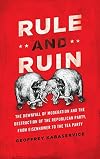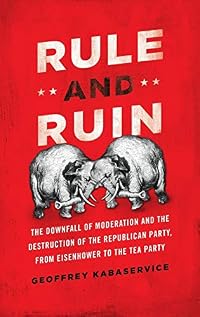
Rule and Ruin: The Downfall of Moderation and the Destruction of the Republican Party, From Eisenhower to the Tea Party
by Geoffrey Kabaservice
On This Page
Description
As the 2012 elections approach, the Republican Party is rocketing rightward away from the center of public opinion. Republicans in Congress threaten to shut down the government and force a U.S. debt default. Tea Party activists mount primary challenges against Republican officeholders who appear to exhibit too much pragmatism or independence. Moderation and compromise are dirty words in the Republican presidential debates. The GOP, it seems, has suddenly become a party of ideological purity. show more Except this development is not new at all. In Rule and Ruin, Geoffrey Kabaservice reveals that the mode show lessTags
Recommendations




































Member Reviews
Kabaservice really likes small government (but antidiscrimination law is good and the distinctive accomplishment of moderate Republicans, for which they didn’t get credit). He tells the story of the destruction of the moderate Republicans as a tragedy; Barry Goldwater’s candidacy seems in retrospect like a rehearsal for Trump, though that’s so awful that the horror with which Goldwater would have regarded Trump can’t even be ironic.
Given the ever-rightward march of today’s Republican Party, it can be difficult to recall that there was a time when moderates played a prominent role within its ranks. How they lost this position and became a alienated presence within the GOP is the subject of Geoffrey Kabaservice’s book. In it he tells a dispiriting tale of the rise of extremism within one of the two dominant parties in American politics, one that charts the key moments in the party’s ideological shift and explains the fate of the moderate politicians caught in this process.
Kabaservice dates the origins of this shift to the 1960s. He identifies four distinct factions within the party at the start of the decade: moderates, progressives, conservative show more “stalwarts”, and reactionaries. With Dwight Eisenhower in the Oval Office the moderates held sway, leaving the stalwarts and the reactionaries frustrated with the direction of events. In the aftermath of the 1960 presidential election, the militant extremists on the right sought to fill the vacuum created by Richard Nixon’s defeat to take over the party infrastructure. Rallying around Barry Goldwater, who had emerged as the right’s leading figure, these activists sought to take over the party at the local and state level by whatever means necessary. Gaining control of these mundane posts, they used their positions to promote Goldwater over Nelson Rockefeller, the liberal New York governor who was the front runner for the party’s presidential nomination in 1964. Benefiting from a backlash against Rockefeller’s divorce and remarriage, they succeeded in winning the nomination for Goldwater, who then lost the subsequent election to Lyndon Johnson in a landslide.
Faced with such an aggressive and self-defeating insurgency, the moderates mobilized to take back control of their party. Kabaservice’s description of their efforts form the heart of his book, and he notes the considerable success they enjoyed both in regaining a degree of control and in electing moderates in the 1966 midterm elections. Yet the extremists proved too well entrenched to dislodge completely, forcing an accommodation between the two sides. Conservatives and reactionaries benefited as well from the broader political trends of the 1960s, as social tensions involving young people and minorities served as easy targets for their rhetoric and convinced moderates to unite with their intraparty rivals. Nevertheless, Kabaservice sees George Romney’s failed presidential bid as the moderates’ last real opportunity to maintain power in the GOP, with their history from the Nixon years onward being one of a slow decline into marginalization and irrelevance.
Kabaservice’s book offers a good account of one of the developments that shaped the modern American political landscape. His description of the internal battles and the personalities involved is particularly useful as he shows that the outcome was not necessarily inevitable, but the product of a series of choices by key individuals and their response to developments that did or did not take place. Yet while Kabaservice provides a valuable description of the activities of the moderate Republican activists, he overstates their importance relative to the activities of the extremists and the broader shifts in the public mood, which downplays the degree to which the moderates were swimming against the political tide. More attention to the takeover by the conservatives of the party organization in the early 1960s, particularly within the previously African-American dominated state and local Republican parties in the South, would have provided a more well-rounded picture of the right-wing entrenchment that moderates faced, one that likely foredoomed them to defeat even before they fully realized that the battle was at hand. As it is, his book provides only a partial portrait of the downfall of moderation within the GOP, albeit one that examines factors that have been understudied for far too long. show less
Kabaservice dates the origins of this shift to the 1960s. He identifies four distinct factions within the party at the start of the decade: moderates, progressives, conservative show more “stalwarts”, and reactionaries. With Dwight Eisenhower in the Oval Office the moderates held sway, leaving the stalwarts and the reactionaries frustrated with the direction of events. In the aftermath of the 1960 presidential election, the militant extremists on the right sought to fill the vacuum created by Richard Nixon’s defeat to take over the party infrastructure. Rallying around Barry Goldwater, who had emerged as the right’s leading figure, these activists sought to take over the party at the local and state level by whatever means necessary. Gaining control of these mundane posts, they used their positions to promote Goldwater over Nelson Rockefeller, the liberal New York governor who was the front runner for the party’s presidential nomination in 1964. Benefiting from a backlash against Rockefeller’s divorce and remarriage, they succeeded in winning the nomination for Goldwater, who then lost the subsequent election to Lyndon Johnson in a landslide.
Faced with such an aggressive and self-defeating insurgency, the moderates mobilized to take back control of their party. Kabaservice’s description of their efforts form the heart of his book, and he notes the considerable success they enjoyed both in regaining a degree of control and in electing moderates in the 1966 midterm elections. Yet the extremists proved too well entrenched to dislodge completely, forcing an accommodation between the two sides. Conservatives and reactionaries benefited as well from the broader political trends of the 1960s, as social tensions involving young people and minorities served as easy targets for their rhetoric and convinced moderates to unite with their intraparty rivals. Nevertheless, Kabaservice sees George Romney’s failed presidential bid as the moderates’ last real opportunity to maintain power in the GOP, with their history from the Nixon years onward being one of a slow decline into marginalization and irrelevance.
Kabaservice’s book offers a good account of one of the developments that shaped the modern American political landscape. His description of the internal battles and the personalities involved is particularly useful as he shows that the outcome was not necessarily inevitable, but the product of a series of choices by key individuals and their response to developments that did or did not take place. Yet while Kabaservice provides a valuable description of the activities of the moderate Republican activists, he overstates their importance relative to the activities of the extremists and the broader shifts in the public mood, which downplays the degree to which the moderates were swimming against the political tide. More attention to the takeover by the conservatives of the party organization in the early 1960s, particularly within the previously African-American dominated state and local Republican parties in the South, would have provided a more well-rounded picture of the right-wing entrenchment that moderates faced, one that likely foredoomed them to defeat even before they fully realized that the battle was at hand. As it is, his book provides only a partial portrait of the downfall of moderation within the GOP, albeit one that examines factors that have been understudied for far too long. show less
Ratings
Members
- Recently Added By
Author Information
4 Works 209 Members
Geoffrey Kabaservice is the author of the critically acclaimed The Guardians: Kingman Brewster, His Circle, and the Rise of the Liberal Establishment. He has written for numerous national publications and has been an assistant professor of history at Yale University.
Some Editions
Awards and Honors
Awards
Distinctions
Series
Belongs to Publisher Series
Common Knowledge
- Canonical title
- Rule and Ruin: The Downfall of Moderation and the Destruction of the Republican Party, From Eisenhower to the Tea Party
- Original publication date
- 2012
- People/Characters
- Dwight D. Eisenhower; Barry Goldwater; William F. Buckley, Jr.; Richard M. Nixon
- Important places
- Washington, D.C., USA; Ripon, Wisconsin, USA
- Important events
- Republican National Convention (1960)
- Epigraph
- "All things in moderation, including moderation"
— attributed to Petronius - Dedication
- To my sister,
Marah Michele Kabaservice - First words
- At 8:50 P.M. on the evening of July 28, 1960, great cascades of brightly colored balloons drifted slowly down from the ceiling of the Chicago International Amphitheater onto the crowd assembled below for the Republican nation... (show all)al convention.
Classifications
- Genres
- Politics and Government, Nonfiction, General Nonfiction, History
- DDC/MDS
- 324.2734 — Society, Government, and Culture Political science Politics & Elections Political parties North America United States
- LCC
- JK2356 .K33 — Political Science Political institutions and public administration (United States) Political institutions and public administration United States Political parties
- BISAC
Statistics
- Members
- 172
- Popularity
- 189,794
- Reviews
- 2
- Rating
- (3.88)
- Languages
- English
- Media
- Paper, Ebook
- ISBNs
- 5
- ASINs
- 3