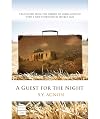
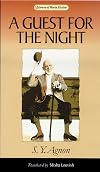
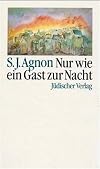
A Guest for the Night
by S. Y. Agnon
On This Page
Description
A Guest for the Night (first published in 1939 as Germany invaded Poland) is Agnon¿s depiction of how all modern movements aside from Zionism ¿ secularism, Haskalah, socialism, communism ¿ failed to provide a viable alternative to traditional life. But, he is clear, even traditional life was untenable, because it all fell apart from within before the first furnaces were ignited in Auschwitz. Even the Guest¿s well-intentioned attempt to revivify and to re-engage the lost world of piety is show more also doomed. The Alte Heim, the old home, can no longer exist ¿ it is a place where we can only be passing guests for the night. Therefore ¿you can¿t go home again,¿ but not for the reasons that Thomas Wolfe suggests; rather, because home no longer exists. It has to be rebuilt, but it can only be rebuilt in the Bayit Hadash, in the new home in the Land of Israel. This is Agnon¿s greatest theme in the novel and, in differing ways, throughout his body of writing: The idea that modern man, modern Jews, are alienated from their spiritual home. While we can¿t go home again, that doesn¿t mean we can¿t move forward through conceiving of a new home ¿ although doing so comes with the great danger of being caught in the disconnect between the old and the new, between what was and what might be. Translated by Misha Louvish, with a new Foreword by Jeffrey Saks. show lessTags
Recommendations






























Member Reviews
I guess this is a great book. It is long. The author develops an original narrative style which I assume is based on rhythms in the Torah. He paints an in-depth picture of a time & place, East Europe (Austria) between the Wars, when all the changes wrought by WW1 were playing out but the specific threats of the Nazis were not yet apparent. People thought they had choices, they went to America, they went to IPalestine ("The Land"), they stayed there. It is an amazing story of a history that stopped. The narrator is forced out of Palestine by violence so he goes back to where he grew up, and he contrasts what used to be with what now is.
Jews--Europe, Eastern--Fiction.
Ratings
Members
- Recently Added By
Lists

Jewish Books
367 works; 24 members

Book Riot's 100 must-read works of Jewish Fiction
100 works; 8 members

Judaism & Israel
104 works; 2 members

Books Read in 2021
5,361 works; 113 members

JBC's Classic Jewish Literature
5 works; 1 member
Author Information

132+ Works 2,619 Members
Shmuel Yosef Agnon was born Shmuel Yosef Halevi Czaczkes in 1888 in Galicia, Austria-Hungary (now Poland). He received training in Yiddish, Hebrew and the Talmud from his father, and was introduced to German literature by his mother. When he was fifteen, his first poems, written in Yiddish and Hebrew, were published in the newspaper. He took his show more pen name, later his legal name, S.Y. Agnon, from the title of his first story Agunot, published in 1909. He lived and worked in Palestine from 1907 until his death in 1970, except for an eleven year stay in Germany. He was buried on the Mount of Olives. Agnon was a prolific novelist and short-story writer. After his move to Jerusalem from Germany, Agnon began writing about the decline of Jewry in Galicia. His first major publication was a two-volume novel, Hakhnasat Kalah (The Bridal Canopy), 1932, which recreates the golden age of Hassidism. Ore'ah Nata' Lalun (A Guest for the Night), 1939, is an apocalyptic novel depicting the ruin of Galicia after World War I. 'Tmol Shilshom (Only Yesterday), published in 1946, is considered his greatest novel, portraying the early pioneer immigrants to Palestine. A great many of his later books are set in his adopted Palestine and deal with the replacement of early Jewish settlements after World War II. Agnon received the Nobel Prize for Literature in 1966, boosting interest in his work outside of Israel. About 85 of Agnon's works have been translated into at least 18 languages. Agnon was made an honorary citizen of Jerusalem in 1962. His portrait appears on the Israeli Fifty New Sheqalim banknote. Other works include Sefer Hamaasim (The Book of Deeds ), published in 1932, Pat Shlema (A Whole Loaf ), from 1933, Shevuat Emunim (Two Tales), 1943, and Kol Sipurav Shel Sh. Y. Agnon ( The Collected Works in 11 volumes), 1931-62. (Bowker Author Biography) Agnon was born in Galicia, the former Austrian crown land in east central Europe. In his home he was influenced by rabbinical and Hasidic traditions and the reviving spirit of European culture, Agnon began writing Hebrew and Yiddish at the age of eight. He contributed poetry and prose to periodicals, such as Ha-Mizpeh and Der Juedische Wecker. After he immigrated to Palestine in 1907, he no longer wrote in Yiddish. He chose the pen name "Agnon" from the title of his first novel, Agunot (Forsaken Wives); its meaning is "cut off" in Hebrew. From 1912 to 1914 Agnon lived in Germany, where he met Salman Schocken and convinced him that someone should undertake the publishing of Hebrew books. In 1931 Berlin Schocken Verlag published four volumes of Agnon's collected works in Hebrew. Agnon was awarded the Bialik Prize for literature in 1934, and in 1936 the Jewish Theological Seminary of America made him an honorary Doctor of Hebrew Letters. Other honors followed, including the Israel Prize in 1954 and 1958. In 1966 he became the first Israeli to receive the Nobel Prize for literature, which was awarded jointly to the Swedish writer Nelly Sachs. Agnon often deals with philosophical and psychological problems in a miraculous or supernatural manner. Reality is colored in a dreamlike atmosphere. Agnon is concerned with contemporary problems of a spiritual nature-the disintegration of traditional life, loss of faith and identity, and loneliness. At the center of his work is the Jew in various manifestations: a person of faith, a nihilist, a victim of pogroms and the Holocaust, a pioneer, and a saint. Creating a unique Hebrew prose style, his works link historic Jewish piety and martyrdom with longing for Israel. Yet they have universal appeal to the modern reader. Agnon himself has said: "I am not a modern writer. I am astounded that I even have one reader. I don't see the reader before me... No, I see before me only the Hebrew letter saying 'write me thus and not thus.' I, to my regret, am like the wicked Balaam. It is written of him that "the word that God putteth in my mouth, that shall I speak"' (The New York Times). (Bowker Author Biography) show less
Awards and Honors
Series
Belongs to Publisher Series
Library of World Fiction (University of Wisconsin Press)
Nobelpreisträger Coron-Verlag (weiß) (1966 (Israel))
Common Knowledge
- Canonical title
- A Guest for the Night
- Original title
- Ore'ah nata lalun
- Original publication date
- 1938
- Blurbers
- Wilson, Edmund; Ben-Amos, Dan
Classifications
- Genres
- Fiction and Literature, General Fiction
- DDC/MDS
- 892.4 — Literature & rhetoric Literatures of other languages Afro-Asiatic literatures Jewish, Israeli, and Hebrew
- LCC
- PZ3 .A2733 .G — Language and Literature Fiction and juvenile belles lettres Fiction and juvenile belles lettres Fiction in English
- BISAC
Statistics
- Members
- 180
- Popularity
- 182,341
- Reviews
- 2
- Rating
- (3.89)
- Languages
- English, German, Hebrew, Spanish
- Media
- Paper, Ebook
- ISBNs
- 12
- ASINs
- 8