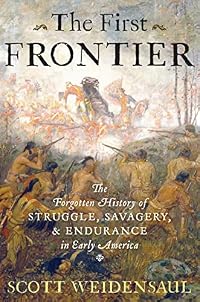
The First Frontier: The Forgotten History of Struggle, Savagery, and Endurance in Early America
by Scott Weidensaul
On This Page
Description
Presents a history of the period during which the Eastern seaboard was a frontier between colonizing Europeans and Native Americans.Tags
Recommendations






Member Reviews
The subtitle is awful; ignore it. This is an excellent book of serious history, no fluff or novelistic devices. Weidensaul retells the story of the Plymouth Bay Colony & it's offspring and their relationships with Native Americans from a less heroic side than you may be used to. The acts of English aggression, deception, and genocide he describes are as awful as anything you'll read about in any annals of war. Weidensaul's source-based narrative is gripping and horrifying in equal measure.
Author Scott Weidensaul points out that the “frontier” in American history usually implies covered wagons heading west, sod busters and gold miners, and Lakota. However, there was a much earlier frontier on the east coast of North America. Weidensaul argues that there was European contact even earlier than Jamestown (1607) and Plymouth (1620); supposedly there were Basque, Breton, English, French, Portuguese and Spanish fishing and whaling camps along the Newfoundland, Canadian and New England coasts as early as the 15th century, and the natives had learned enough foreign words to engage in trade.
It didn’t last, alas. European diseases spread rapidly in susceptible populations, and European ideas of what constituted religion and show more property ownership led to violence and death. Both sides were horribly confused about the others; thoughtful Europeans were mystified by the strange behavior of the natives and thoughtful natives were mystified by the strange behavior of the newcomers and tried to figure out why they acted that way; the less thoughtful just killed them.
The narrative is packed with interesting characters and anecdotes; Weidensaul apologies that most come from the European side but that’s the advantage of literacy. As a sort of compensation, there are lots of native words and names: wαpánahki, pαnáwαhpskek, mi’k’makik (Abenaki, Penobscot, Mikmac) – but there’s no glossary.
King Phillips’ War in Massachusetts is the last chance the natives had to drive the Europeans into the sea, and the closest they came; it’s noted that in terms of losses compared to total population involved this was the bloodiest war ever waged on the continent. In Maine, the natives succeeded in briefly clearing the coast of settlers and got so far as to form a plan for an amphibious attack on Boston using thirteen captured fishing boats, which foundered when the Abenaki leader was killed in battle.
To complicate matters, the European settlers were at war with each other as well as the natives; the English against the French and Spanish. An English mother commented that she would rather have her children captured and tortured to death by natives than fall into the hands of Jesuits – which makes sense if you have the right religious mindset. To some extent, the Europeans were helped by intertribal animosities – the Narragansets, Mohegans and the Niantics helped the English against the Pequots;
The story continues with the settlement of Pennsylvania, where William Penn dealt fairly – at least he thought he was dealing fairly – with the Iroquois League. The Iroquois portrayed themselves as much more powerful than they actually were, claiming that they controlled land from Illinois to South Carolina; ironically similar to Europeans claiming land that they had never seen or set foot on. Thus they successfully convinced the English that they were an indispensable buffer against the French, and there was a “long peace” in Pennsylvania. It didn’t last, of course, and what ended it was bitterly ironic; tolerant Pennsylvania was seen as a refuge for German immigrants fleeing religious persecution, and settling on land the Iroquois saw as theirs. This leads to a sad story that brackets the book; the first chapter recounts a raid on the farm of Amish immigrant Jacob Hochstetler. Mrs, Hochstetler was stabbed and scalped and her youngest son and daughter we tomahawked. Her husband Jacob and sons Joseph and Christian were roped and led away as captives. Seven years later a liberated Jacob Hochstetler was sitting down to dinner with his surviving family when an Indian looked through the door, said something unintelligible, and went back outside. When Jacob went to see what he wanted, he said, in halting German, “My name is Christian Hochstetler”.
Weidensaul’s coverage goes up to the end of the French and Indian War, of course there was plenty of Native/European interaction after that but that’s a different story. Some contemporary illustrations; a few maps; extensive notes and references.
For more on King Philip’s War, see In The Name of War; Flintlock and Tomahawk; and God, War, and Providence. For Indian captivity narratives (including Mary Rowlandson), see Women’s Indian Captivity Narratives. show less
It didn’t last, alas. European diseases spread rapidly in susceptible populations, and European ideas of what constituted religion and show more property ownership led to violence and death. Both sides were horribly confused about the others; thoughtful Europeans were mystified by the strange behavior of the natives and thoughtful natives were mystified by the strange behavior of the newcomers and tried to figure out why they acted that way; the less thoughtful just killed them.
The narrative is packed with interesting characters and anecdotes; Weidensaul apologies that most come from the European side but that’s the advantage of literacy. As a sort of compensation, there are lots of native words and names: wαpánahki, pαnáwαhpskek, mi’k’makik (Abenaki, Penobscot, Mikmac) – but there’s no glossary.
King Phillips’ War in Massachusetts is the last chance the natives had to drive the Europeans into the sea, and the closest they came; it’s noted that in terms of losses compared to total population involved this was the bloodiest war ever waged on the continent. In Maine, the natives succeeded in briefly clearing the coast of settlers and got so far as to form a plan for an amphibious attack on Boston using thirteen captured fishing boats, which foundered when the Abenaki leader was killed in battle.
To complicate matters, the European settlers were at war with each other as well as the natives; the English against the French and Spanish. An English mother commented that she would rather have her children captured and tortured to death by natives than fall into the hands of Jesuits – which makes sense if you have the right religious mindset. To some extent, the Europeans were helped by intertribal animosities – the Narragansets, Mohegans and the Niantics helped the English against the Pequots;
The story continues with the settlement of Pennsylvania, where William Penn dealt fairly – at least he thought he was dealing fairly – with the Iroquois League. The Iroquois portrayed themselves as much more powerful than they actually were, claiming that they controlled land from Illinois to South Carolina; ironically similar to Europeans claiming land that they had never seen or set foot on. Thus they successfully convinced the English that they were an indispensable buffer against the French, and there was a “long peace” in Pennsylvania. It didn’t last, of course, and what ended it was bitterly ironic; tolerant Pennsylvania was seen as a refuge for German immigrants fleeing religious persecution, and settling on land the Iroquois saw as theirs. This leads to a sad story that brackets the book; the first chapter recounts a raid on the farm of Amish immigrant Jacob Hochstetler. Mrs, Hochstetler was stabbed and scalped and her youngest son and daughter we tomahawked. Her husband Jacob and sons Joseph and Christian were roped and led away as captives. Seven years later a liberated Jacob Hochstetler was sitting down to dinner with his surviving family when an Indian looked through the door, said something unintelligible, and went back outside. When Jacob went to see what he wanted, he said, in halting German, “My name is Christian Hochstetler”.
Weidensaul’s coverage goes up to the end of the French and Indian War, of course there was plenty of Native/European interaction after that but that’s a different story. Some contemporary illustrations; a few maps; extensive notes and references.
For more on King Philip’s War, see In The Name of War; Flintlock and Tomahawk; and God, War, and Providence. For Indian captivity narratives (including Mary Rowlandson), see Women’s Indian Captivity Narratives. show less
Scott Weidensaul takes us back to the true frontier, The First Frontier, where lands east of the Hudson and Delaware were hotly contested for two centuries before the American Revolution. People who laid claim to the eastern seaboard came with ambiguous motives from unimaginably different cultures and lands. Although cohabiting the land, they communicated poorly and remained estranged. This peerlessly researched book opens our eyes to a violent time in the history of America of which most of us are uninformed. One would think that as time went by, civil co-habitation would occur, but the author tells us, “Far from being a cordial melting pot, the frontier was becoming an increasingly fractious mishmash.”
Part One entrenches us in the show more various cultures of these early inhabitants of eastern America. Part Two describes the 17th century expansion of the American colonies around Chesapeake Bay and New England, resulting in hatred, fear and bloodshed. Part Three is the story of the farther frontier, the Pennsylvania backcountry, where today a marker proclaiming the site of the first Amish settlement reminds us of the ghosts of that time.
Interesting details from the book include:
- 90% of America’s native people lost their lives from foreign disease not long after European colonists arrived.
- A white woman released from Native American captivity returned home to write the first American bestseller. Mary Rowlandson was the first female writer to publish in North America.
- Brickmaker, Thomas Duston, choose between saving his bedridden wife or his children from the Indians.
- Commercial slave trading boomed on both sides in the 1700s.
- The scrupulous honesty of William Penn earned subsequent respect from the Lenape tribe.
- Fur traders regularly married into Indian society to gain access to their wives’ connections.
- A daughter held captive for a decade recognized her real mother only after hearing her sing an old German hymn.
Although at times plodding, this is first-rate storytelling. The fascinating tales of individuals involved in the clash are interwoven with disturbing accounts of violence and war. The time the reader invests in this time period long left fallow by historians’ pens pays first-rate educational dividends.
The detail in The First Frontier can be daunting to the casual reader. Not for the faint of heart, the book accurately describes the many atrocities of the times. The book is intended to instruct and inform, not to entertain. The payoff for one truly interested in America’s beginnings is intellectually rewarding to one willing to spend time in its pages. Copious notes attest to the exhaustive research poured into the book. Highly recommended.
Houghton Mifflin Harcourt through Netgalley graciously provided the review copy.
Reviewed by Holly Weiss, author of Crestmont show less
Part One entrenches us in the show more various cultures of these early inhabitants of eastern America. Part Two describes the 17th century expansion of the American colonies around Chesapeake Bay and New England, resulting in hatred, fear and bloodshed. Part Three is the story of the farther frontier, the Pennsylvania backcountry, where today a marker proclaiming the site of the first Amish settlement reminds us of the ghosts of that time.
Interesting details from the book include:
- 90% of America’s native people lost their lives from foreign disease not long after European colonists arrived.
- A white woman released from Native American captivity returned home to write the first American bestseller. Mary Rowlandson was the first female writer to publish in North America.
- Brickmaker, Thomas Duston, choose between saving his bedridden wife or his children from the Indians.
- Commercial slave trading boomed on both sides in the 1700s.
- The scrupulous honesty of William Penn earned subsequent respect from the Lenape tribe.
- Fur traders regularly married into Indian society to gain access to their wives’ connections.
- A daughter held captive for a decade recognized her real mother only after hearing her sing an old German hymn.
Although at times plodding, this is first-rate storytelling. The fascinating tales of individuals involved in the clash are interwoven with disturbing accounts of violence and war. The time the reader invests in this time period long left fallow by historians’ pens pays first-rate educational dividends.
The detail in The First Frontier can be daunting to the casual reader. Not for the faint of heart, the book accurately describes the many atrocities of the times. The book is intended to instruct and inform, not to entertain. The payoff for one truly interested in America’s beginnings is intellectually rewarding to one willing to spend time in its pages. Copious notes attest to the exhaustive research poured into the book. Highly recommended.
Houghton Mifflin Harcourt through Netgalley graciously provided the review copy.
Reviewed by Holly Weiss, author of Crestmont show less
Provides a good understanding of the Dutch and their objectives in New England which in turn grants a vision of their influence in central Connecticut. For those who are familiar with Connecticut history it helps understand why they did not last long although their early influence was quite significant.
Ratings
Members
- Recently Added By
Lists

Native American / Indigenous Literature
172 works; 100 members
Author Information

43+ Works 2,637 Members
Scott Weidensaul is the author of Living on the Wind: Across the Hemisphere with Migratory Birds (North Point Press, 1999), which was a Pulitzer Prize finalist; and nearl two dozen other books
Awards and Honors
Classifications
- Genres
- History, Nonfiction, General Nonfiction
- DDC/MDS
- 974 — History & geography History of North America Northeastern United States (New England and Middle Atlantic states)
- LCC
- F106 .W45 — Local History of the United States, Canada and Latin America United States local history Atlantic coast. Middle Atlantic States
- BISAC
Statistics
- Members
- 312
- Popularity
- 101,996
- Reviews
- 4
- Rating
- (4.26)
- Languages
- English
- Media
- Paper, Audiobook, Ebook
- ISBNs
- 3
- ASINs
- 4