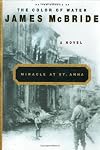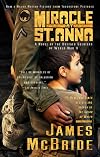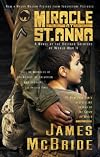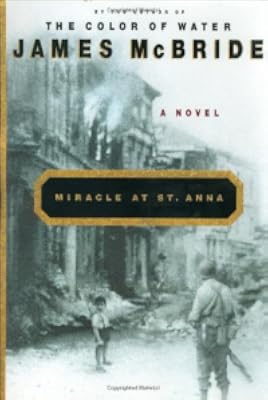
Miracle at St. Anna
by James McBride
On This Page
Description
In a historical novel based on events at a small village in Tuscany during World War II, four African American soldiers from the 92nd Division, a band of partisans, and a young Italian boy come together to experience a miracle.Tags
Recommendations





























Member Reviews
While growing up McBride listened to war stories at the knees of his uncles. What makes these stories a bit unusual was that the tellers were African-American combat veterans of World War II. Black soldiers certainly figured in the war effort, but in the segregated aspect of the times were often relegated to non-combat support roles, e.g. cooks, teamsters, etc. McBride builds his novel from these stories and centers it around four soldiers of the 92nd Infantry Division, an all-black unit that fought in Italy. Three of the soldiers were black and the fourth was Hector Negron, a Puerto Rican of such dark complexion that he was assigned to this unit.
The story opens dramatically in the 1980’s when Hector, a postal clerk in NYC, suddenly show more shoots and kills a patron at his window. When the police search the clerk’s apartment they find an ancient bust long thought to have been lost in the war. The mystery of the bust and the clerk’s murderous act are unveiled as the story unfolds.
Shifting back to the war, the narrative describes a bungled advance against stiff German positions that results in separating the four from their platoon. They moved forward into German-occupied territory and decide to wait until their division catches up with them. They settle in an Italian village where they connect with the locals and with Italian partisans. One of the soldiers, Sam Train, described as the "Chocolate Giant", the largest man most people had ever seen, holds on to a bust of a Renaissance figure that had been dislodged from a famous bridge in Florence. Train in the early hours of the group’s separation encounters a young boy, nearly dead in a shelled barn. Train carries the boy to the village and develops a mystical connection with him, coming to understand him even though they do not speak each other’s language. The boy has survived a massacre of villagers from a nearby village and is thought by Train to be from God.
The soldiers learn from the partisans that the Germans will be advancing in force against their own division. One of the partisans, however, gives false information on the location and attacks a soldier who escapes death only through the intervention of a villager who was accompanying him. The partisan is revealed to be a traitor in league with the Germans.
The Germans shell the village as their advance proceeds, killing many of the villagers. In the end three of the party are killed, along with the boy.
Hector retrieves the bust from Sam and survives. Many years later he recognizes that his customer is the traitorous partisan who had attempted to kill him and who had immigrated to America. In retribution he immediately shoots him.
The novel touches on the race issues that prevailed in the war. The troops are led by white officers, some of whom openly disdain the black soldiers. The villagers have never seen persons of color and some relationships develop that would not have been possible in America in that time. The author evokes the pervading sense of mysticism and supernatural beliefs held by the Italians of the countryside. The cruelty and dark spirit of the war is skillfully portrayed. show less
The story opens dramatically in the 1980’s when Hector, a postal clerk in NYC, suddenly show more shoots and kills a patron at his window. When the police search the clerk’s apartment they find an ancient bust long thought to have been lost in the war. The mystery of the bust and the clerk’s murderous act are unveiled as the story unfolds.
Shifting back to the war, the narrative describes a bungled advance against stiff German positions that results in separating the four from their platoon. They moved forward into German-occupied territory and decide to wait until their division catches up with them. They settle in an Italian village where they connect with the locals and with Italian partisans. One of the soldiers, Sam Train, described as the "Chocolate Giant", the largest man most people had ever seen, holds on to a bust of a Renaissance figure that had been dislodged from a famous bridge in Florence. Train in the early hours of the group’s separation encounters a young boy, nearly dead in a shelled barn. Train carries the boy to the village and develops a mystical connection with him, coming to understand him even though they do not speak each other’s language. The boy has survived a massacre of villagers from a nearby village and is thought by Train to be from God.
The soldiers learn from the partisans that the Germans will be advancing in force against their own division. One of the partisans, however, gives false information on the location and attacks a soldier who escapes death only through the intervention of a villager who was accompanying him. The partisan is revealed to be a traitor in league with the Germans.
The Germans shell the village as their advance proceeds, killing many of the villagers. In the end three of the party are killed, along with the boy.
Hector retrieves the bust from Sam and survives. Many years later he recognizes that his customer is the traitorous partisan who had attempted to kill him and who had immigrated to America. In retribution he immediately shoots him.
The novel touches on the race issues that prevailed in the war. The troops are led by white officers, some of whom openly disdain the black soldiers. The villagers have never seen persons of color and some relationships develop that would not have been possible in America in that time. The author evokes the pervading sense of mysticism and supernatural beliefs held by the Italians of the countryside. The cruelty and dark spirit of the war is skillfully portrayed. show less
From the book jacket: McBride was inspired by an historical incident that took place in a Tuscan village and by the experiences of the Buffalo Soldiers of the 92nd Division, who served in Italy during World War II. It is the story of four American soldiers, the villagers among whom they take refuge, a band of partisans, and an Italian boy, all of whom encounter a miracle.
My reactions:
Like any good war story, McBride includes dangerous situations, tense relationships, descriptions of brutality, and strong characters who behave admirably in dire circumstances. Sam Train is a giant of a man, with limited intellectual capacity, but a strong faith and a tender heart. Bishop Cummings is a minister from Kansas City, but he seems more show more interested in gambling than fighting. Hector Negron is a Puerto Rican from Harlem who resents having been assigned to the Negro division, but whose modest knowledge of Italian is crucial to their mission. Second Lieutenant Aubry Stamps is an educated man, who went to officer candidate school, but is unable to understand or connect with the rural Southern blacks he is commanding. And then we have Angelo, the young Italian boy who has witnessed atrocities no one should have to see, and who is nearly dead when Train plucks him from the rubble.
I like magical realism, and McBride does a reasonably good job of using this technique. But he does not sugarcoat the realities of war, or of the conditions the villagers endured in Tuscany during this time period. The writing is realistic and visceral, though he does add small scenes of compassion that serve to ease the tension. At heart it is a story of brotherhood, redemption, and the power of love and faith.
A few passages really struck me:
To fight the enemy? Which enemy? The Germans? The Italians? The enemy was irony and truth and hypocrisy, that was the real enemy. That was the enemy that was killing him.
A Negro was trying to make rent, save up enough to buy milk for his kids, survive this fucked-up war, and still, when the war was over, when all the fighting was done and all the people made up, a German could go to America and live well, start a factory, wok in business, run a bank, while Stamps would still be … a nigger. He’d be lucky to get a job delivering their mail.
And this description of the Mountain of the Sleeping Man:
Once you see him, you cannot escape him. He follows you everywhere you walk, morning, noon or night, his gargantuan face just over your shoulder – an enraged, snoozing ogre, about to awaken. show less
My reactions:
Like any good war story, McBride includes dangerous situations, tense relationships, descriptions of brutality, and strong characters who behave admirably in dire circumstances. Sam Train is a giant of a man, with limited intellectual capacity, but a strong faith and a tender heart. Bishop Cummings is a minister from Kansas City, but he seems more show more interested in gambling than fighting. Hector Negron is a Puerto Rican from Harlem who resents having been assigned to the Negro division, but whose modest knowledge of Italian is crucial to their mission. Second Lieutenant Aubry Stamps is an educated man, who went to officer candidate school, but is unable to understand or connect with the rural Southern blacks he is commanding. And then we have Angelo, the young Italian boy who has witnessed atrocities no one should have to see, and who is nearly dead when Train plucks him from the rubble.
I like magical realism, and McBride does a reasonably good job of using this technique. But he does not sugarcoat the realities of war, or of the conditions the villagers endured in Tuscany during this time period. The writing is realistic and visceral, though he does add small scenes of compassion that serve to ease the tension. At heart it is a story of brotherhood, redemption, and the power of love and faith.
A few passages really struck me:
To fight the enemy? Which enemy? The Germans? The Italians? The enemy was irony and truth and hypocrisy, that was the real enemy. That was the enemy that was killing him.
A Negro was trying to make rent, save up enough to buy milk for his kids, survive this fucked-up war, and still, when the war was over, when all the fighting was done and all the people made up, a German could go to America and live well, start a factory, wok in business, run a bank, while Stamps would still be … a nigger. He’d be lucky to get a job delivering their mail.
And this description of the Mountain of the Sleeping Man:
Once you see him, you cannot escape him. He follows you everywhere you walk, morning, noon or night, his gargantuan face just over your shoulder – an enraged, snoozing ogre, about to awaken. show less
The story opens with a Puerto Rican bankteller shooting a customer in the face. Then the reader is transported back to an Italian village during World War II and four soldiers part of the 92nd division of African-American soldiers who become separated from their unit. The author gradually helps us understand the reason behind the opening act of aggression. This book is well structured and I had difficulty putting it down. The tragic consequences of war are once again brought home to this reader.
Over in Italy, 4 soldiers from the US Army's Negro 92nd Division are separated from their unit because of inept commands. They face the horror of having seen some of their platoon mates blown up and shot down in front of them. This is a story of how they found a quiet little village of St Anna di Stazzema in Tuscany, and how despite the horrors of war, they managed a few days of peace and relative normalcy among the villagers.
One soldier, Sam Train, is from the South, illiterate and a simple man ... he's also really large. All he wants is to get out of Italy and go home to his grandmother. He finds the marble head of the bust of Primavera, and thinks it's magic, so he keeps it with him at all times. He finds a little boy, shell-shocked show more and injured, hidden under a haystack, scoops him up, and tries to find medical help for him.
Bishop is a manipulative con-man, who found people would drown him in money if he pretended to be a preacher and dish out fire and brimstone sermons while telling his growing congregation not to give him money but to come to him only because they wanted their souls to be saved.
Hector is Hispanic, so he doesn't know why he's even with this division except that he's a little darker than his cousin who also signed up and was assigned to the white division. So he's disgruntled, has sleep apnea and definitely hates the war, hates Italy and figures he's got the short end of the stick being lumped with this lot.
The last, Stamps, is their lieutenant, tries to lead them back to their division but is challenged by their commander's demand at the base, that they hold their position until they capture a German soldier.
While fictitious, there's enough historical facts woven into this story to bring the the horror and terror of wartime Italy to the reader. The author also does a wonderful job of bringing out the depth of each character, and in the case of the separated soldiers, their memories and bitter resentment against the unfair treatment they faced back home before the war, in the war, and what they know they will once again face in terms of discrimination when they go home after the war.
This is one of those books that plucks at your heartstrings, brings tears of sorrow to your eyes, twists your gut in anger, and gives you a little chuckle every now and again. show less
One soldier, Sam Train, is from the South, illiterate and a simple man ... he's also really large. All he wants is to get out of Italy and go home to his grandmother. He finds the marble head of the bust of Primavera, and thinks it's magic, so he keeps it with him at all times. He finds a little boy, shell-shocked show more and injured, hidden under a haystack, scoops him up, and tries to find medical help for him.
Bishop is a manipulative con-man, who found people would drown him in money if he pretended to be a preacher and dish out fire and brimstone sermons while telling his growing congregation not to give him money but to come to him only because they wanted their souls to be saved.
Hector is Hispanic, so he doesn't know why he's even with this division except that he's a little darker than his cousin who also signed up and was assigned to the white division. So he's disgruntled, has sleep apnea and definitely hates the war, hates Italy and figures he's got the short end of the stick being lumped with this lot.
The last, Stamps, is their lieutenant, tries to lead them back to their division but is challenged by their commander's demand at the base, that they hold their position until they capture a German soldier.
While fictitious, there's enough historical facts woven into this story to bring the the horror and terror of wartime Italy to the reader. The author also does a wonderful job of bringing out the depth of each character, and in the case of the separated soldiers, their memories and bitter resentment against the unfair treatment they faced back home before the war, in the war, and what they know they will once again face in terms of discrimination when they go home after the war.
This is one of those books that plucks at your heartstrings, brings tears of sorrow to your eyes, twists your gut in anger, and gives you a little chuckle every now and again. show less
this is one of the first recorded books I listened to and I enjoyed the experience. There is no doubt that listening to it makes it a different experience than reading the story. It was well enough written that it held my interest and at times had me on the edge of the car seat. It is the rare work of historical fiction that uses the tattered political fabric of Italy during World War II to tell a story and as such points out that Italy was full of German loving fascists, fascist loving Italians, Italians who wanted to be liberated from both the aforementioned groups, and people who just wanted the war to stop so that they could have enough to eat in peace. I would recommend this book to anybody who likes historical fiction.
The story here is well worth reading, so if it sounds interesting, I'd recommend it, but the writing can be a bit jarring at times. Changes in first person aren't always given enough depth to feel necessary, and there are Many "he saids, she saids" that are...well, just awkward. I'm also a big fan of finding the one perfect metaphor instead of listing five--McBride isn't. In the end, I enjoyed the story, and there are some moments even of brilliance to the point where what Should be a contrived ending ends up working, but I'd rather he'd have spent 50 of the 300 pages on depth instead of somewhat self-indulgent description. Still, recommended based on the characters and story. I'd read it before you see the film coming out this fall.
(45) Meh. This had potential to be sure. The opening scene was arresting. An interesting WW2 story set in Italy as the Germans fought their way out of a lost cause. The Americans sent to fight in Italy were the Buffalo Soldiers - all black troops with mostly white officers. And bizarrely it had to be white Southern officers that were hand-picked to lead the black troops. Really? What, to echo the ancestral voices of slave owners? . . . St Anna is a church in the Tuscan hills at which an attachment of Buffalo soldiers finds themselves lost - they are stranded on the eve of a German assault with a motley crew including a legendary partisan, a mute little boy, an an assortment of villagers. Frankly, in the end, I am not even sure what said show more 'miracle' is supposed to have been.
I thought the writing was quite pedestrian. Seemed to be written with the eye towards a screenplay. I have never seen the movie and don't necessarily want to all that much after reading this. The only character that I liked was Stamps. The rest rather blurred and faded in and out of my notice. I thought the character development was quite uneven and fairly random. Why so much on Ludovico and the rabbits. . .
So just lukewarm here - nothing terribly bad; nothing terribly good. One of the weaker WW2 novels I've read. The best parts were the black soldiers musings on their white commanders - that dynamic was definitely worth exploring and the most compelling part of the book. The rest -- the statue head, the rabbits, the little boy -- fairly weak and unaffecting. show less
I thought the writing was quite pedestrian. Seemed to be written with the eye towards a screenplay. I have never seen the movie and don't necessarily want to all that much after reading this. The only character that I liked was Stamps. The rest rather blurred and faded in and out of my notice. I thought the character development was quite uneven and fairly random. Why so much on Ludovico and the rabbits. . .
So just lukewarm here - nothing terribly bad; nothing terribly good. One of the weaker WW2 novels I've read. The best parts were the black soldiers musings on their white commanders - that dynamic was definitely worth exploring and the most compelling part of the book. The rest -- the statue head, the rabbits, the little boy -- fairly weak and unaffecting. show less
Members
- Recently Added By
Lists

Books Set in Italy
167 works; 19 members

Books Read in 2025
4,128 works; 98 members
Author Information

12+ Works 18,371 Members
James McBride studied composition at The Oberlin Conservatory of Music in Ohio and received a master's degree in journalism from Columbia University. He was a staff writer for The Boston Globe, People Magazine, and The Washington Post. His works include the memoir The Color of Water, the biography Kill 'Em and Leave, and two novels entitled show more Miracle at St. Anna and Song Yet Sung. He wrote the screenplay for Miracle at St. Anna when it was made into a movie in 2008. He won the National Book Award for The Good Lord Bird. He is a saxophonist and former sideman for jazz legend Jimmy Scott. He has written songs for Anita Baker, Grover Washington Jr., Gary Burton, and Barney, the PBS television character. He received the Stephen Sondheim Award and the Richard Rodgers Foundation Horizon Award for his musical Bo-Bos co-written with playwright Ed Shockley. In 2005, he published the first volume of a CD-based documentary about life as lived by low-profile jazz musicians entitled The Process. He is currently a Distinguished Writer in Residence at New York University. (Bowker Author Biography) show less
Awards and Honors
Awards
Work Relationships
Has the adaptation
Common Knowledge
- Canonical title
- Miracle at St. Anna
- Original publication date
- 2002
- People/Characters
- Sam Train, aka, Diesel; Hector Negron; Bishop Commings, aka, Walking Thunder; Stamps; Ludovico Salducchi; Renata née Salducchi (show all 8); Ettora; Angelo Tornacelli
- Important places
- Bornacchi, Tuscany, Italy; Italy; Tuscany, Italy
- Important events
- World War II (1939 | 1945); World War II, Italian Campaign (1943-07-10 | 1945-05-02)
- Related movies
- Miracle at St. Anna (2008 | IMDb)
- Dedication
- Dedicated to the men of the 92nd Infantry Division, the people of Italy, and the late Honorable James L. Watson of Harlem, NY, who epitomizes the best of both.
- First words
- All the guy wanted was a twenty-cent stamp. (Prologue)
On December 12, 1944, Sam Train became invisible for the first time. - Quotations
- The Lucchesians responded by laying low in the hills outside of town for 140 years, telling stories to their children about the wicked Pisans, who had left only the teetch, bones, and skulls of the great Lucchesian people, co... (show all)nveniently omitting the part about the time they took Pisan teeth, bones, and skulls as souvenirs. (Chap. 12, Highway to Heaven, p. 176)
- Last words
- (Click to show. Warning: May contain spoilers.)They had found yet another miracle, and they were finally free of the last one.
- Publisher's editor
- Spiegel, Cindy
- Original language
- English
Classifications
Statistics
- Members
- 948
- Popularity
- 28,056
- Reviews
- 29
- Rating
- (3.60)
- Languages
- 6 — Dutch, English, French, German, Italian, Swedish
- Media
- Paper, Audiobook, Ebook
- ISBNs
- 37
- UPCs
- 2
- ASINs
- 19