On This Page
Description
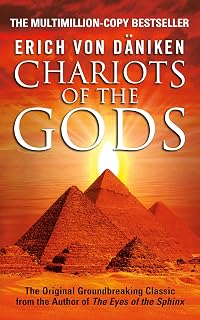
AS SEEN ON ANCIENT ALIENS • Now in a beautiful 50th anniversary edition with a new foreword and afterword by the author, this is the groundbreaking classic that introduced the theory that ancient Earth established contact with aliens.Immediately recognized as a work of monumental importance, Chariots of the Gods endures as proof that Earth has been visited repeatedly by advanced aliens from other worlds. Here, Erich von Däniken examines ancient ruins, lost cities, spaceports, ufos, and show more a myriad of hard scientific facts that point to extraterrestrial intervention in human history. Most incredible of all, however, is von Däniken's theory that we are the descendants of these galactic pioneers—and he reveals the archaeological discoveries that prove it...
The dramatic discoveries and irrefutable evidence:
• An alien astronaut preserved in a pyramid
• Thousand-year-old spaceflight navigation charts
• Computer astronomy from Incan and Egyptian ruins
• A map of the land beneath the ice cap of Antarctica
• A giant spaceport discovered in the Andes
Includes remarkable photos that document mankind's first contact with aliens at the dawn of civilization.. show less
Tags
Recommendations

























Member Recommendations

by anonymous user
Member Reviews
It's interesting to read Chariots now considering the immense influence it's gotten in the form of the very successful Ancient Aliens franchise. It was written in 1968 and it's extremely evident from the state of science fiction and actual science at that time. Däniken thinks men on Mars is a distinct possibility. He returns again and again to "looks like X to me" type reasoning such as how any ancient depiction of a figure with rays around its head must be wearing a helmet with an antenna. Because of course at this time you think of antennas in the form of rabbit ears for radio or TV, or the sci fi round helmet with the sproingy antenna on top. Or how other symbols seem like a battery to him. It's precisely in the dated futurism the show more method behind the madness becomes evident - and the method hasn't changed. Däniken and his acolytes just morph the looks like X to me arguments to be more in line with what sounds plausible today.
Similarly with the arguments about men on Mars or starships needing people to scratch out landing paths in the dirt are quietly dropped in a God of the Gaps fashion as new science comes in and makes old arguments sound dumb. Especially interesting to note how closely this book lines up with Graham Hancock's alt-history, with many notable staples like the Piri Reis map and the exact same lines about how it "exactly" shows a snow free Antarctica. Hancock has borrowed liberally from Däniken's books but also scoffs and swears off the ancient astronauts as nonsense. There's some scale of plausibility where he's gone close enough to actual history to remain in good graces with people who would dismiss Däniken (even though if you listen deeper than his popular appearances you'll soon find such headscratchers as sonically levitated megaliths). show less
Similarly with the arguments about men on Mars or starships needing people to scratch out landing paths in the dirt are quietly dropped in a God of the Gaps fashion as new science comes in and makes old arguments sound dumb. Especially interesting to note how closely this book lines up with Graham Hancock's alt-history, with many notable staples like the Piri Reis map and the exact same lines about how it "exactly" shows a snow free Antarctica. Hancock has borrowed liberally from Däniken's books but also scoffs and swears off the ancient astronauts as nonsense. There's some scale of plausibility where he's gone close enough to actual history to remain in good graces with people who would dismiss Däniken (even though if you listen deeper than his popular appearances you'll soon find such headscratchers as sonically levitated megaliths). show less
In 2018, Berkley published this 50th Anniversary Edition of Erich Von Däniken's Chariots of the Gods. The grandaddy of all ancient aliens books, shows, websites, and theories. There was an old copy in my city library, and I leafed through it from time to time. As a teen onward, I read around Von Däniken and his theories, so I have always been cognizant of him. I much preferred Irwin Ginsburgh's Genesis-centric knock-off First, Man. Then, Adam! and the seemingly more evidence and history-based works by Zecharia SItchin. So, it took me a long time to get to Von Däniken.
There are several problems and issues with Von Däniken's magnum opus. He is very chatty. The book mainly consists of him pointing out some big building or odd artifact show more and saying: "This is odd: aliens." He was the progenitor of the Giorgio A. Tsoukalos meme: "Aliens!" The book is also rather anti-religious, especially against Christianity. It is also full of errors. Historical, categorical, archaeological, etc. Nazca lines look like airfields. (Why planet-hopping UFOers would need an "airfield" is beyond me.) These have been addressed in numerous other locations, so no need to harp on them here. Also, Von Däniken uses the word "utopian" a kajillion times to mean "far-fetched." It was annoying. In fact, the book is rather lean on evidence for ancient alien contact, and is mostly suppositions, though experiments, and digressions on science and the future. Half the book is about modern-day rockets and possible future technology, rather than ancient aliens. Still, the greatest hits of future ancient aliendom is here. The skeleton script for all episodes of Ancient Aliens is here. Big blocks, pyramids, Easter Island, Piri Reis, Pacal, etc. He is very lean on history, it is mostly just "well this must be aliens" supposition. He is definitely the poor man's Sitchin.
In this 50th Anniversary Edition is a new foreword, a foreword from 1999, and a new afterword. In the new foreword, Von Däniken explains away some of his mistakes and again tells how his book came to print. Then there is Von Däniken's foreword from 1999, where he again claims his mistakes are okay, but any mistakes by his critics destroy their whole critique. In his afterword he tries to explain away one of his arrests, again attacks his critics, tries to backdate his theories, and lists legitimate scientists who tangentially give credence to some of his theories. (The theory of panspermia, for example, if true, does not thus support the ancient alien hypothesis.) He claims he never wrote about alien gold, "that was Sitchin!" he bemoans (p. 193), ignoring his own book The Gold of the Gods and the monstrous falsities it was based on.
There is then the original English text of Chariots of the Gods, with introduction, main text, bibliography, and index. The same pictures remain from the original version, with their inane, chatty captions, and the same errors abide. (Like the pillar that "does not rust"; mentioned as false in the foreword, still in the text and photographs.)
It is a nice, new hardcover edition of a seminal, though completely flawed work. show less
There are several problems and issues with Von Däniken's magnum opus. He is very chatty. The book mainly consists of him pointing out some big building or odd artifact show more and saying: "This is odd: aliens." He was the progenitor of the Giorgio A. Tsoukalos meme: "Aliens!" The book is also rather anti-religious, especially against Christianity. It is also full of errors. Historical, categorical, archaeological, etc. Nazca lines look like airfields. (Why planet-hopping UFOers would need an "airfield" is beyond me.) These have been addressed in numerous other locations, so no need to harp on them here. Also, Von Däniken uses the word "utopian" a kajillion times to mean "far-fetched." It was annoying. In fact, the book is rather lean on evidence for ancient alien contact, and is mostly suppositions, though experiments, and digressions on science and the future. Half the book is about modern-day rockets and possible future technology, rather than ancient aliens. Still, the greatest hits of future ancient aliendom is here. The skeleton script for all episodes of Ancient Aliens is here. Big blocks, pyramids, Easter Island, Piri Reis, Pacal, etc. He is very lean on history, it is mostly just "well this must be aliens" supposition. He is definitely the poor man's Sitchin.
In this 50th Anniversary Edition is a new foreword, a foreword from 1999, and a new afterword. In the new foreword, Von Däniken explains away some of his mistakes and again tells how his book came to print. Then there is Von Däniken's foreword from 1999, where he again claims his mistakes are okay, but any mistakes by his critics destroy their whole critique. In his afterword he tries to explain away one of his arrests, again attacks his critics, tries to backdate his theories, and lists legitimate scientists who tangentially give credence to some of his theories. (The theory of panspermia, for example, if true, does not thus support the ancient alien hypothesis.) He claims he never wrote about alien gold, "that was Sitchin!" he bemoans (p. 193), ignoring his own book The Gold of the Gods and the monstrous falsities it was based on.
There is then the original English text of Chariots of the Gods, with introduction, main text, bibliography, and index. The same pictures remain from the original version, with their inane, chatty captions, and the same errors abide. (Like the pillar that "does not rust"; mentioned as false in the foreword, still in the text and photographs.)
It is a nice, new hardcover edition of a seminal, though completely flawed work. show less
As others have pointed out, the von Däniken phenomenon demonstrates that millions will believe in ancient astronauts sooner than they'll credit dark-skinned people and "primitive" societies with the ability to calculate space, create monuments, and mark the earth in ways we still can't comprehend. Still, for some of us 70s youngsters, this book was an important nudge toward a lifelong interest in mystery, anomaly, the as yet unexplained. Rather like THE AMITYVILLE HORROR, another debunked bestseller, it was fun and eerie at the time—and still can be, if read as a historical document and not history per se. Let alone science, let alone revelation.
Unmitigated tosh from cover-to-cover. Admittedly, I was taken in at age 11, but how any adult could accept this tissue of lies is beyond me. Interesting, maybe, for its sci-fi concepts, but as one of the initiators of modern pseudo-science, an awful, awful book.
You are not entitled to your opinion. You are entitled to your informed opinion. No one is entitled to be ignorant - Harlan Ellison
You are not entitled to your opinion. You are entitled to your informed opinion. No one is entitled to be ignorant - Harlan Ellison
I am quite honestly into conspiracy theories. While the ideas presented in this book may come off as a bunch of far fetched work of human imagination but they aren't entirely dismissible just as much as they can't be proved. That's what humans have done since forever. Myths and religious ideologies have been built this way to fill the unexplainable gaps. Yet we don't see them as fiction despite being filled with contradiction upon contradiction. However, in the case of, say, the ancient aliens theory, people in general, are not only skeptical but brush it off entirely as nonsense.
I don't believe in these theories with absolute certainty but they are not entirely baseless. The problem is that the further we go back into history, show more substantial evidence decreases and we ultimately have to give into some speculation at least. Who's to say what the limits of speculation can be? Even if it ridiculous, it sure as hell can be interesting. The author is not advocating some alternate belief cult but is demanding simply for more open-mindedness when it comes to these theories. Science and technology has been further progressing and it may in fact help us uncover the secrets of our past. show less
I don't believe in these theories with absolute certainty but they are not entirely baseless. The problem is that the further we go back into history, show more substantial evidence decreases and we ultimately have to give into some speculation at least. Who's to say what the limits of speculation can be? Even if it ridiculous, it sure as hell can be interesting. The author is not advocating some alternate belief cult but is demanding simply for more open-mindedness when it comes to these theories. Science and technology has been further progressing and it may in fact help us uncover the secrets of our past. show less
I read this, age 18, and my jaw dropped, exactly as Von Daniken intended it should. I stood in a bookshop and read half of it right off, looking around every now and then to see if I was about to be moved on. Then I returned a few days later and finished it. By that time I was hooked, a complete convert to the notion of alien visitors to this planet, and that I was - perhaps - the descendant of one of them. A spooky thought, though quite soon it was a return to parties, bars, discos, record shops, and live rock gigs. (I did mention I was 18?)
A few years later there was a documentary on the BBC - "Horizon" in the days before it became a cartoon documentary series - on the subject of Von Daniken's thesis. An hour long, it painstakingly show more took us to every major site mentioned in the books, to every document source referenced, to secondary sources, to the text of the book itself. One by one, each brick of his thesis was removed, examined, found to be made of straw, and long before the end of the documentary, the Von Daniken wall toppled and fell.
I felt shame at my younger gullibility, but I learned my lesson. There is no Bermuda Triangle, no Philadelphia Experiment, no Turin Shroud, no anything of that order, that will make me "do a Von Daniken" now. Is that a shame? No, not really. There is too much of genuine awesomeness in this amazing universe to waste more than half a second on this kind of tripe. show less
A few years later there was a documentary on the BBC - "Horizon" in the days before it became a cartoon documentary series - on the subject of Von Daniken's thesis. An hour long, it painstakingly show more took us to every major site mentioned in the books, to every document source referenced, to secondary sources, to the text of the book itself. One by one, each brick of his thesis was removed, examined, found to be made of straw, and long before the end of the documentary, the Von Daniken wall toppled and fell.
I felt shame at my younger gullibility, but I learned my lesson. There is no Bermuda Triangle, no Philadelphia Experiment, no Turin Shroud, no anything of that order, that will make me "do a Von Daniken" now. Is that a shame? No, not really. There is too much of genuine awesomeness in this amazing universe to waste more than half a second on this kind of tripe. show less
Thoroughly debunked by current science (and by using the term "current", I mean that the scientific method is to change the theory as evidence presents itself), but I loved it back in high school and I have to say that the idea is still fascinating. (Side note: I didn't realize that it was guilty of that peculiar Western culture superiority complex bias until reading a few of the reviews.)
Members
- Recently Added By
Published Reviews
Dit is de 37ste druk van een controversieel boek, dat vanaf de eerste publicatie in 1969 voor opschudding heeft gezorgd in wetenschappelijke kringen. De auteur gaat uit van de prikkelende hypothese dat de verering van goden binnen oude culturen in wezen kosmonauten betrof, afkomstig van andere universa. Ter onderbouwing van zijn suggestieve stellingen trekt hij alle registers open zonder deze show more ideeën te toetsen aan de weerbarstige wetenschappelijke werkelijkheid. Toch zet de schrijver aan tot reflectie van zijn vooronderstellingen want hoe staat het onder meer met de oude zeekaarten van Piri-Reis, de mythologie van de Soemeriërs en de Ark van het Verbond. Het is onwetenschappelijk hoe de schrijver te werk is gegaan, maar zijn onderzoek verdient ook nu nog aandacht vanuit wetenschappelijke hoek. Het geïllustreerde boek wordt afgesloten met een literatuuroverzicht en een register. Wordt gevolgd door 'De odyssee van de goden'*.
Ruud Booms show less
Ruud Booms show less
added by karnoefel
Lists

Non-fiction that you shouldn't waste your time on
45 works; 15 members

The Joe Rogan Experience Library
254 works; 3 members

Books featured on I Don't Even Own a Television
167 works; 3 members

Books Read in 2023
5,638 works; 147 members

Best Sellers / Popular 1968
237 works; 5 members
Author Information

172+ Works 6,749 Members
Some Editions
Awards and Honors
Notable Lists
Series

Work Relationships
Has the adaptation
Is abridged in
Is replied to in
Common Knowledge
- Canonical title
- Chariots of the Gods? Unsolved Mysteries of the Past
- Original title
- Erinnerungen an die Zukunft: Ungelöste Rätsel der Vergangenheit
- Alternate titles*
- Waren de goden kosmonauten? : herinneringen aan de toekomst
- Original publication date
- 1968
- Related movies
- Erinnerungen an die Zukunft (1970 | IMDb)
- First words
- Introduction: It took courage to write this book, and it will take courage to read it.
Chapter One (Are there intelligent beings in the cosmos?) - Last words
- (Click to show. Warning: May contain spoilers.)Memories which will then be proved and which will illuminate the history of mankind - for the blessing of future generations.
- Original language
- German
- Canonical DDC/MDS
- 001.9421
*Some information comes from Common Knowledge in other languages. Click "Edit" for more information.
Classifications
- Genres
- General Nonfiction, Nonfiction
- DDC/MDS
- 001.9421 — Computer science, information & general works Computer science, knowledge & systems Knowledge and learning in general Aliens/UFOs Mysteries (Atlantis, Bermuda Triangle) Unidentified flying objects (UFOs) Ancient astronauts
- LCC
- CB156 .D3313 — Auxiliary Sciences of History History of Civilization History of Civilization Terrestrial evidence of interplanetary voyages
- BISAC
Statistics
- Members
- 2,853
- Popularity
- 6,390
- Reviews
- 59
- Rating
- (2.87)
- Languages
- 19 — Czech, Dutch, English, Finnish, French, German, Hebrew, Hungarian, Italian, Lithuanian, Norwegian (Bokmål), Norwegian, Polish, Portuguese, Romanian, Croatian, Spanish, Swedish, Turkish
- Media
- Paper, Audiobook, Ebook
- ISBNs
- 92
- UPCs
- 4
- ASINs
- 84