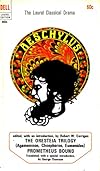
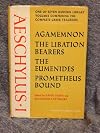
The Oresteia Trilogy (Agamemnon, Choephoroe, and Eumenides) [and] Prometheus Bound
by Aeschylus
On This Page
Tags
Recommendations

















Member Reviews
Members
- Recently Added By
Author Information

Aeschylus was born at Eleusis of a noble family. He fought at the Battle of Marathon (490 b.c.), where a small Greek band heroically defeated the invading Persians. At the time of his death in Sicily, Athens was in its golden age. In all of his extant works, his intense love of Greece and Athens finds expression. Of the nearly 90 plays attributed show more to him, only 7 survive. These are The Persians (produced in 472 b.c.), Seven against Thebes (467 b.c.), The Oresteia (458 b.c.)---which includes Agamemnon, Libation Bearers, and Eumenides (or Furies) --- Suppliants (463 b.c.), and Prometheus Bound (c.460 b.c.). Six of the seven present mythological stories. The ornate language creates a mood of tragedy and reinforces the already stylized character of the Greek theater. Aeschylus called his prodigious output "dry scraps from Homer's banquet," because his plots and solemn language are derived from the epic poet. But a more accurate summation of Aeschylus would emphasize his grandeur of mind and spirit and the tragic dignity of his language. Because of his patriotism and belief in divine providence, there is a profound moral order to his plays. Characters such as Clytemnestra, Orestes, and Prometheus personify a great passion or principle. As individuals they conflict with divine will, but, ultimately, justice prevails. Aeschylus's introduction of the second actor made real theater possible, because the two could address each other and act several roles. His successors imitated his costumes, dances, spectacular effects, long descriptions, choral refrains, invocations, and dialogue. Swinburne's (see Vol. 1) enthusiasm for The Oresteia sums up all praises of Aeschylus; he called it simply "the greatest achievement of the human mind." Because of his great achievements, Aeschylus might be considered the "father of tragedy." (Bowker Author Biography) show less
All Editions
Some Editions
Work Relationships
Is contained in
Contains
Common Knowledge
- Canonical title
- The Oresteia Trilogy (Agamemnon, Choephoroe, and Eumenides) [and] Prometheus Bound (Agamemnon, Choephoroe, and Eumenides)
- Original title
- Ὀρέστεια - Προμηθεὺς Δεσμώτης
- Original publication date
- 458 BC - 415 BC
- People/Characters
- Orestes; Clytemnestra; Aegisthus; Agamemnon; Cassandra (of Troy); Athena
- Canonical DDC/MDS
- 882.011
- Disambiguation notice
- This LT Work is an anthology of four plays by Aeschylus, to wit:
The complete Oresteia trilogy of plays, including: Agamemnon, Choephoroe (a/k/a, The Libation Bearers), and Eumenides (a/k/a... (show all), The Furies),
TOGETHER WITH Prometheus Bound.
Please do not combine this anthology with any of the individual plays, or with any other collection. Thank you.
Classifications
- Genre
- Fiction and Literature
- DDC/MDS
- 882.011 — Literature & rhetoric Classical & modern Greek literatures Classical Greek dramatic poetry and drama standard subdivisions; collections; history, description, critical appraisal; Specific periods Ancient period to ca. 499 Aeschylus
- LCC
- PA3827 — Language and Literature Greek language and literature. Latin language and literature Greek literature Individual authors Aeschylus
Statistics
- Members
- 164
- Popularity
- 198,819
- Reviews
- 1
- Rating
- (3.93)
- Languages
- English, Greek (Ancient), Portuguese (Portugal), Spanish
- Media
- Paper
- ISBNs
- 3
- ASINs
- 16